


Executive Summary
Thai Airways International returned to a net profit of THB 30.9 billion in fiscal year 2025 and exited its court-supervised business rehabilitation process in June 2025, returning to the Stock Exchange of Thailand on 4 August 2025.
The carrier currently operates 83 aircraft with another 21 on order, anchored by a transformational 45 Boeing 787-9 firm order (with 35 options) and a 32-aircraft Airbus A321neo program to refresh the narrowbody backbone.
Bangkok Suvarnabhumi remains the airline’s primary hub, with the Summer 2026 schedule covering 62 international destinations and a return to Amsterdam from 1 July 2026 after a 28-year absence.
Management is targeting THB 200 billion in revenue for 2026, representing roughly 5% growth versus 2025, supported by India and China expansion, Chiang Mai secondary base build-up, and a path toward a 150-aircraft fleet by 2033.
Recommended - Read Full Reports


Read All Reports
Table of Contents
Executive Summary
Thai Airways Company Profile: Key Facts
Thai Airways Revenue and Financial Analysis
Full-Year 2025 Headline Results
Revenue Composition and Drivers
Q1 2026 and Latest Trading Update
2026 Guidance and Growth Drivers
Key Services and Product Segments
Royal Orchid Plus Loyalty Program
Thai Airways Fleet Analysis
Current Fleet Composition
Boeing 787 Strategy: 45 Firm Orders and 10 Leased Bridges
Airbus A321neo Narrowbody Renewal
Airbus A321neo Component Support
Airbus A350 and Boeing 777: Long-Haul Workhorses
A330-300 and Boeing 777-200ER Exit Plan
Fleet Strategy: Toward 150 Aircraft by 2033
Thai Airways Route Network Strategy and Major Destinations
Summer 2026 Schedule Footprint
Northeast Asia: Japan, Korea and China Focus
Southeast Asia and the ASEAN Core
South Asia and India Build-Up
Europe: Return to Amsterdam, Auckland Reconnection
Australasia and the South Pacific
Middle East and Africa Connections
Domestic Network Anchoring
Major Operational Bases and Hubs: Thai Airways
Bangkok Suvarnabhumi: The Primary Hub
Chiang Mai: The Emerging Secondary Base
Phuket and Krabi: Leisure-Focused Operations
Don Mueang and the Subsidiary Question
Thai Airways Competitive Position
Key Direct Competitors
Thai Airways vs Singapore Airlines
Thai Airways vs Cathay Pacific
Thai Airways vs Malaysia Airlines
Thai Airways vs Vietnam Airlines
Thai Airways vs Gulf Carriers
Strategic Rehabilitation and Capital Restructuring Story
From Bankruptcy Protection to Stock Re-listing
Capital Restructuring Mechanics
Sustainability and Sustainable Aviation Fuel
Digital, MRO and Ancillary Diversification
Digital Transformation Investment
MRO Strategic Build-Out
Cargo and Other Ancillary Streams
Key Risks for 2026 and Beyond
Risk 1
Risk 2
Risk 3
Risk 4
Risk 5
Risk 6
Risk 7
Risk 8
Risk 9
Risk 10
Additional Strategic Considerations
Star Alliance Position and Codeshare Breadth
Leadership and Governance
Brand and Service Reputation
Workforce and Operational Efficiency
Capacity Discipline and Pricing Power
My Final Thoughts
Official Sources and Data
Thai Airways Company Profile: Key Facts
Thai Airways International Public Company Limited operates as the flag carrier of the Kingdom of Thailand.
Its operations span passenger services, dedicated belly-hold cargo, ground services, catering, and maintenance, repair and overhaul (MRO) work across multiple subsidiaries.
The airline’s corporate identity has been steeped in Thai cultural design since 1960, when the company was founded as a joint venture between Thailand’s domestic carrier and Scandinavian Airlines System.
Today, it is a publicly listed entity again after a five-year restructuring journey that fundamentally reshaped its balance sheet.
Legal name:        Thai Airways International PCL
IATA / ICAO:       TG / THA
Callsign:          Thai
Founded:           1960
Hub:               Bangkok Suvarnabhumi (BKK)
Secondary base:    Chiang Mai (CNX) being expanded
CEO:               Chai Eamsiri
Alliance:          Star Alliance (founding member)
Loyalty Program:   Royal Orchid Plus
Fleet (current):   ~83 aircraft (Apr/May 2026)
On order:          ~21+ (B787, A321neo)
Listing venue:     Stock Exchange of Thailand (THAI)
FY2025 Revenue:    THB 190.28 billion
FY2025 Net Profit: THB 30.94 billion
The company resumed trading on the Stock Exchange of Thailand on 4 August 2025 under the ticker “THAI” after a more than three-year suspension. The reinstatement marked the culmination of a restructuring plan approved by the Central Bankruptcy Court.
Star Alliance membership remains a strategic asset, granting the carrier interline reach with 25 partner airlines across more than 1,200 destinations and reciprocal frequent-flyer benefits.
Thai has been a founding member of the alliance since 1997.

Thai Airways Revenue and Financial Analysis
Full-Year 2025 Headline Results
Thai Airways finished fiscal 2025 with total revenue (excluding one-time items) of THB 190.28 billion, an increase of THB 2.29 billion or 1.2% versus 2024. The marginal top-line growth obscured strong underlying operational performance, particularly in load factors and traffic.
The 2025 result included a net profit of THB 30.94 billion, reversing a loss recorded in 2024 that had been inflated by one-time restructuring charges. The 2025 number represents a meaningful demonstration that the business model is sustainably profitable post-rehabilitation.
Operating profit for the year reached THB 54,830 million, translating to an operating margin of 15.9% and an EBITDA margin of 21.5%.
These figures place the airline among the better-performing regional flag carriers in the Asia-Pacific region for the year.
Revenue Composition and Drivers
The bulk of revenue continues to derive from passenger services, with cargo, catering, ground handling, and MRO providing meaningful diversification.
In 2025, passenger revenue expanded by approximately 0.5% versus 2024, with the broader top line lifted by ancillary segments and selected pricing actions.
Total passengers carried reached 16.46 million for the year, an increase of 2.0%. Revenue passenger kilometres (RPKs) increased by 8.3%, while available seat kilometres (ASKs) rose roughly 8%, indicating that capacity discipline was matched by a stronger long-haul mix.
The average passenger cabin factor for 2025 was 79.2%, up from 78.8% in 2024. Freight load factor came in at 45.7%, essentially in line with 45.6% in 2024.
FY2025 OPERATING SNAPSHOT (excl. one-time items)
------------------------------------------------------
Total revenue:        THB 190,277 million (+1.2% YoY)
Total expenses:       THB 149,438 million (+2.0% YoY)
Operating profit:     THB 54,830 million
Operating margin:     15.9%
EBITDA margin:        21.5%
Net profit:           THB 30,940 million
Passengers carried:   16.46 million (+2.0%)
RPK growth YoY:       +8.3%
ASK growth YoY:       ~+8%
Cabin factor:         79.2%
Freight load factor:  45.7%
Aircraft utilization: 13.6 hrs/dayQ1 2026 and Latest Trading Update
Management’s latest quarterly update covered the three months to 31 March 2026 and continued to point to robust intra-Asia and China demand, with the first wave of A321neo deliveries supporting new and expanded regional routes during the period.
The first quarter of 2025 had previously delivered total revenue of THB 51,602 million, giving the airline a high base to comp against.
Q2 2025 saw passenger volumes of 3.97 million and a cabin factor of 77.0%, with management highlighting frequency expansion to Shanghai, Hong Kong and Denpasar.
2026 Guidance and Growth Drivers
The company’s headline target for the current year is THB 200 billion in revenue, roughly 5% above the 2025 outturn.
CEO Chai Eamsiri has been explicit that this growth will be driven by new and increased frequencies into India, China, Korea, Japan and the European long-haul return to Amsterdam.
28 aircraft additions are programmed for the year, comprising 14 narrowbody A321neos and 14 widebody assets that include leased Boeing 787s.
This block of incremental capacity directly underpins the revenue uplift.
2026 OFFICIAL TARGETS (as communicated by THAI)
------------------------------------------------------
Revenue target:           THB ~200 billion (≈+5% YoY)
Fleet additions:          ~28 aircraft for the year
   Narrowbodies (A321neo): 14
   Widebodies (incl. 787): 14
New destinations:         Amsterdam (Jul 2026),
                          Auckland (late 2026),
                          Changsha (Jun 2026),
                          Busan (resumption)
Long-term fleet target: 150 aircraft by 2033Key Services and Product Segments
Thai Airways’ commercial product is structured around three core cabins on the long-haul widebody fleet:
Royal First (where retained),
Royal Silk Class (business) and
Economy.
In late 2025, the airline accelerated its strategic shift away from First Class on most aircraft, focusing capital on enhancing the business cabin and creating a more efficient two-class long-haul product.
Royal Silk Business Class is at the heart of the long-haul premium offering.
The product is being rolled out with refreshed lie-flat seating on the new A321neos and will be substantially upgraded with new business class suites on the inbound 787-9 fleet from 2027.

The cargo business operates as a coordinated commercial arm rather than a separate freight company, leveraging the CHORUS Cargo Hub Operation and Revenue Utilization System for yield optimization.
The MRO segment, increasingly a strategic emphasis, is being positioned around a planned U-Tapao MRO hub in southeastern Thailand.
Royal Orchid Plus Loyalty Program
The Royal Orchid Plus program functions as the airline’s customer retention engine and an ancillary revenue contributor. It allows members to redeem miles for upgrades, partner airline flights, hotel stays, dining, car rentals, and lifestyle rewards.
The breadth of redemption partners and the alliance integration meaningfully reduce the deferred revenue burden by giving the airline multiple low-cost ways to use accrued miles.
This is increasingly important as competition for high-value customers in the Asia-Pacific intensifies.
Thai Airways Fleet Analysis
Current Fleet Composition
Thai Airways operated 83 aircraft as of early May 2026, comprising a mix of Boeing and Airbus widebodies plus a growing Airbus narrowbody segment.
Average fleet age sits in the 10 to 11 year range, with the legacy A330s pulling the average up and recent A350 and A321neo deliveries pushing it down.


The current composition draws from eight active aircraft families across both manufacturers.
Each type plays a different role in the route system, allowing the airline to match capacity to demand on routes ranging from short Bangkok-Phuket hops to ultra-long Bangkok-London services.
APPROXIMATE FLEET COMPOSITION (early 2026)
------------------------------------------------------
Type                    Role           Avg age   In fleet
Boeing 777-300ER        Long-haul        ~13y      ~17
Boeing 777-200ER        Med/long-haul    ~22y      ~6
Airbus A350-900         Long-haul        ~8.0y     ~13
Boeing 787-9            Long-haul        ~9.8y     ~3
Boeing 787-8            Long-haul        ~10.5y    ~6
Airbus A330-300         Regional/long    ~15.3y    ~6
Airbus A320-200         Short-haul       ~12y     ~20
Airbus A321neo          Regional         <1y       ~3+
(Numbers approximate; ranges reflect transitional fleet)
Aircraft fleet age shows the A350-900 fleet averaging around 8 years, the 787 fleet averaging around 9.8 years, the 777 fleet averaging around 12 years, and the A330 fleet at over 15 years, the oldest tranche in the system.
Boeing 787 Strategy: 45 Firm Orders and 10 Leased Bridges
The single most consequential fleet decision of recent years was the 45-firm Boeing 787-9 order placed in late 2023 and confirmed in early 2024, with 35 options on top.
The deliveries are scheduled over a ten-year timeframe starting in 2027, powered by GE Aerospace GEnx-1B engines.

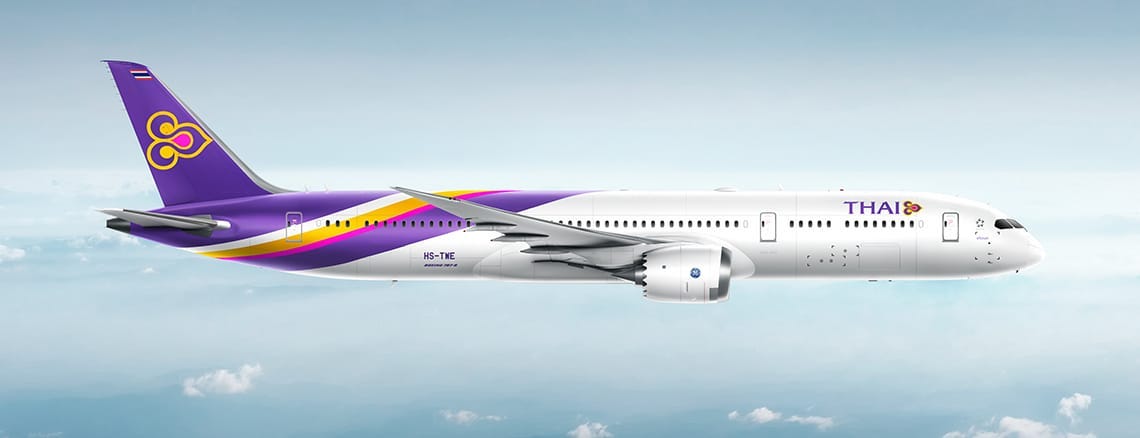
To bridge the gap before the firm orders arrive in 2027, the airline is negotiating leases on 10 wide-body 787s, targeting deliveries from June 2026 onwards.
These interim aircraft will allow the airline to expand network capacity ahead of the long order book maturing.
The 787-9 will become the airline’s principal long-haul tool, designed for routes too thin for the 777-300ER but commercially weak when flown on the smaller widebodies it replaces.
Indicative destinations include thinner European cities, Australian secondary points, and longer Asian connections such as Tel Aviv or specific Indian metros.
Airbus A321neo Narrowbody Renewal
Thai Airways introduced its first A321neo into commercial service on 22 January 2026 between Bangkok and Singapore.
The aircraft is part of a 32-unit operating lease program that will see 16 units arrive in 2026 alone.
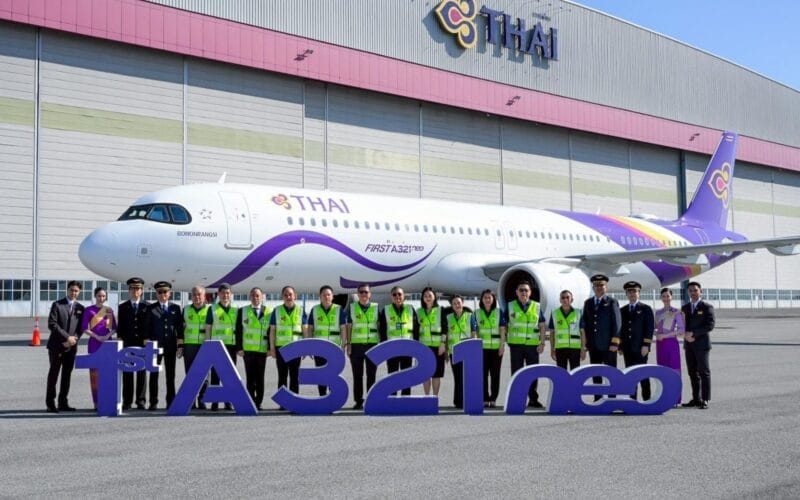
The A321neo configuration features a refreshed two-class cabin with lie-flat seats in business class, a significant uplift on what was previously offered on Thai Smile A320 services.
The remaining aircraft will continue to be delivered in staged batches through 2028.
The aircraft type’s range and economics make it suitable for a wide arc of regional missions from Bangkok, including services to Chinese tier-2 and tier-3 cities such as Changsha, to most Indian metros, and to secondary Korean and Japanese gateways.
The fleet’s commonality with the broader Airbus narrowbody family also reduces training and operational complexity.
Airbus A321neo Component Support
In a parallel agreement, Airbus and Thai Airways extended their existing Flight Hour Services (FHS) component support contract to include the 32 A321neo aircraft in early 2026.
The agreement transfers component management and pool stocking risk to Airbus, ensuring high dispatch reliability without large upfront inventory commitments.
Airbus A350 and Boeing 777: Long-Haul Workhorses
The Airbus A350-900 fleet currently provides the most modern long-haul cabin experience in the system, with fully lie-flat Royal Silk seating and dual-aisle Economy. It is the airline’s preferred type for premium Asian long-haul and European routes, including the resumed Amsterdam service.
The Boeing 777-300ER remains the primary tool for the highest-volume European, Australian and Japanese routes. These twin-aisle aircraft will benefit from a new business class refit that complements the lie-flat product on the new narrowbodies.
A330-300 and Boeing 777-200ER Exit Plan
The A330-300 and 777-200ER fleets are the candidates most exposed to retirement as 787-9s arrive.
Their replacement aligns with the company’s stated medium-term goal of streamlining widebody families to two or three sub-fleets to reduce maintenance and crewing complexity.
Fleet Strategy: Toward 150 Aircraft by 2033
CEO Chai Eamsiri has stated that the airline is targeting a fleet of 150 aircraft by 2033, a near-doubling from current size.
This requires consistent execution on both the 787 program and the A321neo program, plus the option to add up to 35 additional 787s should commercial conditions justify exercising the options.
FLEET STRATEGY ROADMAP
------------------------------------------------------
2026:  Bridge phase. 16 A321neos + leased 787s
       Bring narrowbody up to scale, fill thin routes.

2027:  First firm-order 787-9 delivery from Boeing.
       Start retiring oldest A330 and 777-200ER frames.

2028:  Continued ramp of 787-9 deliveries (10/year).
       Network depth in India, China, Australasia.

2030-33: Optional exercise of 35 additional 787s.
         Path to ~150 aircraft fleet target.
The strategy is, however, consciously cautious.
The CEO has noted that no one inside management is treating 2025 to 2027 as profit-maximization years; the priority is rebuilding network depth, modernizing the product, and securing slots in growth markets before the post-pandemic competitive map fully resets.