


Dear Readers, Welcome to AviationOutlook.
Executive Summary
United Airlines delivered a Q2 2026 pre-tax profit of $1.0 billion on record revenue of $17.67 billion, and lifted its full-year adjusted EPS view to the $9 to $11 range despite absorbing a nearly $6 billion fuel cost headwind.
Delta and United now function as a duopoly at the top of U.S. premium travel, with Delta’s Q2 premium revenue up 17% and United’s international, cargo, and loyalty streams outperforming domestic main cabin trends.
The competitive lane below the majors is compressing quickly: Southwest is monetizing assigned seats and bag fees for the first time in 53 years and Alaska is pushing into long-haul widebodies from Seattle.
H2 2026 competitive risk hinges on three variables: the extension of Newark flight caps through October 2026, the pace of Starlink installations (now targeting close to 1,000 aircraft by year-end), and how quickly the Elevated Polaris Studio Boeing 787-9 fleet scales into long-haul international.
Recommended Reports


Read All Reports
Table of Contents
Executive Summary
Introduction
Company Overview: United at Mid-2026
Key Competitive Differentiators
Competitor Identification and Segmentation
Competitor Deep-Dive
Delta Air Lines
American Airlines
Southwest Airlines
Alaska Air Group
JetBlue Airways
Ultra-Low-Cost / Legacy Fringe
Comparative Benchmarking
Market Positioning Map
Macro Backdrop: Fuel, Demand, and Regulation
Strategic Implications for H2 2026
Strategic Recommendations
Scenario Analysis: H2 2026 and 2027
Risks and Vulnerabilities
What You Should Watch in H2 2026
My Final Thoughts
Introduction
For Q2 2026, United Airlines booked $17.67 billion in revenue, its highest ever for a second quarter, while simultaneously warning that fuel costs would consume roughly $6 billion of headroom it had not planned for.
Yet management still raised the low end of its full-year earnings floor. That combination, growing profit into a fuel spike, is the clearest single tell of where competitive power now sits in the U.S. industry.
The strategic question now is no longer whether United and Delta will continue to widen the gap versus the rest of the domestic field. The question is how quickly that gap converts into structural pricing power, hub dominance, and premium-cabin revenue that legacy peers and low-cost challengers cannot match by 2028.
This report walks through United’s competitive position with: a differentiator map, competitor deep-dives, a benchmarking spread, and a positioning grid, followed by strategic implications for the back half of 2026 and the runway into 2027.
Let’s analyze everything in detail.

Company Overview: United at Mid-2026
United Airlines Holdings runs the world’s most geographically diverse mainline network, operating from seven U.S. hubs in Chicago, Denver, Houston, Los Angeles, New York/Newark, San Francisco, and Washington Dulles, plus a Guam hub anchoring its Pacific operation.
The mainline fleet is now north of 1,000 aircraft, and the company is executing the next chapter of its United Next plan, which layers on more than 250 new aircraft by April 2028, including a rebuilt widebody fleet centered on the Boeing 787.
UNITED AIRLINES QUICK PROFILE (MID-2026)

Ticker:                UAL (NASDAQ)
Q2 2026 Revenue:       $17.67 billion (all-time Q2 record)
Q2 2026 Pre-tax:       $1.0 billion / 5.8% margin
FY 2025 Revenue:       $59.1 billion
FY 2026 Adj. EPS:      $9.00 to $11.00 (raised guidance)
Mainline aircraft:     1,000+
New aircraft by 2028:  250+ (net additions)
U.S. hubs:             7 mainland + 1 Pacific (Guam)
The company is led by CEO Scott Kirby, who in a March 2026 staff memo told employees that United’s long-term plans assumed oil could rise to $175 per barrel without derailing the strategy, foreshadowing the fuel volatility that would emerge from mid-year Middle East tensions.
What sets the 2026 vintage of United apart from its 2019 or 2022 self is not raw size. It is the diversification of revenue: premium, corporate, loyalty, cargo, and international leisure are each growing faster than domestic economy.
That’s a very different beast from the airline that emerged from the pandemic. It’s also the profile that legacy peer American Airlines has struggled to replicate at scale, and that no ultra-low-cost carrier has ever tried to build.
Key Competitive Differentiators
The Widest Overseas Network Among U.S. Carriers
United maintains the widest overseas reach of any U.S. airline, and in 2026 the airline is operating more than 850 daily international flights across roughly 150 international destinations, giving it a structural advantage in the two segments that are growing fastest right now.
Those segments are premium leisure and international business travel, both of which have overtaken domestic main cabin in incremental yield growth.
For Summer 2026, United launched itself as the only U.S. carrier flying nonstop from Newark to four new European destinations including Split, Palermo, Bilbao, and Edinburgh, deepening a lead that Delta and American have not been able to match seasonally.
UNITED'S 2026 INTERNATIONAL NETWORK BY THE NUMBERS

Daily international flights:      850+
International destinations:       ~150
Latin America destinations:       69 (post-Cartagena)
New Summer 2026 European cities:  4 (Newark exclusive)
The Cartagena launches from Houston and Washington Dulles later in 2026 push the Latin America footprint to 69 destinations, and mark a rare case of a legacy U.S. carrier stealing a South American beach market that has historically been dominated by point-to-point Miami traffic.
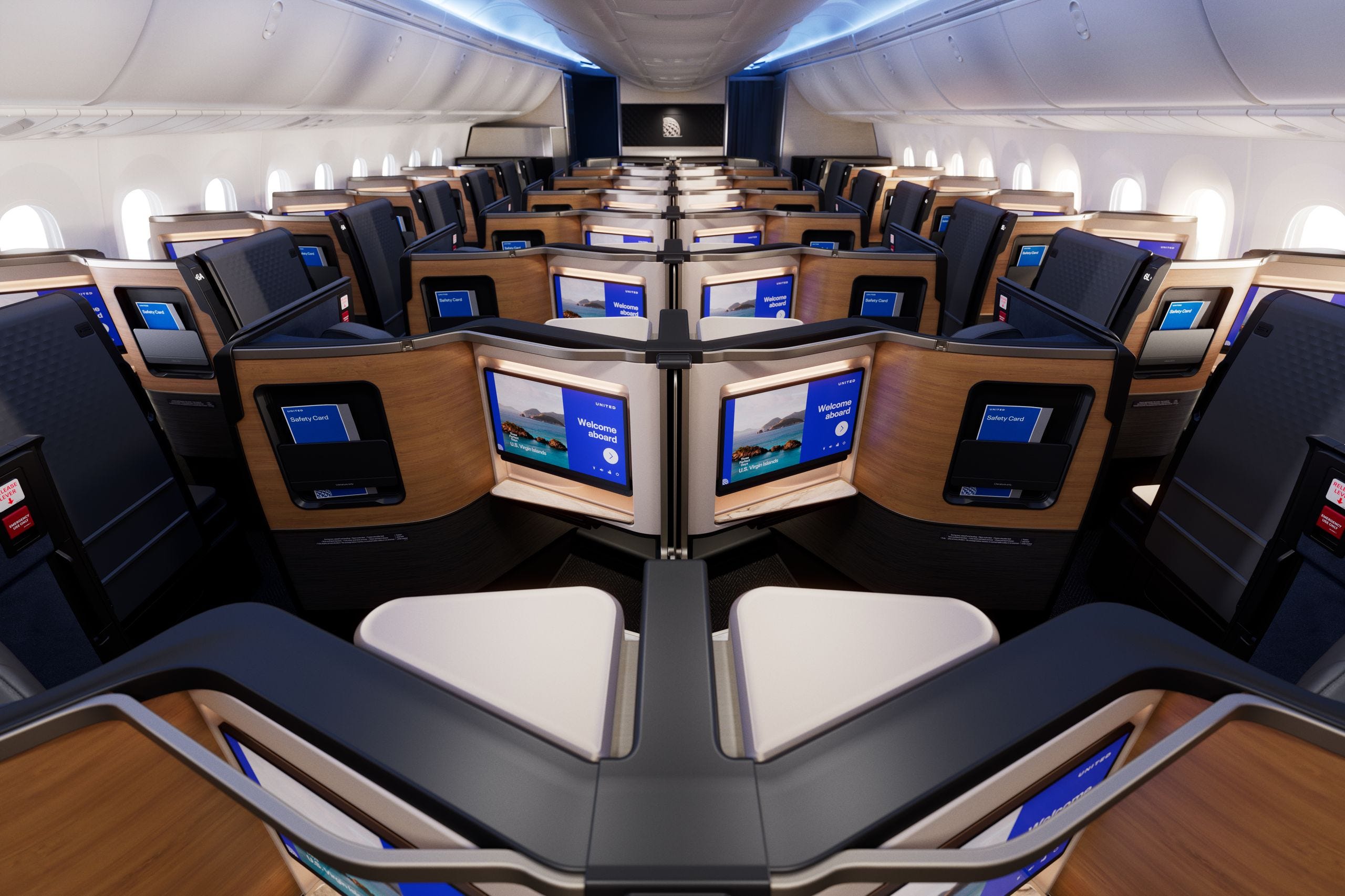
The “Elevated” Polaris Studio Product
United’s second differentiator sits above the wing. The airline is putting a re-engineered widebody premium product into service that competitors will not be able to answer for several years.
The first Elevated 787-9, which carries 99 premium seats out of just 222 total, entered international service on April 22, 2026, on the San Francisco to Singapore route, followed by San Francisco to London Heathrow.
The Polaris Studio suite itself is the largest lie-flat product United has ever offered. It includes a door for privacy, an ottoman that doubles as a companion seat, an expanded dining setup, and champagne service.
That composition, 99 premium seats on a widebody, is the highest proportion of any U.S. carrier and the aircraft that will replace United’s entire 767 fleet by 2030.
2.3 Free Fleet-Wide Starlink Wi-Fi
The third differentiator is connectivity. Starlink Wi-Fi is free for MileagePlus members and is being rolled out across the mainline and regional fleet at a pace no other major has matched.
More than 400 United aircraft carry Starlink today, and the airline expects close to 1,000 aircraft to be equipped before the end of 2026, with 96% of the mainline fleet connected in 2027.

On June 22, 2026, United ran its first Starlink-equipped transatlantic widebody flight, a symbolic milestone for the industry because it puts Starlink into the long-haul premium environment where connectivity is most economically valuable.
Delta and American are still on legacy Viasat or Intelsat systems for the bulk of their fleets. That gap will be increasingly visible to corporate travel managers in Q4 2026 and into 2027, when RFPs weigh in-flight productivity as a real service-level metric.
Hub Density and O’Hare Growth
Fourth, the airline is doubling down on Chicago O’Hare. The Summer 2026 O’Hare schedule makes it the third-largest hub operated by any U.S. carrier, with over 20,000 additional flights layered on year over year.
UNITED SEVEN-HUB DENSITY MAP (2026)

Chicago O'Hare (ORD):   #1 U.S. hub by 2026 growth
Newark (EWR):           Highest on-time northeast airport 2026
Denver (DEN):           United Next mountain hub anchor
Houston (IAH):          New Cartagena/LATAM gateway
San Francisco (SFO):    Polaris Studio launch hub
Washington Dulles (IAD):Transatlantic + LATAM secondary
Los Angeles (LAX):      Trans-Pacific/premium leisure
That density is a moat.
When the FAA extended flight cuts at Newark through October 2026 because of persistent controller staffing issues, United’s ability to reroute passengers through Chicago and Washington Dulles softened the operational blow in a way that no single-hub competitor could replicate.
A Rebuilt MileagePlus Program
Finally, the loyalty engine has been rewired. On April 2, 2026, MileagePlus earn rates changed and card-holding members now get an automatic 10% discount when redeeming miles, with an extra 5% for those who also hold Premier status.
Combined with the Blue Sky reciprocal loyalty tie-up with JetBlue, which unlocked priority boarding, preferred seats, and same-day standby across both airlines in 2026, United now has a defensive perimeter in the northeast leisure market that it did not have twelve months ago.