


Executive Summary
VietJet Air closed 2025 with consolidated revenue of VND 82.093 trillion (about US$3.11 billion), up 14% YoY, and consolidated profit after tax up 51.2% YoY, beating its annual plan by more than 120%.
The Q1 2026 performance accelerated with revenue of VND 21.021 trillion (about US$798.6 million), up 17.1% YoY, and 7.2 million passengers carried in just three months.
The fleet roadmap now blends Airbus narrowbodies (A320, A321, A321neo, A321XLR), wide-body A330ceo and incoming A330neo, the Boeing 737-8, and a finance-leased batch of 10 COMAC C909 aircraft.
Network strategy is pivoting hard toward international growth (China, Central Asia, India, Australia, the United States and Europe) while Q2 2026 has triggered tactical capacity cuts on selected international sectors, indicating disciplined yield management rather than blanket retreat.
Recommended - Read Full Reports


Read All Reports
Table of Contents
Executive Summary
VietJet Air Company Profile: Key Facts
VietJet Air Revenue & Financial Analysis
2025 Audited Full-Year Financial Performance
Q1 2026 Quarterly Acceleration
VietJet Revenue Composition and Growth Drivers
Tax and State Contributions
Capital Structure and Funding Activities
VietJet Air Fleet Analysis
Fleet Size and Group Composition
Aircraft Type Strategy and Configuration
A321neo, A321XLR and Pratt & Whitney Engine Strategy
Boeing 737-8 Integration
Wide-body Strategy and the A330neo
COMAC C909 Finance Lease
AI-Driven Fuel Optimization
Fleet Strategy at a Group Level
VietJet Air Route Network Strategy, Major Destinations and Analysis
Network Footprint and Scale
China Expansion Deep Dive
India and South Asia
Australia Long-haul Network
Northeast Asia Concentration
Southeast Asia Cross-border Operations
Europe and the United States
Q2 2026 Capacity Discipline
Major Operational Bases (Hubs)
Tan Son Nhat International Airport (SGN), Ho Chi Minh City
Noi Bai International Airport (HAN), Hanoi
Da Nang International Airport (DAD)
Long Thanh International Airport Strategy
Bangkok Suvarnabhumi (BKK) - Thai Vietjet
Almaty (ALA) - Vietjet Qazaqstan
VietJet Air Competitive Position
Domestic Market Standing
Major Competitors
VietJet vs. Vietnam Airlines
VietJet vs. Bamboo Airways
VietJet vs. AirAsia Group
VietJet vs. Cebu Pacific
VietJet vs. Scoot
VietJet vs. Sun PhuQuoc Airways
Other Strategic Initiatives
SkyJoy Loyalty Program
Sustainable Aviation Fuel (SAF) and Decarbonization
Long Thanh Maintenance, Repair and Overhaul Center
Vietjet Aviation Academy
International Aviation Finance Centre
Awards and International Recognition
Key Risks for VietJet Air
Risks and Scenario Analysis
Risk 1
Risk 2
Risk 3
Risk 4
Risk 5
Risk 6
Risk 7Risk 8
Risk 9
Risk 10
Risk 11
Risk 12
VietJet Air Future Outlook and Strategic Roadmap
2026-2030 Growth Trajectory
Brand Value Trajectory
ESG and Green Aviation
Digital Transformation
My Final Thoughts
Official Sources & Data
VietJet Air Company Profile: Key Facts
VietJet has shifted from being a Vietnamese low-cost upstart into a multinational aviation group with 254 routes, 135 group aircraft, and operations spanning Vietnam, Thailand, and now Kazakhstan.
VietJet Aviation Joint Stock Company trades on the Ho Chi Minh Stock Exchange under the ticker VJC. The carrier was the first privately owned airline to receive an air operating permit in Vietnam, and it remains the largest private airline in the country.
The chairwoman is Dr. Nguyen Thi Phuong Thao, who founded the carrier and remains the driving force behind its global push.
Group operations are coordinated from Hanoi, with the busiest commercial gateway located at Tan Son Nhat International Airport in Ho Chi Minh City.
VIETJET AIR (AS OF 2026)

Legal entity      : Vietjet Aviation Joint Stock Company
Stock ticker      : HOSE: VJC
Founded           : 2007 (commercial launch December 2011)
Chairwoman        : Dr. Nguyen Thi Phuong Thao
Headquarters      : Hanoi, Vietnam
Group fleet       : 135 aircraft (101 in Vietnam)
Total routes      : 254 (52 domestic + 202 international)
2025 passengers   : 28.2 million
2025 flights      : 153,000+
2025 revenue      : VND 82.093 trillion (~US$3.11 bn)
Subsidiaries / JVs: Thai Vietjet Air, Vietjet Qazaqstan
Safety rating     : 7-Star (AirlineRatings)
IATA / ICAO       : VJ / VJC
VietJet operates as a hybrid low-cost carrier offering economy seating, premium SkyBoss cabins on wide-body aircraft, and a recently launched Business Class product.
The airline is a fully fledged member of the International Air Transport Association with an active IOSA registration.
The group runs three operating brands.
The Vietnam-based parent flies under the VietJet Air banner, Thai Vietjet operates from Suvarnabhumi, and Vietjet Qazaqstan was established in May 2025 as a joint venture with Qazaq Air to anchor Central Asian operations.
VietJet Air Revenue & Financial Analysis
2025 Audited Full-Year Financial Performance
The carrier’s audited 2025 results, released on March 30, 2026, confirmed a year of broad-based outperformance.
Consolidated revenue reached VND 82.093 trillion (about US$3.11 billion), an increase of 14% year-on-year. Parent-level revenue stood at VND 81.426 trillion, or approximately US$3.09 billion.
Profitability advanced even faster than the top line. Consolidated profit before tax came in at VND 2.630 trillion (US$99.6 million), up 44.3% year-on-year, while consolidated profit after tax rose 51.2% to VND 2.123 trillion (US$80.5 million).
The audited statements underscore one important point. The profit beat exceeded the annual plan by more than 120%, suggesting that recovery in regional aviation demand is being amplified by tighter cost discipline and higher utilization across the Airbus narrowbody backbone.
Q1 2026 Quarterly Acceleration
The Q1 2026 read-out came in significantly stronger.
Consolidated revenue reached VND 21.021 trillion (about US$798.6 million), up 17.1% YoY, with consolidated profit after tax soaring 59.6% YoY to VND 1.023 trillion (about US$38.8 million).
Profit before tax climbed 36.5% YoY to VND 1.142 trillion (US$43.3 million). The growth differential between revenue and pre-tax profit suggests engine and lease costs continue to compress unit economics, while the disproportionately faster bottom-line gain after tax reflects favorable tax timing items.
Total assets sat at VND 143.534 trillion (about US$5.45 billion) at the end of March 2026, up from VND 139.459 trillion at year-end 2025. Net debt-to-equity moved down slightly to 2.1 from 2.25, while the liquidity ratio held at 1.5.
KEY FINANCIAL RATIOS (CONSOLIDATED)

                          FY2025 audited     Q1 2026
Revenue                   VND 82.093 trn     VND 21.021 trn
Revenue YoY growth        +14%               +17.1%
Profit after tax          VND 2.123 trn      VND 1.023 trn
PAT YoY growth            +51.2%             +59.6%
Total assets              VND 139.459 trn    VND 143.534 trn
Net debt/equity           2.25               2.1
Liquidity ratio           1.53               1.5
Plan completion (PAT) ~120% n/a (1Q only)VietJet Revenue Composition and Growth Drivers
The group’s revenue model rests on three pillars.
The first is airline transportation revenue, anchored by domestic Vietnam routes and an expanding international network across China, Central Asia, India, Northeast Asia, Southeast Asia, Australia and now Europe.
The second is ancillary revenue, where SkyJoy, baggage, seat selection, in-flight retail, and cargo services contribute meaningfully. The carrier moved 113,923 tons of cargo in 2025, an underappreciated segment that supports yield resilience during low-season passenger periods.
The third is aircraft trading, sale-and-leaseback structuring, and ground services, which have historically produced episodic but material revenue contributions. Group capital activities also contributed to 2025 results, including a VND 5 trillion (about US$189.6 million) equity issuance that strengthened the balance sheet during the year.
Tax and State Contributions
VietJet paid approximately VND 10.537 trillion (about US$399.6 million) in direct and indirect taxes and fees during 2025, reaffirming its position among Vietnam’s largest contributors to the state budget.
The figure equates to roughly 12.8% of full-year consolidated revenue routed through fiscal channels.
For airline analysts watching policy risk in Vietnam, that contribution scale provides political insulation. The state budget reliance creates a structural incentive for stable operating conditions across slot allocations, route licenses, and aviation fuel taxation.
Capital Structure and Funding Activities
The group’s audited liquidity ratio of 1.53 at year-end 2025, alongside net debt-to-equity of 2.25, places its balance sheet within standard aviation safety margins. A 30% stock dividend was approved at the 2026 Annual General Meeting, preserving cash for fleet capex while still rewarding equity holders.
VietJet also closed a US$965 million aircraft financing agreement and pioneered the establishment of an International Aviation Finance Centre in collaboration with the Vietnam International Financial Centre in Ho Chi Minh City.
That second initiative could become a structurally important funding channel for narrowbody and wide-body deliveries through the rest of the decade.
VietJet Air Fleet Analysis
Fleet Size and Group Composition
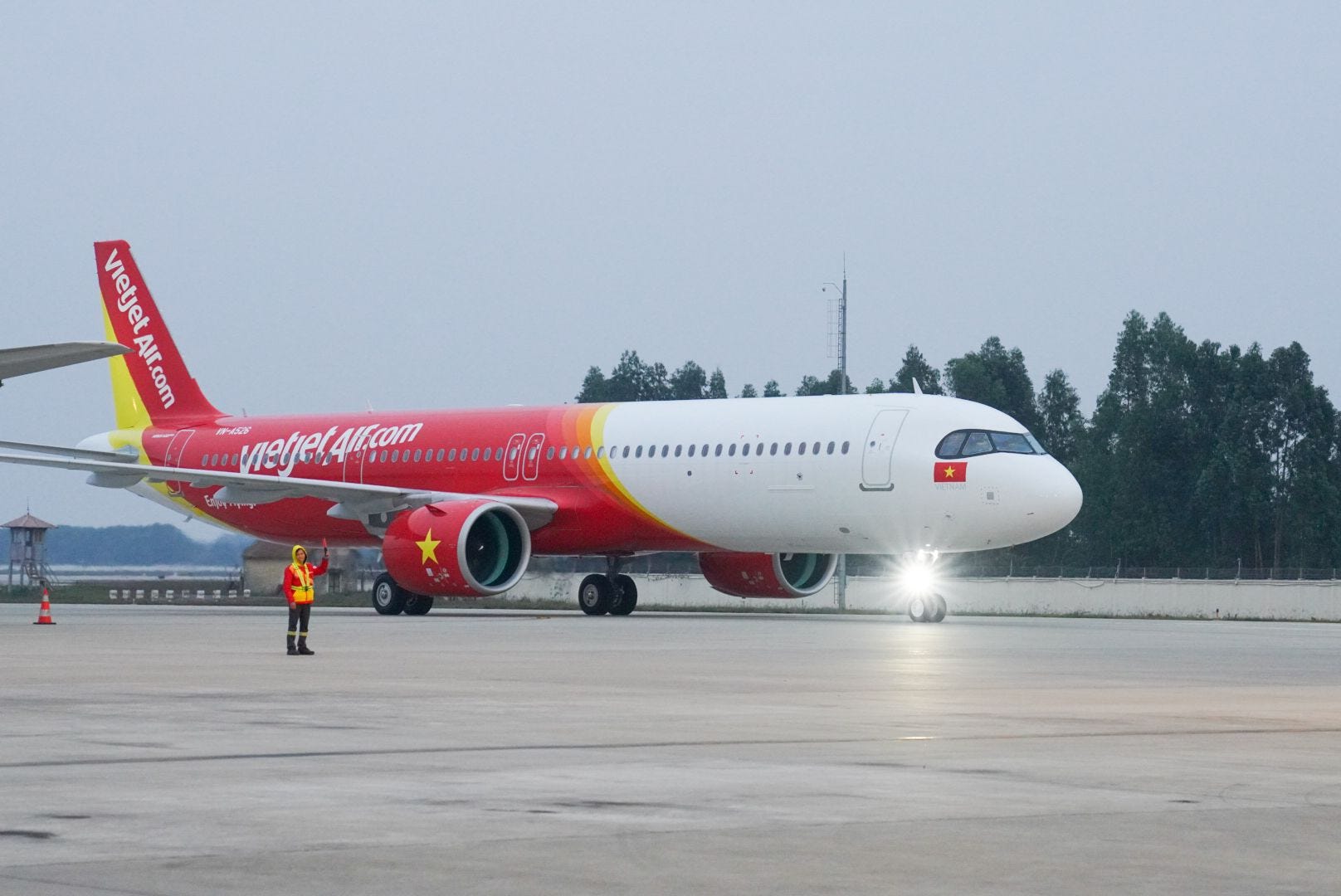
VietJet group operates 135 aircraft as of the most recent disclosures, 101 of which are based in Vietnam under the parent operating certificate. The remainder fly under Thai Vietjet and Vietjet Qazaqstan brands.
The Vietnam-based fleet is dominated by the Airbus A320 family.
Industry data placed the in-service mix at 16 A320s, 78 A321s, 8 A321neos, 8 A330-300s, and 2 COMAC ARJ21 aircraft entering 2026, before deliveries of additional Boeing 737-8s, A321neos and A330neos accelerated through the year.


VIETJET AIR FLEET MIX (CORE PARENT, EARLY 2026)

Aircraft Type         Count
Airbus A320           16
Airbus A321           78
Airbus A321neo        8
Airbus A330-300       8
COMAC ARJ21 (C909)    2
-------
Average fleet age     ~7.5 years
Narrowbody : Widebody ~92% : 8%
The deliberate concentration on the A321 reflects the airline’s pursuit of high seat density at low unit cost. With 230 seats in a single-aisle airframe, the type generates strong revenue per departure on dense regional sectors.
Aircraft Type Strategy and Configuration
The Airbus A321ceo aircraft, with 230 seats configured at 28 to 29 inches of pitch, anchors Vietnam-based domestic and short-haul international flying. The seat width of 18 inches and three inches of recline keep the product competitive for sectors below five hours.
Wide-body services are flown with leased Airbus A330-300 aircraft. Unlike most full-service carriers operating the type at 2-4-2, VietJet runs a denser 3-3-3 economy layout similar to peers Cebu Pacific and AirAsia X, lowering unit costs on long-haul routes to Australia and India.
Premium passengers get the SkyBoss product on the A330, with 59 inches of pitch, 19 inches of width, and recline angles up to 170 degrees. While not lie-flat, it is positioned at a fare point well below traditional business class on competing carriers serving the same long-haul markets.
A321neo, A321XLR and Pratt & Whitney Engine Strategy
The A321neo is doing the heavy lifting in fuel efficiency. The narrowbody type’s average age in the VietJet fleet sits at just 3.6 years, pulling the entire group fleet age below the comparable AirAsia Malaysia and Citilink benchmarks.
In 2025, VietJet finalized an order for 100 A321neo aircraft with 50 purchase options from Airbus, and added an order for 20 Airbus A330neo wide-body aircraft. That positions the airline among the largest narrowbody and wide-body customers globally for the next half-decade.
Powering 44 of those A320neo family aircraft is a US$5.4 billion engine and EngineWise services agreement with Pratt & Whitney, a unit of RTX. Deliveries under that engine contract begin in July 2026 and run alongside a 12-year EngineWise Comprehensive maintenance program.
A321 / A321neo FLEET ROLE

A321ceo (in service)   : Domestic + short-haul international, 230Y
A321neo (in service)   : Higher utilization, 4-5 hour reach, lower fuel burn
A321XLR (on order)     : Range-extension narrowbody for India + secondary EU markets
Engines (next-gen)     : Pratt & Whitney GTF (PW1100G) on 44 of next A320neo family
Fuel efficiency        : ~15-20% improvement vs. CEO generation
SkyBreathe partnership : OpenAirlines AI fuel optimization platformBoeing 737-8 Integration
The integration of the Boeing 737-8 marks a structural shift after years of A320-family exclusivity.

VietJet began receiving its first Boeing 737-8 aircraft in 2025 from the historic 200-jet order originally signed in 2016 and finalized during high-profile US-Vietnam state visits.
The intent is to deploy the type in two streams. First, the parent VietJet Air uses 737-8 capacity to balance the Airbus narrowbody concentration risk. Second, Thai Vietjet has begun an all-Boeing transition, with up to 50 of the 200 frames to be transferred to the Bangkok-based subsidiary.
The 737-8’s range and economics also unlock new geographies. Thai Vietjet’s first international service on the type debuted in late 2025, extending into Vietnamese coastal cities and broader Southeast Asia.
Wide-body Strategy and the A330neo
The current wide-body fleet of eight Airbus A330-300s is leased and includes airframes that previously flew with AirAsia X and Corsair. The aircraft serves Australian capital cities, longer Indian sectors, and selective Northeast Asian peak demand routes.
The forthcoming Airbus A330-900neo aircraft will progressively replace those leased frames. Reuters reported that VietJet expects first delivery this year as it expands into European markets, supporting the airline’s Fly the world strategic platform.
The 20 firm A330neo orders, announced in May 2025, are configured for both passenger experience and operating cost savings. Roll-Royce engine and maintenance agreements signed during 2025 wrap that wide-body strategy into long-term service contracts that smooth maintenance reserves on the income statement.
COMAC C909 Finance Lease
In April 2026, VietJet and SPDB Financial Leasing exchanged a finance lease for 10 COMAC C909 aircraft, formerly known as the ARJ21.
The deal, signed during a state visit by Vietnam’s General Secretary and President To Lam to China, deepens financial and aviation cooperation between the two countries.
The C909 introduction is a strategically modest but operationally significant move. The 90-seat regional jet enables VietJet to serve secondary Chinese airports such as Enshi, Huangshan, and Guilin where slot constraints or stage length make a 230-seat A321 uneconomic.
AI-Driven Fuel Optimization
VietJet’s partnership with OpenAirlines deploys the SkyBreathe platform across operational planning and in-flight execution. The system uses historical and real-time recorder data to identify fuel-saving opportunities on a flight-by-flight basis.
Inputs include weather, payload, route choices, and wind conditions. The platform’s recommendations affect descent profiles, single-engine taxi adoption, weight management, and tankering decisions, translating into measurable cost-per-block-hour reductions across the network.
Fleet Strategy at a Group Level
The strategic frame is straightforward. Maximize aircraft commonality where it preserves crew and maintenance synergies, and accept dual-fleet complexity where the financial benefit is clear, particularly across geopolitical hedging and supplier diversification.
Cirium recognized VietJet as the most emissions-efficient airline for intra-Southeast Asian routes in its 2025 Flight Emissions Review.
That outcome is rooted in two structural advantages, namely the high-density seating layout that reduces emissions per available seat, and the rapid integration of next-generation A321neo airframes.
FLEET STRATEGIC PILLARS

1. Backbone        : A320 family for short-haul, single-fleet ops cost benefit
2. Range extension : A321neo + future A321XLR for thinner long-haul markets
3. Wide-body       : A330ceo today, A330neo from 2026 for 6-12 hour sectors
4. Diversification : Boeing 737-8 across parent + Thai Vietjet
5. Niche regional  : COMAC C909 for secondary Chinese destinations
6. Engine strategy : Pratt & Whitney GTF + Rolls-Royce + CFM International
7. Sustainability  : SAF blends with Petrolimex, AI fuel optimization