


Executive Summary
Viva (formerly Viva Aerobus), the Monterrey-based ultra-low-cost carrier, closed fiscal year 2025 with US$2,376 million in total operating revenue, a 104-aircraft all-Airbus fleet, and a scheduled load factor of 86.0%, as documented in its own fourth quarter disclosure.
The airline became Mexico’s largest domestic passenger carrier in 2025, flying approximately 27.24 million passengers on domestic Mexican routes while also serving 44 domestic and 19 international destinations across five countries.
In December 2025, Viva and Volaris signed a merger of equals to create a new holding company, Grupo Más Vuelos, S.A.B. de C.V., combining 251 Airbus narrowbodies and approximately US$5.36 billion in combined LTM revenue, with closing targeted for 2026 subject to regulatory approval.
Key strategic risks include regulatory scrutiny over competitive concentration, Pratt and Whitney GTF engine availability, and U.S.-Mexico bilateral aviation frictions that continue to affect scheduling at Mexico City’s Felipe Angeles International Airport (AIFA) and Benito Juárez International Airport (MEX).
Recommended - Read Full Reports


Read All Reports
Table of Contents
Executive Summary
Key Facts: Company Profile
Business Overview
Corporate Structure and Ownership
Revenue Profile: LTM and Full-Year 2025 Financial Analysis
TRASM, CASM and Unit Economics
Revenue Growth Drivers
Viva Cargo and Non-Passenger Revenue
Key Services and Products
Fleet: In-depth Analysis
Fleet Size and Composition
Fleet Age: One of the Youngest in the Americas
Aircraft Types, Configuration, and Strategy
Fleet Strategy: Growth, Gauge Upgrade and the GTF Problem
Route Network, Major Destinations and Strategy
Domestic Network: The Mexican Backbone
International Network: U.S. Focus and Latin American Expansion
Network Strategy: Point-to-Point with Connecting Banks
World Cup 2026 Network Surge
Major Operational Bases (Hubs)
Monterrey International Airport (MTY): The Primary Hub
Mexico City: AIFA and MEX
AIFA: Strategic Growth Airport
MEX: Legacy Domestic Backbone
Cancun International Airport (CUN)
Guadalajara International Airport (GDL)
Secondary Bases: Los Cabos, Merida and Tijuana
Competitive Position
Major Competitors
Viva vs. Volaris: The Mexican ULCC Duel (Pre-Merger Benchmark)
Viva vs. Aeroméxico: ULCC vs. Full-Service
Viva vs. U.S. Carriers on Cross-Border Routes
Viva vs. Mexicana de Aviación
Viva vs. Intercity Bus Operators
The Viva-Volaris Merger: Creating Grupo Más Vuelos
Transaction Structure
Strategic Rationale
Regulatory Path and Timeline
Operational Performance and Passenger Traffic
2025 Traffic Pattern
2024 Comparison and Longer-Term Trajectory
Strategic Industry Context
Mexico’s Aviation Market Structure in 2026
Ancillary Revenue and the ULCC Economics Model
FIFA World Cup 2026 as a Network Catalyst
U.S.-Mexico Bilateral Aviation Relations
Key Risks with Probabilities and Scenarios
Risk 1: Regulatory Blockage of the Volaris Merger
Risk 2: Pratt and Whitney GTF Engine Availability
Risk 3: U.S.-Mexico Bilateral Aviation Tensions
Risk 4: GTF-Driven Cost Inflation
Risk 5: Mexican Peso Volatility
Risk 6: Domestic Demand Softness
Risk 7: Competitive Intensity from Volaris
Risk 8: Integration Risk
My Final Thoughts
Official Sources and Data
Key Facts: Company Profile
Viva operates as a single-brand Mexican ultra-low-cost carrier under the legal name Aeroenlaces Nacionales, S.A. de C.V., headquartered at Monterrey International Airport in Apodaca, Nuevo León.
The company is wholly owned by Grupo IAMSA, Mexico’s largest ground-transportation group, and is chaired by Roberto Alcántara Rojas.
The carrier began commercial operations on November 30, 2006, and in October 2024 it simplified its brand identity from “Viva Aerobus” to simply “Viva,” accompanied by a refreshed logo and livery program on newly delivered A321neos.
VIVA (FORMERLY VIVA AEROBUS) — SNAPSHOT (AS OF APRIL 2026)

Legal name .................. Aeroenlaces Nacionales, S.A. de C.V.
Brand ....................... Viva (rebrand from Viva Aerobus, Oct 2024)
IATA / ICAO / Callsign ...... VB / VIV / AEROENLACES
Headquarters ................ Monterrey, Nuevo León, Mexico
Parent ...................... Grupo IAMSA (100%)
Chairman .................... Roberto Alcántara Rojas
CEO ......................... Juan Carlos Zuazua
Primary hub ................. Monterrey International Airport (MTY)
Other bases ................. Cancún, Guadalajara, MEX, AIFA,
                              Los Cabos, Mérida, Tijuana
Fleet size (EoP 2025) ....... 104 aircraft (all Airbus A320 family)
Fleet size (Apr 2026) ....... ~108 aircraft per third-party trackers
Average fleet age ........... ~7.9 years
FY 2025 revenue ............. US$2,376 million
FY 2025 net income .......... US$52 million
FY 2025 load factor ......... 86.0%
Passengers (FY 2025) ........ 29.96 million booked
Destinations ................ 44 domestic + 19 international (5 countries)
Pending transaction ......... Merger of equals with Volaris announced
Dec 18, 2025 → Grupo Más VuelosBusiness Overview
Viva is the Mexican ultra-low-cost carrier (ULCC) that most closely emulates the Spirit-Ryanair playbook, and its economics reflect that lineage.
The airline deliberately flies a single aircraft family, operates dense cabin configurations, and extracts almost half of its revenue from ancillaries rather than from base fares.
The result is a cost base that is materially lower than full-service peers in Mexico, and a revenue engine that has historically depended on domestic leisure demand plus a growing cross-border visiting-friends-and-relatives (VFR) U.S. network.
Mexico’s domestic passenger market remains the airline’s anchor, and Viva carried more domestic passengers than any other Mexican carrier in 2025, a milestone confirmed through publicly disclosed airport group data.
Corporate Structure and Ownership
Viva is a private holding subsidiary of Grupo IAMSA, a privately held conglomerate whose core business is intercity bus transportation in Mexico.
IAMSA acquired full ownership in December 2016, when the founding co-investor, Irelandia Aviation, sold its 49% stake back to the company, consolidating 100% control in Mexican hands.
This corporate lineage matters for two reasons.
First, the Alcántara family, through IAMSA, retains the decisive voting block and has historically directed long-term capital allocation toward fleet growth rather than dividends.
Second, IAMSA’s bus-heavy DNA shapes Viva’s product philosophy, which treats low-cost intercity passenger movement, not premium travel, as the core market to be captured from road transport.
OWNERSHIP & GOVERNANCE STRUCTURE (PRE-MERGER)

Grupo IAMSA (100%)
   │
   └── Aeroenlaces Nacionales, S.A. de C.V.  (operates as "Viva")
              ├── Viva passenger operations (Airbus A320 family)
              ├── Viva Cargo (belly-hold freight service)
              └── Ancillary retail (Vivabus, fare bundles, etc.)
Unlike Volaris, which is publicly traded on the NYSE and BMV, Viva remains a private company.
The 2025 merger of equals with Volaris will change that overnight once consummated, because the combined entity will be listed on both exchanges under the Grupo Más Vuelos banner, a structure described in the joint investor presentation.
Revenue Profile: LTM and Full-Year 2025 Financial Analysis
For fiscal year 2025, Viva reported total operating revenue of US$2,376 million, a 7.3% decline from US$2,565 million in 2024.
The contraction was the first full-year revenue drop since the post-pandemic recovery began, and it reflected a softer fare environment, adverse capacity mix from grounded GTF-powered aircraft, and a tough comparison against an unusually strong 2024 base.
Passenger revenue for the year came in at US$1,251 million, while ancillary revenue reached US$1,125 million, meaning ancillaries accounted for 47.3% of total operating revenue.
That share remains one of the highest in the global airline industry, and it is the single most important structural feature of Viva’s income statement.
FY 2025 REVENUE COMPOSITION (US$ THOUSANDS)

Passenger revenue ............... 1,251,178     52.7%
Ancillary revenue ...............  1,125,191    47.3%
Total operating revenue ......... 2,376,369    100.0%

PRIOR YEAR 2024 (for comparison)
Total operating revenue ......... 2,565,000    (−7.3% YoY)
Operating profit (EBIT) for the full year was US$185 million on a 7.8% EBIT margin, and net income came in at US$52 million, as documented in the carrier’s own 4Q and FY 2025 earnings release.
On a quarterly basis, 4Q 2025 revenue was US$680 million, up 1.8% year over year, signaling that the pricing environment stabilized in the last quarter after a weak first half.
TRASM, CASM and Unit Economics
Unit revenue (TRASM) for 2025 was 9.56 U.S. cents per available seat mile, while unit cost (CASM) was 8.81 U.S. cents.
The 75-basis-point gap is narrower than in the expansion years of 2022 to 2024, and it explains the margin compression that Viva disclosed across interim 2025 results.
The 2Q 2025 disclosure showed TRASM declining 16.8% year over year to 8.75 U.S. cents, which was the low point of the year.
Recovery in the second half brought average stage length to 711 miles for the full year and a scheduled load factor of 86.0%, both of which are strong by ULCC standards and consistent with the airline’s traffic reports.
KEY UNIT METRICS — FY 2025

Available Seat Miles (ASMs) ..... 24,870 million
Revenue Passenger Miles (RPMs) .. ~21,388 million (implied)
Load factor (scheduled) ......... 86.0%
Stage length (avg) .............. 711 miles
TRASM ........................... 9.56 US cents
CASM ............................ 8.81 US cents
CASM ex-fuel .................... derived, mid-5 US cents range
Booked passengers ............... 29,957 thousand
The airline’s absolute CASM is not as low as the leanest Asian or European ULCCs, but its unit cost advantage over Mexican full-service peers is large enough to defend margins through a demand trough, which is exactly the story of 2025.
Revenue Growth Drivers
Three factors drive Viva’s top line in 2026.
The first is international capacity expansion from its hubs in Monterrey, AIFA and MEX toward the United States, with a wave of new routes timed to the FIFA World Cup co-hosted by Mexico, the United States and Canada.
Viva disclosed plans to reach a total of 38 routes from AIFA by end of 2025, up from 29 in 2024, a 31% increase outlined in its domestic press release.
The second driver is continued ancillary optimization, where the airline has applied machine-learning-based dynamic pricing to baggage, seat selection, and bundle products to squeeze more per-passenger yield without raising base fares.
The third driver is the pending merger with Volaris, which will unlock procurement savings, fleet rationalization, and network overlap management that neither carrier can achieve standalone.
Viva Cargo and Non-Passenger Revenue
Viva Cargo is the belly-hold freight arm launched in 2021 to monetize unused cargo capacity in the A320 family’s bin and lower deck.
The product is positioned for small to medium-sized domestic shipments, with weight limits around 150 kilograms per item and package dimensions capped at roughly 1 meter on each side, a design that the company disclosed at launch.
Cargo revenue remains a small fraction of total revenue, but the segment has grown with Viva’s network expansion to include more than a dozen domestic destinations.
The segment’s strategic importance is higher than its revenue contribution suggests, because belly-hold freight monetizes capacity that would otherwise fly empty, directly raising TRASM.
Key Services and Products
Viva’s passenger product stack is built around unbundled base fares with a menu of optional ancillaries.
The core SKUs include checked and carry-on baggage fees, seat selection, “VivaSmart” and “VivaExtra” bundles, priority boarding, onboard retail, and Zonas (extra legroom rows) on A321neo configurations.
The airline also operates a co-branded credit card program with Mexican issuers, a third-party hotel booking affiliate channel via its website, and a loyalty-lite program called “Doters” that accrues points on flights and partner purchases.
The strategic point of this stack is that a ticket sold at US$30 can generate another US$25 in ancillary margin if the customer buys one bag and a seat.
Fleet: In-depth Analysis
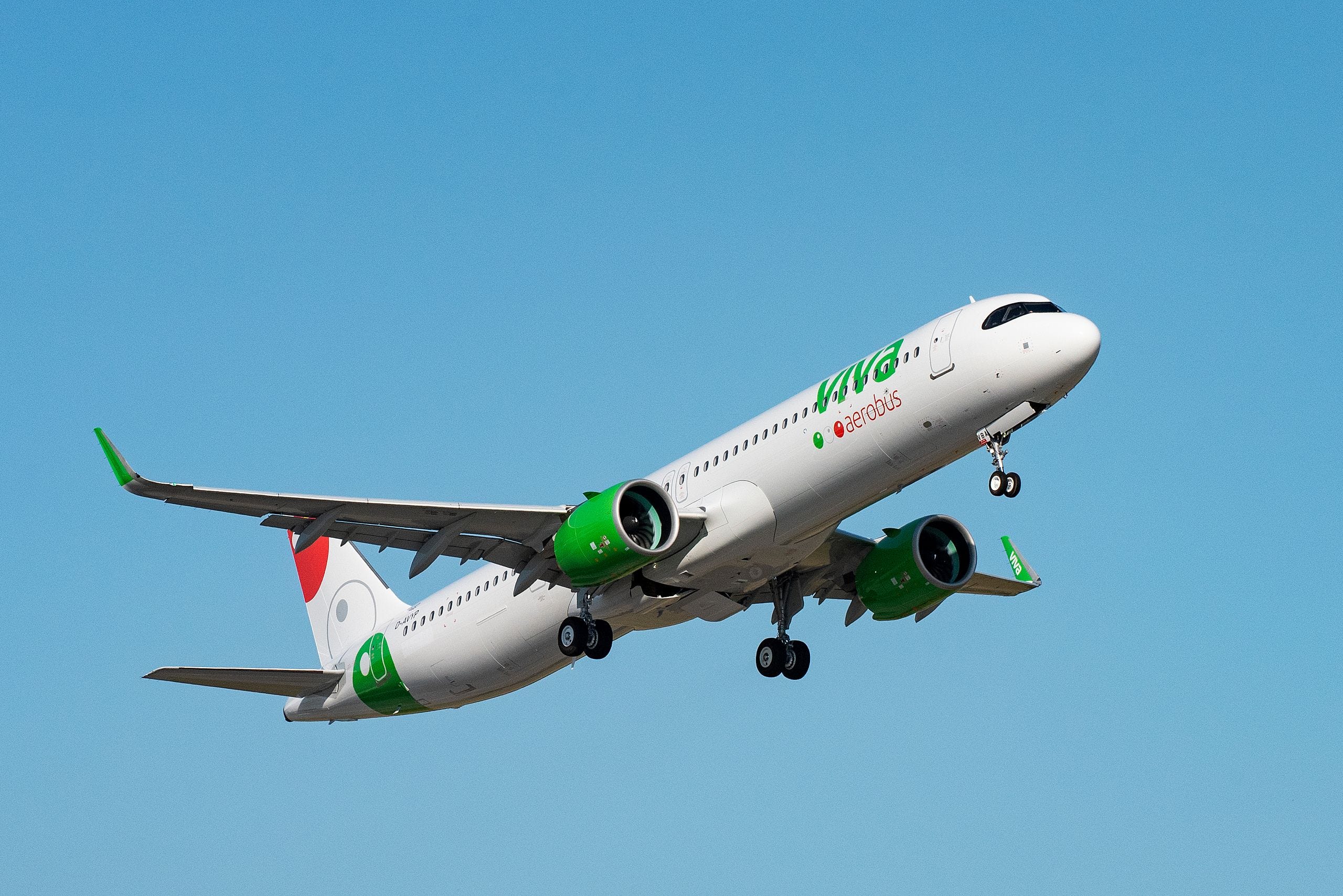
Viva operates a 100% Airbus narrowbody fleet, which is one of only a handful of all-A320-family operations of its size in the Americas.
The company ended 2025 with 104 aircraft on its books, and third-party trackers registered approximately 108 aircraft in service by mid-April 2026 as new deliveries continued to arrive.
Fleet Size and Composition
The end-of-period fleet for 2025 of 104 aircraft is a 4-aircraft net addition from the prior year, reflecting continued A321neo deliveries partially offset by the return of older A320ceo variants.
The family breakdown shows the airline’s strategic pivot toward the larger A321neo gauge, which now represents roughly one-third of the fleet.
VIVA FLEET COMPOSITION (EOP 2025, DERIVED FROM DISCLOSURES
AND THIRD-PARTY TRACKING, APRIL 2026)

Airbus A320-200 (CEO) .......... ~45 aircraft   [mid-life, phasing down]
Airbus A320neo ................. ~12 aircraft   [2017+ deliveries]
Airbus A321-200 (CEO) .......... ~9 aircraft    [large-gauge trunks]
Airbus A321neo ................. ~35+ aircraft  [240-seat growth engine]
Total in service ............... 104 (EoP 2025) / ~108 (Apr 2026)
A notable feature of the fleet is the standardization on Airbus’ “Airspace” cabin on the most recent A321neo deliveries, which provides LED mood lighting, larger overhead bins and a refreshed interior feel that Viva markets under its new brand livery.
The airline took delivery of its first A321neo in June 2020, which has since become the backbone of its capacity growth.
Fleet Age: One of the Youngest in the Americas
The weighted average fleet age at Viva sits around 7.9 years as of April 2026.
That number has crept up slightly from the 5.5-year average the carrier boasted in 2023, because new deliveries have moderated while older A320ceos remain in service pending Pratt and Whitney GTF maintenance recovery on the neo fleet.
Even so, a sub-8-year average makes Viva’s fleet one of the youngest among full-service and low-cost carriers in Latin America, which translates directly to fuel efficiency advantages and lower maintenance costs relative to peers operating older metal.
FLEET AGE COMPARISON (APRIL 2026, APPROX.)

Viva (Mexico) ................... ~7.9 years
Volaris (Mexico) ................ ~6.4 years
Aeroméxico (Mexico) ............. ~9.0 years
JetBlue (USA) ................... ~11.0 years
Spirit Airlines (USA) ........... ~8.6 years
A young fleet matters economically because the neo variants burn roughly 15% less fuel per seat than the ceo generation, and because newer airframes require fewer heavy maintenance checks in the near term.
The challenge, as explained below, is that the neo generation’s Pratt and Whitney GTF engines have created a serious availability problem for Viva and every other neo operator.
Aircraft Types, Configuration, and Strategy
Viva configures its A320-200s with 186 seats, A320neos with 186 seats, A321-200s with 230 seats, and A321neos with 240 seats, the densest single-class layouts permitted by regulators.
The 240-seat configuration on the A321neo is built around the rear airstairs and high-density Airbus cabin-flex layout, and it delivers a unit-cost advantage of approximately 20% per seat versus the A320 on identical stage lengths.
The strategic commitment to the A321neo family was formalized in July 2023, when Viva signed a memorandum of understanding with Airbus for up to 90 additional A321neos.
That MoU has not yet been firmed into a definitive order at the time of writing, and the pending merger with Volaris is likely to reshape those negotiations into a combined orderbook.
A320 FAMILY CONFIGURATION AT VIVA

Type             Seats    Role                       Avg. Age
────────────────────────────────────────────────────────────
A320-200 CEO     186      Domestic workhorse         High
A320neo          186      Growth, leisure trunks     Low
A321-200 CEO     230      High-density trunks        Medium
A321neo          240      International, VFR,        Very Low
                          peak-day capacity
The strategic logic is straightforward.
The A321neo, when filled, produces the lowest CASM in the narrowbody market.
Viva’s network is dense enough on 40-plus-route trunks like Monterrey-Cancun and Mexico City-Cancun to absorb that capacity profitably, and the aircraft’s 4,000-nautical-mile range unlocks U.S. destinations up to the Midwest and Northeast from Mexico’s interior.
Fleet Strategy: Growth, Gauge Upgrade and the GTF Problem
Viva’s fleet strategy rests on three pillars.
First, standardization on a single aircraft family (Airbus A320) to minimize pilot training, maintenance and spare-parts complexity.
Second, gradual gauge upgrade toward the A321neo to capture per-seat unit cost improvements on thick routes.
Third, sale-and-leaseback financing to preserve cash flexibility.
However, the GTF engine problem has complicated the execution plan.
In 2024 and 2025, Viva confirmed that it had received compensation from Pratt and Whitney for grounded aircraft, and at various points during the crisis it took on wet-leased A320 capacity to cover schedule gaps.
The broader industry context is that more than 700 neo-family aircraft have been grounded globally at various points for GTF engine inspections.
Viva’s exposure is material, because any neo grounding forces the carrier to either lease-in capacity at inflated rates or cut schedule, both of which hit unit economics.
FLEET STRATEGY PILLARS (2026 OUTLOOK)

Pillar 1: Fleet commonality (100% Airbus A320 family)
 → Single pilot type rating (A320-A321 common)
 → Unified MX program, lower spare parts inventory
 → Uniform crew scheduling

Pillar 2: Gauge upgrade (A320 → A321neo)
 → 240 seats vs 186 seats = ~29% more capacity per frame
 → Lowest CASM in the narrowbody market when full
 → Range unlocks US interior points from MTY and AIFA

Pillar 3: Sale & leaseback-heavy financing
 → ~US$1.5B in lease liabilities (disclosed in merger deck)
 → Preserves balance-sheet flexibility for growth capex
 → Aligns aircraft to 10-12 year useful-life cycles

OVERLAY: GTF engine availability remains a constraint
 → Ongoing compensation from Pratt & Whitney
 → Selective wet-lease coverage during shop visits
 → Fleet age ticks up as old ceos stay in service