


Executive Summary
Operational scale: Volaris ended 2025 with 155 Airbus A320-family aircraft, 66% of which are New Engine Option (NEO) variants, and transported 7.75 million passengers in Q1 2026 alone while maintaining an 85.0% consolidated load factor.
Financial recovery trajectory: Full-year 2025 revenue of $3,038 million produced a net loss of $104 million, but management is guiding for an EBITDAR margin of 33% and approximately 7% ASM growth in 2026, with engine-grounded aircraft falling from 41 in January to a projected 25 by year-end.
Transformational merger: Shareholders approved combining Volaris with Viva Aerobus on March 25, 2026 with 91.8% of the vote, creating Grupo Más Vuelos with approximately 251 aircraft and roughly 69% of Mexican domestic passenger share, pending regulatory clearance.
Network expansion: Volaris is launching 33 new routes in June 2026 timed to the FIFA World Cup, including service to four new airports and deepening of regional secondary hubs such as Puebla, Querétaro, and San Luis Potosí.
Recommended - Read Full Reports


Read All Reports
Table of Contents
Executive Summary
Introduction
Key Facts: Company Profile
Business Overview
Corporate Identity and Business Model
Financial Performance: Full Year 2025
Fourth Quarter 2025 Performance
First Quarter 2026 Operating Trends
Ancillary Revenue: The Core Economic Engine
2026 Full-Year Outlook
Fleet: In-Depth Analysis
Fleet Size and Composition
Fleet Age and Generational Composition
Aircraft Type Strategy: CEO to NEO Transition
A321neo as the Strategic Growth Platform
GTF Engine Crisis and Fleet Availability
Fleet Plan Through 2027 and Beyond
Route Network, Major Destinations and Strategy
Network Scale and Geographic Scope
Domestic Network Strategy
Transborder Mexico-US Strategy
The 33-Route June 2026 Expansion
Regional Airport Strategy
FIFA World Cup 2026 Opportunity
International Expansion into South America
Major Operational Bases (Hubs)
Hub Structure Overview
Guadalajara (GDL): Commercial and Operational Center
Mexico City (MEX): Premium Domestic and International Position
Tijuana (TIJ): The Strategic Cross-Border Bridge
Focus Cities: Cancún, León, and Monterrey
Competitive Position
List of Major Competitors
Volaris vs. Viva Aerobus
Volaris vs. Aeroméxico
Volaris vs. US Legacy Carriers on Transborder Routes
Volaris vs. Spirit and Frontier (US ULCCs)
Volaris vs. Copa and Central/South American Competitors
The Volaris-Viva Aerobus Merger: Strategic Transformation
Merger Announcement and Transaction Structure
Shareholder Approval
Regulatory Landscape
Potential Synergies and Strategic Logic
Competitive Response Scenarios
Leadership and Corporate Governance
CEO and Executive Team
Board of Directors Structure
Key Risks, Probabilities, and Scenarios
Risk 1: Merger Regulatory Denial or Major Remedies
Risk 2: GTF Engine Availability
Risk 3: US-Mexico Aviation Relations Deterioration
Risk 4: Peso-Dollar Currency Volatility
Risk 5: Fuel Price Spikes
Risk 6: Mexican Domestic Demand Softness
Risk 7: Competitive Response from Aeroméxico or New Entrants
Sustainability and Fleet Efficiency Initiatives
Partnership and Codeshare Structure
Frontier Airlines Codeshare
Copa Airlines Codeshare
Iberia and Hainan Interline Relationships
Operational Data and Key Performance Indicators
Load Factor Trends
Capacity and Utilization
Passenger Volumes
Airport Operations and Slot Portfolio
Technology and Commercial Systems
Workforce and Labor
Financing Structure and Capital Markets Access
Recent Developments Timeline
My Final Thoughts
Official Sources and Data
Introduction
Volaris has quietly become one of the most operationally consequential Mexican airlines of the decade.
The carrier closed 2025 with 155 aircraft, carried 8.2 million passengers in a single quarter, and inked a merger agreement that would reshape half of North American low-cost aviation.
Yet beneath those headlines lies a more complicated story.
Volaris spent much of 2025 flying with roughly 30 jets parked on the tarmac due to a Pratt & Whitney engine crisis, posted a $104 million full-year net loss, and now faces regulatory scrutiny in three countries simultaneously.
For stakeholders tracking Mexican aviation, the next twelve months at Volaris will determine the competitive architecture of the entire region.
Key Facts: Company Profile
Volaris operates as Mexico’s largest ultra-low-cost carrier measured by passenger volume.
The parent company, Controladora Vuela Compañía de Aviación, S.A.B. de C.V., is dual-listed on the New York Stock Exchange under the ticker VLRS and on the Bolsa Mexicana de Valores as VOLARA.
Company Profile Snapshot (as of April 2026)
-------------------------------------------
Legal name:          Controladora Vuela Compañía de Aviación, S.A.B. de C.V.
Brand:               Volaris (IATA: Y4 / ICAO: VOI)
Headquarters:        Mexico City, Mexico
Founded:             August 2005 (as Vuela Airlines)
First flight:        March 13, 2006
Business model:      Ultra-low-cost carrier (ULCC)
Fleet size (FY'25):  155 aircraft (Airbus A320 family only)
Average fleet age:   6.6 years
Destinations:        Approx. 69 across Americas
CEO:                 Enrique Javier Beltranena Mejicano
Board Chairman:      Brian H. Franke
Listings:            NYSE: VLRS / BMV: VOLARA
FY'25 revenue:       $3,038 million USD
FY'25 net loss:      $104 million USD
The business has operated scheduled passenger service since March 2006 and currently serves destinations across Mexico, the United States, Central America (Guatemala, El Salvador, Honduras, Costa Rica), and South America (Colombia, Peru).
The company’s ultra-low-cost model unbundles services so that travelers pay only for the elements of travel they select.
Volaris’ corporate structure includes a subsidiary, Volaris Costa Rica, established in 2016 to operate Central American routes under a local air operator’s certificate. This dual-certificate structure gives the group operational flexibility across different regulatory regimes.
Business Overview
Corporate Identity and Business Model
Volaris positions itself at the deepest-discount end of the Mexican aviation spectrum. The carrier targets visiting friends and relatives (VFR) traffic, price-sensitive leisure passengers, and bus-substitution demand on routes where ground transport is uncompetitive on time.
The operating philosophy centers on unbundled pricing. Base fares cover the seat and a personal item, while checked baggage, carry-on baggage, seat selection, onboard food, and priority services generate separate revenue streams per transaction.
This structure has pushed ancillary revenue per passenger to a level that now exceeds ticket revenue as a share of the company’s top line.
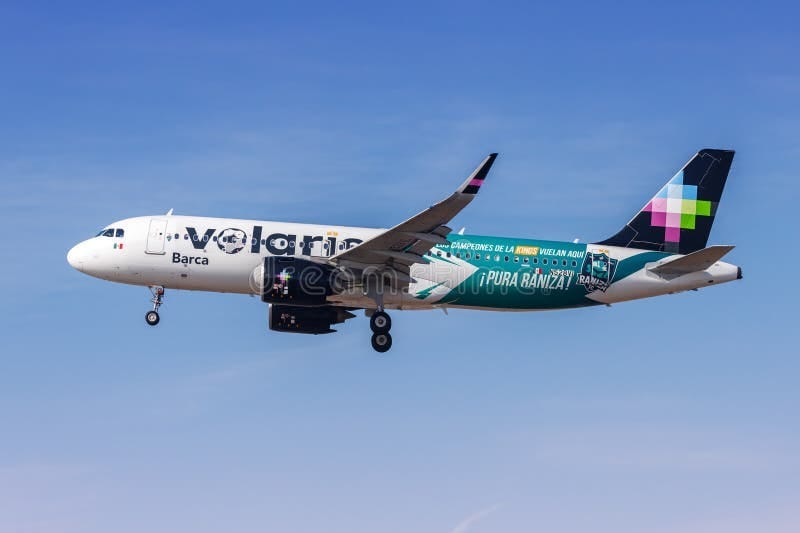
The company operates an entirely uniform fleet of Airbus A320-family narrowbodies.
This single-family approach reduces pilot training costs, parts inventory requirements, and maintenance complexity, all of which feed directly into the unit cost advantage that defines ULCC economics.
Financial Performance: Full Year 2025
Full-year 2025 revenue totaled $3,038 million, a 3% year-over-year decline from 2024.
The decline reflected a difficult year shaped by engine-related capacity constraints, softer cross-border demand in mid-year, and peso-dollar volatility that affected Mexican-denominated revenue when translated to US dollar reporting.
Volaris recorded total revenue per available seat mile (TRASM) of 8.41 cents for the full year, down 9% year-over-year. Cost per available seat mile (CASM) remained essentially flat at 8.04 cents, while CASM excluding fuel rose 4% to 5.58 cents.
Volaris Full Year 2025 Financial Snapshot (USD)
-----------------------------------------------
Total operating revenue:         $3,038 million
Total operating expenses:        $2,903 million
EBITDAR:                         $988 million
EBITDAR margin:                  32.5%
Net loss:                        $(104) million
Loss per ADS:                    $(0.91)
TRASM:                           $8.41 cents
CASM:                            $8.04 cents
CASM ex fuel:                    $5.58 cents
Avg economic fuel cost/gallon:   $2.59
EBITDAR of $988 million fell 13% versus 2024, and the EBITDAR margin compressed by 3.8 percentage points to 32.5%.
The bottom-line shift from modest profitability in 2024 to a $104 million net loss in 2025 reflects the compounded weight of engine-related capacity limitations, higher labor costs, and softer unit revenues in the middle of the year.
Fourth Quarter 2025 Performance
The fourth quarter produced a cleaner signal. Revenue rose 6% year-over-year to $882 million, and the company returned to modest profitability with net income of $4 million.
Q4 EBITDAR of $328 million essentially matched the prior-year quarter, and the EBITDAR margin reached 37.2%, a level consistent with the best quarters the company has ever produced. Available seat miles grew 6% to 9.4 billion, and booked passengers totaled 8.2 million, a 4.4% year-over-year increase.
Load factor for Q4 came in at 85.1%, down 2.2 percentage points from Q4 2024. The dilution in load factor largely reflects the addition of capacity ahead of demand during the seasonal transition and the incremental stretching of the network into newer secondary markets where stage-length dilution applies.
First Quarter 2026 Operating Trends
Volaris has not yet released Q1 2026 financial results, but preliminary traffic data through March 2026 shows total passengers of 7.75 million year-to-date, a 4.5% year-over-year increase. Total ASMs grew 2.3% to 8.94 billion, and RPMs grew 1.9% to 7.60 billion.
The consolidated load factor for Q1 2026 reached 85.0%, down 0.4 percentage points from the prior-year period. The more interesting split sits beneath the headline: domestic RPMs declined 3.4% in Q1 2026, while international RPMs grew 10.0%.
This divergence tells a clear story about the network’s direction in early 2026. The company is deliberately redeploying capacity from slower-growing domestic city pairs toward transborder US-Mexico and Latin American markets.
Ancillary Revenue: The Core Economic Engine
Ancillary revenue now represents the single most defining financial characteristic of the Volaris business model.
In Q4 2025, total ancillary revenue per passenger reached $56, a 1.6% year-over-year increase, and ancillaries accounted for 57.1% of total operating revenue.
For the full year, ancillary revenue per passenger averaged $60, up 6.1% year-over-year in Q4.
The fact that non-ticket revenue now exceeds ticket revenue per passenger places Volaris at the global front edge of the ULCC economic model, comparable only to Spirit, Frontier, Wizz Air, and a handful of Asian operators.
Volaris Ancillary Revenue Profile (2025)
----------------------------------------
Total ancillary revenue per pax (Q4):    $56
Ancillary share of total revenue:        57.1%
Year-over-year per-pax growth (Q4):      +1.6%
FY 2025 average per-pax ancillary:       ~$60
The VClub subscription membership operates as a recurring-revenue ancillary product that unlocks lower fares across the network for paying members.
This functions as a customer retention device and a cash-flow smoothing tool, two attributes that most ULCCs lack.
2026 Full-Year Outlook
Management has guided for approximately 7% ASM growth in 2026, an EBITDAR margin of roughly 33%, and capital expenditures of approximately $350 million. The guidance assumes an average USD/MXN exchange rate of 17.70 pesos and an average US Gulf Coast jet fuel price of $2.10 to $2.20 per gallon.
For Q1 2026 specifically, the company projected ASM growth of 3%, TRASM of 8.50 cents, CASM ex fuel of 6.00 cents, and an EBITDAR margin of 25%. The softer Q1 guidance acknowledges seasonality and the ongoing costs of the engine-related aircraft restoration process.
Capital expenditure of $350 million for 2026 reflects pre-delivery payments on fleet orders, spare engine acquisitions, and continuing investment in the Tijuana maintenance base. This level is broadly consistent with the company’s steady-state investment pattern in recent years.
Fleet: In-Depth Analysis
Fleet Size and Composition
Volaris ended 2025 with 155 aircraft, entirely drawn from the Airbus A320 family. The composition by variant provides a precise view of the company’s fleet engineering.
Volaris Fleet Composition (Year-End 2025)
-----------------------------------------
Aircraft type     | Count | Seats
Airbus A320ceo    |   43  |  179
Airbus A321ceo    |   10  |  228
Airbus A320neo    |   64  |  186
Airbus A321neo    |   38  |  238
TOTAL             |  155  |  ~199 avg
The NEO share of the fleet stood at 66% at year-end 2025, and 92% of aircraft were equipped with sharklet wingtip devices.
The average seating capacity across the fleet reached 199 seats per aircraft, a figure that has increased each year as the company has upgauged toward the larger A321neo variant.
Fleet Age and Generational Composition
The average fleet age sits at roughly 6.6 to 7 years, placing Volaris among the youngest fleets in the Americas. The company retired its last A319ceo aircraft and one A320ceo during Q4 2025, ending more than 15 years of A319 operations.
The retirement of the A319 matters more than a single airframe replacement would suggest. It eliminates the least-efficient variant from the fleet and standardizes the roster around two core families (A320 and A321) with two engine generations (CEO and NEO).
The remaining 43 A320ceo aircraft will exit the fleet progressively over the coming years as leases expire. The 10 A321ceo aircraft, which provide a 228-seat workhorse configuration, will continue to operate alongside newer variants until lease returns begin to take effect.
Aircraft Type Strategy: CEO to NEO Transition
The strategic migration from Current Engine Option (CEO) to New Engine Option (NEO) variants represents the most consequential fleet decision in the company’s history.
NEO aircraft offer approximately 15% better fuel efficiency and longer range, and they carry substantially lower per-seat trip costs when properly configured.
Volaris achieved a historic milestone as the first North American operator of the A320neo in September 2016. Since then, NEO share has climbed from 1% in 2016 to 9% in 2017, 28% in 2019, 45% in 2021, 59% in 2023, 60% in 2024, and 66% by year-end 2025.
Within the NEO portion of the fleet, the company operates two variants: the A320neo (186-seat configuration) and the A321neo (238-seat configuration).
The A321neo has become the preferred growth aircraft for higher-density trunk routes and thin long-haul operations where the 50 additional seats versus the A320neo materially improve trip economics.
A321neo as the Strategic Growth Platform
The A321neo matters to Volaris for reasons beyond seat count. The variant’s extended range allows operations from interior Mexican airports to deeper US destinations and to South American cities without the need for wide-body equipment.
In 2023, Airbus disclosed that Volaris had signed a purchase agreement for 25 A321neo aircraft, part of a broader Indigo Partners-affiliated order backlog.
With 38 A321neos already in service at the end of 2025 and 115 A321neo aircraft still on order at the end of 2024, the A321neo will likely become the single largest variant in the fleet by the late 2020s.
Volaris A321neo Strategic Role
------------------------------
Seat count:                       238
Role:                             High-density trunk routes
                                  Thin long-haul transborder
                                  Peak-season capacity lift
Range advantage vs. A320neo:      +~1,200 nautical miles (approx.)
Trip-cost dilution vs. A320neo:   ~5-10% lower CASM
Base cabin layout:                Single class, high-density
The company has also reportedly received aircraft directly from Airbus’ Mobile, Alabama final assembly line, which provides a US production pathway that affects import logistics and financing structures.
GTF Engine Crisis and Fleet Availability
The single most disruptive fleet issue Volaris has faced in recent history is the Pratt & Whitney GTF engine recall program. The PW1100G geared turbofan engines powering A320neo and A321neo aircraft require mandatory inspections for a potential powder metal turbine disc defect.
At the beginning of 2025, Volaris had more than half its NEO-fleet engines subject to the inspection program, and it averaged more than 30 Airbus jets out of service throughout much of the year. Out-of-service aircraft peaked at 41 in January 2026 before falling to a projected 25 by year-end 2026.
The airline has managed the issue through a compensation agreement with Pratt & Whitney in place since December 2023. The arrangement covers most of Volaris’ fixed costs associated with grounded aircraft but does not compensate for lost revenue opportunities.
CEO Enrique Beltranena has described the operational response: leasing additional aircraft, extending existing leases, purchasing spare engines, and boosting utilization of flyable airframes.
The company has deliberately avoided using wet-lease or ACMI arrangements with foreign operators, preserving its internal operational control at the cost of capacity flexibility.
Fleet Plan Through 2027 and Beyond
The fleet plan through 2027 is driven by two parallel curves: new A320neo and A321neo deliveries arriving from Airbus and Mobile, and progressive retirement of remaining A320ceo aircraft.
With 115 A321neos and 24 A320neos in the firm order backlog at year-end 2024, the forward fleet plan skews heavily toward the larger A321 variant.
By 2030, under current order intake and retirement curves, the Volaris fleet is likely to exceed 200 aircraft, of which more than 70% will be A321neo variants. Seating capacity per aircraft will rise meaningfully above the current 199-seat average as this mix shift plays out.
Volaris Forward Fleet Plan (Indicative)
---------------------------------------
Year-End 2025:   155 aircraft | 66% NEO | ~199 seats avg
2026 (plan):     ~7% ASM growth capacity trajectory
2027-2028:       Continued A320ceo retirements
                  Accelerated A321neo deliveries
Long-term mix:   A321neo dominant, A320neo secondary
The fleet’s uniformity around a single OEM and family is a structural advantage that merger economics with Viva Aerobus will compound, since Viva also operates an all-A320-family fleet.