


Dear Readers, Welcome to AviationOutlook.
Let’s analyze the topic in detail.
Executive Summary
Volotea closed 2025 with record financials: roughly €840 million in revenue, EBITDA above €190 million, and an EBIT margin of 8.5%-9%, more than doubling the prior year’s operating profit while consolidating its position as Europe’s most reliable low-cost carrier.
The carrier operates an all-Airbus fleet of 41 A319 and A320 aircraft today, with a clearly stated plan to scale to 45-46 aircraft in 2026 and to deploy approximately 14 million seats across 430+ routes (over half of them exclusive) connecting 110 small and mid-sized European cities.
Two new operating bases come online in 2026, Limoges (February) and Montpellier (November), bringing the total to 21 European bases and reinforcing France as Volotea’s largest market (60% of operations).
Shareholder structure was refreshed with a €71 million capital raise completed in March 2026, with Aegean Airlines crossing 20% ownership, joined by PAR Capital and the Alaeo management vehicle, providing a long-runway balance sheet for the next growth chapter.
Recommended - Read Full Reports


Read All Reports
Table of Contents
Executive Summary
Introduction
Volotea Company Profile: Key Facts
Volotea Revenue and Financial Analysis
2024 Audited Performance: The Foundation Year
2025 Performance: The Inflection Year
Why the 2025 Margin Step-Up Happened
The Capital Structure: €71 Million Raise Completed March 2026
2026 Guidance and the Forward Earnings Power
Revenue Mix and Key Services
Volotea Fleet Analysis
Fleet Size and Composition
Fleet Age and Mid-Life Strategy
Fleet Strategy: Sourcing Replacements
Cabin Product
IATA Operational Safety Audit Status
The Electric and Hydrogen Fleet Bet
Volotea Route Network Strategy
The Point-to-Point Underserved-City Doctrine
Geographic Distribution
Route Selection Criteria
Island Connectivity as a Strategic Pillar
Major Destinations
Network Exclusivity Premium
Major Operational Bases (Hubs)
The 21-Base Network in 2026
France: 12 Bases and 60% of Operations
The Limoges Base: February 2026 Launch
The Montpellier Base: November 2026 Launch
Italy: 6 Bases and 22 Routes from Naples Alone
Spain: Asturias and Bilbao Anchor the Home Market
Base Performance Hierarchy in 2025
Volotea Competitive Position
Major Competitors in European Low-Cost Aviation
Volotea vs Vueling
Volotea vs Ryanair
Volotea vs easyJet
Volotea vs Transavia
Volotea vs Iberia Express
Volotea’s Differentiated Position: The Summary
Strategic Partnerships and Alliances
Aegean Airlines: From Commercial Partner to Lead Shareholder
ITA Airways: Bilateral Codeshare from April 2026
Abra Group: Transatlantic Joint Venture
Sustainability: The Voloterra Programme
CO2 Reduction Track Record
Sustainable Aviation Fuel Adoption
Network Design as a Sustainability Lever
Direct Air Capture Partnership: 280 Earth
Awards and Industry Recognition
Operational Performance Deep Dive
On-Time Performance and Reliability
Customer Satisfaction (Net Promoter Score)
Load Factor Discipline
Volotea’s 2026 Outlook and Beyond
Headline 2026 Plan
Forward Strategic Themes for 2026-2028
Long-Range Considerations
Key Risks
Risk 1
Risk 2
Risk 3
Risk 4
Risk 5
Risk 6
Risk 7
Risk 8
Risk 9
Risk 10
My Final Thoughts
Official Sources and Data
Introduction
Volotea operates an aviation business model that does not look like its peers.
It’s neither a high-volume ultra-low-cost machine like Ryanair, nor a hybrid network feeder like Vueling.
It’s a focused point-to-point operator stitching together secondary and tertiary European cities that the majors largely ignore, and in 2026 that contrarian focus is paying off in a way few European carriers can match.
In this in-depth analysis report, you will see how a 41-aircraft, all-Airbus fleet generated EBIT growth of more than 100% in a single year, how the airline secured 60% market share of France’s regional connectivity, and why Aegean Airlines doubled down on its stake during 2025-2026.
You will also see the operational pillars (a 99.7% completion rate, a 90% load factor, and 79% on-time performance) that explain why Skytrax and the World Travel Awards keep handing the same low-cost trophies to a Barcelona-based airline most travellers outside continental Europe have never flown.
This report walks through Volotea’s financials, fleet, network, operating bases, competitive positioning, sustainability roadmap, and the principal risks that could disturb the trajectory.
This report is for industry stakeholders who need a precise picture of where Volotea stands at the midpoint of 2026 and where it’s heading next.
Let’s get started.
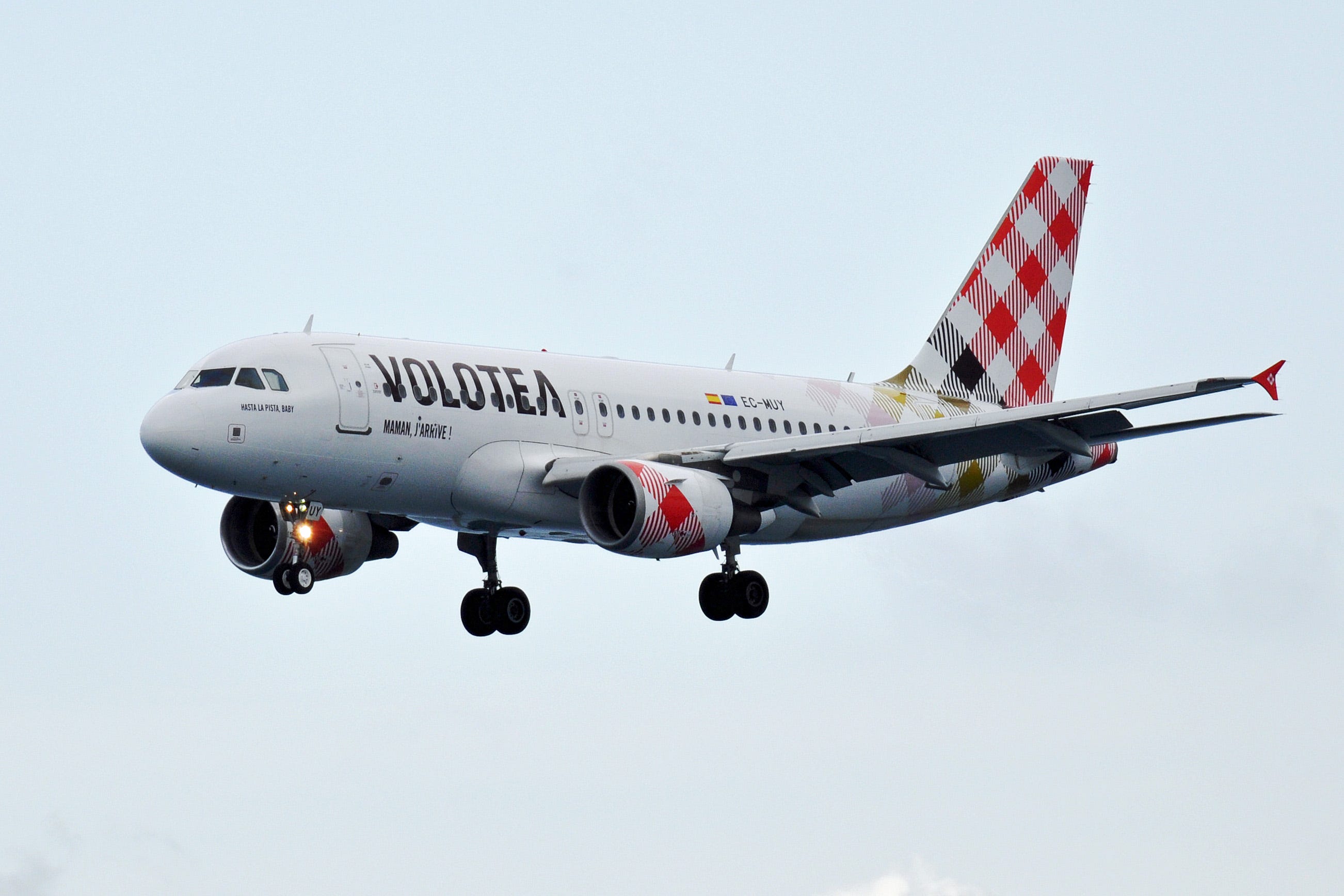
Volotea Company Profile: Key Facts
The carrier’s identity is best understood through the founders, the location, and the operating philosophy that has remained constant since the first flight on 5 April 2012.
COMPANY PROFILE
------------------------------------------------------------
Legal name:               Volotea, S.L.
Registered office:        Castrillón (Asturias), Spain
Corporate headquarters:   Travessera de Gràcia 56, 4ª,
                          08006 Barcelona, Spain
Founded:                  2011 (first flight April 5, 2012)
Founders:                 Carlos Muñoz and Lázaro Ros
                          (previously founders of Vueling)
CEO:                      Carlos Muñoz (Founder & CEO)
COO:                      Eduard Diviu
ESG Director:             Gloria Carreras
Chief People Officer:     Mónica Allés
Employees:                ~2,250
Fleet (June 2026):        41 Airbus aircraft (17 A319, 24 A320)
                          Target: 45-46 by year-end 2026
Operating bases:          21 across Spain, France, Italy
Network reach:            110 airports, 17 countries, 430+ routes
2025 passengers:          ~11.3 million
Cumulative passengers:    80 million (since 2012)
IATA / ICAO codes:        V7 / VOE
Callsign:                 VOLOTEA
2024 revenue:             €811 million
2025 revenue (forecast):  ~€840 million
The corporate domicile in Asturias and the operational headquarters in Barcelona were deliberate choices.
Asturias gave Volotea its initial AOC and government support; Barcelona placed the airline at the heart of Europe’s leisure traffic flow, with proximity to maintenance providers and the labour market that founders Muñoz and Ros knew intimately from their Vueling years.
Carlos Muñoz continues to run the company he co-founded, an unusual constancy in European aviation.
After taking Vueling public in 2006 and seeing it absorbed into IAG, Muñoz raised capital in 2009 and launched Volotea in 2011 with a single thesis: Europe’s small and mid-sized cities are systematically underserved on a point-to-point basis, and there is room for a profitable operator that owns that niche rather than trying to compete head-on with Ryanair on London or Madrid trunk routes.
That thesis is still the strategic foundation in 2026.
The airline does not chase Frankfurt-London or Madrid-Paris density.
It chases routes like Nantes-Verona, Bordeaux-Naples, or Florence-Strasbourg, where it can be the only direct operator and where price elasticity is dominated by leisure and visiting-friends-and-relatives demand.
Volotea Revenue and Financial Analysis
2024 Audited Performance: The Foundation Year
Volotea’s 2024 financial year was the platform on which the 2025 outperformance was built. The carrier closed 2024 with total revenue of €811 million, a 17% jump from the €694 million reported in 2023.
The far more impressive line was EBITDA, which expanded to €148 million from €96 million the year before. That is a 54% increase, translating into an 18% EBITDA margin in an industry where European low-cost margins typically sit in the low double digits.
Operating profit (EBIT) reached €33.5 million in 2024, a number that is small in absolute terms but materially positive after years of investment-mode losses.
The combination of capacity discipline (only modest seat growth), a stable cost structure, and pricing strength in exclusive markets did the heavy lifting.
2025 Performance: The Inflection Year
The carrier’s October 2025 guidance, subsequently confirmed by its February and March 2026 results communications, places 2025 revenue at approximately €840 million, a 4% year-on-year increase.
EBITDA was projected above €190 million, up 29% versus 2024, with an EBITDA margin in the 22-24% range. That is roughly five percentage points higher than 2024 and places Volotea among the most profitable airline operators in Europe on an EBITDA-margin basis, regardless of business model.
Operating profit was guided to €70-80 million for 2025, more than double the €33.5 million achieved in 2024. The implied EBIT margin of 8.5%-9% is the airline’s highest since launch in 2011.
KEY FINANCIAL TRAJECTORY (€ millions)
---------------------------------------------------------
                          2023      2024      2025 (est.)
---------------------------------------------------------
Total revenue              694       811        ~840
EBITDA                      96       147.2      >190
EBITDA margin             ~13.8%    ~18%       22-24%
EBIT                       n/a       33.5       70-80
EBIT margin                n/a       ~4.1%     8.5-9%
Passengers (millions)    ~10.7      11.5       11.3
Seat capacity (millions)  ~12.6     ~12.6      12.7
---------------------------------------------------------Why the 2025 Margin Step-Up Happened
Three drivers explain the operating-profit doubling between 2024 and 2025.
First, capacity restraint. Volotea grew seats only around 1% in 2025 (12.7 million versus 12.6 million in 2024) while routes remained at roughly 420. That allowed average fares and ancillary spend per passenger to rise faster than unit costs.
Second, network mix. The proportion of exclusive routes (routes on which Volotea is the only direct operator) crossed 50% in 2025. Exclusive routes price at a premium and absorb fuel-cost shocks better than routes shared with Ryanair or easyJet.
Third, operational reliability. A 99.7% flight completion rate drove down EU261 compensation claims, hotel re-protection costs, and crew disruption pay, all of which had inflated 2023-2024 operating expense lines across the European low-cost sector.
The Capital Structure: €71 Million Raise Completed March 2026
Volotea launched a capital-raise plan in September 2024 originally sized at up to €100 million. Strong 2025 performance meant the company drew down less than planned. The final tranche of €15 million closed in March 2026, bringing the total raised to €71 million.
The principal subscribers were Aegean Airlines (Greece), PAR Capital (a US fund specialised in aviation investments), Alaeo (the holding vehicle representing CEO Carlos Muñoz and the senior management team), and a smaller cohort of pre-existing European shareholders.
Aegean’s stake crossed 20% with this final round, formalising it as Volotea’s largest single external shareholder.
The strategic significance for an industry stakeholder reading this report is twofold.
Aegean’s deeper involvement signals integration potential between the two carriers (notably for Mediterranean and Greek-island connectivity), and PAR Capital’s continued participation indicates institutional investor conviction in the model.
2026 Guidance and the Forward Earnings Power
For 2026, Volotea has guided to around 14 million seats (+12% versus 2025), more than 80,000 flights, and approximately 430 routes. CEO Carlos Muñoz has framed 2026 as the year in which the airline can grow above 10%, “limited only by the number of aircraft available.”
That last phrase is critical. Volotea is fleet-constrained, not demand-constrained. With 45-46 aircraft expected by year-end 2026, the airline can capture meaningfully more market share in its existing geographies.
Below that growth rate, additional A319 or A320 aircraft would need to be sourced on the secondary lease market, which the airline has been actively scouting since 2024 (see Fleet Analysis below).
Revenue Mix and Key Services
Volotea generates revenue through three main streams.
Ticket revenue remains the dominant line, supported by a yield-management system tuned to small-market dynamics with limited or no direct competition. Average ticket prices are typically lower than legacy carriers operating the same city pair via a hub, but higher than Ryanair on competitive segments.
Ancillary revenue covers seat selection, baggage fees, priority boarding, and an in-flight catering programme. Volotea publishes its ancillary catalogue transparently on its booking flow.
The Megavolotea subscription programme is the third lever and Volotea’s most distinctive ancillary product.
For €39.99 per year (Megavolotea) or €159.99 per year (Megavolotea Plus), members get discounts on every fare, free seat selection, and other perks.
The programme passed 200,000 subscribers in late 2023 and continues to grow; among Megavolotea members in 2025, the Net Promoter Score reached 56.8 versus the all-customer NPS of 48.6, indicating powerful retention economics.
THE MEGAVOLOTEA STACK
---------------------------------------------------------
Megavolotea          €39.99/year   ~€10 discount per
                                   booking, free seat
                                   selection (limited),
                                   sale-day priority
Megavolotea Plus    €159.99/year   30% off all fares,
                                   advanced seat
                                   selection, dedicated
                                   support
NPS impact 2025:    +8 points over baseline customer NPS
Recommendation:     93% (Megavolotea) vs 90% (overall)
---------------------------------------------------------
The subscription model creates a recurring high-margin revenue stream that is largely uncorrelated with seasonal traffic, and that is one of the under-appreciated reasons Volotea’s EBITDA margin overshot consensus in 2025.