


Executive Summary
WestJet operates a fleet of 192 aircraft built around a Boeing 737 family backbone, seven Boeing 787-9 Dreamliners for widebody long-haul, and 39 De Havilland Dash 8-400 turboprops operated by WestJet Encore for regional feed.
Calgary International Airport (YYC) has been formally designated the carrier’s exclusive global connecting hub, and reached its 100th non-stop destination in early 2026 with the announcement of a Calgary to São Paulo route.
A 25% minority equity stake held by Onex Partners funds closed in October 2025 to a consortium of Delta Air Lines (12.7%), Korean Air (10%) and Air France-KLM (2.3%), opening unprecedented commercial and network opportunities.
In 2025, the airline carried 22.6 million guests on 215,397 flights serving 139 destinations, and is adding eight new transatlantic routes and four new domestic routes for the summer 2026 schedule.
Recommended - Read Full Reports


Read All Reports
Table of Contents
Executive Summary
Introduction
Key Facts: Company Profile
Business Overview
Corporate Structure and 2025–2026 Ownership Reset
Leadership and the Von Hoensbroech Era
Revenue, Scale and Operating Performance
Revenue Growth Drivers
Key Services and Products
WestJet Fleet: In-depth Analysis
Fleet Size and Composition
Fleet Age
Aircraft Type Strategy and Configuration
Boeing 737-8 MAX: The Strategic Cornerstone
Boeing 737-800 NG and 737-700 NG: The Existing Narrowbody Backbone
Boeing 787-9 Dreamliner: The Widebody Strategic Weapon
Boeing 737 MAX 10: The Future Backbone
De Havilland Dash 8-400 (Q400): The Regional Lifeline
Fleet Strategy Through 2030
Route Network, Major Destinations and Strategy
Network Overview
Domestic Network Strategy: Owning the West
Transborder Strategy: Calculated Retreat and Targeted Growth
International Strategy: Transatlantic Leisure at Narrowbody Economics
Long-haul Dreamliner Strategy from Calgary
Nordic and Azores Gateway Routes from Western Canada
Sun Country and Leisure Network
Major Operational Bases (Hubs)
Calgary International Airport (YYC): The Exclusive Global Connecting Hub
Calgary Operational Infrastructure
Toronto Pearson International Airport (YYZ): Secondary Strategic Hub
Vancouver International Airport (YVR): Pacific Gateway
Edmonton International Airport (YEG): Operational Secondary Base
Halifax Stanfield International Airport (YHZ): Atlantic Gateway to Europe
Competitive Position
Major Competitors
WestJet vs. Air Canada
WestJet vs. Porter Airlines
WestJet vs. Flair Airlines
WestJet vs. Air Transat
Airline Partnership Context
Other Key Strategic Dimensions
Leisure Travel Strategy Post Sunwing Integration
Cabin Densification, Reversal and Product Strategy
Starlink Wi-Fi and Connected Cabin
Labour Relations
Sustainability Profile
Economic Impact Footprint
Key Risks with Probabilities and Scenarios
Risk 1: Boeing 737 MAX 10 Certification Delay
Risk 2: Pilot Contract Dispute
Risk 3: Sao Paulo and Long-haul Dreamliner Route Economics
Risk 4: Canadian Domestic Competitive Intensity
Risk 5: Fuel Price Shock
Risk 6: IPO Market Reception
Risk 7: Weather and Operational Disruption
Risk 8: Geopolitical Impact on Long-haul Flying
My Final Thoughts
Official Sources and Data
Introduction
Canada’s second-largest airline is in the middle of its most consequential strategic reset since its founding in 1996.
With the Sunwing integration completed, a new international ownership consortium in place, and a fleet growing toward 200 aircraft, WestJet is behaving less like a regional low-cost disruptor and more like a globally ambitious network carrier anchored in Calgary.
This report examines how the airline is reconfiguring its fleet, route network, hub architecture, and competitive position heading through 2026, with a focus on the operational and strategic questions that matter most to aviation stakeholders.
Key Facts: Company Profile
Legal entity:            WestJet Airlines Ltd. / The WestJet Group
Headquarters:            Calgary, Alberta, Canada
Founded:                 February 1996 (first flight)
IATA / ICAO / Callsign:  WS / WJA / WESTJET
Chief Executive Officer: Alexis von Hoensbroech (since Feb 2022)
Ownership:               Onex Partners (majority)
                         Delta Air Lines (12.7%)
                         Korean Air (10%)
                         Air France-KLM (2.3%)
Fleet size:              ~192 aircraft (mainline + Encore)
Employees:               ~14,000+ (post-Sunwing integration)
2024 revenue:            ~C$7.3 billion
2025 passengers:         22.6 million
Global hub:              Calgary (YYC)
Regional subsidiary:     WestJet Encore
Leisure vacation arm:    WestJet Vacations + Sunwing Vacations
The carrier’s business scope today is far broader than the regional low-cost carrier it was in the early 2000s.
It’s now a full-service network airline operating transborder, Caribbean, Mexico, transatlantic, and trans-Pacific services, a regional turboprop subsidiary, a leisure airline brand, and a tour operator that sells packaged holidays.
Business Overview
Corporate Structure and 2025–2026 Ownership Reset
The WestJet Group has been controlled by Toronto-based private equity firm Onex Corporation since a 2019 take-private transaction. The ownership picture became materially more interesting in 2025.
In October 2025, Onex Partners closed the sale of a 25% equity stake in the airline to a three-airline consortium made up of Delta Air Lines, Korean Air and Air France-KLM. Delta initially acquired the full 25% and then sold a 2.3% sliver to its SkyTeam joint-venture partner Air France-KLM.
Public reporting indicates Onex expects to take WestJet to public markets again roughly two years after closing, which would place a potential IPO window into late 2027. That return to public markets would make WestJet one of the most watched Canadian listings in years.
Leadership and the Von Hoensbroech Era
Alexis von Hoensbroech took over as CEO in February 2022 after leading Austrian Airlines through the pandemic.
He has reshaped the executive suite aggressively, appointing Samantha Taylor as Executive Vice-President and Chief Experience Officer in March 2025, and bringing in Marek Andryszak as President of Sunwing Vacations Group effective March 2026.
John Weatherill remains Executive Vice-President and Chief Commercial Officer, responsible for network planning, alliances, pricing and revenue management. He is the executive voice of most network announcements and is the architect behind Calgary’s positioning as a global connecting hub.
The von Hoensbroech playbook has three defining elements: own the west in Canada, use the 737 MAX 8 as a transatlantic narrowbody weapon, and monetize the leisure travel business as a structurally separate growth vector.
Revenue, Scale and Operating Performance
WestJet is a private company, so its detailed financials are not publicly available the way Air Canada’s are. However, its debt is rated and S&P Global has disclosed that the carrier generated approximately C$7.3 billion of revenue in calendar year 2024.
That revenue base is the result of a specific mix. Passenger revenue dominates, with ancillary revenue (bags, seat selection, premium upgrades, WestJet Rewards monetization, credit card co-brand economics and vacations packaging) accounting for a growing slice of the pie.
Reported revenue indicators (WestJet Group)
--------------------------------------------
2024 revenue (calendar)         ~C$7.3 billion
Fleet as of Mar 31, 2025        195 aircraft
2025 passengers carried         22.6 million
2025 flights operated           215,397
Destinations served (2025)      139
New routes launched in 2025     36 inaugural
The carrier’s network is aggressively scaling but the economics are still being rebalanced.
Industry reporting on Canadian airline finances shows that domestic yields have compressed as ultra-low-cost entrants exited and capacity was reabsorbed through 2025, while transatlantic leisure unit revenue has been a standout for WestJet’s summer seasons.
Revenue Growth Drivers
The first growth driver is the narrowbody-powered transatlantic leisure story. The Boeing 737 MAX 8’s extended range has allowed WestJet to profitably fly seasonal European routes that would have been uneconomic with a widebody.
This is enabling five new seasonal international destinations from Toronto and three new European routes from Halifax for summer 2026.
The second growth driver is the vertically integrated leisure business.
WestJet Vacations and the newly integrated Sunwing Vacations package hotel content, ground handling, transfers and flights on WestJet-operated metal. This is an attractive ancillary margin pool that pure-play network carriers cannot replicate.
The third driver is the Dreamliner long-haul layer.
The 787-9 fleet is concentrated on high-value routes such as Calgary to London Heathrow, Paris Charles de Gaulle, Tokyo Narita, plus premium sun-country flying where the airline can sell 16 lie-flat business class seats and 28 premium economy seats at substantially higher unit revenue.
Key Services and Products
Scheduled passenger transportation is the core business. Cabin classes include standard Economy, Extended Comfort / Premium Economy, and on 787-9 aircraft, Business Class with lie-flat seating.
The airline also operates WestJet Cargo, which leverages belly capacity on both narrowbody and widebody flights. The Sao Paulo expansion explicitly mentions widebody belly-cargo capacity as a secondary rationale, since perishables and pharmaceutical shipments between Canada and Brazil are commercially attractive.
The WestJet Rewards program was restructured in 2025, adding the ability to earn tier qualifying spend on cabin upgrades and on carrier partners, and expanding complimentary upgrade eligibility for Platinum, Gold and Silver members as of January 15, 2025.
WestJet Rewards tier structure
------------------------------
Teal        Entry (no spend threshold)
Silver      Annual spend target, status perks
Gold        Elevated earning, upgrade priority
Platinum    Top tier, best upgrade priority
WestJet’s RBC co-branded credit card ecosystem is a meaningful ancillary revenue pool.
According to the airline’s own disclosures, World Elite Mastercard cardholders saved an average of C$585 on their second ticket using their companion voucher benefit in 2025.
WestJet Fleet: In-depth Analysis
Fleet Size and Composition
WestJet’s fleet at the start of 2026 stands at 192 aircraft, though the number fluctuates weekly as deliveries, redeliveries and line maintenance moves occur.
S&P Global Ratings disclosed a fleet of 195 aircraft as of March 31, 2025, and WestJet confirmed that it supports nearly 200 aircraft with 14,000+ employees following the Sunwing integration.
The composition, drawing from WestJet’s own aircraft page and cross-checked with industry sources:
WestJet Group fleet composition (April 2026, approx.)
-----------------------------------------------------
Boeing 737-8 MAX          55 aircraft (mainline)
Boeing 737-800 NG         55 aircraft (mainline)
Boeing 737-700 NG         36 aircraft (mainline)
Boeing 787-9 Dreamliner    7 aircraft (mainline, long-haul)
De Havilland Dash 8-400   39 aircraft (WestJet Encore)
Total                    ~192 aircraft
This is a two-family fleet architecture.
The vast majority of operations run on a single Boeing 737 type rating, with a small Dreamliner long-haul sub-fleet and a turboprop regional subsidiary filling in the geography the mainline cannot profitably serve.
Fleet Age
WestJet describes its overall fleet as having an average age under 10 years, which is young for an established North American carrier. The 787-9 sub-fleet has an average age of 6.1 years, with deliveries between January 2019 and September 2022.
The 737 MAX 8 fleet is even newer on average. The Boeing 737-700 NG is the older segment, with tails that have been flying for over a decade, and is a natural candidate for eventual replacement as MAX 10 deliveries ramp up.
This young fleet profile matters for three reasons: lower fuel burn, lower maintenance cost per block hour, and stronger residual values that support sale-leaseback financing decisions.
Aircraft Type Strategy and Configuration
Boeing 737-8 MAX: The Strategic Cornerstone
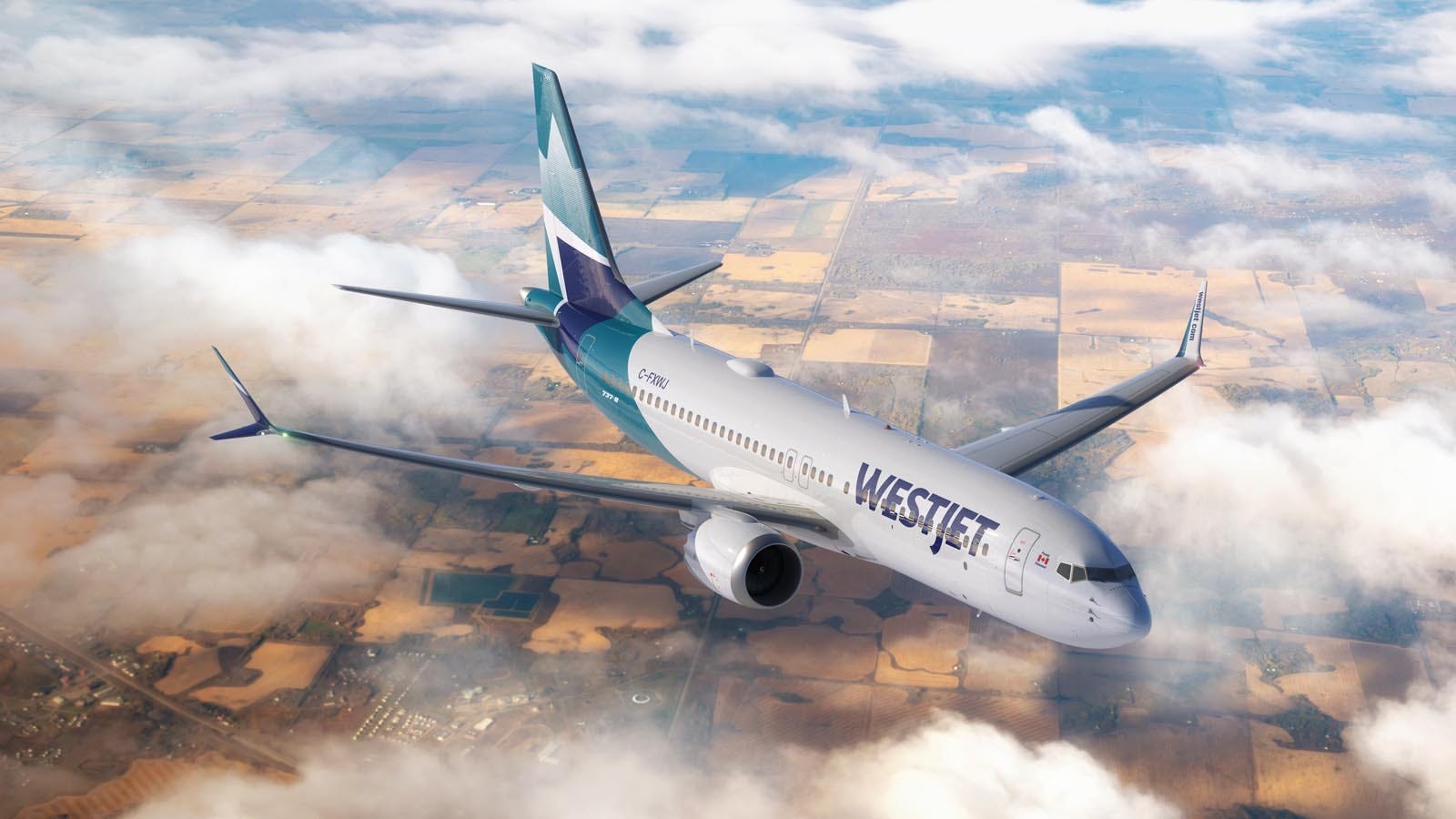
The Boeing 737-8 MAX is the single most important aircraft type in the WestJet Group. The airline describes it as the cornerstone of the expanding fleet and calls out a 13% fuel efficiency gain over its direct predecessor.

The MAX 8 has a stated range of 6,480 km in WestJet configuration, which is the single fact that makes the summer 2026 transatlantic expansion economically viable.
It allows narrowbody flights from Halifax to Madrid, Lisbon and Copenhagen, from Toronto to Glasgow, Cardiff and Ponta Delgada, and from Edmonton and Winnipeg to Reykjavik.
Boeing 737-8 MAX at WestJet
---------------------------
Fleet size            55 (mainline) + firm MAX 8 orders
Seats                 174-189 depending on configuration
Cabin                 Economy, Premium
Range                 6,480 km
Role                  Domestic, transborder, sun, seasonal EU
Seat configurations have been a sensitive topic.
After passenger backlash over densification on 737-800s and earlier MAX 8 deliveries, WestJet began reversing the extra row of seats and is settling on configurations between 174 and 189 seats.
Boeing 737-800 NG and 737-700 NG: The Existing Narrowbody Backbone
The 737-800 NG still represents 55 aircraft and handles a very large share of the transborder and sun-country flying. With a 5,667 km range and the same 174-189 seat envelope, it shares commonality with the MAX 8 at the flight-deck level, which is operationally valuable.
The 737-700 NG, at 36 aircraft, is the smaller-gauge narrowbody workhorse. With 132 seats and a 6,115 km range, it handles thinner domestic markets where trip length and load factor make smaller gauge economics more favorable. These are the oldest mainline tails and will be progressively retired.
Boeing 787-9 Dreamliner: The Widebody Strategic Weapon
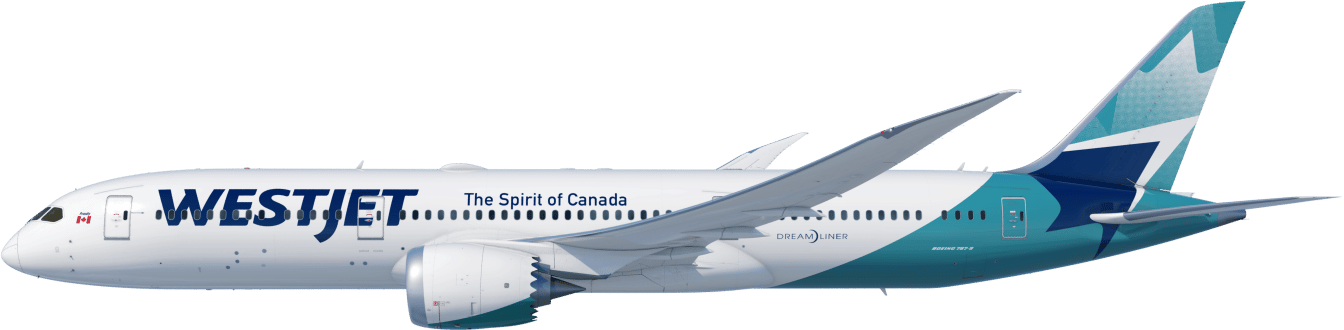
The Dreamliner sub-fleet is small but strategically outsized. WestJet operates 7 aircraft, configured with 320 seats across three cabins: 16 lie-flat business seats (1-2-1), 28 premium economy seats (2-3-2), and 276 economy seats (3-3-3).
With a range of 14,140 km, the 787-9 can reach any city WestJet cares about. Its regular long-haul routes include Calgary to London Heathrow, Paris Charles de Gaulle and Tokyo Narita, with the Calgary to São Paulo route starting November 2026 marking its 100th non-stop destination and, at 14 hours, the airline’s longest flight.
Boeing 787-9 Dreamliner at WestJet
----------------------------------
Fleet size            7 (firm orderbook expanded to 9)
Total seats           320
Business Class        16 lie-flat (1-2-1)
Premium Economy       28 (2-3-2)
Economy               276 (3-3-3)
Range                 14,140 km
In February 2026, WestJet converted six 737 MAX 10 orders into two additional Boeing 787-9 Dreamliners, taking the firm 787-9 orderbook from 7 to 9 aircraft with 4 additional options, meaning the Dreamliner fleet could eventually reach 20 aircraft if all options convert.
Boeing 737 MAX 10: The Future Backbone
WestJet is one of the largest publicly disclosed customers for the Boeing 737 MAX 10 variant. The airline placed an order for 60 firm MAX 10s with 25 options, and despite the six-unit conversion to 787-9s, it retains a substantial MAX 10 commitment.
The airline confirmed in early 2026 that it still expects first delivery in Q4 2026, contingent on Boeing’s certification timeline.
WestJet has already backed away from a 212-seat densified MAX 10 configuration in response to customer feedback, settling on a 199-seat layout with four lavatories and a 12-seat premium cabin.
De Havilland Dash 8-400 (Q400): The Regional Lifeline
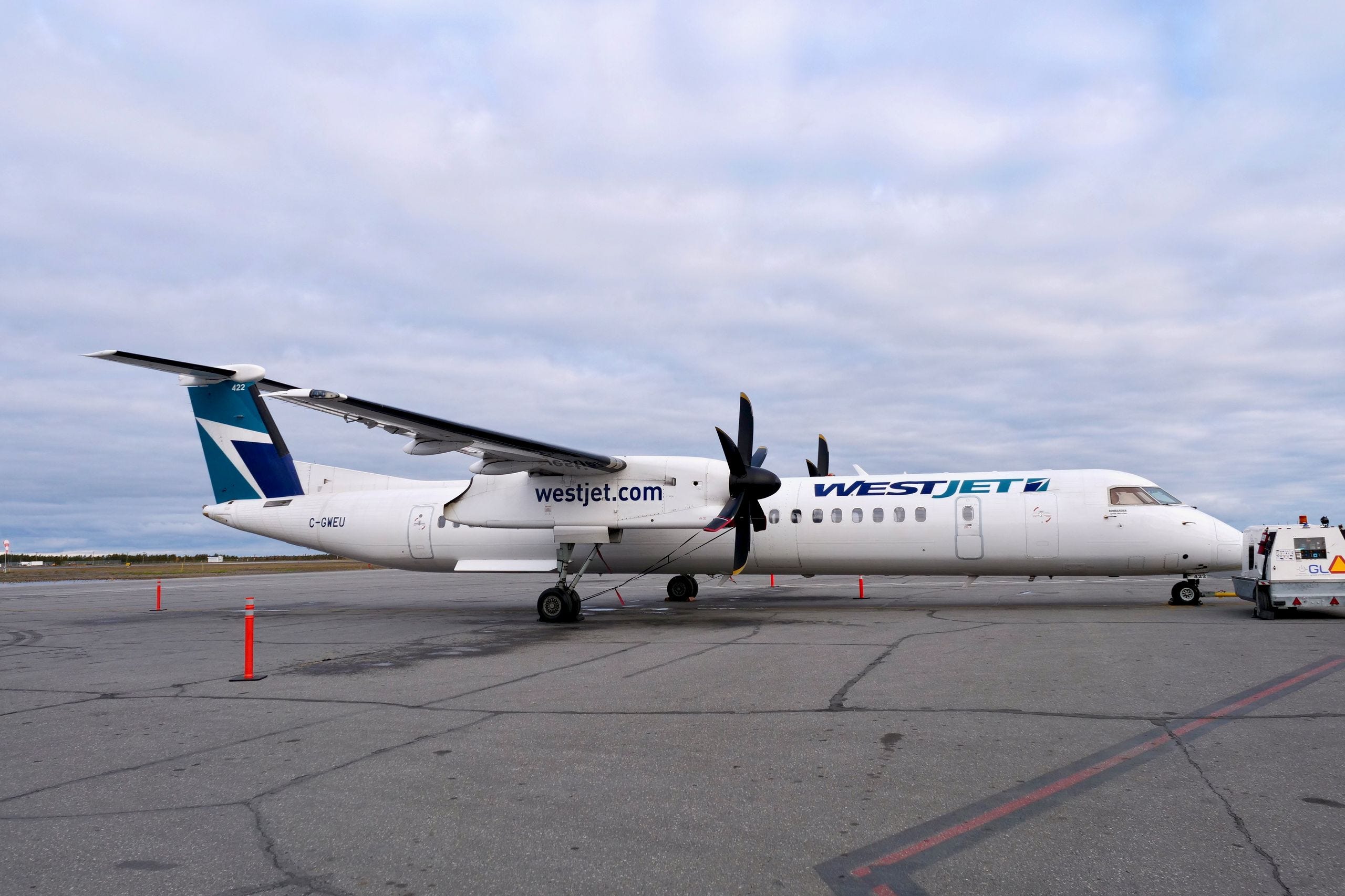
The Dash 8-400 fleet, operated by WestJet Encore, numbers 39 aircraft with 78 seats each and a 2,040 km range.
These turboprops connect thinner regional points (such as Campbell River, Terrace, North Bay and Sault Ste. Marie) to the jet network through Calgary and other major bases.
The type’s appeal is simple: it is the highest-capacity turboprop on the market, and on sectors under two hours it has materially lower unit costs than a regional jet. The Q400 also enables WestJet to serve communities where the runway or demand profile does not support 737 operation.
Fleet Strategy Through 2030
The fleet strategy has five interlocking components.
First, continue to concentrate on a simplified two-type mainline fleet (737 family and 787-9) to maximize pilot, engineering and spares commonality. This is a direct contrast to Air Canada’s more fragmented fleet with multiple Airbus, Boeing and Embraer sub-fleets.
Second, pivot narrowbody growth toward the MAX 8 and MAX 10, retiring the older 737-700s progressively. The MAX 10 brings capacity up toward 200 seats per aircraft while preserving commonality.
Third, double down on the 787-9 as the long-haul platform. With 9 firm and up to 11 options, the Dreamliner is WestJet’s answer to Air Canada’s widebody dominance, but focused on Calgary-anchored routes rather than trying to duplicate Air Canada’s global network.
Fourth, maintain the Encore Dash 8-400 fleet for regional feed. There is no current indication of a Q400 replacement program, which suggests the airline expects the type to remain operationally valuable well into the 2030s.
Fifth, continuously refresh the cabin product. A new standard 180-seat economy cabin with 30 inch pitch is being rolled out, along with new premium seating options and Starlink Wi-Fi installations across the 737 family.