


Dear Readers, Welcome to AviationOutlook.
Let’s analyze today’s topic in detail.
The fireball that engulfed Launch Complex 36 at Cape Canaveral on the evening of May 28, 2026, did more than destroy a single rocket. It rippled through a carefully constructed timeline that connects Jeff Bezos’ satellite ambitions to the in-flight Wi-Fi plans of Delta Air Lines.
For Delta, which placed a major strategic bet just two months earlier on Amazon’s low-Earth-orbit broadband network (instead of Starlink) for 500 of its aircraft, the explosion raises a fundamental question.
Can the supply chain that promises gigabit-speed connectivity at 35,000 feet actually deliver on its 2028 commitments?
This is not a hypothetical concern anymore.
The collision of two parallel programs, Delta’s next-era connectivity rollout and Amazon Leo’s race to meet a federal regulatory deadline, now hinges on how quickly Blue Origin can rebuild what was its “only operational orbital launch pad”.
This in-depth analysis examines what aviation industry stakeholders should understand about the cascade of dependencies created by the incident, the realistic timeline pressures facing Delta’s program, and the strategic recalibration that may be necessary across the airline’s connectivity roadmap.
QUICK-REFERENCE FACT SHEET

Event:        Blue Origin New Glenn static-fire anomaly
Date:         Thursday, May 28, 2026, ~9:00 p.m. EDT
Location:     LC-36, Cape Canaveral Space Force Station
Planned use:  LN-01 mission with 48 Amazon Leo satellites
Payload:      Not yet integrated; satellites remained off-pad
Delta deal:   Announced March 31, 2026
Aircraft: 500 initial, with installation beginning 2028Recommended - Read Full Reports


Read All Reports
The Incident at LC-36: What Actually Happened
Just before 9 p.m. EDT on May 28, Blue Origin technicians began a routine static fire test of a New Glenn rocket.
The vehicle was being prepared for the LN-01 mission, scheduled for as soon as June 4, which would have been the first of 48 Amazon Leo satellites to ride on New Glenn.
Instead of a controlled engine burn, the rocket erupted in a massive fireball.
Fortunately, all personnel were safely outside the hazard zone, and the satellite payload had not yet been transported from its processing facility to be mated with the launch vehicle.
In a post on social media, Jeff Bezos called it a “very rough day” but pledged the company would rebuild whatever needed rebuilding and return to flight.
The damage assessment, however, indicates the setback is structural, not just symbolic.
Initial reporting from the Cape suggests at least one lightning protection tower was destroyed, the transporter erector was lost, and ground support equipment sustained heavy damage.
The Eastern Range remained mission-capable for other launches, but LC-36 is Blue Origin’s only orbital launch facility, which means no New Glenn can fly until the pad is restored.
PAD DAMAGE INVENTORY (preliminary, as of June 2, 2026)

- New Glenn vehicle:        Total loss
- Transporter erector:      Destroyed
- Lightning towers:         At least one destroyed
- Ground support equipment: Heavy damage
- Concrete pad surface:     Significant impact damage
- Personnel injuries:       Zero reported
The FAA confirmed that because the test was outside the scope of FAA-licensed launch activities and did not affect air traffic, it would not trigger a new federal investigation.
Blue Origin will lead the root cause analysis itself, while the company simultaneously assesses pad reconstruction needs.
Why This Matters for Delta: The Connection Few Outside Aviation Have Made
On March 31, 2026, Delta Air Lines and Amazon announced a multi-year agreement to deploy Amazon Leo connectivity on 500 Delta aircraft beginning in 2028.
The deal extends an existing relationship between Delta and AWS, and it represents Delta’s most significant in-flight connectivity decision in years.
Delta’s CEO Ed Bastian framed the partnership as a way to secure “the fastest and most cost-effective technology available” while deepening a relationship with a company that brings retailing capability, AWS infrastructure, and Amazon Prime content alongside satellite bandwidth.
What is not always understood outside the aerospace industry is that Delta’s 2028 service target depends on Amazon Leo achieving a constellation density that the network does not yet have.
Wi-Fi on aircraft requires far more satellites in view than fixed broadband service, because planes move quickly through coverage cells and need redundant orbital paths above them at all times.
DELTA-AMAZON LEO DEAL: HEADLINE TERMS

- Initial fleet:           500 aircraft (of ~1,150 currently Wi-Fi equipped)
- Service start:           2028 (rolling installation)
- Customer cost:           Free for SkyMiles Members
- Antenna:                 Single Leo Ultra-derived phased array per plane
- Peak download:           Up to 1 Gbps per aircraft
- Peak upload:             Up to 400 Mbps per aircraft
- Coverage scope:          Domestic and international flights
- Existing IFC partners:   Viasat and Hughes remain in service
The math behind that timeline is exactly what makes the Blue Origin setback so consequential.
Amazon Leo needs to scale fast, and New Glenn was supposed to be one of the rockets doing most of the heavy lifting in the back half of that scaling effort.
The Constellation Race: Where Amazon Leo Stands Today
As of the most recent launch, Amazon has placed 331 production satellites in orbit across 12 missions.
That’s a meaningful achievement given that full-scale deployment only began in April 2025, but it is also far short of the regulatory finish line Amazon must cross by mid-summer.
The FCC license granted to Amazon Leo, originally as Project Kuiper in 2020, requires the company to have 1,618 satellites in orbit by July 30, 2026. That number represents 50 percent of the first-generation 3,236 satellite constellation.
Falling short of the milestone could expose Amazon to license modifications or reductions.
The implication for the aviation industry is straightforward.
Amazon’s pre-incident plan called for ramping monthly launch cadence using remaining Atlas V capacity, transitioning to Vulcan Centaur and Falcon 9, and bringing Ariane 6 and New Glenn online through 2027 to add throughput.
New Glenn’s seven-meter fairing was particularly important because it can carry 48 Amazon Leo satellites per flight, compared with significantly smaller batches on alternative vehicles.
Each lost New Glenn launch slot effectively erases dozens of satellites from the deployment curve.
LAUNCH VEHICLE CAPACITY ASSUMPTIONS (Amazon Leo manifest)

- Atlas V 551:        ~27 satellites per launch
- Vulcan Centaur:     ~45 satellites per launch
- Ariane 6:           Up to ~35 satellites per launch
- Falcon 9:           ~24 satellites per launch
- New Glenn:          ~48 satellites per launch
Amazon has already signaled to the FCC that it may need a milestone extension because of broader launch industry constraints.
The Blue Origin incident strengthens that argument while simultaneously narrowing the company’s options for closing the gap.
How New Glenn Fits Into the Amazon Leo Manifest
Amazon’s contract with Blue Origin reserves 24 New Glenn launches for satellite deployment missions.
At 48 satellites per launch, the full New Glenn block represents more than 1,100 satellites, a substantial portion of the first-generation constellation and an even larger share of the inventory needed to enable dense aviation service.
The LN-01 mission destroyed on May 28 was the first of those 24. Until LC-36 returns to operational status, the remaining missions cannot fly from that pad, which is currently Blue Origin’s only orbital launch site.
The closest historical reference point is the September 2016 SpaceX Falcon 9 explosion at Cape Canaveral’s SLC-40 pad. That pad took roughly 15 months to return to service, although SpaceX had alternative pads available that allowed continued flight operations during the rebuild.
KEY DIFFERENCES FROM 2016 SPACEX PAD INCIDENT

Factor                  SpaceX 2016 (SLC-40)      Blue Origin 2026 (LC-36)
-------------------------------------------------------------------
Alternate pads          Yes (39A, Vandenberg)     No
Vehicle flight history  Extensive                 ~4 flights
Customer launch backlog Moderate                  Heavy (Amazon Leo)
Time to flight resume   ~5 months (other pads)    Pad-dependent
Time to pad return      ~15 months                Unknown
Blue Origin has not issued a public timeline for LC-36 reconstruction.
Industry reports suggest that at least 12 months is a reasonable lower bound, with no firm public estimate from Blue Origin yet, given the visible structural damage and the absence of public information about a rebuild plan.
For Delta’s 2028 installation target, an extended pad outage matters in a specific way.
Each month without New Glenn launches is a month when fewer satellites can be added to the orbital planes that need to be densely populated to support thousands of moving aircraft.
The Aviation Antenna and Why Density Matters
In April 2026, Amazon Leo unveiled its aviation antenna, an electronically steered phased array derived from the company’s Leo Ultra ground terminal.
The aircraft version measures 147 x 76 x 6.6 centimeters, sized to minimize drag and fuel penalties, and supports the headline 1 Gbps download and 400 Mbps upload figures cited in the Delta announcement.
Those speeds, however, are theoretical peak rates.
Actual throughput depends on how many satellites are visible to a given antenna at a given time, how heavily loaded those satellites are with other traffic, and how well beam-hopping and handover logic perform as the aircraft moves between coverage cells.
For a comparable point of reference, SpaceX currently advertises up to 310 Mbps download and 44 Mbps upload for its Starlink aviation terminals, with the company now operating service on more than 1,400 commercial aircraft globally.
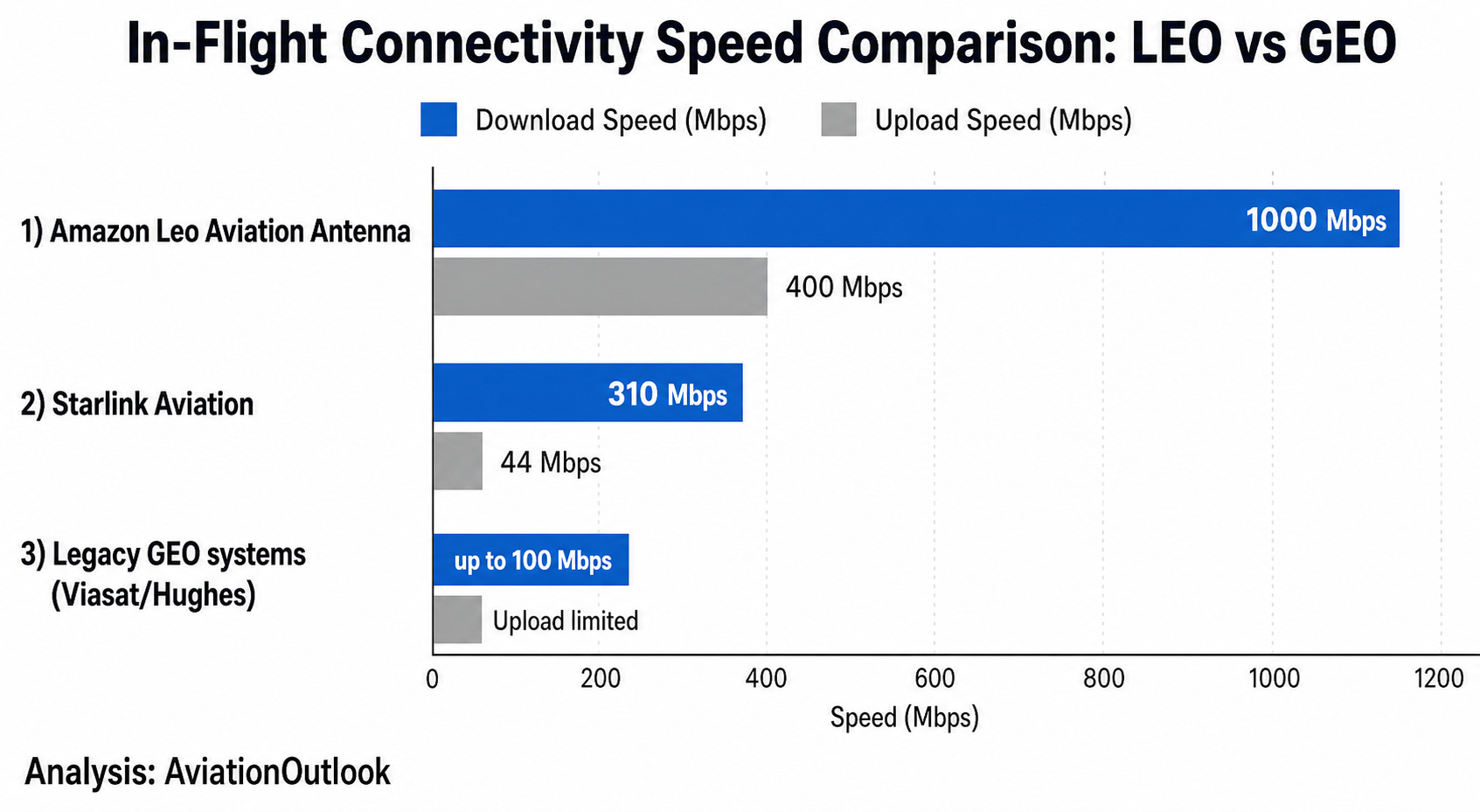
Image source: AviationOutlook analysis. Comparative peak throughput figures for Amazon Leo’s aviation antenna, Starlink aviation terminals, and legacy geostationary in-flight connectivity systems, based on each provider’s published specifications.
The point is that Amazon’s published gigabit figures require both the antenna and a mature, densely populated constellation overhead.
The aviation antenna hardware is moving forward independent of the pad incident, but the second condition is exactly what the Blue Origin setback complicates.
WHY AVIATION NEEDS DENSER COVERAGE THAN FIXED BROADBAND

- Aircraft move at ~500 knots through coverage cells
- Each plane requires near continuous overhead satellite visibility
- High elevation angle reduces handover frequency
- Polar and oceanic routes need orbital plane diversity
- Cabin loads of 100+ active users demand high cell capacityDelta Air Lines’ Wi-Fi Provider Strategy
A critical detail that has been underappreciated in the public conversation is that Delta did not