


Executive Summary
Widerøe is Scandinavia’s largest regional airline, headquartered in Bodø, Norway, and now a wholly owned subsidiary of the Norwegian Group following the 2024 acquisition.
The carrier set a new annual record of 4.13 million passengers in 2025, supported by a turboprop-and-jet fleet that operates approximately 50 aircraft serving more than 50 destinations across Norway and Europe.
Widerøe operates from five primary bases (Bergen, Bodø, Oslo, Sandefjord/Torp and Tromsø), holds PSO contracts running through October 2027 and October 2028, and maintains a separate ground-handling subsidiary serving 41–42 Norwegian airports.
Group total operating revenue attributed to Widerøe reached NOK 7,241 million in 2024 and rose toward NOK 7.90 billion on a trailing basis through 2025, while fleet renewal pressure, electrification ambitions, and PSO contract dynamics define the strategic agenda for 2026.
Recommended - Read Full Reports


Read All Reports
Table of Contents
Executive Summary
Widerøe Company Profile: Key Facts
Widerøe Revenue & Financial Analysis
A Closer Look at the 2024 and 2025 Numbers
Widerøe’s Revenue Sources
Revenue Growth Drivers Through 2025 and into 2026
Cost Pressures and Profitability
Why Widerøe’s Revenue Quality Differs from Mainline Carriers
Widerøe Fleet Analysis
Fleet Size and Composition
Fleet Age Profile and Why It Is Not a Weakness
Embraer E190-E2 Strategy
Why the Dash 8 Q400 Remains the Backbone
Fleet Renewal Strategy
Sustainable Aviation and Future Aircraft
Widerøe Route Network Strategy, Major Destinations + Analysis
A Network That Mirrors Norway’s Geography
PSO Routes Are the Skeleton
Northern Norway as a Strategic Stronghold
Commercial Domestic Routes
International Network with the E190-E2
Codeshare and Interline Strategy
Major Operational Bases (Hubs)
A Five-Base System Anchored on Norwegian Geography
Bodø, the Operational Headquarters
Tromsø and Arctic Operations
Bergen and Western Norway
Oslo and Sandefjord/Torp
Widerøe Competitive Position
Competitive Field Overview
Widerøe vs SAS Scandinavian Airlines
Widerøe vs Norwegian Air Shuttle
Widerøe vs Danish Air Transport (DAT)
Widerøe vs Loganair
Widerøe vs Lufthansa Group and KLM Cityhopper
The Flyr Cautionary Tale
Widerøe Ground Handling and Other Group Activities
Widerøe Ground Handling AS
A Note on the SAS Ground Handling Decision
Widerøe Cargo and Charter
Widerøe Zero
Widerøe under Norwegian Air Shuttle Ownership
How the Acquisition Reshaped the Strategic Map
Operational Integration Choices
Group-Level Performance Lift
Sustainability, Electrification and Long-Run Strategy
A Carrier Designed for the Green Transition
Customer-Facing Sustainability Tools
Future Aircraft Ambitions
Operational Risks for Widerøe
Risk 1
Risk 2
Risk 3
Risk 4
Risk 5
Risk 6
Risk 7
Risk 8
Risk 9
Risk 10
Strategic Outlook for 2026 and Beyond
The Three Strategic Questions
The Norwegian Group Effect
Why This Matters to the Norwegian Aviation System
Practical Considerations for Industry Stakeholders
For Operators and Maintenance Partners
For Airports and Air Navigation Service Providers
For Aircraft Manufacturers
For Tourism and Industry Stakeholders
Widerøe’s 2025 Operating Cadence in Numbers
Reading the Group Traffic Reports
The Q3 2025 EBIT Story
A Brief History That Shapes Today’s Strategy
From 1934 to 2026
Strategic Implications of the History
Final Considerations on the 2026 Profile
A Concise Reading of Widerøe’s Position
A Quick Note on Branding and Customer Perception
My Final Thoughts
Official Sources & Data
Widerøe Company Profile: Key Facts
Widerøe sits at the heart of Norway’s domestic aviation system, connecting fjord-side communities, oil-industry hubs, and Arctic settlements that no other carrier can reach with daily regularity.
The airline is older than most of its European peers, having flown its first commercial routes from a small frozen lake outside Oslo in the mid-1930s.
The corporate structure today reflects a layered Norwegian aviation lineage. Widerøe was historically majority-owned by SAS, then by Torghatten ASA from 2013, and was finally acquired by Norwegian Air Shuttle ASA in early 2024.
Widerøe - (2026)
-------------------------------------------------
Legal name        : Widerøes Flyveselskap AS
Trading name      : Widerøe
IATA / ICAO       : WF / WIF
Callsign          : WIDEROE
Founded           : 19 February 1934
Headquarters      : Bodø, Norway
Parent company    : Norwegian Air Shuttle ASA
Operating bases   : Bergen, Bodø, Oslo, Sandefjord/Torp, Tromsø
Technical base    : Florø
Fleet size        : ~50 aircraft (Dash 8 family + E190-E2)
Destinations      : 40+ in Norway, 8+ in Europe
Loyalty program   : Norwegian Reward
Ground handling   : Widerøe Ground Handling AS (41+ airports)
2025 passengers   : 4.13 million (annual record)
The airline’s 90-plus-year heritage is not just a marketing point.
It is the operational reason Widerøe has retained the institutional knowledge, dispatch culture and short-strip pilot training capability that allow it to fly into airports such as Honningsvåg, Mehamn, Hasvik and Berlevåg in conditions that defeat almost any other operator.
A useful way to read Widerøe’s identity in 2026 is as a hybrid airline.
It is at once a PSO-contracted social-infrastructure provider for the Norwegian state, a commercial regional carrier feeding Norwegian Air Shuttle’s mainline network, and an emerging laboratory for sustainable short-haul aviation through its Widerøe Zero unit.
The airline’s primary fleet contractor relationship is with De Havilland Canada for the Dash 8 family and with Embraer for the E190-E2, the latter making Widerøe the global launch operator of that variant in commercial service.
Widerøe Revenue & Financial Analysis
A Closer Look at the 2024 and 2025 Numbers
Widerøe’s reported financial picture cannot be examined in isolation any longer. Since the closing of the acquisition by Norwegian Air Shuttle ASA in early 2024, Widerøe is a fully consolidated segment within the Norwegian Group’s financial statements.
The 2024 consolidated annual report disclosed total operating revenue for the Widerøe segment of NOK 7,241 million, a level that established the carrier as a substantial mid-cap regional airline in European terms.
By the end of 2025, market data tracking Norwegian Air Shuttle ASA showed Widerøe revenue at approximately NOK 7.90 billion on a trailing basis, indicating continued top-line expansion.
Widerøe — Operating Revenue Trajectory
----------------------------------------------------
FY 2024 reported revenue : NOK 7,241 million
FY 2025 trailing revenue : ~NOK 7.90 billion
Year-on-year change      : ~ +9% (approximate)
2025 annual passengers   : 4.13 million (record)
2024 annual passengers   : ~3.8 million
The first quarter of 2025 set the tone for the year. Widerøe’s operating revenue reached NOK 1,841 million in 1Q2025, a 20.7% year-on-year increase, while operating costs rose by a similar 21.6% to NOK 1,884 million.
That cost growth pattern is important context. Widerøe’s revenue ramp during 2024 and 2025 was supported by two parallel forces, namely fleet hours growing back into PSO contracts that came into effect from 1 April 2024, and improved commercial yields on intra-Norway leisure routes.
Widerøe’s Revenue Sources
Widerøe’s revenue mix is unusual for a European regional airline. Three streams sit at its core, and each behaves very differently across the calendar year and across the economic cycle.
The first stream is publicly tendered short-runway PSO flying. Under contracts awarded by the Norwegian Ministry of Transport and Communications, Widerøe operates several state contract routes where pricing, frequency, and minimum capacity are largely determined by the public tender, not by the market.
The second stream is fully commercial regional flying. These routes connect coastal Norway, fjord cities, and resource-economy hubs with Bergen, Bodø, Tromsø, Oslo and Sandefjord/Torp.
The third stream is short-haul international flying with the Embraer E190-E2 jets, plus ground handling, cargo and charter services packaged through the wider Widerøe corporate group.
Widerøe — Revenue Building Blocks
----------------------------------------------------
1. Norwegian PSO (state-tendered) routes
2. Commercial domestic Norway routes
3. International / E190-E2 commercial routes
4. Widerøe Ground Handling AS (B2B services)
5. Widerøe Cargo (belly-hold + interline)
6. Charter / wet-lease activity
7. Ancillaries (bag, seat, biofuel, partners)Revenue Growth Drivers Through 2025 and into 2026
The strongest single growth driver in 2024 and 2025 was the reactivation and expansion of PSO route flying under contracts that took effect on 1 April 2024. Those contracts have a duration until October 2027 and October 2028, depending on the package.
The second key driver was the integration with Norwegian’s distribution channels. The post-acquisition cooperation framework allowed Widerøe inventory to flow more fluidly into Norwegian’s e-commerce engine and the Norwegian Reward loyalty program after the SAS EuroBonus partnership ended on 16 October 2025.
A third commercial driver was a structural rebound in the international short-haul leisure market post-pandemic, particularly outbound from Bergen and Sandefjord/Torp on the E190-E2, where Widerøe could fill 110-seat jets on routes that the 78-seat Dash 8-Q400 could not economically serve at peak.
A fourth driver, less visible but financially significant, was disciplined pricing within Norway. Norwegian Group’s October 2025 traffic disclosures indicated Widerøe unit revenue of NOK 3.24, up 5.8% year-on-year, reflecting a yield environment supportive of the regional model.
Cost Pressures and Profitability
Widerøe’s profitability has historically been tightly bracketed by aircraft costs, fuel costs and the structure of state PSO compensation. The Norwegian Group’s 2025 segment commentary highlighted that Widerøe delivered EBIT of NOK 38 million in a recent quarter, with improved punctuality and regularity.
The 2025 group result, with operating profit (EBIT) of NOK 3,732 million for the full year, is the highest in Norwegian Group history. While that figure consolidates the mainline operation as well, Widerøe’s contribution stabilised the group earnings profile through a difficult winter quarter.
Norwegian Group — Reported 2025 Highlights
----------------------------------------------------
Group EBIT 2025          : NOK 3,732 million (record)
Group EBIT 2024          : NOK 1,873 million
Group passengers 2025    : 27.3 million
Group passengers 2024    : 26.4 million
Widerøe passengers 2025  : 4.13 million (record)
Widerøe Q4 EBIT          : Improvement vs prior year
Looking into 2026, the cost equation will be shaped by three variables in parallel.
The first is the cost of capital tied up in older Dash 8-100 and Dash 8-200 airframes that will eventually require replacement.
The second is sustainable aviation fuel (SAF) availability and pricing on the international jet routes.
The third is the wage and crewing inflation typical of the Norwegian labour market.
Why Widerøe’s Revenue Quality Differs from Mainline Carriers
Operationally, two-thirds of Widerøe’s flight legs are short, with average sector lengths under one hour on the turboprop network. That has a significant effect on yield per kilometre and on cost per available seat kilometre.
PSO compensation also smooths out the revenue line. Where a mainline carrier sees revenue collapse in a demand shock, Widerøe still receives contracted PSO support for legally required minimum frequencies. That gives it a different financial personality from Norwegian Air Shuttle’s mainline 737 fleet.
Finally, Widerøe’s commercial base relies more on business and necessity travel than on price-sensitive leisure flows. The economy of Norway’s coastal and Arctic communities depends on Widerøe in ways that do not map onto demand elasticity assumptions used for typical European low-cost markets.
Widerøe Fleet Analysis
Fleet Size and Composition
Widerøe operates one of the most distinctive regional fleets in European commercial aviation.
The carrier flies a mix of De Havilland Canada Dash 8 turboprops in three sub-variants (the 39-seat Dash 8-100/200, the 50-seat Dash 8-300 and the 78-seat Dash 8-Q400) along with the 110-seat Embraer E190-E2 jets.

According to Widerøe’s own published fleet pages, the airline operates 16 Dash 8-Q400 aircraft and three Embraer E190-E2 aircraft, alongside a substantial population of Dash 8-100/200/300 frames used predominantly on the short-runway regional network.
Widerøe Fleet — 2026 Snapshot
----------------------------------------------------
Embraer E190-E2          : 3 aircraft (110 seats)
Dash 8-Q400              : 16 aircraft (78 seats)
Dash 8-300               : ~3 aircraft (50 seats)
Dash 8-100/200           : ~25+ aircraft (39 seats)
Total active fleet       : ~50 aircraft
Avg fleet age (overall)  : Substantial; Dash 8 ~25 years
E190-E2 average age      : ~7-8 years
A 2026 fleet update from independent spotting sources tracked Widerøe at 50 aircraft active, with an average fleet age weighted heavily by the Dash 8 classics.
Fleet Age Profile and Why It Is Not a Weakness
It is tempting to see the average fleet age and assume that the airline is overdue for capital expenditure. The reality is more nuanced.
The Dash 8 classic family is a robust short-runway airframe. Widerøe has explicitly invested in extending the service life of its older Dash 8-100/200 aircraft. In 2025, the airline confirmed an avionics upgrade program using Universal Avionics flight display technology, modernising the cockpits and adding open-world communication capabilities.
Widerøe’s own sustainability framing also explains the philosophy. The airline has stated that producing entirely new aircraft generates emissions and that, by extending the lifespan of existing turboprop airframes, the carbon impact of capital renewal is reduced.
That argument has limits, of course, but it is intellectually consistent with the carrier’s broader environmental positioning under the Widerøe Zero brand and the Norwegian fleet renewal narrative that operates in parallel.
Embraer E190-E2 Strategy
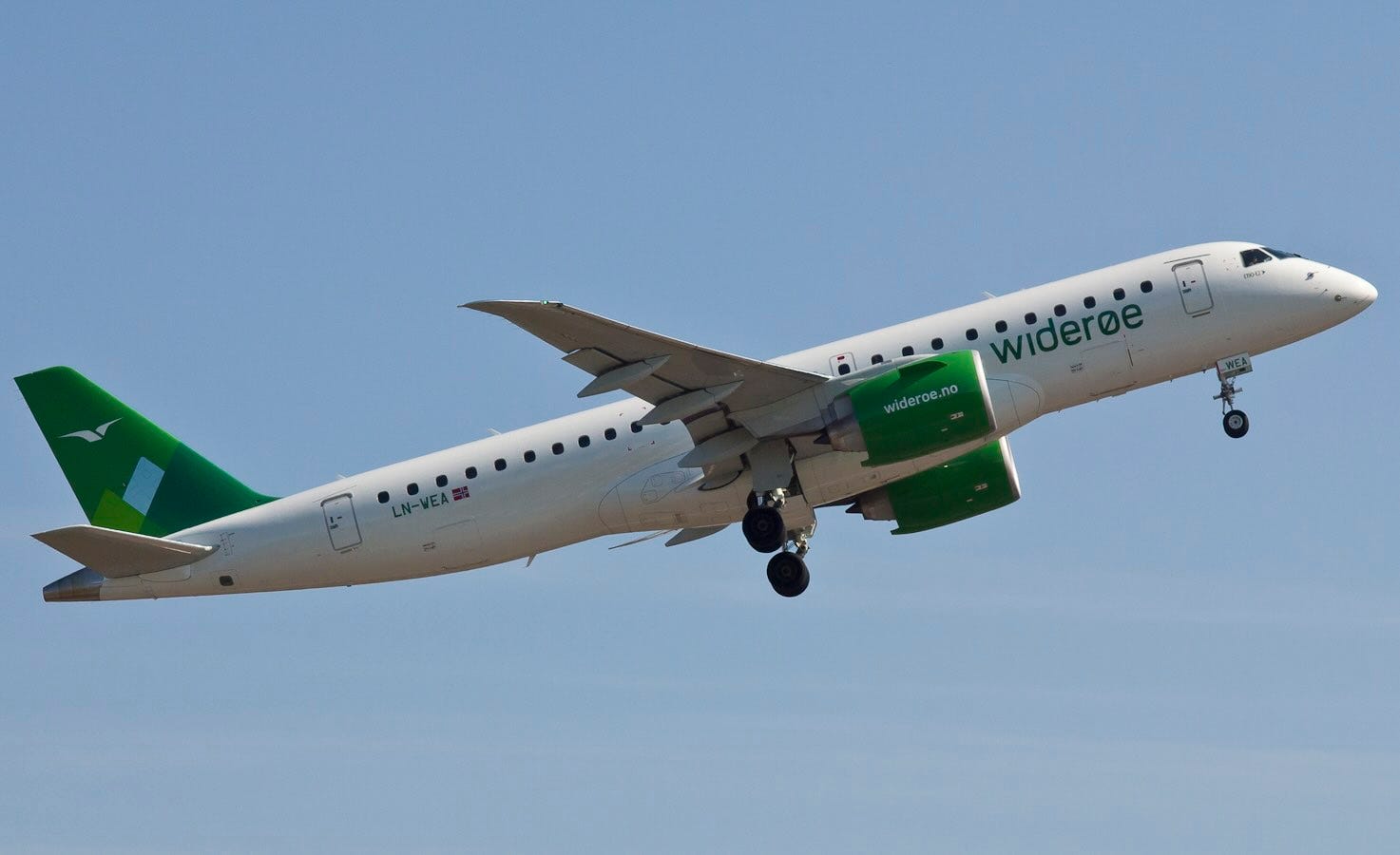
The Embraer E190-E2 represents a real strategic shift. Widerøe became the first airline in the world to put the E190-E2 into commercial operation in 2018, and the carrier currently operates three examples.
The E190-E2 was specified by Widerøe with 110 seats in a single-class configuration, in-seat power outlets at every seat, and the option to pre-reserve any seat on E190-E2 services.
The airframe is a 21st-century clean-sheet jet with new Pratt & Whitney geared turbofan engines, delivering material fuel-burn improvements over older 100-seat regional jets.
Widerøe E190-E2 — Configuration
----------------------------------------------------
Total seats          : 110 (single class)
Layout               : 2x2, no middle seats
Cabin power          : In-seat power at every seat
Seat reservation     : Pre-reservable on all flights
Role                 : International + thicker domestic
Launch role          : World's first E190-E2 operator
Widerøe’s contracted relationship with Embraer covers up to 15 E2 jets, comprising three firm orders for the E190-E2 and purchase rights for 12 further E2 aircraft.
That option pool is one of the most consequential strategic levers in the airline. If Widerøe converted the option block, it would meaningfully shift the airline from a turboprop-led carrier toward a hybrid jet plus turboprop network.
Why the Dash 8 Q400 Remains the Backbone
The Dash 8-Q400 is the most economically intense aircraft in the Widerøe fleet for moderate-sector domestic flying. It has a maximum cruise speed of 667 km/h, a maximum take-off weight of 29,574 kg, and 78 seats, according to the airline’s own published fleet specifications.
The Q400 also brings true short-runway capability, which is essential at airports like Sandane, Sogndal and Førde, where the Dash 8 family’s STOL characteristics are operationally non-negotiable.
In 2024, De Havilland Canada announced the sale of two additional Dash 8-400 aircraft to Widerøe, which strengthens the operational backbone of the airline through the second half of the decade.
Fleet Renewal Strategy
Widerøe’s fleet renewal strategy is best understood as a portfolio. Three things must happen in parallel.
First, the Dash 8-100/200 fleet must continue to receive avionics upgrades, structural inspections and component pool support so it can keep operating into the 2030s while the next generation of small-aircraft technology matures.
Second, the Dash 8-Q400 fleet must be renewed in tranches as airframes accumulate cycles, supplemented by selectively buying additional Q400s in the secondary market.
Third, the E190-E2 option pool must be exercised in a disciplined way that aligns jet capacity with the Norwegian Group’s mainline 737 fleet, avoiding internal cannibalisation.
Widerøe has also publicly explored fleet renewal plans A, B, and C as alternatives, while in May 2025 the carrier signalled a cost-cutting program specifically aimed at financing renewal capex.
Sustainable Aviation and Future Aircraft
Widerøe’s longer-horizon fleet thinking is anchored in the airline’s Widerøe Zero initiative. The unit has been positioned as a consultancy and incubator for low-emissions aviation, with a clear ambition that all domestic short-haul flights will eventually be electric.
In 2023, Widerøe Zero and Eve Air Mobility extended their partnership with a letter of intent covering up to 50 eVTOL aircraft, plus a service and operations solutions package, with the aim of launching eVTOL operations in Scandinavia.
The airline has, at various points, also worked with Rolls-Royce and Tecnam on electric aircraft concepts and has stated publicly that turboprop technology emits the least CO2 for most of its flights given typical Norwegian sector lengths.