


Executive Summary
Scale and traffic: 63.4 million passengers in FY25, with Q3 FY26 passenger numbers climbing 12.5% year-on-year to 17.5 million, and December 2025 traffic up 15.5% to 5.85 million.
Strategic pivot: A decisive retreat from the Abu Dhabi joint venture, a full exit by September 1, 2025, and a focused return to Central and Eastern Europe, Italy, and Western Europe.
Fleet transition: A multi-year migration toward an all-Airbus A321neo fleet by 2033, supported by delivery deferrals and a cut in A321XLR orders from 47 to around 11 units.
Main overhang: Engine groundings expected to persist through the end of 2027, with guidance shaped by Middle East volatility and fuel cost swings.
Recommended - Read Full Reports


Read All Reports
Table of Contents
Executive Summary
Introduction
Key Facts: Company Profile
Business Overview
Corporate Structure and Governance
Financial Analysis and Revenue Metrics
Unit Economics and Cost Discipline
Revenue Growth Drivers
Balance Sheet and Liquidity
Key Services and Product Offering
Fleet: In-depth Analysis
Fleet Size and Composition
Fleet Age and Renewal
Phase-out of the A321ceo Family
The A320 Family Tail
Aircraft Type Strategy and Configuration
Airbus A321neo Standard
Airbus A321XLR Extra Long Range
Fleet Strategy
From Growth to Disciplined Growth
Target End-State
Sustainability and Fuel Efficiency
The Pratt & Whitney GTF Overhang
Route Network, Major Destinations and Strategy
Network Scale and Shape
Major Destinations and Regions
Central and Eastern Europe
Italy
United Kingdom
Western Europe and the Balkans
Middle East and Beyond
Network Strategy
Density Over Sprawl
Seasonal Resilience and VFR Traffic
Post-Ceasefire Ukraine Optionality
Major Operational Bases (Hubs)
The Base System Explained
Flagship Bases by Size and Strategic Importance
Budapest, Hungary
Bucharest Otopeni, Romania
London Luton, United Kingdom
Milan Malpensa and the Italian Bases
Warsaw and the Polish Expansion
Additional Bases in Central and Southeast Europe
Base Closures and Consolidation
Competitive Position
List of Major Competitors
Airline vs Airline Comparisons
Wizz Air vs Ryanair
Wizz Air vs easyJet
Wizz Air vs Pegasus Airlines
Wizz Air vs Lufthansa Group (Austrian Airlines, Eurowings)
Wizz Air’s Competitive Position Scorecard
Other Strategic Outlook
Operating Model Deep Dive
High Aircraft Utilization as a Weapon
Distribution and Direct Sales
Talent, Labor, and Crew Costs
Technology and Customer Experience
ESG and Sustainable Aviation
Capital Allocation and Shareholder Returns
The Abu Dhabi Chapter and Lessons Learned
Partnerships and Interlining
Route Launches to Watch in 2026
Operational KPIs to Monitor Through 2027
Key Risks with Probabilities and Scenarios
1. Engine Groundings Last Longer Than 2027
2. Middle East Instability Disrupts Routes
3. Fuel Price Shock
4. Competitive Capacity Flood in CEE
5. UK Regulatory and Brexit-Related Risk
6. Ukraine Escalation or Prolonged Conflict
7. Labor Disputes and Crew Cost Inflation
8. Foreign Exchange Risk
Risk Mitigants Already in Place
My Final Thoughts
Official Sources and Data
Introduction
Wizz Air Holdings Plc has walked into 2026 carrying two stories at once, one of aggressive European expansion and one of deep operational pain caused by grounded aircraft.
The Hungarian ultra-low-cost carrier ended calendar year 2025 with 257 aircraft and revenue growth of 10.2% in Q3 FY26, while simultaneously absorbing the financial shock of 33 aircraft still on the ground due to Pratt & Whitney GTF engine issues.
Key Facts: Company Profile
COMPANY PROFILE SNAPSHOT — WIZZ AIR HOLDINGS PLC (APR 2026)

Legal entity        : Wizz Air Holdings Plc (LSE: WIZZ)
Founded             : 2003 (first flight May 19, 2004)
CEO                 : József Váradi (co-founder)
Headquarters        : Budapest, Hungary
Stock listing       : London Stock Exchange, FTSE 250
Parent structure    : Wizz Air Hungary Ltd., Wizz Air UK Ltd., Wizz Air Malta Ltd.
Fleet (31 Dec 2025) : 257 aircraft (Airbus A320ceo, A321ceo, A320neo, A321neo, A321XLR)
Aircraft on ground  : 33 (GTF engine issues) + 3 (Ukraine)
Network             : 800+ routes, 32 bases, 16 countries
Destinations        : ~200 across Europe, North Africa, Middle East, Caucasus
Passengers (FY25)   : 63.4 million
Total revenue (FY25): €5,267.6 million
Passengers (Q3 FY26): 17.5 million (+12.5% YoY)
Revenue (Q3 FY26)   : €1,296.4 million (+10.2% YoY)
Load factor (Q3) : 89.8%Hungary remains the center of gravity.
The group’s flagship operating company, Wizz Air Hungary Ltd., is registered at Lechner Ödön fasor in Budapest, with Wizz Air UK Ltd. headquartered at London Luton Airport.

Business Overview
Corporate Structure and Governance
Wizz Air operates under a holding company model that was designed to manage regulatory complexity across post-Brexit Europe. The parent, Wizz Air Holdings Plc, sits at the top and owns three main operating airlines: Wizz Air Hungary, Wizz Air UK, and Wizz Air Malta.
Each operating airline holds its own air operator certificate, which gives the group flexibility to serve UK, EU, and third-country markets from appropriate jurisdictions. The Malta subsidiary has become particularly important for flying routes across the Mediterranean, North Africa, and the Gulf.
József Váradi, the co-founder, still runs the company as CEO more than two decades after the first flight. His continued presence is an important strategic signal, because he remains the architect of the ultra-low-cost model at the heart of the group.
Financial Analysis and Revenue Metrics
FY25, which ended March 31, 2025, delivered total revenue of €5,267.6 million, up 4% on the prior year, with a profit after tax of €213.9 million.
That recovery came despite the engine headwind, and it was driven by a 2.2% rise in passenger numbers.
FY25 TOTALS (WIZZ AIR HOLDINGS PLC)

Total revenue       : €5,267.6 million   (+4% YoY)
Fuel cost           : (€1,797.6 million) (-3% YoY)
Passengers          : 63.4 million       (+2.2% YoY)
Profit after tax    : €213.9 million
Fleet (end-FY25)    : 231 aircraft
The current fiscal year has been bumpier. In the first nine months of FY26, the group delivered a net profit of €184.2 million, but Q3 by itself was loss-making due to seasonal winter softness and cost pressures.
The airline reported a Q3 FY26 EBITDA of €176.2 million and an operating loss of €123.9 million, with a net loss for the quarter of €139.3 million. Those numbers reflect the typical northern hemisphere winter seasonality that all European low-cost carriers experience.
Rolling 12-month revenue reached €5,663.4 million as of December 31, 2025. That number tells a cleaner story of the underlying scale of the business, stripping out quarterly seasonality.
Unit Economics and Cost Discipline
Ultra-low-cost carrier economics live and die at the unit level. In Q3 FY26, Wizz Air reported total cost per available seat kilometer (CASK) of 4.35 euro cents, with an ex-fuel CASK of 2.94 euro cents.
Total revenue per available seat kilometer (RASK) landed at 3.83 euro cents for the quarter.
The gap between CASK and RASK in the seasonally weak winter quarter is normal, but it highlights how important summer performance is to full-year profitability.
Q3 FY26 UNIT ECONOMICS

Total RASK       : 3.83 euro cents
Total CASK       : 4.35 euro cents
Ex-fuel CASK     : 2.94 euro cents
Load factor      : 89.8%
ASK growth       : ~11% YoY
The ex-fuel CASK is the most telling number for anyone benchmarking Wizz against Ryanair and easyJet.
It remains one of the lowest in European aviation, which is the structural reason the airline can keep fares low.
Revenue Growth Drivers
The biggest near-term growth driver is capacity, not yield. The group guided to approximately 10% ASK growth for FY26 with a low double-digit increase in seat capacity.
Ancillary revenue is the second pillar. In Q3 FY26 alone, ancillary revenue hit €599.5 million, which is almost pulling level with passenger ticket revenue of €696.9 million for the same period.
Ancillary mix includes checked and carry-on bag fees, seat selection, priority boarding, and onboard retail. The model is direct, transparent, and priced aggressively, which is consistent with the ultra-low-cost playbook.
Balance Sheet and Liquidity
Liquidity is adequate but not generous. The group reported total cash of €1,984.8 million at December 31, 2025, against net debt of €5,196.0 million.
The debt level reflects the fleet expansion strategy and the impact of sale-and-leaseback transactions that have funded a large share of the A321neo growth. The airline has been actively managing maturities, and compensation payments from Pratt & Whitney have helped cushion the cash impact of groundings.
Key Services and Product Offering
Wizz Air sells an unbundled fare with everything extra priced separately. The base product is a one-way ticket with a small personal item, and every additional service adds to the final price paid.
The airline offers a membership subscription called WIZZ Discount Club and a credit product called WIZZ Multipass, both of which are designed to lock frequent flyers into recurring revenue streams. These subscription-style ancillaries are increasingly important for smoothing revenue across seasons.
Cabin layout is dense, with single-class seating and thin-profile seats that maximize seat count per aircraft. The A321neo in Wizz configuration carries 239 seats, which gives it one of the best unit cost positions in the single-aisle segment.
Fleet: In-depth Analysis
Fleet Size and Composition
As of December 31, 2025, Wizz Air operated 257 aircraft, making it one of the three largest low-cost carrier groups in Europe. Fleet composition is currently in transition between the older ceo family and the newer neo family.
WIZZ AIR FLEET COMPOSITION (31 DEC 2025)

A320ceo            : 28 aircraft
A321ceo            : 41 aircraft
A320neo            :  6 aircraft
A321neo            : 176 aircraft
A321neo XLR        :  6 aircraft
---------------------------------
Total              : 257 aircraft
(incl. 3 in Ukraine; excl. wet-leased aircraft)
The A321neo is the backbone of the operation, representing more than two-thirds of the fleet. That concentration is deliberate and reflects a long-running decision to standardize on the largest, most fuel-efficient narrowbody in the Airbus family.
Fleet Age and Renewal
Fleet age is a moving target, but the airline’s push toward the A321neo family has kept it young by European standards. Data shows an average fleet age of around 6.3 years for the Hungarian entity alone.
A newer fleet means better fuel burn, lower maintenance costs, and lower cabin CO2 per seat. It also supports the airline’s sustainability narrative, which ranks Wizz among the world’s most fuel-efficient carriers by grams of CO2 per seat.
Phase-out of the A321ceo Family
In March 2026, the airline formally announced the gradual phase-out of its A321ceo fleet. All 41 A321ceo aircraft are to leave the fleet by March 2029.
The retirement is coupled with the steady arrival of new A321neo and A321XLR aircraft. The logic is simple: the engines on the ceo are fuel-hungry by current standards, while the neo delivers roughly 20% better fuel efficiency.
The A320 Family Tail
The 28 A320ceo and six A320neo aircraft form a smaller sub-fleet. Over time, these too are expected to cycle out, leaving a much cleaner and more uniform fleet structure dominated by the A321neo.
The long-term end state was spelled out clearly by the company in 2026, with plans for an all-A321neo fleet of up to 380 aircraft by 2033. That consolidation is one of the most aggressive fleet simplification plans in European aviation.
Aircraft Type Strategy and Configuration
Airbus A321neo Standard
The A321neo is the primary growth aircraft. In Wizz configuration, it offers very high seat density, which compresses unit costs and supports aggressive fare positioning.
Engines are Pratt & Whitney PW1100G geared turbofans, which is where much of the current trouble sits. The GTF engine saves fuel versus older turbofans but has suffered durability issues on powdered metal parts that have forced accelerated inspections and groundings.
Airbus A321XLR Extra Long Range
Wizz Air was the first ultra-low-cost carrier to operate the A321XLR, with its first aircraft delivered in March 2025. The type gives the airline a 4,700 nautical mile range and has been used on London to Jeddah and London to Medina.
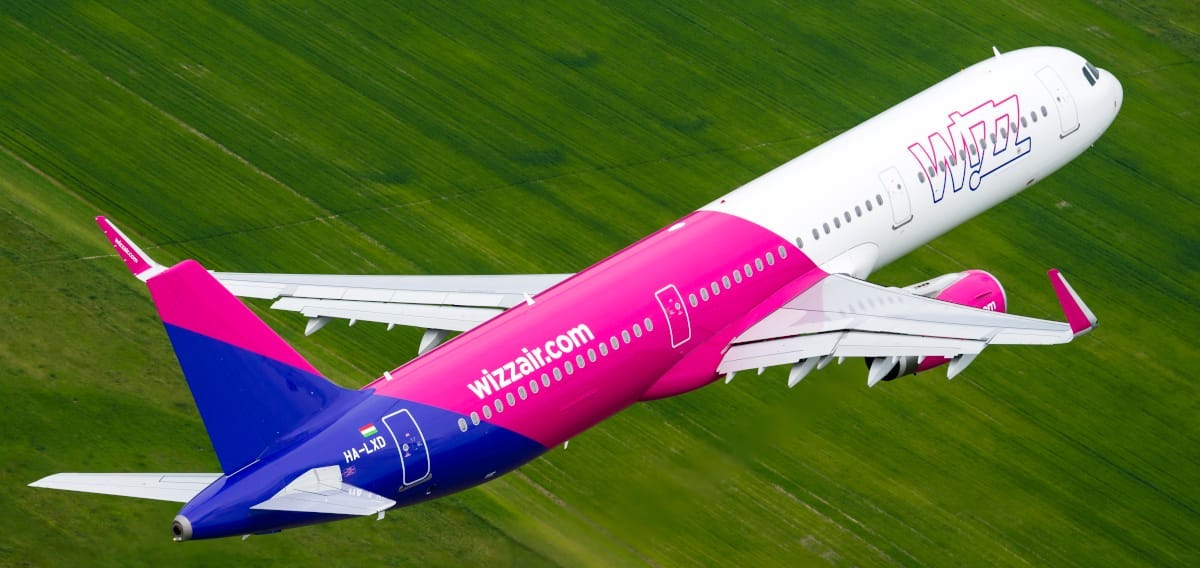
The long-range variant was originally ordered in much larger numbers, but the company has since reduced the XLR order to around 11 units. The reason is strategic: after exiting Abu Dhabi, the airline no longer needed the same volume of long-range aircraft.
Two of the six delivered XLRs were also grounded to conserve engine cycles for shorter A321neo routes, which shows how pragmatic the XLR strategy has become.
Fleet Strategy
From Growth to Disciplined Growth
The 2026 fleet plan is best described as disciplined growth. The airline confirmed deferrals of 88 Airbus aircraft deliveries and a smaller XLR commitment.
That adjustment reflects a sober look at supply chain reality. Engine lead times, MRO slot availability, and Middle East demand softness all pointed toward a more staggered intake rather than a sprint.
Target End-State
The long-range target is a fleet of about 305 aircraft by March 2028 and over 420 by F30. By 2033, the airline aims to operate an all-A321neo family fleet of around 380 aircraft.
FLEET TRAJECTORY

March 2025        : 231 aircraft
December 2025     : 257 aircraft
Target March 2028 : ~305 aircraft
Target F30        : 420+ aircraft
Target 2033 : ~380 aircraft, all-A321neo familySustainability and Fuel Efficiency
The fleet strategy is also a sustainability strategy. The airline’s decarbonization roadmap targets a 30% emissions reduction from new aircraft technology and fleet renewal, combined with a 53% reduction from sustainable aviation fuel by 2050.
New Business Traveller reporting shows Wizz Air among the most CO2-efficient airlines in the world at roughly 52.9 grams of CO2 per seat. That is a direct consequence of high density A321neo aircraft flying high load factors.
The Pratt & Whitney GTF Overhang
No fleet discussion can avoid the GTF story. As of December 31, 2025, 33 aircraft were grounded due to engine inspections, down from 40 a year earlier.
The CFO publicly indicated that the airline expects GTF-related groundings to persist until the end of 2027. Even a full return to service in 2027 would still be constrained by global GTF inspection slot availability.
To support the airline financially, Wizz Air signed a commercial support agreement with Pratt & Whitney through December 31, 2026, which compensates for the operational impact. The deal is material: in its annual report the group confirmed it had received significant compensation from Pratt & Whitney for the PW1100G issues.