


Executive Summary
Woodward closed fiscal 2025 with record consolidated net sales of $3.6 billion, and the aerospace segment alone delivered roughly $2.3 billion of that revenue, lifting segment earnings to $507 million at a 21.9 percent margin.
The company entered fiscal 2026 with momentum that surprised even its own management team. Q2 FY2026 produced aerospace segment sales of $703 million, up 25 percent year over year, prompting a guidance raise to 20–23 percent total company sales growth.
Two transformational acquisitions (Safran’s North American electromechanical actuation business and Valve Research & Manufacturing) plus a $200 million Spartanburg, South Carolina greenfield plant for spoiler actuation are reshaping the company’s aerospace footprint for the next decade.
Defense smart weapons demand, F-35 Lots 18-19 ramp, Boeing 737 MAX rate increases, and the LEAP engine aftermarket wave together form a multi-year tailwind that few aerospace component suppliers can match.
Recommended - Read Full Reports


Read All Reports
Table of Contents
Executive Summary
Key Facts: Woodward Company Profile
Why Woodward Matters in 2026?
Woodward Company Overview
A 156-Year-Old Engineering House With a New Industrial Identity
Leadership and Governance
Two-Segment Operating Structure
Footprint and Manufacturing Capacity
Woodward Revenue & Financial Analysis
Fiscal Year 2025 Headline Numbers
Q1 Fiscal Year 2026 Performance
Q2 Fiscal Year 2026 Acceleration
Updated Fiscal 2026 Guidance
Capital Allocation and Free Cash Flow
Woodward Growth Drivers: An In-Depth Look
Commercial OEM Growth: The 737 MAX and A320neo Story
Widebody Recovery: 787 and A350
Commercial Services: The Aftermarket Inflection
Defense OEM and Smart Weapons
Defense Services Growth
LTM Revenue Trajectory
Key Product Lines and Programs: Woodward Aerospace
Aircraft Engine Controls
Aircraft Actuation
Thrust Reverser Actuation Systems
Sensors and Smart Components
Defense and Space Programs
Major Woodward Competitors
Woodward vs. Moog
Woodward vs. HEICO
Woodward vs. TransDigm
Woodward vs. Curtiss-Wright
Woodward vs. Honeywell, Parker Hannifin, Eaton, and Collins Aerospace
Woodward Competitive Analysis and Moat
Sole-Source Position on Best-Selling Platforms
Certification and Switching Costs
Vertical Integration in Critical Components
Aftermarket Network Effects
Recent Strategic Developments
Safran Electromechanical Actuation Acquisition
Pilot Controls Divestiture
Heavy Duty Gas Turbines Combustion Parts Divestiture
Spartanburg Manufacturing Facility
Aerospace Industry Backdrop for 2026 and Beyond
Production Rate Recovery
Aftermarket Demand Is Structural
Defense Spending and Stockpile Replenishment
Aerospace Mega Trends Affecting Woodward
More-Electric Architecture
Sustainable Aviation Fuel and Combustion
Precision Defense
Digital Aftermarket
Financial and Commercial Implications
Margin Trajectory
Backlog Visibility
Capital Intensity
Pricing Power
Key Risks With Probabilities and Scenarios
1. Boeing 737 MAX Rate Slip
2. Pratt & Whitney GTF Engine Shortage
3. Defense Procurement Reductions
4. Macroeconomic Slowdown
5. Supply Chain Disruptions
6. Regulatory and Geopolitical
7. Acquisition Integration
Strategic Outlook for 2026 and Beyond
Near-Term (FY2026 to FY2027)
Medium-Term (FY2028 to FY2030)
Long-Term (Beyond FY2030)
Woodward SWOT Analysis
My Final Thoughts
Official Sources and Data
Key Facts: Woodward Company Profile
COMPANY: Woodward, Inc.
TICKER: WWD (NASDAQ)
HEADQUARTERS: 1081 Woodward Way, Fort Collins, Colorado 80524
FOUNDED: 1870 (Rockford, Illinois)
FOUNDER: Amos W. Woodward
CHAIRMAN & CEO: Charles "Chip" Blankenship (since 2022)
EMPLOYEES: ~10,200 (FY2025)
FY2025 NET SALES: $3.6 billion
AEROSPACE SEGMENT FY2025 SALES: $2.3 billion (~64% of total)
AEROSPACE SEGMENT FY2025 EARNINGS: $507 million (21.9% margin)
FY2026 GUIDANCE: $4.3B–$4.4B revenue; Adjusted EPS $9.15–$9.45
SHARE REPURCHASE AUTHORIZATION: $1.8 billion (announced Nov 2025)
PRIMARY SEGMENTS: Aerospace, Industrial
Woodward is the global leader in the design, manufacture, and service of energy conversion and control solutions for aerospace and industrial markets.
The aerospace segment, which is the focus of this analysis, supplies fuel systems, actuation, sensors, and combustion controls to nearly every major commercial and military airframe and engine program built today.
The company operates plants in 13 countries and trades on the NASDAQ under WWD.

Why Woodward Matters in 2026?
Walk into the engine bay of a Boeing 737 MAX, an Airbus A350, or a Lockheed Martin F-35, and there is a high probability that something Woodward makes is regulating fuel flow, moving a control surface, or igniting combustion.
The company is a quiet but indispensable link in the aerospace value chain. That quiet status changed materially in 2025 and 2026.
With commercial aftermarket revenue accelerating, defense smart-weapons content scaling, and three production facilities in active expansion, Woodward is now executing the largest capacity build-out in its 156-year history.
For aerospace executives evaluating supply-chain risk and program continuity, understanding Woodward’s trajectory is no longer optional.
Woodward Company Overview
A 156-Year-Old Engineering House With a New Industrial Identity
Amos Woodward received a patent for a noncompensating mechanical waterwheel governor in 1870 and began selling the device to grain mills in northern Illinois. The product solved a basic engineering problem: keeping rotational speed steady when load conditions changed.
That core competency, controlling energy precisely, never left the company. Today’s Woodward engineers solve the same fundamental problem at vastly higher speeds and pressures, but the conceptual lineage from waterwheel governor to modern jet-engine fuel metering valve is direct and deliberate.
The company moved its corporate headquarters from Illinois to Fort Collins, Colorado over the past two decades. The current campus sits on a 120-acre site along the Cache la Poudre River and houses both administrative offices and the Drake Motion Control Technology Center.
Leadership and Governance
Charles “Chip” Blankenship has served as Chairman of the Board and Chief Executive Officer since 2022. He previously held senior operating roles at Arconic and GE Aviation. His public commentary has emphasized operational discipline, portfolio refinement, and selective vertical integration in airframe-critical components.
The Annual Meeting of Stockholders held on January 28, 2026 reaffirmed the board’s strategic direction and reauthorized the executive compensation framework tied to long-term aerospace platform wins.
Two-Segment Operating Structure
Woodward reports through two operating segments: Aerospace and Industrial. This article concentrates exclusively on the aerospace, aviation, and defense business per the article scope.
Within aerospace, the company splits revenue across four channels: Commercial OEM, Commercial Services (aftermarket), Defense OEM, and Defense Services.
Each of these channels has performed differently across recent quarters, and the trajectory of each is critical for industry stakeholders trying to model program supply availability.
WOODWARD AEROSPACE REVENUE CHANNELS
Channel              | Demand Drivers
---------------------|------------------------------------------
Commercial OEM       | Boeing 737 MAX, A320neo, A350, 787 builds
Commercial Services  | LEAP/GTF MRO, fleet utilization, retrofits
Defense OEM          | F-35, F-15EX, Apache, Patriot, smart bombs
Defense Services | Repairs, sustainment, FMS programsFootprint and Manufacturing Capacity
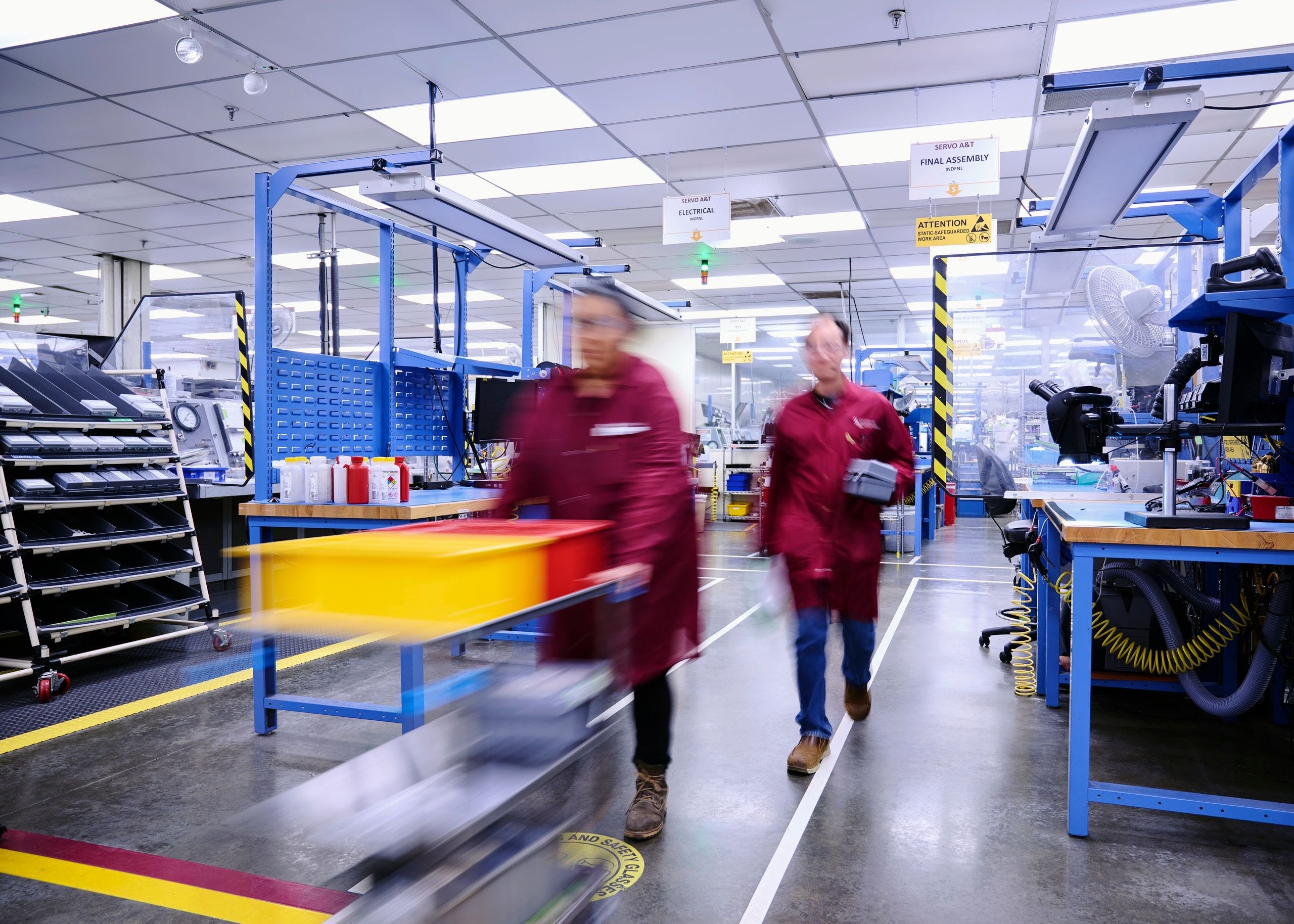
Woodward operates aerospace-relevant plants in Fort Collins, Colorado; Loveland, Colorado; Niles, Illinois; Rockton, Illinois; Santa Clarita, California; Duarte, California; Skokie, Illinois; and across international locations, including the United Kingdom, Germany, the Netherlands, the Czech Republic, China, Japan, and Mexico.
The 1000 East Drake Road Motion Control Technology Center in Fort Collins is the primary aerospace actuation engineering site. The Duarte, California, facility is the historic home of the company’s thrust reverser actuation work for narrowbody nacelles.
In September 2025, the company announced a 300,000-square-foot manufacturing facility in Spartanburg County, South Carolina, with a $200 million investment and an anticipated 2027 operational start.
The site will initially focus on spoiler actuation for the Airbus A350 program before broadening into other servo-hydraulic flight control work.
Woodward Revenue & Financial Analysis
Fiscal Year 2025 Headline Numbers
Fiscal 2025 was a record year by every meaningful financial metric. Net sales reached $3.6 billion, up 7 percent year over year, driven primarily by aerospace strength offsetting industrial softness in select transportation end markets.
The aerospace segment generated approximately $2.3 billion in net sales, an increase of 14 percent over fiscal 2024. Aerospace segment earnings rose to $507 million at a 21.9 percent margin, reflecting both volume leverage and disciplined pricing.
Q4 fiscal 2025 alone produced aerospace segment sales of $661 million with segment earnings of $162 million at a 24.4 percent margin, a striking acceleration into year-end.
WOODWARD FY2025 AEROSPACE SEGMENT (FULL YEAR)
Net Sales:          $2.3 billion
Sales Growth:       +14% YoY
Segment Earnings:   $507 million
Segment Margin:     21.9%

Q4 FY2025 AEROSPACE
Net Sales:          $661 million
Segment Earnings:   $162 million
Segment Margin:     24.4%
Q1 Fiscal Year 2026 Performance
The first quarter of fiscal 2026 (October-December 2025) extended the momentum. Aerospace segment earnings were $148 million, or 23.4 percent of segment net sales. Total company revenue reached $996.5 million, up 29 percent year over year.
That quarter included the first full reporting period in which the Safran electromechanical actuation acquisition contributed inorganically. Management indicated that organic growth was strong on a like-for-like basis even excluding the acquisition contribution.
Q2 Fiscal Year 2026 Acceleration
The second quarter of fiscal 2026 (January-March 2026), reported on April 29, 2026, was the most consequential quarter in Woodward’s recent history. Net sales reached $1.09 billion, a 23 percent year-over-year increase, marking the first time the company surpassed $1 billion in quarterly sales.
Aerospace segment sales rose 25 percent to $703 million. Within aerospace, commercial services grew 36 percent year over year while commercial OEM rose 30 percent. Defense OEM increased 9 percent to $151 million and defense services increased 8 percent to $59 million.
Aerospace segment earnings were $158 million, or 22.5 percent of segment net sales. First-half fiscal 2026 segment earnings totaled $306 million at 22.9 percent of segment sales.
WOODWARD AEROSPACE Q2 FY2026 BREAKDOWN
Commercial Services:    +36% YoY
Commercial OEM:         +30% YoY
Defense OEM:            +9% YoY ($151M)
Defense Services:       +8% YoY ($59M)
Total Aerospace Sales:  $703M (+25% YoY)
Segment Earnings:       $158M (22.5% margin)
Updated Fiscal 2026 Guidance
Following the Q2 beat, management raised fiscal 2026 guidance for the second consecutive quarter. Revenue is now expected at $4.3 billion to $4.4 billion. Adjusted EPS guidance moved to $9.15 to $9.45.
Aerospace segment sales growth guidance was raised to 21–24 percent from the prior 15–20 percent range. Aerospace segment margin guidance moved to 23–23.5 percent versus prior 22–23 percent.
The company expects 30–35 percent flow-through on incremental aerospace sales for the remainder of the fiscal year.
Capital Allocation and Free Cash Flow
Free cash flow for fiscal 2025 was approximately $340 million. Capital expenditures are guided at approximately $290 million for fiscal 2025 and a similarly elevated level for fiscal 2026, reflecting the Spartanburg build and existing site expansions.
In November 2025, the board authorized a $1.8 billion share repurchase program over three years, replacing the prior $600 million authorization which had been completed more than a year ahead of plan.
The decision signals management’s confidence in long-term cash generation while balancing organic capacity investment.