


Executive Summary
XiamenAir, the first Chinese airline to operate under a modern enterprise system, closed 2024 with operating revenue of RMB 36.438 billion, an 8.57% year-on-year rise, while net profit slipped 5.64% to RMB 569 million, revealing a top-line-driven recovery running ahead of a still-thin bottom line.
The carrier flies over 400 domestic and international routes across six continents, anchored by twin home hubs at Xiamen Gaoqi and Fuzhou Changle, with secondary hubs at Beijing Daxing and Hangzhou Xiaoshan.
Its mainline fleet of 172 aircraft remains dominated by the Boeing 737 family, with a dozen Boeing 787 widebodies handling long-haul trunks, including the 19 hour 20 minute JFK-Fuzhou service, currently the longest nonstop passenger flight on the planet.
Majority-owned by China Southern Airlines (55%), XiamenAir is preparing for a generational hub shift as the new Xiamen Xiang’an International Airport is scheduled to open in late 2026, a move that reshapes the airline’s operating economics and long-haul ambitions.
Recommended - Read Full Reports


Read All Reports
Table of Contents
Executive Summary
Key Facts: Company Profile
Business Overview
Corporate Structure and Ownership
Revenue Base and LTM Financial Performance
Revenue Growth Drivers
Key Services and Product Lines
Safety and Operational Performance
Subsidiaries and Group Reach
XiamenAir Fleet: In-Depth Analysis
Fleet Size, Composition and Age
Boeing 737 Family: The Backbone
Widebody Fleet: The Dreamliner Spine
The Airbus Pivot
Aircraft Configuration Strategy
Special Liveries and Brand Strategy
Fleet Strategy: Renewal, Commonality, and Capacity Discipline
Sustainability and Efficiency Considerations
Cargo Fleet and Logistics Integration
Route Network, Major Destinations and Strategy
Network Structure
Domestic Trunk Network
Regional International Network
Long-Haul Intercontinental Network
Network Strategy and Commercial Logic
Diaspora-Led Route Economics
Southeast Asia as Primary International Growth Market
Selective Long-Haul Discipline
Codeshare and Alliance Reach
Major Operational Bases (Hubs)
Xiamen Gaoqi International Airport (XMN)
The Xiang’an Airport Transition
Fuzhou Changle International Airport (FOC)
Beijing Daxing International Airport (PKX)
Hangzhou Xiaoshan International Airport (HGH)
Competitive Position
Major Competitors
XiamenAir vs. China Southern Airlines
XiamenAir vs. China Eastern Airlines
XiamenAir vs. Air China
XiamenAir vs. Hainan Airlines
XiamenAir vs. Shenzhen Airlines
XiamenAir vs. Fuzhou Airlines
Low-Cost Competition
Competitive Positioning Summary
Loyalty, Brand and Customer Strategy
Egret Miles
Service Brand Strategy
Digital and Technology
Regulatory and Macro Context
Fuel Surcharges and Pricing
Boeing-Airbus Sourcing Dynamics
International Flying Regulatory Tailwinds and Headwinds
Industry Positioning: What Makes XiamenAir Distinctive?
Safety Culture as a Commercial Asset
Disciplined International Expansion
Regional Economic Embeddedness
Partnership-Led Global Reach
Key Risks, with Probabilities and Scenarios
1: Boeing Supply and Certification Disruption
2: Jet Fuel and Commodity Shocks
3: Yuan Volatility and Dollar Liabilities
4: Xiang’an Airport Transition Execution
5: Long-Haul Yield Compression
6: Regional Geopolitical Tensions
7: Group-Level Restructuring
8: Low-Cost Competitive Encroachment
9: Climate Transition and Sustainable Aviation Fuel
Outlook: What to Watch Between Now and 2027
Xiang’an Airport Opening
Fuzhou Long-Haul Build-Out
Fleet Renewal Acceleration
Loyalty and Ancillary Monetization
Group Integration Signals
My Final Thoughts
Official Sources and Data
Key Facts: Company Profile
XiamenAir is a state-linked Chinese full-service carrier headquartered in the coastal city of Xiamen, Fujian Province. It has been continuously profitable for most of its operating history and is one of the few Chinese carriers with a long reputation for safety discipline.
AIRLINE PROFILE : XIAMEN AIRLINES CO., LTD. (XiamenAir)
-------------------------------------------------------
IATA / ICAO Code        : MF / CXA
Callsign                : "Xiamen Air"
Founded                 : 25 July 1984
Legal status            : Limited liability company (unlisted)
Ultimate parent         : China Southern Air Holding Company
Ownership (equity)      : China Southern Airlines 55%
                          Xiamen C&D Group 34%
                          Fujian Investment & Development 11%
Chairman                : Zhao Dong
Alliance                : SkyTeam (member since 2012)
Main hubs               : Xiamen Gaoqi (XMN), Fuzhou Changle (FOC)
Secondary hubs          : Beijing Daxing (PKX), Hangzhou Xiaoshan (HGH)
Focus cities            : Changsha, Chongqing, Quanzhou,
                          Shanghai-Hongqiao, Tianjin
Mainline fleet          : ~172 aircraft (Apr 2026)
Group fleet             : ~220 aircraft (incl. Hebei + Jiangxi)
Frequent flyer program  : Egret Miles
Key subsidiaries        : Hebei Airlines (99.47%), Jiangxi Air (60%)
Revenue 2024 (standalone): RMB 36,438 million
Net profit 2024         : RMB 569 million
Passengers 2024         : 43.14 million
The carrier is quietly one of the most interesting airline case studies inside China. It combines a conservative, safety-first operating culture with a long history of international reach that outpaces many mid-sized peers.
Hubs and focus cities are structured around Fujian’s coastal economy, supporting a strong catchment for both inbound Southeast Asian flows and outbound traffic from the Taiwan Strait region.
Business Overview
XiamenAir operates a full-service hybrid of domestic trunk flying, regional Asia-Pacific services and a small but meaningful long-haul widebody network.
Its revenue profile is heavily weighted to passenger transport, with cargo-belly monetization and maintenance services as secondary contributors.
Corporate Structure and Ownership
The airline was born on 25 July 1984 as a joint venture between what is now the Civil Aviation Administration of China, a local Xiamen development company and a Fujian investment vehicle. That original structure has evolved, but the spirit of a locally anchored, nationally backed enterprise is still visible on the cap table today.
Its ultimate majority shareholder is China Southern Air Holding Company, acting through listed subsidiary China Southern Airlines. The 2020 recapitalization that took China Southern’s direct equity stake to 55% gave the parent group tighter financial and strategic control without erasing the two local co-owners, who together still hold 45% of the carrier.
Minority shareholders Xiamen C&D Group and Fujian Investment & Development Group ensure the airline remains deeply embedded in the Fujian provincial economy. That embeddedness matters because local authorities have historically supported infrastructure projects, slot allocations and route development that benefit the home carrier.
OWNERSHIP STACK
---------------
China Southern Air Holding Co. (state-owned)
        |
        v
China Southern Airlines (Group Company)
        |
        | 55% equity
        v
+---------------------+       Xiamen C&D Group (34%)
|    XIAMEN AIR       | <---  Fujian Investment &
|  (MF / CXA)         |       Development Group (11%)
+---------------------+
   |              |
   | 99.47%       | 60%
   v              v
Hebei Airlines  Jiangxi Airlines
The governance signal is clear. China Southern sets strategic guardrails, while Xiamen Air’s management team retains meaningful autonomy on commercial and operational decisions, a balance that has allowed the carrier to maintain a distinct brand identity inside the SkyTeam family.
Revenue Base and LTM Financial Performance
On a standalone basis, Xiamen Airlines generated RMB 36.44 billion of operating revenue in 2024, roughly 5 billion above 2023 levels. That top-line growth of 8.57% reflected both continued domestic travel recovery and the steady ramp-up of international flying after the late-2022 reopening.
Net profit was RMB 569 million, down 5.64% year-on-year despite higher revenue. That compression points to the combined pressure of jet fuel costs, currency effects on U.S. dollar-linked liabilities, and competitive yield pressure on restored long-haul routes.
The key takeaway is that Xiamen Airlines is in a cash-generative recovery band without yet reaching the margin strength of its pre-pandemic years. Its parent’s 2024 annual report frames the subsidiary’s performance inside a quality-over-speed strategic pivot, which aligns with the softer net margin.
XIAMEN AIRLINES : REVENUE & PROFIT (RMB million)
-------------------------------------------------
Year          Op. Revenue     Net Profit      YoY Rev.
2023          ~33,564*        ~603*           ---
2024          36,438          569             +8.57%
*derived from 2024 YoY change disclosuresRevenue Growth Drivers
The biggest single growth driver has been the restoration of international capacity, particularly to Southeast Asia and Northeast Asia. Fuzhou-Surabaya, Xiamen-Vientiane and Fuzhou-Nagoya are typical examples of the carrier’s methodical point-to-point expansion throughout 2025 and early 2026.
Domestic trunk routes between Xiamen, Fuzhou, Hangzhou and the Beijing Daxing base also remain a reliable volume engine. These short-haul corridors benefit from seasonal leisure peaks and consistent corporate demand across Fujian’s export-oriented economy.
Ancillary revenue and loyalty monetization are growing inputs too, particularly after the January 2026 relaunch of Egret Miles under the “Travel Without Limits” positioning. The new program design emphasizes diversified earning pathways beyond pure flight activity, a deliberate shift toward a more commercially flexible loyalty model.
Key Services and Product Lines
Passenger transport is the core product, divided across three main cabin brands on widebodies and a single two-class layout on narrowbodies. Long-haul 787s offer Business Class and Economy, while the 737 fleet typically provides Economy with a premium-leaning forward zone on select routes.
Cargo is operated partly through belly capacity and partly through Xiamen Airlines Cargo, the group’s freight arm, which also handles transport business for China Southern Airlines, Hebei Airlines and Jiangxi Airlines. The arrangement allows the group to sweat cargo capacity across affiliated airlines without maintaining a large dedicated freighter fleet.
Maintenance, repair and overhaul services, training, and travel retail round out the revenue base. A long-running KLM maintenance relationship provides a signal that the carrier’s technical operations meet European standards, which is strategically relevant as it deepens its European network.
Safety and Operational Performance
Few Chinese carriers match Xiamen Airlines on long-run safety metrics. As of August 2025, the airline had recorded over 9.35 million safe flight hours and 476 consecutive months of safe operations.
The airline is also the only Chinese carrier to have been named APEX “World Class” multiple times, an industry recognition that carries weight with corporate procurement teams and SkyTeam partners.
That safety-and-service reputation is a meaningful competitive moat, particularly as Chinese carriers expand long-haul offerings where reliability perceptions influence partner choice.
Operationally, the group flew 290,000 flights in 2024 while transporting 43.2 million passengers, numbers that imply a high-utilization operating model appropriate for its 737-heavy fleet.
Subsidiaries and Group Reach
The Xiamen Airlines group is not just the mainline carrier. Its consolidated reach includes Hebei Airlines, a Shijiazhuang-based carrier in which Xiamen holds a 99.47% equity stake, and Jiangxi Airlines, a Nanchang-based operator where Xiamen owns 60%.
This multi-brand footprint gives the group geographic reach across North China (Hebei) and Central China (Jiangxi), complementing its Fujian home base. It also diversifies slot portfolios at congested airports like Beijing Capital, Shijiazhuang Zhengding and Nanchang Changbei.
GROUP FOOTPRINT SNAPSHOT
------------------------
- Xiamen Airlines (MF)   : Fujian + nationwide + long-haul intl.
- Hebei Airlines (NS)    : North China focus, Shijiazhuang base
- Jiangxi Airlines (RY)  : Central China focus, Nanchang base

Combined group fleet size (approx.): ~220 aircraft
Parent China Southern has explicitly authorized 2026 financial guarantees for Xiamen Airlines to support Hebei Airlines, Jiangxi Airlines, Xiamen Airlease and Shangzhou related vehicles.
Those intragroup guarantees signal sustained support during the 2026 fleet and hub investment cycle.
XiamenAir Fleet: In-Depth Analysis
Fleet strategy is where XiamenAir is most distinctive among Chinese majors.
Unlike China Southern and China Eastern, which operate sprawling multi-type fleets, Xiamen built its reputation on disciplined Boeing commonality and only recently began welcoming Airbus metal.
Fleet Size, Composition and Age
The mainline XiamenAir fleet sits at around 172 aircraft as of April 2026, with an average fleet age in the 10-year range.
Including subsidiaries Hebei Airlines and Jiangxi Airlines, the group operates closer to 220 aircraft, as disclosed in the airline’s 2024 corporate social responsibility report.
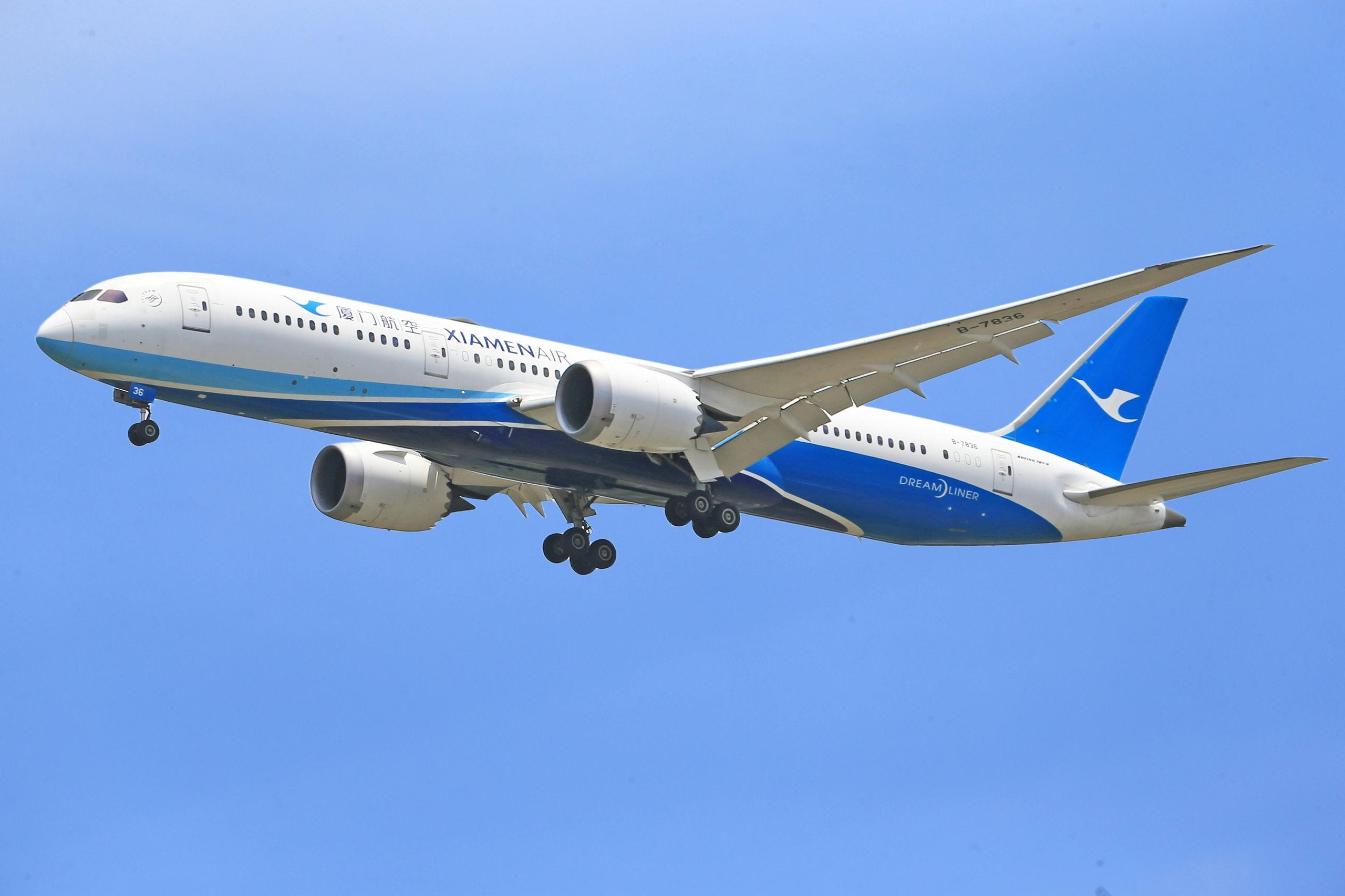
The fleet is overwhelmingly a Boeing 737 fleet. Well over 120 narrowbodies of the 737 family handle the bulk of rotations, supported by a small twin-engine widebody fleet of Boeing 787-8 and 787-9 Dreamliners for long-haul missions.

MAINLINE FLEET COMPOSITION (approx., mid-2024 baseline)
-------------------------------------------------------
Boeing 737-700          : 6 aircraft
Boeing 737-800          : 117 aircraft
Boeing 737 MAX 8        : 19 aircraft
Boeing 737-800BCF (frt) : 1 aircraft
Airbus A321neo          : 17 aircraft
Boeing 787-8            : 6 aircraft
Boeing 787-9            : 6 aircraft
-------------------------------------------------------
Total in service        : 172
The average age of around 10 years is younger than peers like Air China or China Eastern, but slightly older than the fleets of newer low-cost entrants.
That positioning gives Xiamen reasonable fuel burn discipline while leaving meaningful depreciation runway on most assets.
Boeing 737 Family: The Backbone
The Boeing 737-800 is the airline’s workhorse, with more than 110 units carrying the brunt of domestic and short-haul international flying. Standard cabin layouts are consistent across the 737-800 subfleet, supporting flexible route-to-aircraft assignment.
The 737 MAX 8 is gradually growing as deliveries resumed in the China market. Boeing recently restarted 737 MAX deliveries to China, and Xiamen Airlines was among the first to take new aircraft, signaling its willingness to keep Boeing as the narrowbody core even amid broader diversification.
Six Boeing 737-700s remain in the fleet, typically used on thinner domestic routes where the smaller cabin size aligns better with demand. These aircraft are the oldest frames in service and will likely be the first to leave during the next fleet renewal cycle.
Widebody Fleet: The Dreamliner Spine
Twelve Boeing 787 Dreamliners handle all of XiamenAir’s long-haul flying. The split is six 787-8s, purchased first starting in 2014, and six 787-9s, the larger variant that backbones the airline’s growing Europe and North America flying.
The 787-9 cabin configuration is 30 Business Class plus 257 Economy Class seats. That 287-seat layout is relatively dense for a 787-9, prioritizing unit-cost competitiveness on ultra-long-haul missions like Fuzhou-Amsterdam and JFK-Fuzhou.
Three additional 787-9s are on order according to tracking sites, keeping the Dreamliner line open for the next wave of long-haul expansion. Those deliveries will be especially important if XiamenAir moves its long-haul operations into the new Xiang’an airport after its late-2026 opening.
The Airbus Pivot
The A321neo arrival in 2022 ended Xiamen’s decades-long all-Boeing identity. Seventeen A321neos are now in service, with an additional eighteen on order, plus twenty Airbus A320neos reportedly scheduled to join.
This pivot is part hedging, part economics. It gives Xiamen access to Airbus deliveries during periods when Boeing supply is constrained or politically disrupted, and it provides a larger narrowbody option for slot-constrained routes where a 737-800 would leave revenue on the table.
Operationally, however, the dual-OEM approach adds complexity. Pilot pools, spares and maintenance workflows must be duplicated, which is an acceptable trade for a carrier of this scale but is worth tracking for cost inflation risk.
Aircraft Configuration Strategy
XiamenAir configures its cabins with a focus on practical comfort and consistent SkyTeam-grade product. Business Class on the 787-9 features flat-bed seating in a 1-2-1 reverse herringbone layout, competitive with regional peers on long-haul lanes.
Economy cabins trend dense. 2-3-2 or 3-3-3 layouts on 787s and 3-3 on 737s reflect the airline’s cost-sensitive leisure and VFR focus, particularly on Southeast Asian and overseas Chinese corridor routes.
In-flight product investments during 2024 and 2025 emphasized service process refinement over hardware upgrades. The carrier publicly highlighted service process improvements in its 2024 CSR narrative rather than a cabin retrofit program.
Special Liveries and Brand Strategy
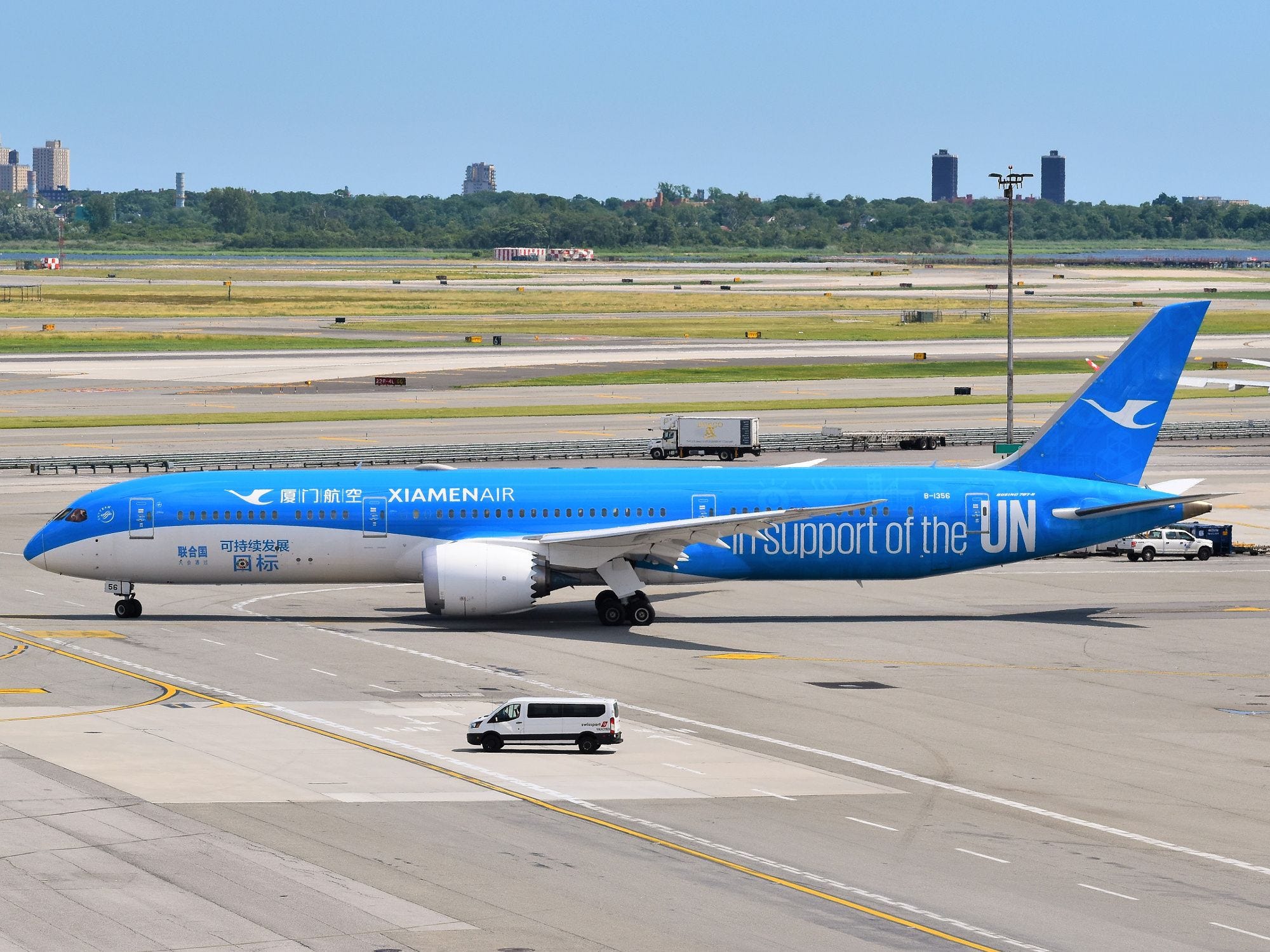
Xiamen Airlines has used aircraft liveries as branded marketing billboards for years. The Universal Beijing Resort Jurassic World livery on a Boeing 737 and the “United Dream” 787-9 in the United Nations partnership color scheme are widely recognized examples.
These aren’t simply decorative. Each livery ties into a broader tourism or institutional partnership that helps the airline deepen relationships with destination authorities and corporate partners, reinforcing route development work.
Fleet Strategy: Renewal, Commonality, and Capacity Discipline
The stated fleet strategy is deliberate and incremental. Rather than attempting to leapfrog peers with massive one-time orders, Xiamen Airlines has historically grown in controlled tranches, tied closely to route profitability evidence.
A representative recent action was the firm 30-unit 737 MAX order for Xiamen Airlines booked in 2017 at a list value of USD 3.6 billion. That order has been absorbed gradually, illustrating the airline’s preference for flexibility over front-loaded deliveries.
FLEET STRATEGY PILLARS
----------------------
1. Commonality-first narrowbody core (Boeing 737 NG + MAX)
2. Selective Airbus hedge (A321neo / A320neo)
3. Dreamliner-only widebody platform (787-8 + 787-9)
4. Group-level capacity flexibility (Hebei + Jiangxi absorb cycles)
5. Safety-led maintenance culture (KLM tech partnership signal)
6. Deliberate pace over capacity grabs
Looking ahead to 2026 and 2027, the main fleet priorities are threefold.
First, absorb new 737 MAX 8 and MAX 10 deliveries as China’s regulatory path for the MAX 10 type clarifies.
Second, scale the A320neo family to bring additional narrowbody choice into the fleet.
Third, incrementally add 787-9s to support the European and North American push.
Sustainability and Efficiency Considerations
The 787 fleet gives XiamenAir materially better fuel burn per seat on long-haul than the older widebodies operated by competitors. On the narrowbody side, the 737 MAX 8 and A320neo family provide a double-digit fuel consumption advantage over 737-800s.
Parent group disclosures reference digital transformation and operational refinement as 2025 strategic priorities.
For XiamenAir specifically, that translates into flight planning, weight management and auxiliary power unit usage optimization efforts, all of which reduce unit costs even without new aircraft.
Cargo Fleet and Logistics Integration
The airline operates one Boeing 737-800BCF as a cargo conversion in its mainline fleet. Group cargo activity is coordinated through Xiamen Airlines Cargo, which serves multiple group and external customers rather than acting as an independent freighter carrier.
This cargo model prioritizes commercial flexibility over scale. It aligns with the group’s positioning as a passenger-led operator that treats cargo as an incremental yield contributor rather than a separate business pillar.