


Executive Summary
Grupo Aeroméxico closed FY2025 with total revenue of $5.4 billion, Adjusted EBITDAR of $1.7 billion (31.2% margin), and net income of $351.9 million, alongside operating income of $928 million.
The airline operated 165 aircraft at year-end 2025, an average age of 8.6 years, weighted toward Boeing 737 MAX 8/9, 787-8/9 Dreamliners, and Embraer E190s under the Connect brand.
The carrier transported 24.587 million passengers in 2025 with a system load factor of 85.9%, completing a return to listed-equity status via a $222.8 million IPO on the NYSE in November 2025.
The Delta Joint Cooperation Agreement reached a forced unwind under DOT order during 2025, while the airline launched Barcelona, Paris, and Philadelphia routes ahead of the 2026 World Cup, where Mexico will host matches.
Recommended - Read Full Reports


Read All Reports
Table of Contents
Executive Summary
Introduction
Aeromexico Company Profile: Key Facts
Aeromexico Revenue and Financial Analysis
FY2025 Top-Line Performance
Adjusted EBITDAR and Margin Quality
4Q2025 Sequential Recovery
1Q2026 Initial Read
Revenue Growth Drivers Going Forward
Cost Structure and Capital Allocation
Key Services and Product Lines
Aeromexico Fleet Analysis
Fleet Size and Composition
Fleet Age and Renewal Trajectory
Aircraft Type Strategy and Cabin Configurations
Boeing 787-9 Dreamliner
Boeing 787-8 Dreamliner
Boeing 737 MAX 8 and MAX 9
Boeing 737-800 (Next Generation)
Embraer 190
Fleet Strategy: Why the Boeing-Embraer Concentration
Aircraft on Order and Future Deliveries
Cargo Fleet
Sustainability and SAF
Aeromexico Route Network, Major Destinations and Strategy
Network Reach and Destination Count
Domestic Network Strategy
United States Transborder Network
Latin America and Caribbean Network
European Network and 2026 Expansion
Asia and Long-Haul Strategy
Codeshares and Partnerships
Major Operational Bases (Hubs)
Mexico City International Airport (MEX) – Primary Hub
Felipe Ángeles International Airport (AIFA) – Secondary Mexico City Base
Monterrey International Airport (MTY) – Northern Hub
Guadalajara International Airport (GDL) – Western Hub
Tijuana International Airport (TIJ) – Cross-Border Operations
Cancún International Airport (CUN) – Leisure Gateway
Aeromexico Competitive Position
Major Competitors
Aeromexico vs. Volaris
Aeromexico vs. Viva
Aeromexico vs. Mexicana de Aviación
Aeromexico vs. American Airlines (US-Mexico Transborder)
Aeromexico vs. Delta Air Lines (Post-JV Unwind)
Aeromexico’s IPO and Capital Structure
November 2025 NYSE Debut
Ownership Structure
SkyTeam Alliance Position
On-Time Performance and Operational Excellence
Mexico Aviation Industry Context
Cargo Operations Deep Dive
Aeroméxico Rewards Loyalty Program
Digital and Distribution Strategy
Sustainability and ESG Profile
Operational and Regulatory Context
Mexican Regulatory Environment
US Department of Transportation
Mexican Federal Aviation Policy
Key Risks (With Probability and Scenario Analysis)
Risk 1
Risk 2
Risk 3
Risk 4
Risk 5
Risk 6
Risk 7
Risk 8
Risk 9
Risk 10
Risk 11
Risk 12
Strategic Outlook for 2026 and 2027
My Final Thoughts
Official Sources and Data
Introduction
Aeromexico has spent the last six years moving through more turbulence than most legacy carriers face in three decades.
The Mexican flag carrier emerged from Chapter 11 in early 2022, weathered the 2021 downgrade of Mexico to FAA Category 2, and on November 6, 2025 became the first Mexican airline in years to ring the bell at the New York Stock Exchange with a $2.8 billion valuation.
Heading into the 2026 FIFA World Cup, the airline is operating a 165-aircraft fleet, served 24.6 million passengers in 2025, and faces a genuinely unique operating context: it just lost its Antitrust Immunity with Delta, gained back FAA Category 1 status for Mexico, and is launching a Barcelona and a Paris route from Monterrey. Every meaningful operational lever is moving at once.
This in-depth analysis report examines Aeromexico, covering financial performance, fleet composition, hub strategy, competitive positioning, specific risk vectors that will shape calendar 2026 and 2027, and more.

Aeromexico Company Profile: Key Facts
Aeromexico, legally Aerovías de México, S.A. de C.V., is the flag carrier of Mexico, operating as the principal subsidiary of holding company Grupo Aeroméxico, S.A.B. de C.V. The airline’s corporate offices and main hub anchor at Mexico City International Airport’s Terminal 2.
The Group also operates Aeroméxico Connect, the regional brand that flies the entire Embraer E190 fleet, and Aeroméxico Cargo, which handles belly-hold and dedicated freighter operations from Mexico City.
Together, the units form the largest full-service aviation platform in the country.
GRUPO AEROMÉXICO – KEY FACTS
- IATA / ICAO Codes: AM / AMX
- Callsign: AEROMEXICO
- Founded: September 15, 1934 (as Aeronaves de México)
- Headquarters: Mexico City, Mexico
- Main Hub: Mexico City International Airport (MEX), Terminal 2
- Holding Company: Grupo Aeroméxico, S.A.B. de C.V.
- Listings: NYSE: AERO ; BMV: AERO (since November 6, 2025)
- CEO: Andrés Conesa Labastida (since 2005)
- Alliance: SkyTeam (founding member, since 2000)
- Operating Fleet: 165 aircraft (Dec 31, 2025)
- Average Fleet Age: 8.6 years
- 2025 Passengers Carried: 24.587 million
- 2025 Total Revenue: US$5.361 billion
- 2025 Net Income: US$351.9 million
- Largest Shareholders: Apollo Global Management, Delta Air Lines
The airline’s positioning is best understood as a hybrid between a Latin American legacy hub-and-spoke carrier and a network-focused premium operator that competes directly with US majors on transborder Mexico–USA flying.
Aeromexico Revenue and Financial Analysis
FY2025 Top-Line Performance
Aeromexico finished 2025 with total revenue of $5,361 million, down 4.6% from the $5,620 million reported a year earlier. Passenger revenue declined 5.6% year-over-year to $4,860 million.
The decline does not reflect a weak underlying business. Capacity for the system rose only marginally with available seat miles up 0.5%, while the airline absorbed ongoing pressure from binational political tension and the impact of the FAA Category 2 downgrade carryover that was only formally reversed in late 2023.
Profitability remained strong despite the modest revenue dip. The carrier reported full-year operating income of $928 million at a 17% margin and net income of $351.9 million for a 6.6% net margin.
Adjusted EBITDAR and Margin Quality
The most useful indicator of underlying earnings power for an airline is Adjusted EBITDAR. Aeromexico delivered $1.672 billion in Adjusted EBITDAR, translating to a 31.2% margin for the year.
Industry benchmarks place a 30%+ EBITDAR margin in the upper quartile of global full-service airlines.
The figure compares favorably with Delta and IAG and signals that the post-bankruptcy cost reset is structurally durable rather than a one-time benefit.
GRUPO AEROMÉXICO FY2025 KEY FINANCIALS
- Total Revenue: $5,361M (vs. $5,620M FY2024, -4.6%)
- Passenger Revenue: $4,860M (-5.6% YoY)
- Operating Income: $928M (17.3% margin)
- Adjusted EBITDAR: $1,672M (31.2% margin)
- Net Income: $351.9M (6.6% margin)
- Adjusted Net Leverage: ~1.6x (FY2026 outlook reference)
- 2025 Passengers Transported: 24,587,000
- System Load Factor: 85.9%
- Total ASMs (FY2025): 35,804M4Q2025 Sequential Recovery
The fourth quarter marked an inflection. Total revenue of $1,438 million was effectively flat at +0.2% versus Q4 2024, and operating leverage drove net income to $164.9 million versus $75.4 million in the prior-year quarter.
Fourth-quarter passenger revenue rose 4.3% year-on-year while passenger unit revenue (PRASM) climbed 6.2%. The combination of stable capacity, recovering yields, and ratably stronger US transborder demand confirmed the recovery thesis the management team had been signaling since Q3.
1Q2026 Initial Read
Trading momentum carried into the first quarter of the new fiscal year.
Recent disclosures alongside the annual report on Form 20-F referenced 1Q26 revenue near $1,341 million and liquidity of approximately $1.2 billion, supporting the operational guidance that 2026 will outperform 2025.
Revenue Growth Drivers Going Forward
Three growth drivers will shape FY2026 and FY2027 outcomes.
First, fleet additions tied to the World Cup ramp will flow into the network in the first half of 2026, increasing capacity in markets where the airline already enjoys pricing power.
Second, the launch of Mexico City to Barcelona service and Monterrey to Paris service introduces two structurally underserved Mexico to Europe pairs. These long-haul routes carry a higher proportion of premium-cabin revenue per ASM than transborder narrowbody flying.
Third, Aeromexico Cargo grew 20% in 2025, driven by e-commerce volumes between Asia and the Americas that increasingly route through Mexico City as a logistics gateway. Cargo is now a meaningful contributor to overall unit revenue.
Cost Structure and Capital Allocation
The airline ended 2025 with adjusted net leverage near 1.6x, an unusually conservative position for a Mexican carrier compared with the deeply leveraged years just before and during the pandemic.
Liquidity of approximately $1.2 billion in early 2026 funds the planned capex schedule for new 787s and the continued MAX deliveries.
Capital allocation priorities, as outlined on the Q4 2025 earnings call, are weighted toward fleet renewal, network expansion, and digital infrastructure rather than dividends or buybacks during the immediate post-IPO phase.
Key Services and Product Lines
Mainline Aeromexico operates two-cabin domestic and three-cabin long-haul service, with the Premier One business class product on Boeing 787-9 aircraft offering 1-2-1 lie-flat suites with direct aisle access. Premier on the 787-8 is a previous-generation reverse-herringbone product.
Aeroméxico Connect operates the Embraer 190 fleet, with Premier Class offered alongside AM Plus extra-legroom seating.
The Connect brand handles short-haul thin domestic routes and select US transborder city-pairs where 76 to 99 seats match the demand profile better than a 737.
AEROMÉXICO – PRODUCT SEGMENTATION (2026)
- Long-Haul Premium: Premier One (1-2-1 lie-flat) on B787-9
- Long-Haul Premium: Premier Class (lie-flat) on B787-8
- Narrowbody Domestic/Transborder: Two-cabin B737-800 / B737 MAX 8 / B737 MAX 9
- Regional / Thin Routes: E190 with Premier + AM Plus + Main Cabin
- Cargo: Belly-hold mainline + dedicated B767-300F freighter capacity
- Loyalty: Aeroméxico Rewards (membership +14.0% YoY at June 2025)
The Aeroméxico Rewards program reached approximately 14% year-over-year membership growth between June 2024 and June 2025, based on disclosures filed with the SEC ahead of the IPO.
Aeromexico Fleet Analysis
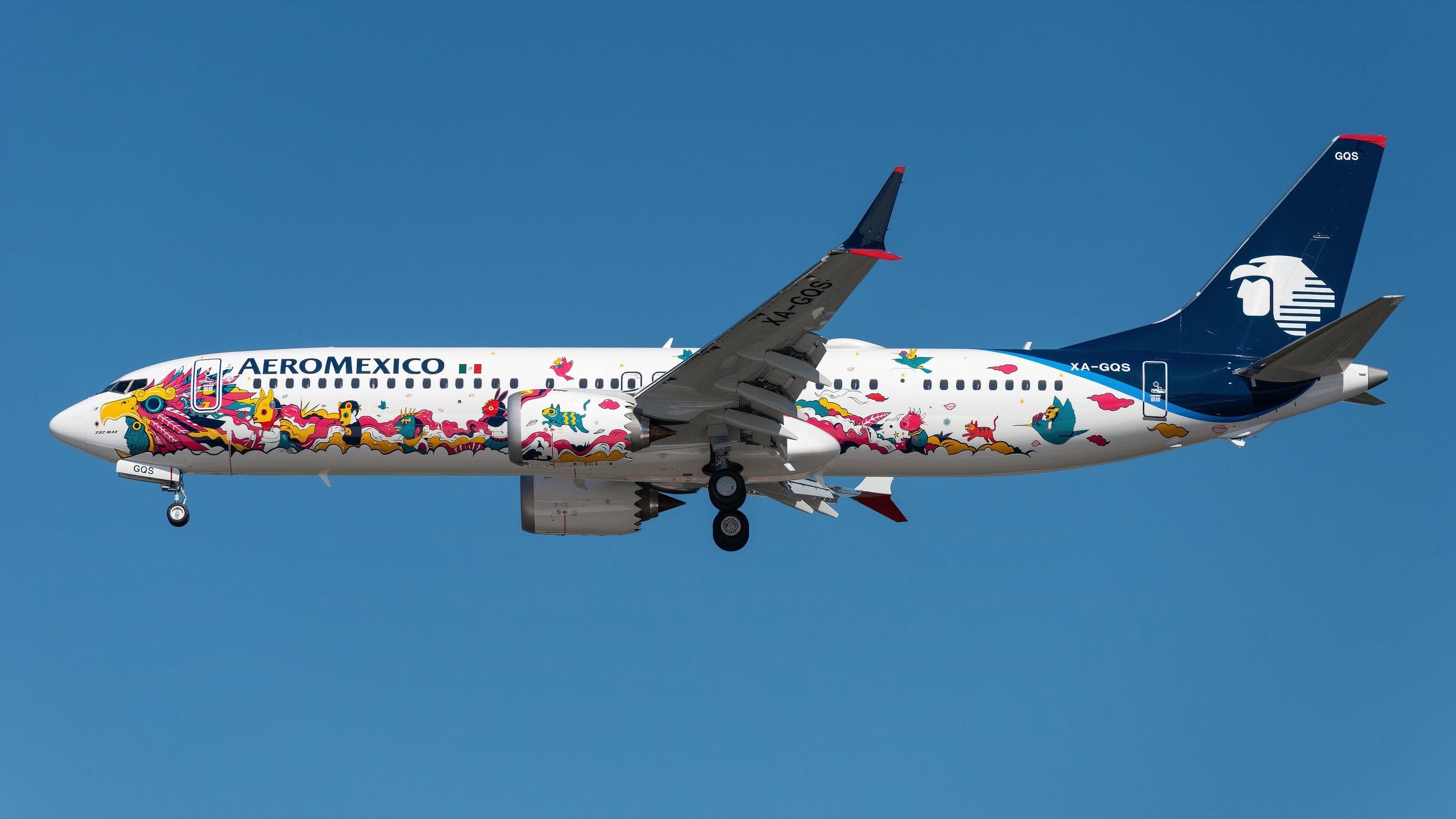
Fleet Size and Composition
Aeromexico’s operating fleet stood at 165 aircraft at year-end 2025, an increase of 17 aircraft over the prior year. The expansion came predominantly from MAX deliveries, with one Boeing 737 MAX 8 and two Boeing 737 MAX 9 entering service in the fourth quarter alone.


The composition is deliberately concentrated on three Boeing types and one Embraer type, simplifying maintenance, training, and crew scheduling across two operating certificates.
AEROMÉXICO OPERATING FLEET (as of December 31, 2025)
Mainline (Aeroméxico, AOC: AMX)
  - Boeing 737-800:        34 aircraft
  - Boeing 737 MAX 8:      45 aircraft
  - Boeing 737 MAX 9:      30 aircraft
  - Boeing 787-8:           ~8 aircraft (subset of 22 total 787s)
  - Boeing 787-9:          ~14 aircraft (subset of 22 total 787s)
  Mainline Subtotal:      131 aircraft

Regional (Aeroméxico Connect, AOC: SLI)
  - Embraer 190:           34 aircraft
  Connect Subtotal:        34 aircraft

GRAND TOTAL:              165 aircraft
Average Fleet Age: 8.6 yearsFleet Age and Renewal Trajectory
An average fleet age of 8.6 years places Aeromexico above ultra-low-cost competitor Volaris (whose Airbus A320 family fleet sits at approximately 7 years) yet below the global legacy carrier average of roughly 11 years.
The 8.6-year figure is a weighted blend, the 787 fleet is younger and the 737-800 cohort older.

Boeing 787-8 frames in service at Aeromexico are now 9 to 13 years old, and several are approaching the threshold where airlines typically begin to consider redelivery or upgauge to 787-9. The 737 MAX cohort, by contrast, is on average newer than four years.
Aircraft Type Strategy and Cabin Configurations
Aeromexico has standardized its cabin layouts to a high degree, which simplifies revenue management and operational recovery during irregular operations. Each platform plays a distinct role in the network.
Boeing 787-9 Dreamliner
The 787-9 is Aeromexico’s flagship long-haul aircraft. Configurations include 38 Premier One business class lie-flat suites in 1-2-1 layout, and the cabin includes an onboard Sky Bar feature on selected aircraft.
The 787-9 anchors flying to Tokyo Narita, Madrid, Paris, Amsterdam, Buenos Aires, São Paulo, and to several US gateway cities including New York JFK, Los Angeles, and San Francisco.
Boeing 787-8 Dreamliner
The 787-8 carries an older Premier Class configuration with reverse-herringbone seating in a 2-2-2 layout in some sub-fleets and a more updated arrangement in others. It is typically deployed on slightly thinner long-haul rotations or as a substitution for the 787-9 during heavy maintenance cycles.
The capacity for up to 274 passengers on the 787-9 versus a smaller seat count on the 787-8 makes the larger variant more economical on premium-heavy markets.
Boeing 737 MAX 8 and MAX 9
The MAX family is the workhorse for transborder and South American flying. The MAX 8 typically operates Mexico to US routes ranging from 2 to 5 hours, while the MAX 9, with its larger capacity, is being deployed on the highest-demand domestic and US transborder city-pairs where slot constraints make upgauging the only practical capacity action.
The MAX program has been the single largest source of unit-cost improvement for the airline relative to legacy 737-800 economics.
Boeing 737-800 (Next Generation)
The 34-aircraft 737-800 sub-fleet remains in service to provide capacity flexibility while MAX deliveries continue. Average ages on the 737NG fleet are higher and progressive retirement is expected as MAX deliveries fulfill the Group’s order book through Q1 2027.
Embraer 190
The Embraer 190 fleet operated by Aeroméxico Connect serves more than 300 daily flights to 42 destinations. The 99-seat E190 enables service to airports that cannot economically support a 737, including key US transborder city-pairs like Raleigh-Durham and Austin from Mexico City.
The fleet is being upgraded with Viasat Amara in-flight connectivity as part of a multi-year cabin refresh.
Fleet Strategy: Why the Boeing-Embraer Concentration
The strategic decision to concentrate on Boeing narrowbodies and Embraer regional jets traces back to multiple factors.
First, fleet commonality reduces training cost and rotational complexity for crew.
Second, US-built airframes simplify spare-parts logistics for an airline whose largest international market is the United States.
Third, Aeromexico’s relationship with Boeing is institutional. The 2025 announcement that Aeroméxico would add 29 aircraft to support the 2026 FIFA World Cup is sourced almost entirely from Boeing.
FLEET STRATEGY PILLARS – AEROMÉXICO 2026
1. Three-type narrowbody simplification: 737NG retirement, MAX 8 + MAX 9 standardization
2. Single long-haul platform: Boeing 787 family (no Airbus widebody)
3. Single regional type: Embraer E190 (no turboprop, no smaller jets)
4. Cargo upgrades: B767-300P2F freighters; six in service
5. Cabin investment: Premier One on 787-9; Viasat IFC retrofit on E190 fleet
6. Average age target: Maintain in 8 to 9 year band through 2027
Aircraft on Order and Future Deliveries
The airline has continued 787-9 deliveries through Q4 2025 and Q1 2027, with the new long-haul livery introduced in late 2025. MAX 8 and MAX 9 deliveries continue throughout 2026.
This pacing matches the network expansion timeline: Barcelona launches in March 2026, Paris from Mexico City and Monterrey in April 2026, with summer-season frequencies dependent on widebody availability.
Cargo Fleet
Aeroméxico Cargo operates six Boeing 767-300 passenger-to-freighter (P2F) aircraft, with the most recent delivery in December 2024. The freighters fly under wet-lease arrangements alongside belly-hold capacity on mainline 787 and 737 services.
The 2025 interline partnership with Uzbekistan-based My Freighter opened a new connectivity corridor between Mexico and Central Asia, anchored on textiles and e-commerce.
Sustainability and SAF
Aeroméxico has committed to 5% sustainable aviation fuel use by 2030, with 20% of that volume targeted from domestic Mexican sources. The airline operated the first SAF-powered commercial flight in Latin America in 2011 and continues to use SAF on selected domestic and international rotations.
The newer Boeing 787-9 and MAX 8/9 platforms carry approximately 15 to 25% lower fuel burn per seat than the previous-generation aircraft they are replacing, which provides a meaningful share of the airline’s emissions reduction trajectory before SAF becomes a material contributor.