


Welcome to AviationOutlook: The aviation newsletter built exclusively for decision-makers.
Become an “Annual” member now & get this special discount offer.
As a paid member, you get access to:
200+ Reports - All major airlines + aerospace & defense companies (updated regularly).
Daily / Weekly - Deep-dive analysis & insights.
Monthly - Industry outlook reports.
In case you missed it, here are the latest analysis:
Singapore Airlines Trapped in Air India’s Money Pit With No Cheap Exit in Sight
Indra Sistemas - Company Analysis and Outlook Report 2026 (Updated)
Check Out All Reports
Executive Summary
Transat A.T. posted record fiscal 2025 results with revenues of $3.4 billion and all-time high adjusted EBITDA of $271 million, yet stumbled in Q2 2026 with a $20.7 million adjusted EBITDA loss driven by a $95 million fuel and Cuba shock.
The carrier completed its Elevation Program in mid-2026, hitting the targeted $100 million annualized improvement in adjusted operating income exactly on schedule.
Air Transat operates an all-Airbus fleet of 42 aircraft (8 A321ceo, 19 A321LR, 13 A330-200, 2 A330-300) and will take four A321XLRs from 2027 while phasing out the aging A330s between 2029 and 2032.
The joint venture with Porter Airlines, launched in June 2024, now coordinates pricing, schedules and revenue sharing across overlapping routes, creating a credible third force against Air Canada and WestJet in Canadian leisure markets.
For winter 2026-2027 the airline is adding Aruba, Barbados and Los Cabos from Montreal while converting Toronto-Paris and Montreal-Barcelona to year-round service, signaling a decisive pivot toward diversification after exiting Cuba and both Florida gateways.
Are you a part of a team?
Equip your whole team with aviation industry intelligence. Consider “Group” or “Enterprise” plan.
Here’s what you get in this analysis report:
Air Transat Company Profile: Key Facts
Revenue and Financial Analysis
Fiscal 2025: The Record Year That Reset the Baseline
Last Twelve Months Revenue Trajectory
Latest Quarterly Earnings and Guidance
Six-Month and Last-Twelve-Month Perspective
Cost Structure, Fuel Exposure and Currency Dynamics
Liquidity, Debt Paydown and the LASR Backstop
Growth Drivers and Key Services
The Elevation Program: From Turnaround to Run-Rate
The Porter Airlines Joint Venture: Creating the Third Force
Loyalty Program Launch: Closing the Revenue Gap
Product and Service Architecture
Tour Operator Integration and Packaging Power
Distribution Strategy and the Direct Booking Push
Fleet Analysis
Current Composition and Age Profile
A321XLR: The Next Growth Vector
Fleet Strategy Logic: Narrowbody Long-Haul Economics
Cabin Configuration and Product Consistency
Lease Structure and Fleet Flexibility
Sustainability Positioning
Route Network Strategy and Major Destinations
Summer 2026: Africa and Secondary Europe Drive Growth
Winter 2026-2027: Rebuilding the Sun Portfolio
Network Architecture: Hub Concentration with Focus City Growth
Seasonality Management: The Two-Network Model
South America and the Lima Precedent
Major Operational Bases
Competitive Position
The Canadian Leisure Market Structure
Major Competitors
Air Transat versus Air Canada Rouge
Air Transat versus WestJet
The Skytrax Advantage
Air Transat versus European Leisure Carriers
Where Air Transat Wins and Where It Concedes
Strategic Contexts Shaping 2026 and Beyond
The Cuba Suspension and Geopolitical Risk
Government Debt Restructuring and the LASR Facility
Labor Stability Through 2027
Pratt & Whitney GTF Engine Resolution
The Network Carrier Transformation
What the Remainder of 2026 Holds
Key Risks
Stakeholder Implications
My Final Thoughts
Official Sources and Data
Introduction
In 2025, Transat A.T. did something it had failed to do since 2018: it reported a full-year net profit. The $241.9 million bottom line, flattered by a $345.3 million accounting gain on government debt restructuring, still represented the first profitable fiscal year in seven.
Six months later the story flipped again.
Second-quarter results released in June 2026 showed a $79 million net loss as an industry-wide fuel spike and the indefinite suspension of Cuba flying wiped out $95 million of expected EBITDA in a single quarter.
The swing captures the central tension in the Air Transat case: a structurally stronger business model colliding with external shocks that remain brutally expensive for a mid-sized leisure carrier.
This deep-dive report examines what has actually changed inside the Montreal-based group, why the fleet and network choices made between 2022 and 2026 matter more than the quarterly noise, and how the completed Elevation Program plus the Porter joint venture position Air Transat for the remainder of 2026 and beyond.
Let’s analyze everything in detail.
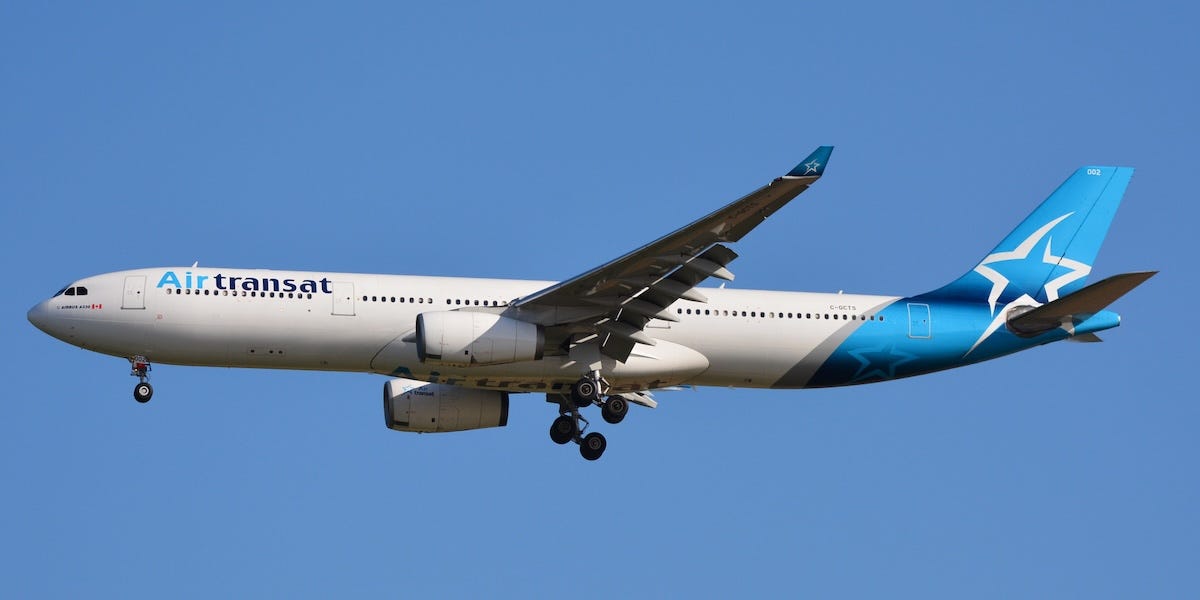
Air Transat Company Profile: Key Facts
Air Transat is the operating airline brand of Transat A.T. Inc., a publicly traded Montreal company listed on the Toronto Stock Exchange under ticker TRZ.
The group functions as a vertically integrated leisure travel provider: the airline sells seats directly and also feeds Transat’s own tour operator brands (Transat, Club Med specialists, and the Trafic Tours destination services network).
Founded in 1986, the airline carried roughly 5.4 million passengers in fiscal 2025 across a network that spans Europe, the Caribbean, Mexico, Central and South America, North Africa and the domestic Canadian transcontinental market.
COMPANY SNAPSHOT - TRANSAT A.T. INC.
Parent:               Transat A.T. Inc. (TSX: TRZ)
Founded:              1986 (Montreal)
Headquarters:         Montreal, Quebec, Canada
CEO:                  Annick Guerard (since May 2021)
CFO:                  Jean-Francois Pruneau
Employees:            ~5,000
Fleet:                42 aircraft (all Airbus)
Primary hubs:         Montreal-Trudeau (YUL), Toronto Pearson (YYZ)
Focus cities:         Quebec City (YQB), Ottawa (YOW), Vancouver (YVR), Calgary (YYC)
Fiscal 2025 revenue:  C$3.398 billion
Fiscal 2025 adj. EBITDA: C$271 million (record)
Loyalty program:      New program launching H2 2026 with Desjardins and Visa
Alliance:             Joint venture with Porter Airlines (launched June 2024)
Skytrax:              World's Best Leisure Airline 2025 (7th win, 3rd consecutive)
The carrier has deliberately avoided joining a global alliance.
Instead it built a bespoke partnership with Porter Airlines that functions as a North American feeder network while preserving Air Transat’s independence on long-haul leisure routes.