- AviationOutlook
- Posts
- Airbus - Company Analysis and Outlook Report (2026)
Airbus - Company Analysis and Outlook Report (2026)
Executive Summary
Airbus delivered 793 commercial aircraft in 2025, narrowly exceeding its revised target despite significant supply chain challenges, with revenues reaching €47.4 billion in the first nine months.
The company maintains a commanding backlog of 8,665 commercial aircraft, representing approximately 11 years of production at current rates, providing exceptional revenue visibility through 2035.
Supply chain constraints and engine shortages remain the primary operational challenge, forcing production rate adjustments and delivery target revisions from 820 to 790 aircraft in 2025.
Strategic acquisitions and partnerships position Airbus for long-term dominance, including the Spirit AeroSystems integration completed in December 2025 and the announcement of a European space industry consolidation with Leonardo and Thales.
Also Read:
Table of Contents
Business Overview: The European Aviation Giant
Airbus operates as the world’s leading aircraft manufacturer, competing directly with Boeing in commercial aviation while maintaining diversified operations across defense, space, and helicopters.
The company’s headquarters in Leiden, Netherlands, oversees a global industrial footprint spanning Europe, Asia, and North America. With 159,409 employees as of September 2025, Airbus represents one of Europe’s most strategically important industrial corporations.
Core Business Segments and Revenue Drivers
Commercial Aircraft Division
Airbus Commercial Aircraft generated €33.9 billion in revenue during the first nine months of 2025, representing 71% of total revenues.
The division’s product portfolio spans from the A220 regional jet through the flagship A350 widebody. The A320neo family dominates the backlog with approximately 88.9% of outstanding orders consisting of single-aisle narrowbody aircraft.
Production rates tell the growth story. The A320 family is ramping toward 75 aircraft per month by 2027. The A350 widebody program targets a rate of 12 aircraft monthly by 2028, up from an average of 4.5 per month in 2025.
Image source: commons.wikimedia.org
Airbus Helicopters
The helicopter division delivered 218 units in the first nine months of 2025, generating €5.7 billion in revenue.
This represents 16% year-over-year revenue growth driven by both military and civilian demand. Spain’s contract for 100 military helicopters announced in December 2025 exemplifies the strong defense market position.
Airbus Defence and Space
Defence and Space operations produced €8.9 billion in revenue through September 2025, a 17% increase year-over-year.
The division underwent significant restructuring in 2025, implementing a new organizational structure in July and reducing headcount by approximately 2,500 positions through mid-2026. Order intake totaled €6.8 billion, though this represented a 38% decline from the exceptionally strong €11.0 billion booked in the same period of 2024.
Financial Performance: Last Twelve Months
Revenue (LTM): €86.9 billion
EBITDA (LTM): €11.5 billion
EBIT Adjusted (9M 2025): €4.1 billion
Net Income (9M 2025): €2.6 billion
Free Cash Flow (9M 2025): €-0.9 billion
The company targets full-year 2025 EBIT Adjusted of approximately €7.0 billion with free cash flow before customer financing around €4.5 billion.
Revenue quality remains strong with defense revenues accounting for €9.2 billion, or 19% of the consolidated total through nine months. Services across all divisions continue growing, providing higher-margin recurring revenue streams.
Key Product Lines and Programs
A321XLR: Game-Changing Market Entry
The A321XLR entered service in November 2024 with Iberia, marking a transformational moment for narrowbody economics.
American Airlines became the first U.S. carrier to operate the aircraft in December 2025. The A321XLR’s 4,700 nautical mile range enables point-to-point long-haul routes previously requiring widebody aircraft, fundamentally altering network economics for airlines.
The aircraft received EASA type certification with Pratt & Whitney engines in February 2025, expanding engine optionality beyond the CFM LEAP powerplant. This dual-engine strategy reduces supply chain risk while providing airlines competitive procurement flexibility.
A320neo Family: Production Backbone
The A320neo family achieved a historic milestone in October 2025, becoming the most-delivered airliner type in aviation history.
With nearly 20,000 orders accumulated since program launch, the A320neo family represents Airbus’s cash generation engine. The company delivered 392 A320 family aircraft in the first nine months of 2025.
Supply chain challenges, particularly fuselage panel defects discovered in November 2025, temporarily constrained production. Despite these issues, Airbus maintains its trajectory toward rate 75 by 2027, though this represents a more gradual ramp than initially planned.
A350: Widebody Excellence
The A350 program delivered 33 aircraft through September 2025, well below the production capacity due to persistent supply chain bottlenecks.
The company targets rate 12 by 2028, more than doubling current production levels. The A350-1000 variant continues gaining traction, with STARLUX Airlines taking delivery of its first A350-1000 in January 2026.
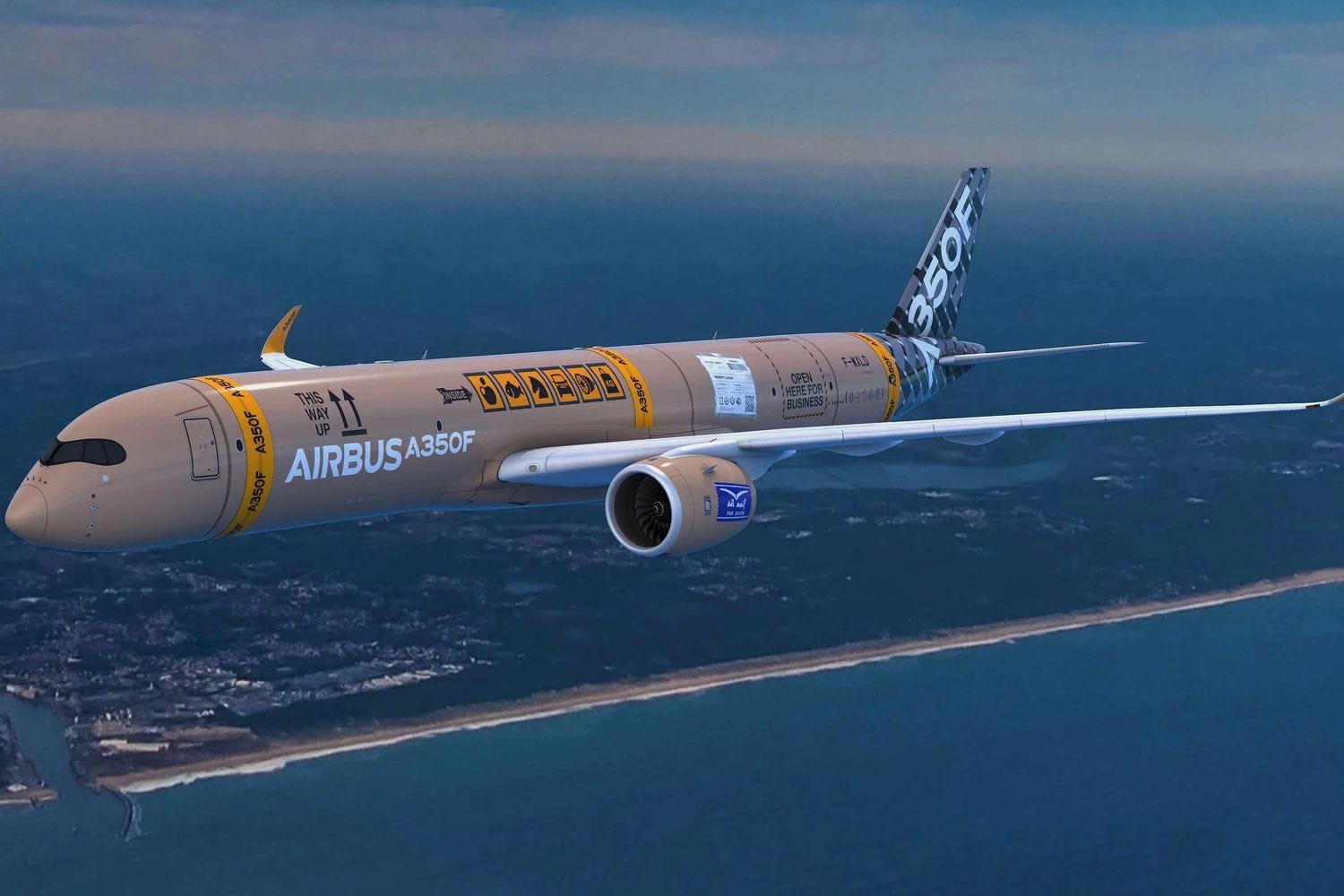
The A350F freighter variant, now targeting first flight in Q3 2026, addresses the growing cargo market. Entry into service is planned for the second half of 2027 following a one-year delay to strengthen the business case.
A220: Strategic Repositioning
The A220 program underwent production rate adjustments in 2025, scaling back from rate 14 to rate 12 aircraft per month for 2026.
Airbus delivered 62 A220 aircraft in the first nine months of 2025. The program continues maturing, with improved economics expected as production experience accumulates and supply chain efficiencies develop.
Competitive Analysis and Market Position
Porter’s Five Forces Analysis
Threat of New Entrants: Very Low
Capital requirements, regulatory barriers, and technological complexity create nearly insurmountable entry barriers. The commercial aircraft duopoly has remained intact for decades.
Development costs for new aircraft programs exceed $15 billion, requiring multi-decade payback periods. Manufacturing scale economies favor incumbents with established production systems.
Bargaining Power of Suppliers: High
Airbus faces significant supplier power, particularly from engine manufacturers CFM International and Pratt & Whitney.
Engine supply shortages constrained deliveries throughout 2025, forcing revised guidance. Both engine suppliers struggle with technical issues and production capacity limitations.
The December 2025 acquisition of Spirit AeroSystems work packages represents a strategic move to internalize critical aerostructures production, reducing supplier dependency for key components.
Bargaining Power of Buyers: Moderate to High
Airlines possess substantial negotiating power through large fleet orders and competitive manufacturer choice.
However, the 8,665 aircraft backlog demonstrates strong underlying demand exceeding supply. This supply-constrained environment reduces buyer leverage in the near term, though long-term pricing power remains balanced.
Switching costs for airlines are significant due to pilot training, maintenance infrastructure, and fleet commonality benefits. Multi-fleet operators can credibly threaten switching, maintaining competitive discipline.
Threat of Substitutes: Low
No viable substitutes exist for long-distance air travel in the commercial transport market.
Regional alternatives including high-speed rail compete for shorter routes under 500 kilometers, but this represents a small portion of total aviation demand. Business jets serve premium point-to-point travel but cannot substitute for mass transportation.
Competitive Rivalry: Intense
The Airbus-Boeing duopoly creates sustained competitive intensity.
Boeing secured more gross orders in 2025 with approximately 1,000 gross orders compared to Airbus’s 797, though Airbus maintained delivery leadership with 793 aircraft versus Boeing’s estimated 561 deliveries.
Market share dynamics favor Airbus with 56% of the commercial aircraft backlog versus Boeing’s 44%. This structural advantage positions Airbus for sustained revenue growth through 2035.
Competitive Moat Assessment
Scale Economies
Airbus’s production volumes generate per-unit cost advantages that smaller competitors cannot replicate.
The A320 family production system, spanning final assembly lines in Toulouse, Hamburg, Mobile, and Tianjin, represents one of the most efficient aircraft manufacturing operations globally. Fixed cost absorption across 700+ annual deliveries creates substantial margin advantages.
Intellectual Property and Know-How
Decades of aerospace engineering experience create accumulated knowledge that competitors cannot quickly acquire.
Airbus’s fly-by-wire technology, composite materials expertise, and aerodynamic optimization represent proprietary advantages developed through billions in R&D investment. The company spent €2.1 billion on self-financed R&D in the first nine months of 2025.
Customer Switching Costs
Airlines face multi-million dollar costs switching aircraft families due to pilot training requirements, maintenance tooling, and spare parts inventory.
Fleet commonality benefits create powerful incentives for airlines to stay within aircraft families. An A320 operator adding A321neo capacity avoids substantial transition costs compared to introducing a new manufacturer’s aircraft.
Network Effects
The global parts supply network, maintenance infrastructure, and pilot availability create self-reinforcing advantages.
More than 11,000 Airbus commercial aircraft in service generate a mature support ecosystem. This installed base attracts third-party service providers, creating a comprehensive support infrastructure that benefits all Airbus operators.
Recent Developments and Timeline
2025 Q4
December 8, 2025: Airbus completed the acquisition of Spirit AeroSystems facilities in Kinston, North Carolina; Wichita, Kansas; Tulsa, Oklahoma; and Subang, Malaysia. The €439 million compensation transaction strengthens supply chain control for A350 sections and A220 fuselages.
December 3, 2025: Airbus revised 2025 delivery guidance downward from 820 to approximately 790 aircraft due to A320 family fuselage panel defects. Financial guidance remained unchanged at €7.0 billion EBIT Adjusted.
November 28, 2025: The company announced a precautionary fleet action for certain A320 Family aircraft after analysis revealed potential solar radiation data corruption affecting critical systems.
2025 Q3
October 29, 2025: Third quarter results showed revenue of €47.4 billion and EBIT Adjusted of €4.1 billion for the nine-month period. The company delivered 507 commercial aircraft through September.
October 23, 2025: Airbus, Leonardo, and Thales signed a memorandum of understanding to merge their space activities into a new European space champion, potentially operational by 2027.
October 14, 2025: Airbus streamlined its tactical uncrewed aerial system portfolio, consolidating Survey Copter, Aliaca, and Capa-X offerings under unified management.
2025 Q2
July 1, 2025: Airbus Defence and Space implemented a new organizational structure designed to strengthen operational efficiency and customer focus.
2025 Q1
February 21, 2025: The A321XLR with Pratt & Whitney engines received EASA type certification, enabling deliveries to airlines selecting the PW1100G powerplant option.
Financial and Commercial Implications
Revenue Growth Trajectory
Airbus enters 2026 with exceptional revenue visibility through its 8,665 aircraft backlog valued at approximately €500 billion at list prices.
Annual revenue should reach €80-85 billion by full-year 2026 assuming approximately 820 aircraft deliveries and continued services growth. The company’s three-year revenue growth rate stands at 9.7%, outpacing industry averages.
Defense revenues provide counter-cyclical balance, growing 19% year-over-year in the first nine months of 2025. This diversification reduces commercial aviation exposure while capturing increased European defense spending.
Margin Dynamics and Profitability
EBIT Adjusted margins improved to 8.7% for the first nine months of 2025 compared to 6.3% in the prior year period.
Several factors drive margin expansion. Favorable hedge rates protect against currency volatility. Higher delivery volumes provide better fixed cost absorption. Services revenue growth contributes higher-margin recurring income streams.
The A320neo family remains the profit engine, generating strong per-unit contributions as the program matures. A350 margins improve gradually as production rates increase and learning curve benefits accumulate.
Cash Generation and Capital Allocation
Free cash flow remains pressured in the near term due to inventory build-up supporting Q4 deliveries and production rate increases.
The company generated negative €0.9 billion free cash flow before customer financing through September 2025. Fourth quarter deliveries typically drive strong cash conversion as pre-delivery payments convert to final payments.
Full-year 2025 guidance targets €4.5 billion free cash flow before customer financing. This represents approximately 6% FCF yield on enterprise value, demonstrating solid cash generation despite the production ramp environment.
Capital allocation priorities include funding rate increases, R&D investment, and returning cash to shareholders through dividends and buybacks. The company maintained a share buyback program in Q4 2025.
Balance Sheet Strength
Airbus maintains a robust financial position with net cash of €7.0 billion as of September 30, 2025.
This represents a decline from €11.8 billion at year-end 2024, driven by dividend payments and working capital investment. Gross cash stood at €21.3 billion, providing substantial liquidity for operations and strategic investments.
Credit ratings remain investment grade. Fitch affirmed the A rating in January 2026, projecting EBITDA leverage around 1.5x at year-end 2025. The strong capital structure supports ongoing investments while maintaining financial flexibility.
Key Risks and Mitigation Scenarios
Supply Chain Disruption Risk (Probability: High, Impact: High)
Engine manufacturers continue struggling with production capacity and technical issues.
CFM International’s LEAP engine production lags demand while Pratt & Whitney addresses geared turbofan durability concerns requiring accelerated shop visits. These constraints directly impact Airbus delivery capability.
Mitigation Strategy: The Spirit AeroSystems acquisition internalizes critical aerostructures production. Airbus actively works with engine suppliers on capacity expansion while maintaining dual-source engine options where possible. The company adjusts production rates to match realistic engine availability rather than overpromising deliveries.
Scenario Analysis: Continued engine shortages could constrain 2026 deliveries to 800-820 aircraft versus higher targets. Each 20-aircraft shortfall represents approximately €1.5-2.0 billion in delayed revenue, though deferred rather than lost.
Geopolitical and Trade Risk (Probability: Moderate, Impact: Moderate to High)
U.S. tariffs and trade tensions create uncertainty, though 2025 guidance now includes currently applicable tariff impacts.
The U.S. manufacturing presence in Mobile, Alabama, provides some political insulation. However, escalating trade conflicts could impact costs, supply chains, or customer financing.
Mitigation Strategy: Airbus maintains geographically diversified production across Europe, North America, and China. The company engages constructively with governments on both sides of trade disputes while emphasizing job creation in key political constituencies.
Scenario Analysis: Severe trade restrictions could increase costs by 2-3% through tariffs and supply chain rerouting. More significant risks involve potential aircraft order cancellations if trade tensions severely damage international airline economics.
Competitive Pressure from Boeing Recovery (Probability: Moderate, Impact: Moderate)
Boeing’s stabilization following production and safety challenges could intensify competitive dynamics.
Boeing’s 2025 order momentum with 1,000 gross orders suggests the manufacturer regaining commercial traction. The 787 Dreamliner production recovery directly competes with A350 in the widebody segment.
Mitigation Strategy: Airbus leverages its backlog cushion and production stability to maintain market position. Superior on-time delivery performance and production quality provide competitive differentiation. The A321XLR offers unique narrowbody range capabilities that Boeing cannot match until potential NMA/797 program launch in the 2030s.
Scenario Analysis: Intensified Boeing competition could reduce order intake by 10-15% annually while maintaining current backlog work-off. Given the multi-year order book, near-term revenue impact remains minimal, though long-term market share dynamics warrant monitoring.
Decarbonization and Regulatory Risk (Probability: High, Impact: Moderate)
Aviation faces increasing pressure to reduce carbon emissions through regulatory requirements and customer demand.
The EU Emissions Trading System, sustainable aviation fuel mandates, and potential carbon taxes create compliance costs and operational changes. Aircraft efficiency improvements face physical limits requiring breakthrough technologies.
Mitigation Strategy: Airbus pursues a multi-track strategy including sustainable aviation fuel adoption, hydrogen propulsion research, and continuous efficiency improvements. All Airbus aircraft are certified for 50% SAF operation as of 2025, with 100% SAF capability targeted by 2030.
The ZEROe hydrogen aircraft program targets 2035 entry into service, though timelines were recently adjusted to reflect technical and infrastructure challenges. Airbus focuses near-term efforts on SAF scale-up and evolutionary efficiency gains while pursuing revolutionary hydrogen technology for long-term transformation.
Scenario Analysis: Accelerated regulatory requirements could necessitate earlier introduction of expensive decarbonization technologies, potentially impacting margins by 1-2 percentage points. Conversely, successful hydrogen aircraft commercialization by 2035 would provide substantial competitive advantage in an increasingly carbon-constrained market.
Financial Risk: Currency Exposure (Probability: High, Impact: Moderate)
Airbus faces structural dollar exposure with 60-70% of revenues dollar-denominated while approximately 60% of costs are euro-denominated.
Dollar weakness creates translation headwinds and impacts competitiveness versus Boeing. The company employs extensive hedging programs to mitigate near-term volatility.
Mitigation Strategy: Multi-year hedge book provides 3-5 year forward coverage at known rates. The company targets increasing dollar-based costs through U.S. supplier relationships and manufacturing. Natural hedges through dollar-denominated debt reduce net exposure.
Scenario Analysis: A 10% dollar decline versus euro reduces annual EBIT by approximately €500 million absent hedging. The hedge book smooths this impact over 3-5 years, limiting annual profit volatility to €100-150 million for major currency swings.
Strategic Analysis Frameworks
SWOT Analysis
Strengths | Weaknesses |
|---|---|
• Backlog of 8,665 aircraft providing 11 years revenue visibility | • Persistent supply chain dependencies creating delivery constraints |
• Market-leading A320neo family with 88% of narrowbody backlog | • Complex global manufacturing footprint with geopolitical risks |
• Diversified business across commercial, defense, helicopters, and space | • A220 program margins remain below corporate average |
• Strong balance sheet with €7 billion net cash position | • Defense segment restructuring with workforce reductions underway |
• Technological leadership in composite materials and fly-by-wire systems | • Limited presence in business aviation segment compared to competitors |
Opportunities | Threats |
|---|---|
• Asia-Pacific aviation growth with China, India, Southeast Asia expansion | • Boeing competitive recovery following 737 MAX and 787 stabilization |
• A321XLR opening new point-to-point long-haul routes | • Macroeconomic downturn reducing airline profitability and order intake |
• European defense spending increases amid geopolitical tensions | • Decarbonization regulations requiring costly technology transitions |
• Space industry consolidation creating European champion | • Engine manufacturer struggles constraining production ramp-up |
• Services and aftermarket expansion with growing installed base | • Geopolitical tensions impacting international trade and supply chains |
PESTEL Analysis
Political
European government support provides R&D funding and export credit backing. However, U.S.-EU trade tensions create tariff risks while China’s domestic aircraft ambitions threaten future market access.
Rising defense budgets across Europe benefit Airbus Defence and Space. The Ukraine conflict and NATO expansion drive military procurement while increasing focus on European strategic autonomy.
Economic
Global airline capacity is projected to grow 3-4% annually through 2026. Emerging market middle-class expansion drives long-term demand fundamentals.
Interest rate environments affect aircraft financing costs and airline economics. Currency volatility, particularly euro-dollar fluctuations, impacts competitive positioning and profitability.
Social
Climate consciousness influences travel behavior and regulatory pressure. “Flight shaming” movements in Northern Europe affect demand patterns while younger demographics prioritize sustainability.
Pilot and technician shortages constrain airline growth. Boeing forecasts 660,000 new pilots needed globally through 2044, creating training and workforce development challenges.
Technological
Sustainable aviation fuel technology advancement enables emissions reduction with existing aircraft. Production scaling and cost reduction remain critical challenges.
Hydrogen propulsion research could revolutionize long-term aviation but faces infrastructure and physics limitations. Electric propulsion shows promise for regional aircraft but battery energy density constrains larger applications.
Digitalization and artificial intelligence improve manufacturing efficiency, predictive maintenance, and operational optimization.
Environmental
Aviation contributes approximately 2-3% of global CO2 emissions. Regulatory pressure increases through emissions trading systems, carbon taxes, and sustainable fuel mandates.
Noise pollution regulations affect airport operations and flight schedules. Airbus’s newer generation aircraft meet increasingly stringent noise standards while improving community acceptance.
Legal
International trade law complexity affects supply chains and market access. WTO disputes over subsidies create ongoing U.S.-EU tensions.
Product liability and safety certification requirements demand rigorous processes. The regulatory environment heavily favors incumbent manufacturers through certification barriers that protect against new competition.
Intellectual property protection enables R&D investment returns. However, technology transfer requirements in some markets create strategic tensions around knowledge sharing.
Implications by Stakeholder Group
Airlines
Operational Considerations: Supply chain delays affecting delivery schedules require capacity planning flexibility. Airlines should maintain buffer capacity and delay aircraft retirement to manage fleet transition risks.
Financial Impact: Production constraints limit aircraft availability, potentially supporting used aircraft values and lease rates. This benefits airlines with modern fleets while creating challenges for those requiring rapid fleet renewal.
Strategic Actions:
Diversify orders between Airbus and Boeing to reduce single-manufacturer dependency
Negotiate delivery flexibility clauses in purchase agreements
Accelerate cabin refresh programs on existing aircraft to extend useful life
Engage suppliers on sustainable aviation fuel procurement strategies
Suppliers
Opportunity Assessment: The 8,665 aircraft backlog provides exceptional revenue visibility for tier-1 and tier-2 suppliers through 2035. Component manufacturers should invest in capacity expansion to support rate increases.
Risk Management: Engine manufacturers face intense pressure to resolve production constraints. Critical suppliers must balance capacity investment against demand uncertainty while maintaining quality standards.
Strategic Actions:
Invest in automation and digitalization to improve productivity
Diversify customer base beyond Airbus to reduce concentration risk
Explore Spirit AeroSystems integration implications for competitive dynamics
Develop sustainable materials and processes aligned with decarbonization trends
Investors and Financial Analysts
Valuation Considerations: The order backlog provides exceptional revenue visibility compared to most industrials. Margins should expand 2026-2028 as production rates increase and learning curves progress.
Key Metrics to Monitor:
Quarterly delivery rates versus guidance
Book-to-bill ratio and order intake composition
Engine delivery rates from CFM and Pratt & Whitney
Free cash flow generation and working capital efficiency
Program-level margins, particularly A320neo and A350
Investment Thesis: Airbus represents one of the highest-quality European industrial franchises with sustainable competitive advantages. Near-term challenges around supply chain constraints and cash flow generation create entry opportunities for long-term investors. The company trades at a premium valuation versus aerospace peers, justified by superior backlog quality and competitive positioning.
Defense and Government Entities
Strategic Autonomy: The Airbus-Leonardo-Thales space venture strengthens European strategic capabilities in critical satellite and space infrastructure.
Procurement Implications: A400M program discussions with launch nations require balanced negotiations on pricing, capabilities, and order quantities. Government support remains essential for program sustainability.
Policy Considerations:
European defense budgets should maintain upward trajectory to support industrial base
Collaborative programs reduce per-unit costs through production scale
Technology development funding advances capabilities while strengthening industrial competitiveness
Export control frameworks must balance security concerns with commercial competitiveness
Aviation Industry Professionals
Workforce Trends: Pilot and technician demand creates career opportunities but also challenges for airlines and MRO providers. Training capacity must expand to meet fleet growth requirements.
Technology Evolution: Next-generation aircraft require new skillsets in composite materials, digital systems, and electric/hybrid propulsion. Continuous learning becomes essential for career progression.
Safety Culture: Manufacturing quality issues and production pressures demand vigilant safety culture maintenance. Regulatory oversight and industry self-policing must prevent corners being cut during rate increases.
Airbus Nine-Month 2025 Results (Official earnings release)
Airbus Investor Relations - Financial Results (Quarterly reports and presentations)
Orders and Deliveries Database (Official order book)
Spirit AeroSystems Acquisition Completion (Official announcement)
Space Industry Merger MoU (Joint press release)
A321XLR Certification (Regulatory filing)
Defence and Space Restructuring (Corporate announcement)
Reuters Industry Coverage (Third-party analysis)
Fitch Ratings Report (Credit analysis)
My Final Thoughts
Airbus enters 2026 from a position of structural strength despite near-term operational challenges. The 8,665 aircraft backlog represents one of the most valuable order books in global manufacturing, providing revenue visibility through 2035 that few corporations can match.
Supply chain constraints will moderate delivery growth in 2026, but these represent timing issues rather than fundamental demand problems. The company’s ability to deliver 793 aircraft in 2025 despite engine shortages and production quality issues demonstrates operational resilience.
Three strategic moves position Airbus for sustained competitive advantage.
First, the Spirit AeroSystems acquisition addresses critical supply chain vulnerabilities while bringing key production capabilities in-house.
Second, the A321XLR’s successful market entry creates a decade-long competitive moat in the narrowbody long-haul segment.
Third, the European space consolidation with Leonardo and Thales establishes a credible alternative to SpaceX and other U.S. competitors.
The greatest risk involves complacency during this period of structural advantage.
Boeing’s challenges have created a window where Airbus could capture disproportionate market share, but the window will eventually close. Manufacturing quality, delivery reliability, and customer service excellence must remain priorities even as production pressures intensify.
For aviation industry stakeholders, the message is clear: Airbus’s dominance will shape industry dynamics through at least 2030.
Airlines, suppliers, and governments must plan strategies accounting for Airbus’s structural advantages while recognizing that Boeing’s eventual stabilization will restore competitive balance.
The current environment rewards those who secure production slots, build strong supplier relationships, and position for the next decade’s growth rather than focusing exclusively on near-term challenges.


Reply