


Welcome to AviationOutlook: The newsletter built exclusively for aviation, aerospace & defense decision-makers.
Read by the people who run this industry. Become a paying member and gain full access now.
As a paid member, you get access to:
200+ Reports - All major airlines + aerospace & defense companies (updated regularly).
Deep-dive analysis & insights.
Industry outlook reports.
Recommended:
Check Out All Reports
Executive Summary
Archer Aviation’s Q2 2026 results show $5.0 million of revenue, a $177.1 million adjusted EBITDA loss and $1,560.6 million of liquidity. At the Q2 pace of about $193.5 million per quarter in operating cash use plus capital spending, that cash reaches roughly mid-2028 without new capital.
The agreement with Boeing for Wisk Aero, Insitu and SkyGrid adds a profitable drone maker with over $200 million of annual revenue. The antitrust waiting period expired on September 24, and closing is targeted by year-end.
Halo and Thunder, the commercial and defense variants of the platform built with Anduril, target first flight in 2027 and customer deliveries in 2029. Insitu carries defense revenue until then.
Midnight closed FAA Phase 3 in April and sits in Phase 4, the formal compliance demonstration. The UAE moved the aircraft into a Restricted Type Certificate program in May, and US pre-certification flights under the eIPP start in Texas this year.
Integration, FAA testing, a UAE service start and a patent counterclaim from Vertical Aerospace all land inside the next several months, which stacks execution risk into one stretch.
Are you a part of a team?
Equip your whole team with aviation industry intelligence. Consider “Group” plan.
Here’s what you get in this analysis report:
Archer Aviation Company Profile: Key Facts
Archer Aviation Revenue & Financial Analysis
Q2 2026 Results at a Glance
Burn and Runway Math
Operating Expense Anatomy
What Insitu Changes on the Income Statement
Key Programs, Product Lines and Strategic Analysis
Midnight: FAA Certification Status
UAE Launch Edition and the Restricted Type Certificate Path
US eIPP Operations and the LA28 Hub at Hawthorne
Halo and Thunder: The Dual-Use Hybrid VTOL Platform
The Boeing Transaction: Structure and Closing Path
Insitu: The Revenue Engine
Wisk: Autonomy Stack and Patent Position
ZEE and SkyGrid: Airspace Software
ACES: The Charging Network Play
Manufacturing: Covington and the Scale Question
Competitive Position: Joby, Vertical and BETA
IP and Litigation Exposure
Scenario Model: Q4 2026 Through 2028
Milestone Calendar: What to Watch
Risk Register
Archer Aviation Performance Analysis: Is Archer Gaining Ground or Losing It?
Where Archer Is Gaining Ground
Where Archer Is Losing Ground or Exposed
Scorecard
My Final Thoughts
Official Sources & Data
Archer booked $5.0 million of revenue in the second quarter, and by the end of 2026 it intends to own a business that earns more than $200 million a year.
Against Archer’s annualized Q2 revenue of $20 million, that’s a factor of ten, which is why this report spends as much time on drones and autonomy as on air taxis.
Three clocks now run at once.
Cash covers roughly seven to eight quarters,
The FAA’s Phase 4 testing moves through its heaviest stretch, and
Boeing integration must begin while both continue.
The deep-dive analysis below put numbers on each clock, test the Halo and Thunder timeline against the cash plan, and score whether Archer is gaining or losing ground.
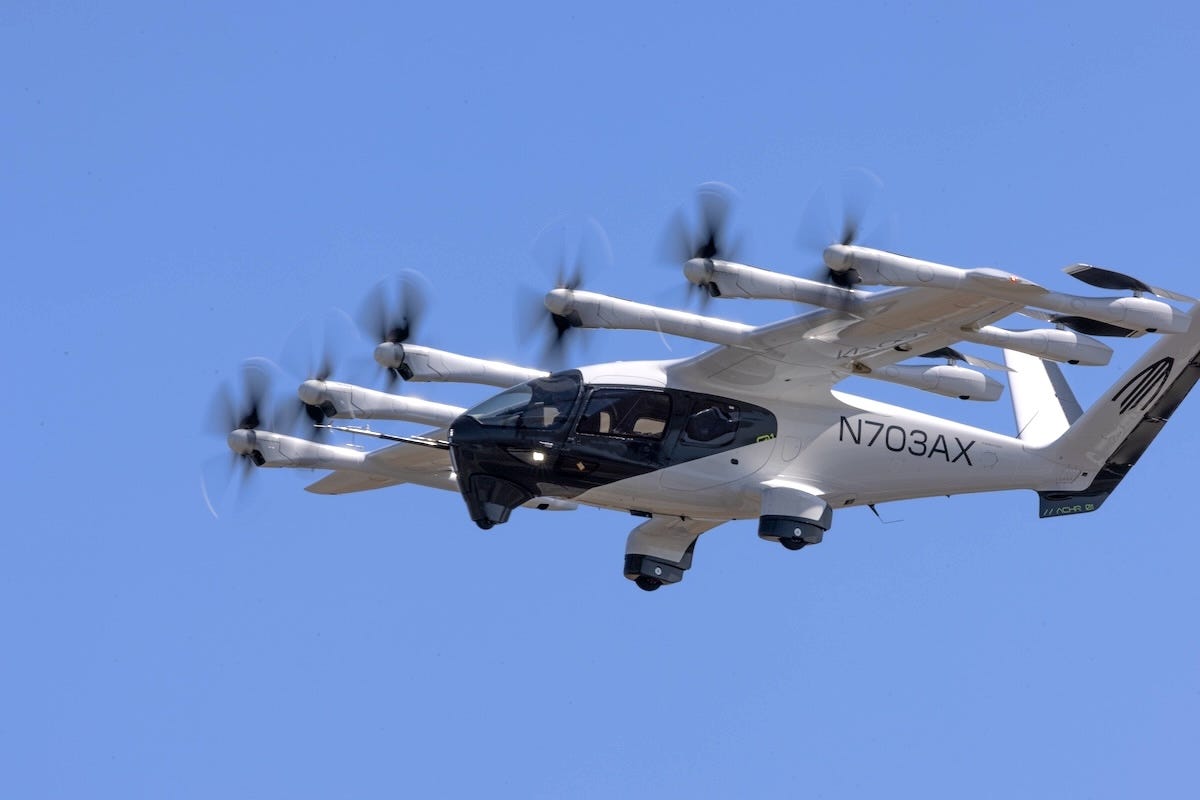
Archer Aviation Company Profile: Key Facts
Archer was founded in 2018 by Adam Goldstein and Brett Adcock, and Goldstein remains CEO. The company is based in San Jose, California, and is developing piloted air taxis, autonomous hybrid VTOL aircraft and aviation AI.
Its patent estate passed 1,000 assets after the Lilium portfolio purchase, which cost EUR 18 million for roughly 300 assets.
ARCHER AVIATION INC. (NYSE: ACHR)
Founded: 2018
Headquarters: San Jose, California
Founder and CEO: Adam Goldstein
Piloted aircraft: Midnight (pilot plus four passengers, 150 mph top speed)
Autonomous aircraft: Halo (commercial) and Thunder (defense), built with Anduril
AI platform: ZEE (aviation foundation model)
Pending acquisitions: Wisk Aero, Insitu, SkyGrid (from Boeing), closing targeted by end of 2026
Production site: Covington, Georgia
Los Angeles hub: Hawthorne Airport (80 acres, under 3 miles from LAX)
First international market: Abu Dhabi, with Abu Dhabi Aviation
Q2 2026 liquidity: $1,560.6M
Archer is the official air taxi provider of the LA28 Olympic Games and Team USA. Midnight is designed for a pilot and four passengers and a top speed of 150 miles per hour.
The aircraft uses 12 electric motors in a fixed-wing configuration. The pricing goal is often described as competitive with Uber Black or Uber Premier fares.
Archer Aviation Revenue & Financial Analysis
Q2 2026 Results at a Glance
Revenue grew from $1.6 million in Q1 to $5.0 million in Q2, an increase of 213 percent that came from expanded operations at Hawthorne Airport.
The year-earlier quarter had no revenue.
Q2 2026 (quarter ended June 30)
Revenue: $5.0M (Q1 2026: $1.6M; Q2 2025: $0)
Cost of revenue: $4.3M
Research and development: $186.0M
General and administrative: $93.9M
Total operating expenses: $284.2M
Net loss: $263.2M
Adjusted EBITDA: loss of $177.1M (guided range: $170M to $200M)
Cash, equivalents and short-term investments: $1,560.6M
Restricted cash: $7.3M
Revenue minus cost of revenue leaves $0.7 million, a 14 percent gross margin on an airport fuel-and-handling business. That margin describes the Hawthorne fixed base operator and says nothing yet about aircraft economics.
Research and development spending was 37 times revenue in the quarter. Total operating expenses were roughly 57 times revenue.