


Executive Summary
Binter Canarias closed 2024 with €336 million in turnover and €18.2 million in net profit, transporting 5.6 million passengers, a 13% year-on-year jump, across 63 routes.
The fleet now consists of 26 ATR 72 turboprops and 16 Embraer E195-E2 jets, with an additional six E195-E2s on firm order from the 2023 Paris Air Show and four next-generation ATR 72-600s with PW127XT engines (plus five options) due for delivery from 2026.
The 2026 summer schedule will be the largest in company history, adding new mainland Spain destinations including Logroño-Agoncillo and Vitoria-Gasteiz, with the airline now connecting 19 mainland Spanish cities plus 17 international destinations across Africa and Europe.
Two operational hubs at Gran Canaria (LPA) and Tenerife North (TFN), backed by a Madrid base opened in 2024, give the carrier a defensible triangular network that competitors struggle to replicate without absorbing equivalent fixed costs.
Recommended - Read Full Reports


Read All Reports
Table of Contents
Executive Summary
Binter Canarias Company Profile: Key Facts
Ownership and Corporate Structure
The Binter System: 16 Group Companies
Leadership
Binter Canarias Revenue and Financial Analysis
Revenue and Profit - Latest Reported Period
Latest Trading Update and Guidance for 2025
Balance Sheet Position
Revenue Growth Drivers
Key Services and Product Architecture
Binter Canarias Fleet Analysis
Fleet Size and Composition
Aircraft Type Strategy
The Embraer E195-E2 Strategy
Embraer Order Pipeline
Fleet Age and Modernisation Trajectory
Binter Canarias Route Network Strategy
Inter-Island Network
Mainland Spain Network
International Network
Network Analysis and Strategic Logic
Major Operational Bases (Hubs)
Gran Canaria Airport (LPA) - Primary Hub
Tenerife North Airport (TFN) - Second Hub
Madrid Barajas (MAD) - Mainland Operational Base
Smaller Operating Stations
Binter Canarias Competitive Position
Major Competitors
Binter vs. Canaryfly
Binter vs. Iberia and Iberia Express
Binter vs. Vueling
Binter vs. Ryanair
Binter vs. Air Europa
Sustainability and Environmental Strategy
Fleet Emissions Profile
SAF and Operational Initiatives
Awards and Industry Recognition
Digital Transformation and Distribution
Operational Performance and Service Quality
Regulatory Framework and Public Service Obligations
Key Risks for Binter Canarias
Risk 1
Risk 2
Risk 3
Risk 4
Risk 5
Risk 6
Risk 7
Risk 8
Risk 9
Risk 10
Future Outlook: 2026 and Beyond
Three-Year Direction
Strategic Themes to Watch
How Binter Compares to Other European Regional Airlines
Cargo and Ancillary Revenue
My Final Thoughts
Official Sources and Data
Introduction
A regional carrier that commands around 90% domestic market share inside one of Europe’s busiest archipelago aviation systems, while simultaneously executing a $430 million Embraer modernization and quietly stealing peninsular Spain market share from Iberia, deserves a closer look than it usually gets.

Binter Canarias has done exactly that over the past 36 months, and the trajectory it has set for the 2026 to 2030 horizon is going to redraw the competitive map across the Canary Islands, mainland Spain, West Africa, and the Atlantic islands of Macaronesia.
This deep-dive report examines the airline’s €336 million revenue base, its hybrid ATR plus Embraer twin-fleet strategy, the rapidly enlarging mainland network, and the operational moats that protect its position.
QUICK OVERVIEW — BINTER CANARIAS, 2026
Headquarters:       Telde, Gran Canaria, Spain
Founded:            18 February 1988 (operations 26 March 1989)
IATA / ICAO:        NT / IBB
Domestic share:     ~90% of Canary Islands inter-island market
Aircraft fleet:     42 (26 ATR 72 + 16 Embraer E195-E2)
Daily flights:      Approximately 255 (peak season)
Annual passengers:  5.6 million (2024); target ~6 million (2025)
Workforce: 1,127 employeesBinter Canarias Company Profile: Key Facts
Binter Canarias is the flag carrier of the Canary Islands.
The airline began life in 1989 as a regional subsidiary of Iberia, configured to bind together the seven main islands of the archipelago with frequent, short-haul rotations.
Today it functions as a fully private, Canary-owned business with a holding structure built around five Canarian investor groups.
The carrier’s first flight, NT 104, departed Tenerife North at 08:00 local time on 26 March 1989, bound for Gran Canaria, with a CASA CN-235 turboprop manufactured by Construcciones Aeronáuticas.
From those 36 daily inter-island rotations, the company has grown into a 42-aircraft operation generating just over a third of a billion euros in annual revenue.
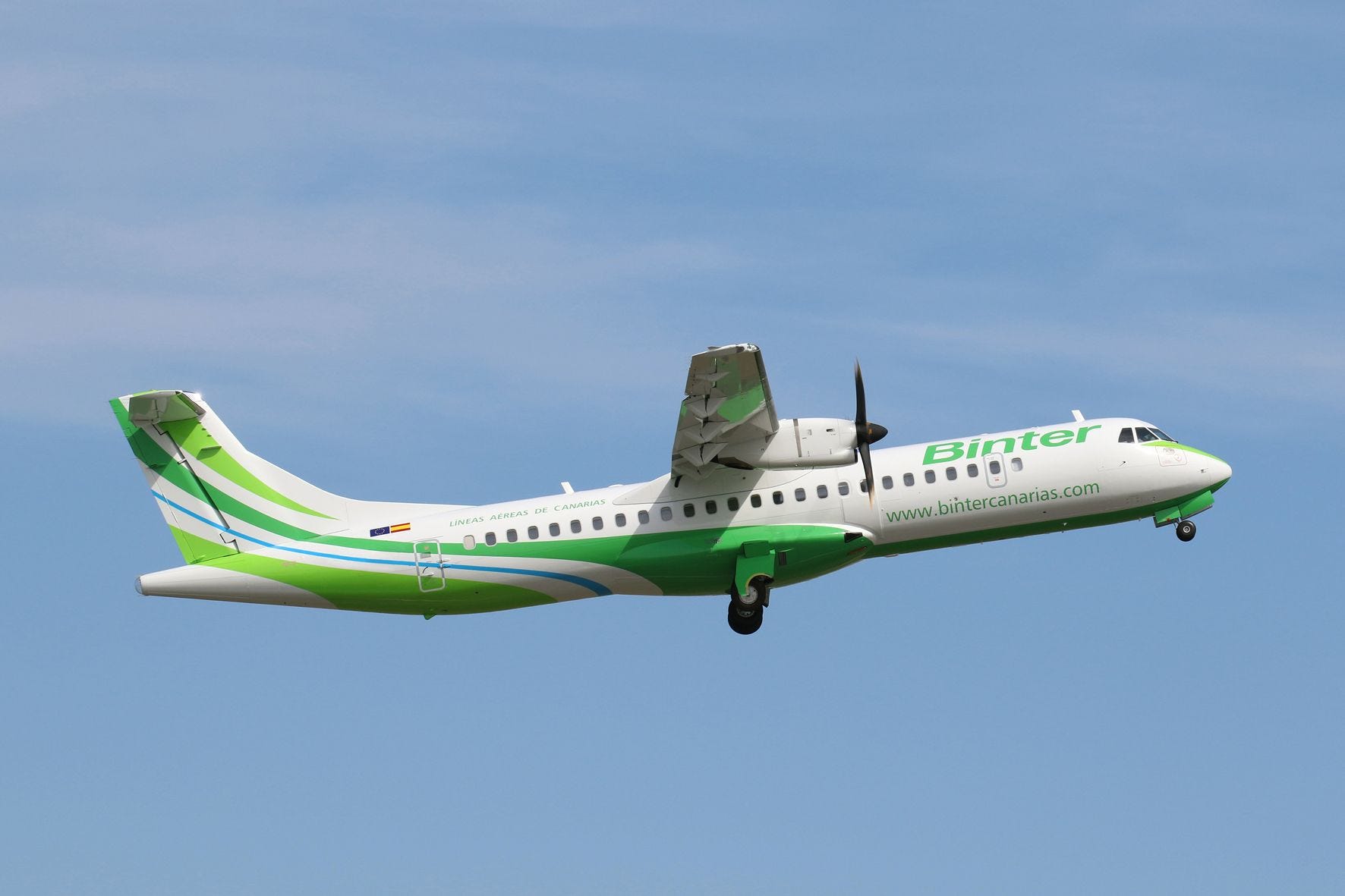
The strategic pivot point came in 2002, when a consortium of Canarian investors acquired the airline from Iberia, ending its status as a state-linked subsidiary.
That privatisation reset the airline’s commercial DNA.
The new owners reinvested heavily into modern equipment and expanded the geographic mandate beyond strictly inter-island flying.
Ownership and Corporate Structure
The shareholder map confirmed in the most recent 2024 consolidated accounts shows a tightly held company controlled by five Canarian holding companies.
Ilsamar Tenerife, represented by Juan Luis Lorenzo Rodríguez, owns 49.8% and is therefore the controlling stake.
The remaining equity is split among RNR Lareinuam, the vehicle of long-serving president Rodolfo Núñez Ruano with 13.8%, Satocan Logística led by Juan Miguel Sanjuán Jover with 13.3%, Flapa under Alfredo Morales Martín with 12.7%, and Suaris Capital owned by Ana Suárez Calvo with 10.1%.
Binter distributed a €6.3 million dividend from reserves in the most recent cycle, up 14% from the prior year’s €5.5 million.
The Binter System: 16 Group Companies
Binter Canarias S.A. is the operating airline, but the wider Binter Group includes 16 affiliated companies covering ground handling, maintenance, training, cargo, and ancillary aviation services.
This vertical integration is a deliberate strategy that allows the group to capture value across the airline supply chain instead of outsourcing margin to third parties.
Two subsidiaries operate aircraft.
Canarias Airlines, trading as Canair, has functioned since 2011 as a CRJ-1000 operator providing capacity support.
Naysa Servicios Aéreos was relaunched in June 2023 as a dedicated ATR operator for regional capacity, using the historical name of a former Canary Islands carrier that had been absorbed into the group in 2018.
BINTER GROUP STRUCTURE — KEY OPERATING ENTITIES
Binter Canarias S.A.         Main airline (ATR 72 + E195-E2)
Canarias Airlines (Canair)   Wet-lease / capacity subsidiary
Naysa Servicios Aéreos       Regional ATR operations
Binter Sistemas              Group services arm
Total companies in Group:    16
Leadership
The chairman and majority-aligned shareholder, Rodolfo Núñez Ruano, has been the public face of the airline through two cycles of fleet renewal and the strategically defining 2024 entry into the Madrid market.
The director, Juan Ramsden, oversees commercial and operational execution. Núñez previously chaired CajaCanarias for 12 years before assuming the airline presidency.
Binter Canarias Revenue and Financial Analysis
The financial story of Binter Canarias in the post-pandemic period is one of recovery, stabilisation, then deliberate capacity expansion financed largely through bank debt rather than equity issuance.
The structural choice has accelerated growth but has also added significant gearing.
Revenue and Profit - Latest Reported Period
For fiscal year 2024, Binter Canarias reported turnover of €336 million and net profit of €18.2 million. Top-line revenue was essentially flat year-on-year compared with the €337 million booked in 2023, but the net result declined by about €4 million.
Management attributed the profit compression to higher financial expenses linked directly to the ongoing fleet renewal programme.
As newer Embraer aircraft entered the books, depreciation and interest costs rose faster than incremental revenue could absorb in the short term, a textbook fleet-investment trade-off.
BINTER CANARIAS — FIVE-YEAR FINANCIAL SUMMARY
Year   Turnover (€m)   Net Profit (€m)
2024   336             18.2
2023   337             22.1
2022   304             15.4
2021   195             -0.4
2020   131             -16.7
2019   220             21.1
Source: Consolidated accounts via Tenerife Weekly (Jan 2026)Latest Trading Update and Guidance for 2025
The airline expects to lift passenger volume to approximately six million in calendar 2025, from 5.6 million in 2024.
The route count is scheduled to widen from 63 to 65 active services for 2025, with four brand-new mainland destinations launched from Gran Canaria and another five from Tenerife.
That puts the airline on track for roughly 7% to 8% passenger growth in 2025, an outsized result for a regional carrier in a saturated European market. Capacity growth on certain corridors, including the Logroño link, is running at approximately 36% above tender minimums.
Balance Sheet Position
Consolidated assets jumped from €300 million to €560 million during 2023 to 2024, reflecting the €200 million investment committed to acquiring seven Embraer airframes, one spare engine, and the buyout of Apoyo y Logística Industrial Canarias.
Bank debt climbed in parallel, from €92 million to €266 million, indicating the airline financed most of the fleet outlay through borrowings rather than retained earnings. Equity stood at €71 million at year-end.
The interest cover ratio implied by these numbers remains positive but tighter than during 2019, the last fully pre-COVID year.
Revenue Growth Drivers
The first major driver is the Madrid corridor, which the airline launched in February 2024. The carrier reported 25% market growth on Madrid–Canary Islands services during its first year, indicating it accreted demand rather than just stealing share from incumbents Iberia and Air Europa.
The second driver is geographic diversification across mainland Spain. By bypassing the Madrid bottleneck and offering point-to-point service from cities such as Vigo, Valencia, Asturias, Santander, Vitoria, and Pamplona to the Canaries, Binter taps a passenger pool that previously had to transit through hubs.
The third driver is West Africa. The airline maintains the densest network of any European operator to destinations such as Nouakchott, Dakar, Dakhla, Marrakech, and Banjul, providing both passenger and corporate connectivity that competitors cannot match.
Key Services and Product Architecture
Binter’s commercial product is built around three core elements.
First is the Bintazo flash-sale brand, used periodically to stimulate demand on mainland routes.
Second is the Flexiplus fare, introduced for the Madrid corridor in 2024, offering changeable tickets, baggage, lounge access, and premium service elements at a higher price point.
Third is the BinterMás loyalty programme, which couples mileage earning with priority services and is used as a retention tool against low-cost competitors.
Free inter-island connections from peninsular Spain or international gateways are a structural advantage that lets a passenger book Logroño to El Hierro on a single ticket.
PRODUCT TIERS — BINTER CANARIAS, 2026
Basic Fare           Cabin baggage + snack included
Bintazo Promo Fare   Limited-time discount (typically 50% off)
Flexiplus            Premium service + flexibility + lounge
BinterMás            Frequent-flyer programme
Binter Canarias Fleet Analysis
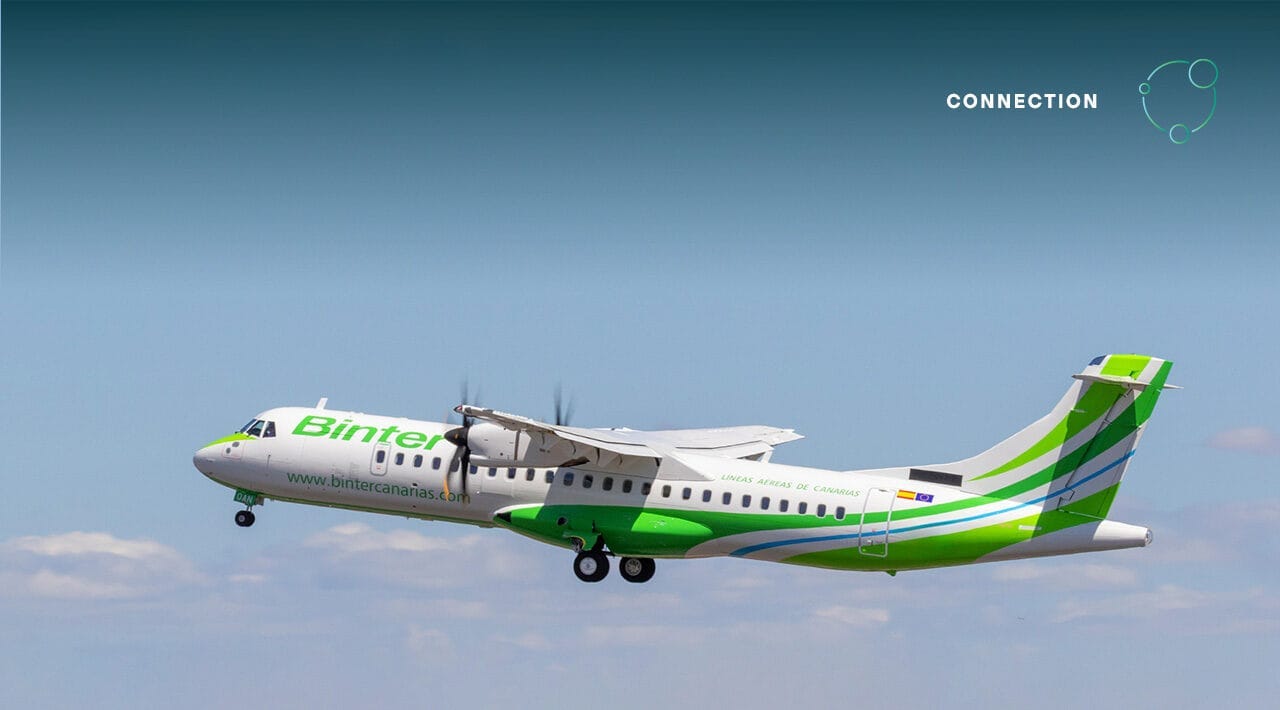
The fleet today is the cleanest expression of Binter’s twin-engine commercial philosophy.
Turboprops handle the very short, high-frequency inter-island sectors that dominate the Canary network.
Regional jets handle the longer, thinner peninsular and international routes that were impossible with the ATR alone.
Fleet Size and Composition
As confirmed on the airline’s own corporate fleet page, the current operating fleet contains 26 ATR 72 aircraft and 16 Embraer 195-E2 aircraft, totalling 42 airframes.
Independent tracking via Planespotters corroborates these numbers and lists the average fleet age at roughly 5.7 years.
The ATR portion is essentially the 72-600 sub-variant, the latest production model. The Embraer fleet is composed exclusively of E195-E2 frames, the largest member of the E-Jet E2 family.
FLEET COMPOSITION SUMMARY — MAY 2026
Aircraft Type          Variant       Quantity   Seats   Avg Age
ATR 72                 72-600        26         70-72   ~6 years
Embraer 195-E2         E195-E2       16         132     ~3 years
Total active fleet                   42
Average fleet age: ~5.7 yearsAircraft Type Strategy
The ATR 72-600 was chosen for its short-field performance and operating economics on stage lengths under 250 nautical miles.
Tenerife to Gran Canaria is roughly 60 kilometres of overwater track, and the turboprop’s direct operating costs per block hour on such short rotations remain unmatched by any jet currently in production.
Binter’s ATRs operate at seat configurations of 70 or 72 economy seats, and the type carries over five million passengers annually for the carrier on around 210 daily flights.
The airline completed its 18-aircraft ATR 72-600 modernisation programme and is now executing a second wave by replacing four older 72-600 frames with brand-new examples powered by Pratt & Whitney PW127XT engines.
The PW127XT delivers 40% longer time-on-wing, 20% lower direct maintenance cost, at least 3% block fuel saving, and certification to operate with up to 50% sustainable aviation fuel. The deal, valued at approximately €215 million, was placed at the end of 2024 and includes five further options.
The Embraer E195-E2 Strategy
The jet decision in 2019 was a watershed for Binter.
The airline became the European launch customer for the Embraer E195-E2, taking the first frame in late 2019.
The decision to install a special 132-seat single-class configuration with a 79-centimetre seat pitch, rather than the standard 146-seat layout, reflects a deliberate product strategy.
By choosing a lower-density cabin, Binter trades unit cost for product differentiation.
On mainland Spain corridors crowded with Iberia, Iberia Express, Vueling, Air Europa, and Ryanair, the wider seat pitch and quieter cabin become a tangible reason for passengers to choose Binter despite slightly higher fares than the low-cost incumbents.


The E195-E2 is also the quietest, cleanest, and most fuel-efficient single-aisle jet in commercial service today.
Compared to the previous-generation E195, it delivers approximately 25.4% better fuel efficiency per seat, an environmental performance that matters increasingly for European emissions trading scheme exposure.
Embraer Order Pipeline
Binter has placed three separate orders for E195-E2 aircraft.
The original 2019 firm order was for five aircraft.
A second order announced in late 2022 added five more frames for delivery during 2023 and 2024, with a list-price value of US$389.4 million.
A third order, placed at the Paris Air Show in June 2023, added six further aircraft valued at US$504.7 million. Cumulatively, the airline has firm orders for 16 E195-E2s, of which roughly 16 are now in operation with the balance still being delivered.
EMBRAER E195-E2 ORDER PIPELINE — BINTER CANARIAS
Order Date     Quantity     List Price (USD)   Status
2019           5            ~$300m             Delivered
Late 2022      5            $389.4m            Delivered
Paris 2023     6            $504.7m            Partial delivery
Total firm:    16 aircraft
Fleet Age and Modernisation Trajectory
The average fleet age of about 5.7 years is meaningfully younger than the European regional carrier average.
With the four new ATR 72-600s arriving from 2026 plus continued Embraer deliveries, the average could compress further to under five years by 2028.
The cost implications matter for analysts. A young fleet reduces maintenance reserves, lowers fuel burn, and protects the airline against the cost spikes that older fleets face as airframes approach mid-life heavy checks.