


Dear Readers, Welcome to AviationOutlook.
Let’s analyze the topic in detail.
Executive Summary
Cape Air, legally trading as Hyannis Air Service Inc., is the largest independent commuter airline in the United States, operating a mixed piston fleet of approximately 98 aircraft across 34 cities in the Northeast, Midwest, Mountain West, and Caribbean as of mid-2026.
The carrier is in the middle of a generational leadership transition, with long-tenured CEO Linda Markham retiring in 2026 and Mike Migliore stepping up as President & CEO; founder Dan Wolf has moved from the board into a Senior Strategic Consultant role focused on fleet optimization.
The fleet strategy is anchored by an ongoing transition from the Cessna 402C to the Italian-built Tecnam P2012 Traveller, with 30 P2012s already in service against a 102-unit original order envelope.
Cape Air’s commercial moat rests on three pillars that competitors struggle to replicate at scale: Essential Air Service (EAS) contracts in rural Montana and Vermont, summer-peaked island flying out of Boston and Hyannis, and a Caribbean inter-island network anchored at San Juan and St. Thomas, all stitched together by interline and codeshare agreements with JetBlue, United, American, Delta, Alaska, and Hawaiian.
Recommended - Read Full Reports


Read All Reports
Table of Contents
Executive Summary
Why This Report Matters Right Now
Cape Air Company Profile: Key Facts
Leadership Transition: The 2025-2026 Handover
Linda Markham’s 25-year arc
What changes under Mike Migliore
Founder Dan Wolf moves to advisory role
Current senior leadership team
Cape Air History: From One Cessna to a Continental Footprint
The 1989 launch
Geographic expansion arc
Cape Air Performance Analysis
Revenue structure: how the dollars actually flow
Cape Air Revenue growth drivers
Key services and products
Cape Air Fleet Analysis: The Numbers, the Strategy, and the Bottleneck
Current fleet composition
The Cessna 402C: workhorse of the network
Cessna 402 retirement trajectory
The Tecnam P2012 Traveller: the planned replacement
Why the 102-aircraft order has stalled at 30
The Britten-Norman BN-2 Islander niche
Fleet age and reliability dynamics
The Eviation Alice electric aircraft order
Cape Air Route Network Strategy: Major Destinations and Analysis
Network overview
1: The Northeast and the Cape & Islands
2: Midwest network from Saint Louis
3: Mountain West (Montana)
4: Caribbean
Seasonality and capacity flexing
Partner integration: the distribution multiplier
Major Operational Bases (Hubs)
Boston Logan International Airport (BOS): the primary northeastern hub
Cape Cod Gateway Airport (HYA): the corporate home base
New York JFK: the JetBlue feed hub
Saint Louis Lambert (STL): Midwest hub
Billings Logan (BIL): Mountain West hub
San Juan Luis Muñoz Marín (SJU) and St. Thomas Cyril E. King (STT): Caribbean dual hub
Cape Air Competitive Position
Major competitors (US commuter and small-community segment)
Cape Air vs. Southern Airways Express
Cape Air vs. Boutique Air
Cape Air vs. Contour Airlines
Cape Air vs. Silver Airways and Tropic Ocean (Caribbean overlap)
The Essential Air Service Question: Regulatory Backdrop for 2026
What EAS is and why it matters for Cape Air
The 2025 to 2026 budget challenge
Probability-weighted view
Operations and Maintenance: The In-House Advantage
Maintenance footprint
Pilot pipeline and the LIFT Academy partnership
Brand, Customer Experience, and Cabin Product
The MOCHA HAGoTDI mantra
Cabin product comparison
Awards and recognition
Sustainability and Emerging Technology
Why Cape Air is interesting on the sustainability side
The Eviation Alice and electric pathway
What “fleet optimization” likely means in 2026
Key Risks: Probability and Scenario Analysis
Risk 1
Risk 2
Risk 3
Risk 4
Risk 5
Risk 6
Risk 7
Risk 8
Risk 9
Risk 10
Strategic Outlook for 2026 and Beyond
What to watch through the rest of 2026
Caribbean as the growth engine
Northeast network rationalization
Sister-brand Nantucket Airlines
My Final Thoughts
Official Sources and Data
Why This Report Matters Right Now
The next 18-24 months will define what Cape Air looks like for the rest of the decade.
A leadership change at the top, a federal budget proposal that puts EAS subsidies in the political crosshairs, and a historic 2025 route expansion into New Bedford, Islip, Norwood, and St. Barthélemy are all hitting at the same time.
This deep-dive report walks through every operationally relevant lever: the fleet plan that quietly stalled at 30 Tecnam P2012s instead of the originally announced 102, the city pairs where Cape Air is winning vs. losing against Southern Airways Express and Boutique Air, the partner-airline distribution model that makes a 9-seat piston twin economically viable, and the regulatory and operating risks that sit underneath the next four budget cycles in Washington.
If your work touches small-community air service, regional fleet replacement decisions, codeshare strategy, or Caribbean inter-island feed, this is a must-read analysis report.
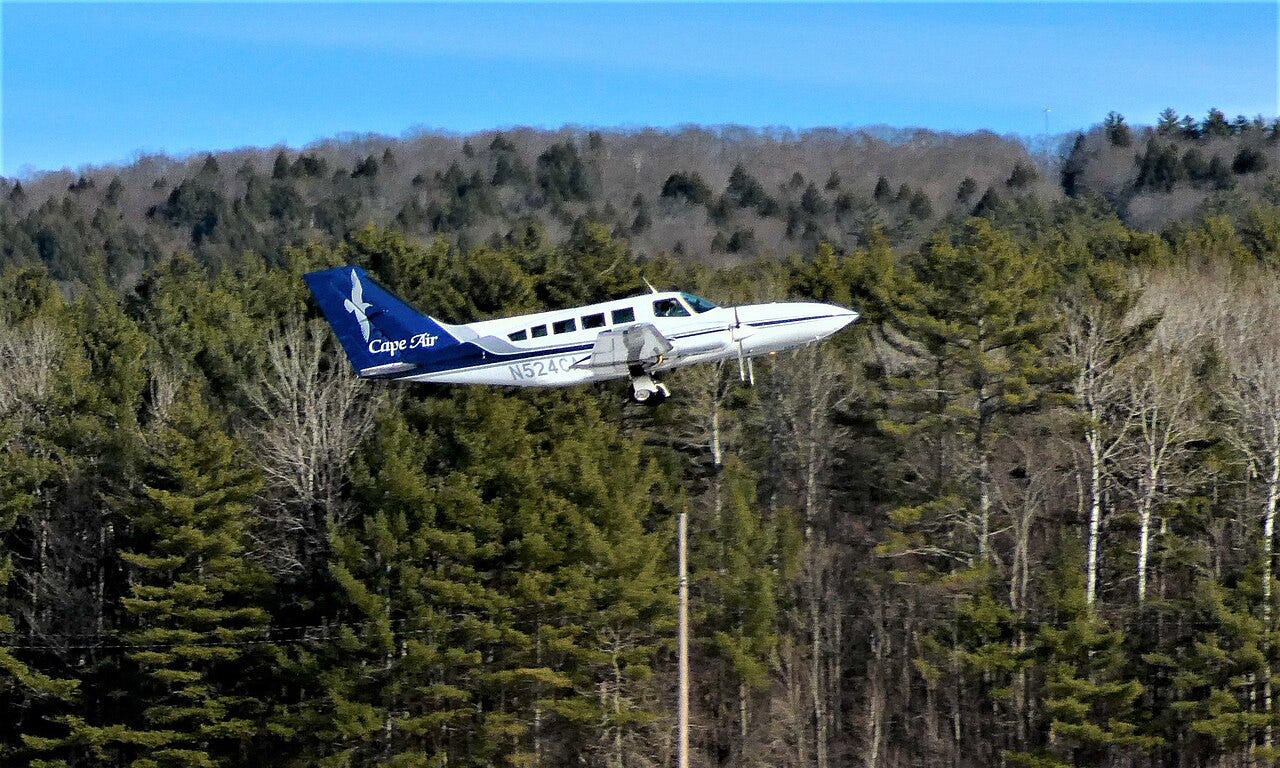
Cape Air Company Profile: Key Facts
Legal name:           Hyannis Air Service, Inc.
Brand:                Cape Air (and Nantucket Airlines sister brand)
IATA / ICAO / Call:   9K / KAP / CAIR
Founded:              1989 (first revenue flight Boston–Provincetown)
Founder:              Daniel A. (Dan) Wolf
HQ:                   660 Barnstable Road, Hyannis, MA 02601
                      (Cape Cod Gateway Airport)
President & CEO:      Mike Migliore (effective 2026; was President & CFO from Sept 2025)
Outgoing CEO:         Linda Markham (retiring 2026, 25-year company veteran)
COO:                  Andrew Bonney
CFO:                  Casey Stone
Ownership:            Privately held; partially employee-owned via ESOP
Employees:            ~700 across four operating regions
Fleet (publicly disclosed): 64 Cessna 402C + 30 Tecnam P2012 + 4 BN-2 Islander
                            ~98 aircraft total incl. spares
Cities served:        34 (US Northeast, Midwest, Mountain West, Caribbean)
Daily flights:        300+ (up to 525 in peak summer per Cape Air Pilots site)
Annual passengers:    ~400,000 (per 2025 company release)
Operating regions:    Northeast/Cape & Islands; Midwest; Mountain West;
Puerto Rico/USVI/BVI CaribbeanThe corporate structure is worth pausing on. The operating certificate has lived under the name Hyannis Air Service, Inc. since the company’s founding, which is why the airline’s tail number registrations and U.S. Department of Transportation dockets all reference that legal entity rather than the Cape Air brand.
Cape Air’s ownership profile is also unusual in U.S. regional aviation.
The company is partly employee-owned through an Employee Stock Ownership Plan that the Federal Reserve Bank of Boston has profiled in its “Invested” series, with the rest of the equity held privately by founder Dan Wolf and other early investors.
That hybrid structure is part of why Cape Air has been able to keep flying routes that publicly traded regionals would have walked away from a decade ago.
Leadership Transition: The 2025-2026 Handover
Linda Markham’s 25-year arc
Linda Markham was named CEO effective January 1, 2022, after years as President. Cape Air described her at the time as the only female CEO of a major or regional U.S. airline, a distinction that carried through her entire term.
In September 2025, the airline announced that Markham would retire in 2026 after 25 years of service. CFO Mike Migliore was promoted immediately to President & CFO, with the understanding that he would assume the CEO role upon her departure.
The formal CEO transition was confirmed on March 13, 2026, when Cape Air named Migliore President & Chief Executive Officer.
What changes under Mike Migliore
Migliore is a 15-year Cape Air veteran whose background is finance and long-range planning rather than operations.
That tilt matters because the two largest open questions in front of the airline right now are capital allocation decisions: what to do with the unfilled portion of the Tecnam P2012 order, and how to manage the cost base if Essential Air Service funding is cut.
“Over the past 15 years, Mike has served on Cape Air’s Executive Committee and has been a key leader in shaping our strategic planning priorities,” Markham said in the transition announcement. “His leadership and deep commitment to our core values have played a pivotal role in our continued success.”
Founder Dan Wolf moves to advisory role
In a less-noticed line of the same September 2025 release, Cape Air disclosed that founder Dan Wolf had stepped down from the Board and become a Senior Strategic Consultant focused on “emerging technologies and fleet optimization.”
Translation: Wolf, who personally pre-ordered 75 Eviation Alice electric aircraft back in 2022, is now the person quietly working the file on what comes after the Cessna 402.
Current senior leadership team
Michael Migliore  – President & CEO
Andrew Bonney     – Chief Operating Officer
Casey Stone       – Chief Financial Officer
Aaron Blinka      – Vice President, Planning (commercial / network)
Cape Air History: From One Cessna to a Continental Footprint
The 1989 launch
Cape Air’s origin story is one of the most cited in U.S. commuter aviation. Dan Wolf founded the company in 1989 with one route and three flights a day between Boston and Provincetown, eight employees, and a first-year passenger total of just 8,000.
The first revenue flight occurred the following year.
Geographic expansion arc
Cape Air’s regional buildout is well documented, and it followed a clear pattern of layering one geography at a time:
1989  Boston–Provincetown (founding route)
1990s Expansion across southern New England (Hyannis, ACK, MVY,
      New Bedford, Providence)
1993-2013 South Florida and the Keys (later exited)
1998  First Caribbean routes launched
2004-2018 Micronesia ops out of Guam with two ATR-42s
      (United Express; ended May 2018)
2009  Midwest entry with St. Louis hub
2013  Montana EAS network from Billings
2017  Order announced for 102 Tecnam P2012 Travellers
2019  First Tecnam P2012 delivered to Hyannis
2022  Letter of intent for 75 Eviation Alice electric aircraft
2025  Major Northeast + Caribbean route expansion (4 new city pairs)
2026  Leadership transition; Mike Migliore becomes CEO
The Micronesia chapter is particularly relevant for understanding Cape Air’s strategic discipline.
The company ran United Express turboprop service between Guam, Rota, Saipan and a handful of outer islands for 14 years before shutting it down in 2018 when the economics no longer justified continued operation.
That willingness to exit a market is part of why Cape Air has avoided the financial blowups that have hit several of its small-airline peers over the same period.
Cape Air Performance Analysis
Revenue structure: how the dollars actually flow
The revenue base is structurally different from a typical mainline carrier. Cape Air’s revenue mix is best understood as four parallel streams:
Stream 1: Scheduled passenger revenue on private-pay routes. This includes the seasonal Cape & Islands network (BOS–ACK, BOS–MVY, HYA–ACK, HYA–MVY), the Caribbean inter-island network, and the newly launched Northeast city pairs like Islip-Boston and New Bedford-Boston.
Stream 2: Essential Air Service subsidy revenue. This is contracted revenue from the U.S. Department of Transportation under the EAS program, which pays carriers to maintain service to small communities that would otherwise lose air access. For Rutland, Vermont alone, the subsidy is approximately $2.6 million per year under a four-year award running from November 2023 through October 2027.
Stream 3: Codeshare and interline settlement revenue. Cape Air books passengers on partner metal across the JetBlue, United, American, Delta, Alaska, and Hawaiian networks, with interline e-ticket agreements carrying AA, AS, B6, DE, DL, HA, QR, and UA. Some of these are pure interline; the JetBlue arrangement is a true codeshare with loyalty integration on TrueBlue points.
Stream 4: Ancillary revenue. Cape Air sells checked-baggage upgrades, pet transport on select cabins, and seasonal merchandise through its corporate site.