


Welcome to AviationOutlook: The aviation newsletter built exclusively for decision-makers.
Become an “Annual” member now & get this special discount offer.
As a paid member, you get access to:
200+ Reports - All major airlines + aerospace & defense companies (updated regularly).
Daily / Weekly - Deep-dive analysis & insights.
Monthly - Industry outlook reports.
In case you missed it, here are the latest analysis reports:
Embraer - Company Analysis and Outlook Report 2026 (Updated)
American Airlines’ Six-Route Europe Play: Yield Discipline or Widebody Overreach?
Check Out All Reports
Executive Summary
Cathay Pacific Group posted record group revenue of HK$116.8 billion for full year 2025, with attributable profit reaching HK$10.8 billion, the highest annual profit since 2010 and the third consecutive year of solid financial performance.
The combined Cathay Pacific and HK Express operation carried more than 36 million passengers in 2025, a 27% year-on-year jump, while Cathay Cargo moved 1.67 million tonnes of freight with cargo revenue of approximately HK$24.3 billion.
The Group has firmly committed over HK$100 billion across fleet renewal, cabin products, lounges, and digital innovation, with more than 100 new-generation aircraft on order, including 35 Boeing 777-9s, 26 Airbus A350-1000s, 30 A330-900s, 14 A321neos and 6 A350Fs.
Capacity is planned to grow approximately 10% in 2026 as the carrier exploits Hong Kong’s Three-Runway System and launches new long-haul services, including Seattle from 30 March 2026, while expanding frequencies to existing flagship routes.
Recommended - Read Full Reports


Read All Reports
Table of Contents
Executive Summary
Cathay Pacific Company Profile: Key Facts
Cathay Pacific Revenue & Financial Analysis
Full Year 2025 Headline Numbers
Revenue Mix and LTM Performance
Latest Earnings Report and Forward Guidance
Revenue Growth Drivers
Key Services and Products
Cathay Pacific Fleet Analysis
Fleet Size and Composition
Fleet Age and Mix Strategy
Aircraft Types Strategy and Configuration
Fleet Strategy and Forward Order Book
Cathay Pacific Route Network Strategy, Major Destinations and Analysis
Network Footprint as of Mid-2026
North America Strategy
European Strategy
Asia-Pacific Strategy
Ultra-Long-Haul and Tactical Routes
Australia and New Zealand Strategy
Major Operational Bases (Hubs)
Hong Kong International Airport (HKG)
Operational Sub-Bases and Specialised Facilities
Cathay Pacific Competitive Position
Major Competitors
Cathay Pacific vs Singapore Airlines
Cathay Pacific vs Emirates
Cathay Pacific vs Qatar Airways
Cathay Pacific vs ANA and Japan Airlines
Cathay Pacific vs Air China
Cathay Pacific vs Korean Air
Cathay Pacific vs HK Express (Internal)
Cathay Pacific Premium Cabin Strategy
The Aria Suite
Aria Studio for Regional Widebodies
Halo Suite First Class
Ground Product
Cathay Cargo Strategy
Cathay Cargo Volume and Revenue Performance
Cargo Fleet and Order Book
Specialised Cargo Verticals
Cathay Pacific Sustainability Programme
Net Zero by 2050 Commitment
Sustainable Aviation Fuel Programme
Greater Bay Area and Mainland China Strategy
Key Risks (With Probability & Scenario Analysis)
Risk 1
Risk 2
Risk 3
Risk 4
Risk 5
Risk 6
Risk 7
Risk 8
Strategic Outlook for 2026 and Beyond
My Final Thoughts
Official Sources and Data
Cathay Pacific Company Profile: Key Facts
Cathay Pacific is the flagship carrier of the Hong Kong Special Administrative Region and the sole locally registered full-service international airline of meaningful scale operating from Hong Kong International Airport.
The carrier was established in 1946 and celebrated its 80th anniversary during 2026 under the campaign banner “80 Years Together”.
It is a founding member of the oneworld alliance and is publicly listed on the Stock Exchange of Hong Kong.
Together with subsidiary HK Express and freight specialist Cathay Cargo, the operation forms the wider Cathay Group, which now serves over 100 passenger destinations worldwide.
Cathay Pacific - Key Facts (2026)
------------------------------------------
Legal Name           : Cathay Pacific Airways Limited
Founded              : 24 September 1946
Headquarters         : Cathay City, Hong Kong International Airport
Hub                  : Hong Kong International Airport (HKG)
Alliance             : oneworld (founding member)
IATA / ICAO          : CX / CPA
Callsign             : Cathay
Chief Executive      : Ronald Lam Siu-por
Group Chair          : Patrick Healy
Subsidiaries         : HK Express, Cathay Cargo, Air Hong Kong (60%)
Major Shareholders   : Swire Pacific (~45%), Air China (~27.11%),
                       Qatar Airways (~9.99%), HKSAR Govt (~6.08%)
Passenger Network    : 100+ destinations (Group)
Fleet                : 179 aircraft (Nov 2025)
Group Headcount      : Over 32,000 employees, recruiting 3,000+ in 2026
The ownership structure has continued to evolve. In January 2026, Air China trimmed its stake by selling approximately 1.61% of Cathay Pacific for HK$1.32 billion, but retains around 27.11% and remains the second-largest shareholder.
Cathay Group Chair Patrick Healy described the 2025 performance as “an excellent achievement that reflects the commitment of our teams”. The Group offered employees more than 11 weeks of eligible pay in discretionary bonuses and profit sharing in addition to a salary increase for 2026.
The carrier is unique among Asian majors in that it has no domestic market. Every revenue passenger kilometre depends on cross-border traffic, which makes route network design and hub competitiveness existential rather than merely strategic.

Cathay Pacific Revenue & Financial Analysis
Full Year 2025 Headline Numbers
The headline figures confirm a clear inflection point in the Group’s post-pandemic rebuilding journey. Total Group revenue climbed 11.9% year-on-year to HK$116.766 billion in 2025, the highest annual top line in the company’s history.
Attributable profit landed at HK$10,828 million, up roughly 9.5% from HK$9,888 million in 2024. The result included a non-recurring gain of approximately HK$878 million under Other Income tied to a settlement with Hong Kong Aircraft Engineering Company Limited (HAECO) over an aircraft parts management joint venture.
The Group’s airlines and subsidiaries on their own reported attributable profit of HK$10 billion, while associates contributed HK$447 million versus HK$288 million in 2024.
Cathay Group FY2025 Key Financials (HK$ billion)
------------------------------------------------
Total Revenue              : 116.8   (+11.9% YoY)
Cathay Cargo Revenue       : 24.3    (+1.2% YoY)
Attributable Profit        : 10.8    (+9.5% YoY)
Non-recurring HAECO Gain   : 0.88
Gearing Ratio              : 0.60
Dividend per Share (total) : HK$0.84 (HK$5.2bn total)Revenue Mix and LTM Performance
The carrier reports revenue across passenger and cargo segments. Passenger services remain the dominant contributor following the post-pandemic normalisation, while cargo continued to provide a stable secondary revenue stream throughout 2025.
Cathay Cargo’s revenue increased 1.2% to HK$24,279 million in 2025. Available freight tonne kilometres rose 8.3%, demonstrating capacity restoration even amid global trade volatility.
Last twelve months (LTM) revenue tracking through the first quarter of 2026 indicates continuing momentum. The Group’s January 2026 traffic figures showed Cathay Pacific carried 11% more passengers than January 2025, with available seat kilometres up 14%.
For March 2026, the airline carried 24% more passengers than the same month a year earlier, though management cautioned that jet fuel prices rose significantly during the quarter.
Latest Earnings Report and Forward Guidance
The 2025 annual results were released on 11 March 2026 and constitute the most authoritative recent statement of the Group’s trajectory. Group Chair Patrick Healy stated that the foundation built over the three-year rebuilding window has positioned Cathay to withstand “current market turbulence”.
The forward guidance is unusually specific for the airline industry. The Group expects to grow passenger capacity by approximately 10% in 2026, driven by frequency additions and new destinations across the network.
Cathay Pacific 2026 Forward Guidance Highlights
-----------------------------------------------
Passenger capacity growth : ~10% YoY
Cargo capacity            : Increases as a by-product of pax growth
New narrowbody deliveries : 8 in 2026
Aircraft pipeline         : 100+ across all categories
Strategic Investment      : Well over HK$100bn (multi-year)
Capacity scenario flag    : Plan may flex if jet fuel stays elevated
Chief Executive Ronald Lam noted in a March 2026 interview that demand might not be sustainable if jet fuel prices remained double pre-conflict levels. The short-term goal, he stressed, is to maintain capacity rather than cut back, although the 10% growth plan could be revised.
Revenue Growth Drivers
Multiple structural and tactical drivers are underpinning the revenue trajectory.
The first is sheer volume. Cathay Pacific and HK Express together carried more than 36 million passengers in 2025, up 27% year-on-year, setting two consecutive months of all-time records during the summer peak.
The second driver is network breadth. During 2025, the Group launched flights to 20 new destinations, pushing the combined passenger network past 100 cities. Each new gateway brings incremental origin and destination traffic plus connecting feed through Hong Kong.
The third driver is the renewed customer proposition. The retrofit programme bringing the Aria Suite business class onto Boeing 777-300ER aircraft and an upcoming Aria Studio flat-bed product for the regional Airbus A330-300 fleet are designed to improve premium yield and brand differentiation.
A fourth driver is the slow but visible recovery of Cathay Cargo volumes. Cathay Cargo carried 1.67 million tonnes in 2025, with cargo revenue reaching US$3.1 billion and volumes rising 9.5% year-on-year.
The fifth driver is HK Express. While the low-cost subsidiary posted losses in 2025 from a difficult Japan market correction, network diversification under the Cathay Group banner is producing early signs of stabilisation.
Key Services and Products
The product hierarchy is now anchored by four primary cabin classes plus a sixth ground product. First class continues on selected Boeing 777-300ERs and will be reinvented for the Boeing 777-9 fleet from 2027 onwards.
Business class is being progressively replaced by the Aria Suite, which has won Best New Business Class at TheDesignAir Awards. Premium Economy and Economy round out the four-cabin product, with the carrier also reducing seat counts on the narrowbody A321neo in response to customer feedback.
On the ground, Cathay reopened its flagship The Wing, First lounge on 22 April 2026 after a multi-year redesign. A new dedicated lounge in New York is scheduled to follow, marking the first time the carrier has operated a standalone lounge in the United States.
Cargo customers receive a fifth product family through Cathay Cargo, with specialised offerings including Cathay Pharma, Cathay Fresh, Cathay Live and Cathay Mail. These verticals are designed to capture higher-yield specialised freight that competes more on service quality than price.
Cathay Pacific Fleet Analysis
Fleet Size and Composition
As of November 2025, the Cathay Pacific mainline operation runs 179 active aircraft split between passenger and freighter fleets. The carrier is one of the most widebody-heavy operators in the world, with 143 widebody aircraft accounting for roughly 90% of the passenger fleet.


The average aircraft offers 302 seats, the second-highest figure among major airlines globally behind only Emirates at 398. Cathay ranks 11th worldwide for seats for sale, despite being the 19th-largest international operator by flights.
Cathay Pacific Fleet Composition
------------------------------------------------------
PASSENGER AIRCRAFT
Airbus A321neo          : 16
Airbus A330-300         : 43
Airbus A350-900         : 30
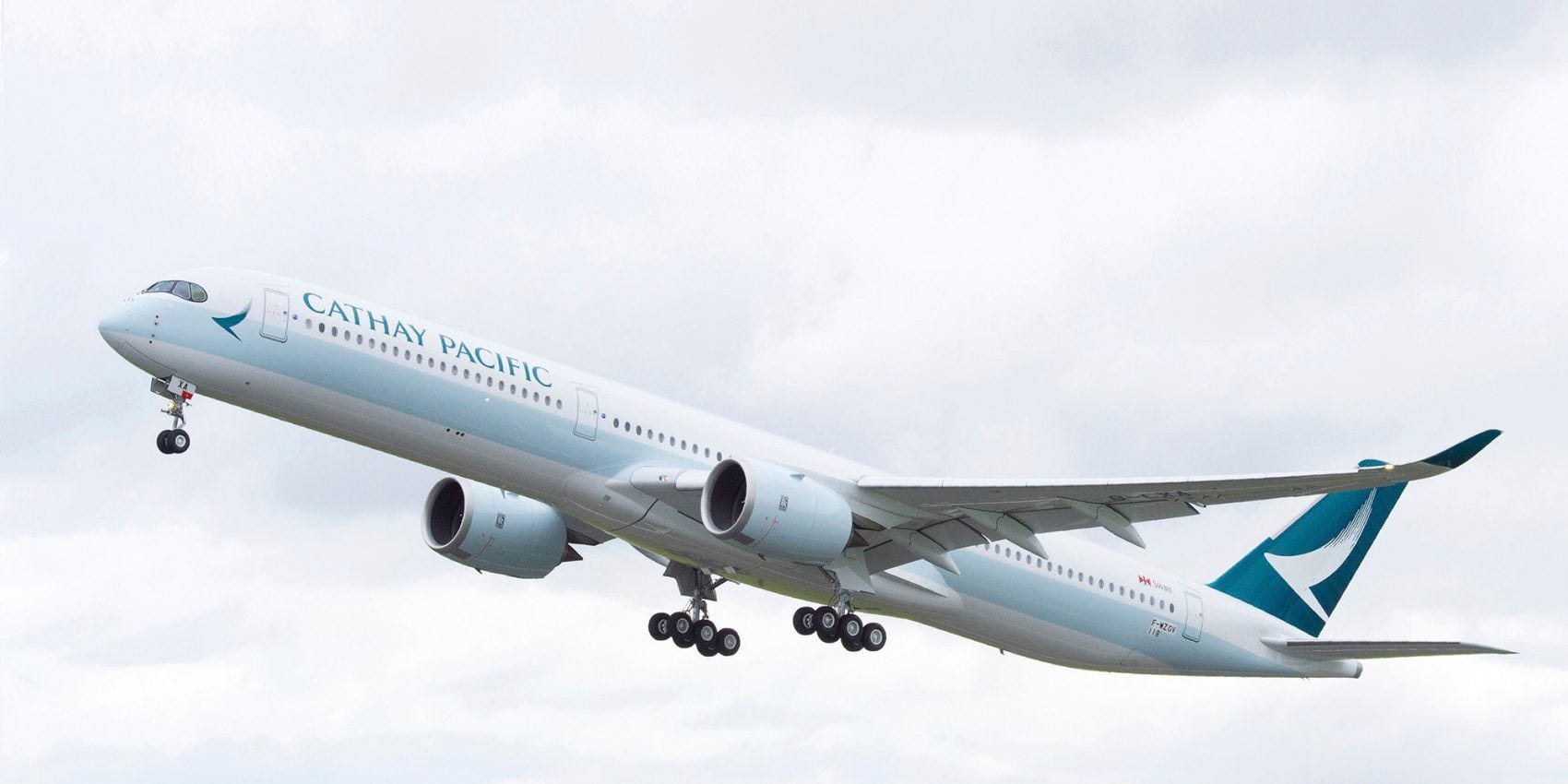
Airbus A350-1000        : 18
Boeing 777-300          : 17
Boeing 777-300ER        : 35
                          ---
Total Passenger         : 159

FREIGHTER AIRCRAFT
Boeing 747-400ERF       : 6
Boeing 747-8F           : 14
                          ---
Total Freighter         : 20

TOTAL FLEET             : 179
The Airbus A330-300 fleet remains the workhorse of the regional network.
The carrier operates multiple seating configurations on the type, ranging from premium-heavy three-class layouts to denser high-capacity layouts for short hops to mainland China and the Greater Bay Area.
The Boeing 777-300ER constitutes the long-haul backbone, with several distinct sub-fleets including aircraft retrofitted with the Aria Suite, aircraft retaining first class, and densified aircraft used on shorter regional sectors.
The newest variants offer 6 First, 53 Business, 34 Premium Economy and 201 Economy seats.
Fleet Age and Mix Strategy
Cathay’s commercial logic favours owning relatively young widebody assets that can be optimised over long routes where their range and seat economics matter most. The retirement of older Boeing 777-300 non-ER aircraft is expected to accelerate once the Boeing 777-9 begins arriving from 2027.
The narrowbody footprint is currently small but growing rapidly. The 16 Airbus A321neos in service, in a 12 Business and 190 Economy layout, target medium-haul regional routes where a widebody is uneconomic but a high-frequency offering is competitively important.
Aircraft Types Strategy and Configuration
The carrier’s fleet philosophy can best be described as a three-tier widebody architecture supported by a focused narrowbody segment. Each tier serves a distinct mission set with overlapping capability for tactical flexibility.
The long-haul tier sits at the top of the architecture. It includes the Airbus A350-1000, which seats 46 Business, 32 Premium Economy and 256 Economy passengers in 334 total seats, and is the chosen platform for the longest ultra long haul missions.
The mid-tier comprises Airbus A350-900 aircraft seating 38 Business, 28 Premium Economy and 214 Economy passengers across 280 seats. This type is highly versatile and flies a mix of long-haul, medium-haul and tactical regional sectors.
The regional widebody tier is currently held by the Airbus A330-300 family. From 2028, deliveries of the new Airbus A330-900 will progressively renew this tier with a more fuel-efficient platform tailored to Asian regional missions.
Fleet Strategy and Forward Order Book
Cathay’s fleet strategy through 2030 and beyond is one of the most ambitious in Asia. The carrier currently holds approximately 85 firm aircraft on order plus rights for over 80 more, with deliveries stretching through the 2031 to 2032 window.
Cathay Pacific Order Book (Firm Orders)
---------------------------------------
Airbus A321neo          : 14
Airbus A330-900         : 30   (deliveries from 2028)
Airbus A350-1000        : 26   (incl. 6 added Aug 2025)
Airbus A350F (freighter): 6
Boeing 777-9            : 35   (deliveries from 2027)
                          ---
Total Firm Order Book   : ~111
Option Rights           : ~80+ additional aircraft
The Boeing 777-9 will be the platform for the next-generation first class product. Cathay has reaffirmed confidence in the type with 9 aircraft scheduled for delivery in 2027 and the balance arriving from 2028 onwards.
In August 2025, Cathay placed an additional order for six Airbus A350-1000s. This brought the total A350-1000 order book to 26 and the combined A350 commitment to 48 frames. The new A350-1000s are powered by higher-thrust Rolls-Royce Trent XWB-97 engines.
In 2024, the carrier ordered 30 Airbus A330-900s with options for 30 more, plus 32 Airbus A320neo family aircraft for the wider Group network. Eight new narrowbodies are scheduled for delivery during 2026 itself.
The freighter strategy will see the existing Boeing 747-400ERF aircraft eventually replaced by the Airbus A350F, with six firm orders on the books. The Boeing 747-8F will continue to anchor the long-range heavy freighter mission for the foreseeable future.
The strategic underpinning of these orders is the HK$100 billion investment committed in August 2024 over a seven-year horizon. The funds flow not only into aircraft but also cabin retrofits, lounges, digital systems and sustainability initiatives.