


Welcome to AviationOutlook: The aviation newsletter built exclusively for decision-makers.
Become an “Annual” member now & get this special discount offer.
As a paid member, you get access to:
200+ Reports - All major airlines + aerospace & defense companies (updated regularly).
Daily / Weekly - Deep-dive analysis & insights.
Monthly - Industry outlook reports.
In case you missed it, here are the latest analysis reports:
Embraer - Company Analysis and Outlook Report 2026 (Updated)
American Airlines’ Six-Route Europe Play: Yield Discipline or Widebody Overreach?
Check Out All Reports
Executive Summary
Cebu Pacific delivered its strongest financial performance in history in 2025, posting a net income of P12.3 billion, a 128% surge, on record revenues of P119.9 billion, driven by 26.9 million passengers carried and an 84% seat load factor.
The airline enters 2026 as the Philippines’ undisputed market leader with 56.2% domestic share and 22% international share, backed by a 100-aircraft fleet where 72% of jets are fuel-efficient Airbus NEO variants.
A geopolitical fuel shock driven by the US-Israeli war on Iran has forced the airline to suspend five international routes and reduce frequencies on nine others as of March 2026, while raising all-in average fares by up to 26%; the scale and duration of this disruption is now the defining near-term risk.
Despite the near-term headwinds, Cebu Pacific’s long-cycle story remains intact: a landmark 152-aircraft Airbus A321neo order (the largest in Philippine aviation history), a growing five-hub network, and a 30-million passenger target for its 30th anniversary year underpin the strategic ambition for 2026 and beyond.
Recommended - Read Full Reports


Table of Contents
Executive Summary
Key Facts: Company Profile
Business Overview: How Cebu Pacific Built the Philippines’ Dominant Airline?
Revenue and Growth Drivers: Deep Dive
The Headline Numbers
Revenue by Segment
Trailing Twelve-Month Revenue (LTM)
Q4 2025 Performance
Balance Sheet Snapshot (End of 2025)
Key Services and Products: The Cebu Pacific Commercial Model
The Low-Cost Carrier Framework
Cargo Operations
Digital Channels and Customer Technology
Network and Major Destinations: Five Hubs Serving Southeast Asia and Beyond
The Domestic Core
The Five-Hub Strategy
International Network and Long-Haul Expansion
Fleet Strategy: Building for Scale, Managing for Efficiency
Current Fleet Composition (as of end-2025)
2026 Fleet Plan: Steady Modernization
The Historic A321neo Order: Long-Cycle Ambition
The Pratt & Whitney GTF Engine Challenge
Major Competitors: The Philippine Aviation Landscape
Philippine Airlines (PAL)
AirAsia Philippines
Competitive Summary
Competitive Analysis and Moat
Scale and Network Density
Fleet Age and Fuel Efficiency
Brand Leadership and Consumer Trust
The Hub Advantage and Infrastructure Development
Sustainability as a Cost and Regulatory Moat
Recent Developments
Cebu Pacific Turns 30 - The “Dreamer Plane” and the 30 Million Passenger Target
The Manila-Riyadh Launch - Cebu Pacific Enters the Middle East
Record 2025 Financial Results Released - And the Fuel Shock Arrives
The Middle East Fuel Crisis - Route Suspensions and Fare Increases
Routes Suspended (April to October 2026)
Routes with Frequency Reductions
Key Risks: Probabilities, Scenarios, and Management Responses
Risk 1: Prolonged Fuel Price Shock
Risk 2: Pratt & Whitney GTF Engine Groundings
Risk 3: High Financial Leverage
Risk 4: Airport Infrastructure Constraints
Risk 5: China Market Recovery Uncertainty
Risk 6: Philippine Peso Depreciation
My Final Thoughts
Primary Sources and Official Data
Key Facts: Company Profile
Company Name:      Cebu Air, Inc. (operator: Cebu Pacific)
PSE Ticker:        CEB
Parent Company:    JG Summit Holdings, Inc. (Gokongwei family)
Founded:           1988 (operations commenced March 8, 1996)
30th Anniversary:  March 8, 2026
CEO:               Michael B. Szucs
CFO:               Mark Cezar
President & CCO:   Xander Lao
Headquarters:      Pasay City, Metro Manila, Philippines
Fleet (end 2025):  100 aircraft
Fleet Age (avg):   5.9 years (end 2024)
Passengers (2025): 26.9 million (record)
Revenue (2025):    PHP 119.9 billion (~USD 2.05B, TTM Sep 2025)
Net Income (2025): PHP 12.3 billion
Hubs:              Manila (NAIA), Mactan-Cebu, Clark,
                   Davao, Iloilo
Destinations:      37 domestic, 26 international
Routes:            82 domestic, 42 international
Weekly Flights:    3,148 scheduled weekly
Domestic Mkt Share:56.2% (FY2025)
Intl Mkt Share:    22.0% (FY2025)
Business Overview: How Cebu Pacific Built the Philippines’ Dominant Airline?
Cebu Pacific is the Philippines’ largest airline by fleet size and passenger volume, and the clear commercial leader in both the domestic and international segments. Operated by Cebu Air, Inc. and listed on the Philippine Stock Exchange, the carrier is a subsidiary of JG Summit Holdings, one of the country’s most diversified conglomerates controlled by the Gokongwei family.
The airline was founded in 1988 and launched commercial flights on March 8, 1996, with an inaugural Manila-to-Cebu service. It was built on a single, foundational premise: democratize air travel in an archipelago of over 7,100 islands, where geography makes flying not a luxury but a practical necessity.
Over three decades, Cebu Pacific pioneered the unbundled low-cost carrier (LCC) model in the Philippines, transitioning away from bundled full-service fares in 2005. It overtook Philippine Airlines in passenger volume in 2010, listed on the Philippine Stock Exchange that same year, and has not relinquished the top spot since.
By the end of 2025, the airline had carried over 270 million passengers in its 30-year history, operating from five hubs across the country with a 100-strong aircraft fleet. Its domestic market share of 56.2%, nearly double that of its closest competitor Philippine Airlines, reflects a structural dominance that no rival has come close to challenging.
CEO Michael B. Szucs frames the airline’s mission clearly: “We have become part of the fabric of the Philippines. The Philippines needs a low-cost carrier that offers safe, reliable, affordable and convenient bus service in the sky, which is essentially what we do.”

Revenue and Growth Drivers: Deep Dive
The Headline Numbers
Cebu Pacific’s full-year 2025 results represent a genuine operational and financial inflection point. Total revenue rose 14% to P119.9 billion, a new record. Net income surged 128% to P12.3 billion, compared to P5.4 billion in 2024.
EBITDA climbed 21% to P30.9 billion, expanding the EBITDA margin to 26%. Operating income increased 25% to P11.5 billion, lifting the operating margin to 10%.
The pre-tax core income, which strips out non-recurring items, jumped 54% to P4.8 billion, signaling that the underlying earnings quality, not just headline profit, improved substantially year-on-year.
Revenue by Segment
FY2025 Revenue Breakdown:

Passenger Revenue:    PHP 80.8 billion  (+13% YoY)  ~67% of total
Ancillary Revenue:    PHP 32.0 billion  (+14% YoY)  ~27% of total
Cargo Revenue:        PHP  7.2 billion  (+27% YoY)  ~ 6% of total
                      ─────────────────────────────
Total Revenue:        PHP 119.9 billion (+14% YoY)
Passenger revenue growth was underpinned by record traffic of 26.9 million passengers, up 10% year-on-year, supported by an 84% seat load factor. Domestic traffic grew 8% to 20 million while international traffic expanded 14% to 6.9 million.
Ancillary revenue, which includes fees for seat selection, baggage, meals, travel insurance and other add-ons, grew to P32 billion, accounting for 27% of total revenue. This is a critical indicator of revenue quality for low-cost carriers: a high ancillary share means the airline is extracting more value per passenger regardless of base fare levels.
Cargo was the fastest-growing revenue line in 2025, rising 27% to P7.2 billion as volumes reached 215 million kilos, also up 27% year-on-year. The deployment of high-density 459-seat A330neo widebodies on key domestic and international routes meaningfully expanded belly cargo capacity without adding dedicated freighter operations.
Trailing Twelve-Month Revenue (LTM)
As of September 30, 2025, Cebu Pacific’s trailing twelve-month revenue stood at approximately USD 2.05 billion, with an enterprise value of around USD 3.05 billion.
This LTM figure captures the ongoing revenue ramp-up through the second and third quarters of 2025, periods that reflected the benefits of both fleet additions and improved load factors before the Q4 seasonal softness partially moderated growth.
Q4 2025 Performance
Fourth-quarter net income rose 40% to P2.8 billion as total revenues increased 6% to P32.3 billion. Passenger revenue in Q4 grew 5% to P21.1 billion, ancillary revenue rose 8% to P9.3 billion, and cargo revenue advanced 19% to P2 billion.
EBITDA reached P8.7 billion in the quarter, expanding the margin to 27%.
Balance Sheet Snapshot (End of 2025)
Cash and Cash Equivalents:  PHP  21.7 billion
Total Assets:               PHP 264.7 billion
Total Liabilities:          PHP 245.7 billion
Total Equity:               PHP  19.0 billion
Net Debt:                   PHP 169.7 billion
Capital Expenditure:        PHP   6.4 billion (FY2025)
The balance sheet reflects the capital intensity of the airline business. Net debt of P169.7 billion against equity of P19 billion produces a high leverage ratio, a structural characteristic shared by many Asian LCCs with aggressive fleet expansion programs and lease-heavy aircraft acquisition strategies.
Key Services and Products: The Cebu Pacific Commercial Model
The Low-Cost Carrier Framework
Cebu Pacific operates a pure, high-density, single-class LCC model. There are no first-class or business-class seats. Fares are unbundled: the base ticket price covers only the seat, with passengers paying separately for checked baggage, seat selection, meals, travel insurance, and priority boarding.
This model drives two strategic outcomes. First, it keeps base fares structurally low, which attracts price-sensitive Filipino travelers who might otherwise take inter-island ferries or buses. Second, it creates the conditions for a robust ancillary revenue stream, which, at P32 billion in 2025, is equivalent to roughly 40% of passenger ticket revenue itself.
Cargo Operations
Cebu Pacific does not operate dedicated freighter aircraft. Instead, it monetizes belly capacity on its passenger fleet, particularly the A330neo widebodies deployed on high-volume routes. Cargo revenues of P7.2 billion in 2025, up 27% year-on-year, reflect how much the addition of wide-body aircraft to the network has improved yield per flight.
The airline previously sold its two ATR freighters in 2024 as part of a deliberate shift back to a pure passenger model while continuing to grow cargo revenues through belly capacity.
Digital Channels and Customer Technology
Cebu Pacific has made digital transformation a core service priority. The airline became Southeast Asia’s first carrier to fully implement generative AI-powered customer service, in partnership with AI provider Ada, representing a significant upgrade to its customer interaction model.
On the operations side, Cebu Pacific signed an agreement with Lufthansa Systems to implement a next-generation operations control and crew management solution. The airline is also migrating to SAP Cloud ERP Private solutions, targeting full transition by Q3 2027, in partnership with PwC.
These technology investments serve a dual purpose: reducing operating costs through automation and improving the passenger experience to defend against potential full-service airline encroachment in premium leisure segments.
Network and Major Destinations: Five Hubs Serving Southeast Asia and Beyond
The Domestic Core
Cebu Pacific serves 37 domestic destinations across 82 domestic routes, with a total of 3,148 scheduled weekly flights across its system. Its primary domestic hub is Manila’s Ninoy Aquino International Airport, which accounts for approximately 73% of the airline’s total seat capacity.
Domestic passengers reached 20 million in 2025, up 8%, with a domestic market share of 56.2%. By December 2025, that figure had climbed to 59%, further widening the gap with Philippine Airlines’ 28%.
The Philippines’ unique geography, over 7,100 islands with major population centers spread across Luzon, Visayas and Mindanao, makes air travel structurally irreplaceable for large segments of the population. CEO Szucs noted that domestic tourism in the Philippines is stronger than anywhere else in Asia, ranking first regionally for domestic tourism intensity.
The Five-Hub Strategy
Beyond Manila, Cebu Pacific has built an active hub network across:
Hub 1:  Manila (NAIA) - Primary hub, ~73% of capacity
Hub 2:  Mactan-Cebu International Airport - Second hub
Hub 3:  Clark International Airport (DMIA) - Fastest-growing hub
Hub 4:  Davao International Airport - Mindanao gateway
Hub 5:  Iloilo International Airport - Visayas regional hub
Clark International Airport has emerged as the airline’s third-largest hub, with approximately one million passengers processed through the terminal in 2024. Cebu Pacific is the largest operator at Clark. In the first half of 2026, it plans to increase Clark seat capacity by 38%, offering approximately 1.2 million seats, supporting the Philippine government’s strategy to decongest Metro Manila.
For Davao and Iloilo, the airline has been reporting strong traction in international connectivity, reflecting a deliberate strategy to grow secondary cities into genuine international gateways rather than mere domestic transit points.
International Network and Long-Haul Expansion
Cebu Pacific serves 26 international destinations spanning Asia, Australia, and the Middle East across 42 international routes. International passengers grew 14% to 6.9 million in 2025, with the airline’s international market share reaching 22%, surpassing Philippine Airlines for the first time in a quarter during 2024 and sustaining that lead through 2025.
Long-haul operations represent the most visible growth vector. The airline currently operates to Sydney and Melbourne in Australia, Dubai, and, as of March 1, 2026, Riyadh, Saudi Arabia.
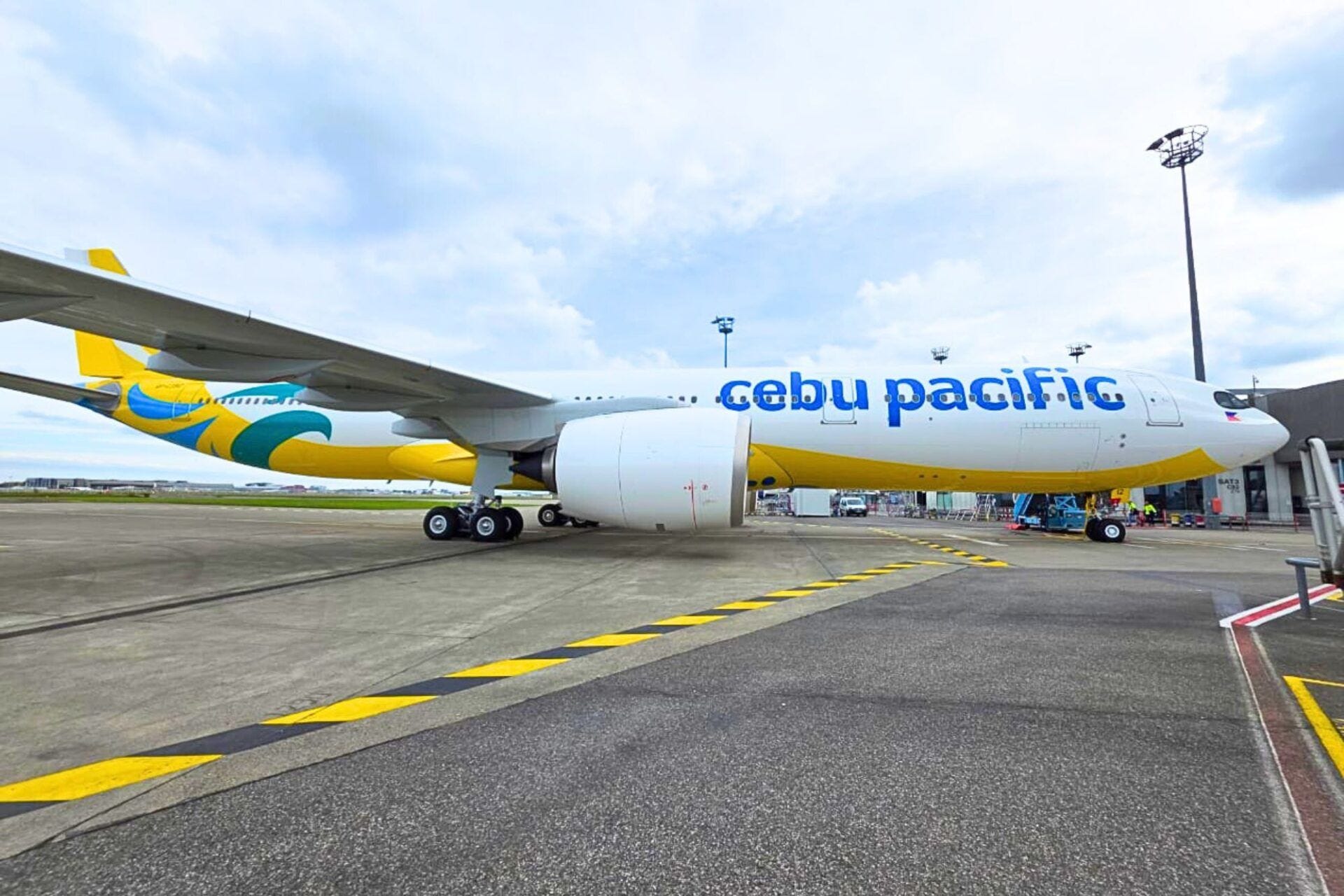
The Riyadh service, operated four times weekly on the A330neo, targets an estimated 800,000 overseas Filipino workers (OFWs) in Saudi Arabia.
This route is Cebu Pacific’s fourth long-haul service and is commercially significant not just for OFW traffic but for the inbound tourism opportunity from a Saudi population that CEO Szucs describes as “a young demographic with a great propensity to travel.”
China remains a recovery story. Pre-pandemic, Cebu Pacific operated 35 weekly flights to China from Manila. That figure was reduced to just seven weekly services across two Chinese cities as demand failed to recover at the pace seen on other routes.
The Philippine government’s decision, effective January 16, 2026, to grant 14-day visa-free entry to Chinese nationals is intended to accelerate this recovery, and if it does, the China market represents a meaningful untapped upside for the network.
Fleet Strategy: Building for Scale, Managing for Efficiency
Current Fleet Composition (as of end-2025)
Cebu Pacific ended 2025 with exactly 100 aircraft in its operational fleet, making it the largest carrier in the Philippines by fleet size.
Fleet Composition (mid-2025 snapshot):

Airbus A330neo (wide-body):   12 aircraft (459-seat config)
Airbus A320 family:           40 aircraft (narrow-body)
Airbus A321 family:           26 aircraft (narrow-body)
ATR 72 turboprops:            22 aircraft (regional)
                              ────────────
Total:                       100 aircraft

Average Fleet Age:            5.9 years (end-2024)
NEO (New Engine Option) %:    72% of jet fleet (Dec 2025)
This fleet profile makes Cebu Pacific one of the youngest commercial fleets in Asia.
As of December 2025, 72% of its jets were Airbus NEO-family aircraft, delivering an estimated 80,000 tonnes in fuel savings and avoiding approximately 252,000 tonnes of carbon emissions over the course of the year. Cebu Pacific is also the largest Airbus A330neo operator in Asia-Pacific.

2026 Fleet Plan: Steady Modernization
For 2026, the airline plans to receive seven aircraft while retiring seven older planes, keeping fleet size constant at 100. The seven inbound deliveries comprise two Airbus A330neos and five Airbus A320neo-family aircraft.
The first delivery of 2026 was an A320neo, registration RP-C4166, which arrived in Manila on March 6, 2026. This aircraft was handed over by Airbus on March 5, 2026, making it the first of four expected A320neo deliveries this year, alongside two A330neos.
The fleet strategy is explicitly designed to increase the proportion of NEO-generation aircraft in the mix. Each new-generation aircraft replaces an older, less fuel-efficient predecessor, improving unit economics even without growing total fleet size.
Capital expenditure for 2026 is budgeted at approximately P30 billion for fleet modernization, mirroring the 2025 level. Reuters reported capex guidance of P35 billion from the earnings call, with 95-96% of that amount tied to aircraft deliveries.
Management has flagged that the volatile fuel price environment may require a review of the capex plan as 2026 progresses.
The Historic A321neo Order: Long-Cycle Ambition
The most consequential fleet decision in Cebu Pacific’s history came in October 2024, when it firmed up a purchase agreement for up to 152 Airbus A321neo aircraft, in a deal first announced as an MoU in July 2024. The transaction, valued at approximately USD 24 billion (~P1.4 trillion) at list prices, is the largest aircraft order in Philippine aviation history.
The deal covers a firm order of 70 aircraft with options to purchase up to 82 more, reaching the headline figure of 152. First deliveries are expected in 2029.
This order positions Cebu Pacific for a decade-long capacity expansion, securing access to highly fuel-efficient, longer-range narrow-body aircraft at a time when slot availability for new Airbus deliveries is extremely constrained globally.
The Pratt & Whitney GTF Engine Challenge
No discussion of Cebu Pacific’s fleet strategy is complete without addressing the Pratt & Whitney PW1100G Geared Turbofan (GTF) engine issue, which affected multiple airlines globally and hit Cebu Pacific particularly hard in 2023 and 2024.
At its peak, Cebu Pacific had up to 20 aircraft grounded due to the powder metal contamination problem in certain GTF engine variants. This forced the airline to wet-lease second-hand A320-200s to plug capacity gaps, adding cost without improving efficiency.
In June 2025, Cebu Pacific secured four free-of-charge PW1133G-JM engines from Pratt & Whitney as part of a compensation package, alongside broader support for aircraft-on-ground (AOG) mitigation. The airline also signed a long-term engine maintenance deal with RTX/Pratt & Whitney in June 2025.
As of mid-2025, approximately 16 aircraft remained grounded and awaiting engine fixes, although the pace of returns was improving. Management acknowledged ongoing financial burdens from the issue while confirming that the worst of the grounding crisis had passed.