


Dear Readers, Welcome to AviationOutlook.
Executive Summary
Delta Air Lines’ mainline in-service fleet has grown to roughly 987 aircraft, with 232 narrowbodies and 85 widebodies now on firm order following three separate 2026 orders.
The Atlanta-based carrier placed a landmark first direct Boeing 787-10 order for up to 60 airframes (30 firm + 30 options), plus 31 additional Airbus widebodies (16 A330-900s and 15 A350-900s), and exercised options for 34 more A321neos in a single seven-month stretch.
Delta’s oldest metal, the Boeing 757-200 and 767-300ER, is being systematically retired between 2026 and 2030 as A321neos, A330-900s, A350-1000s, and 787-10s arrive. The 737 MAX 10 is expected in Delta colors in 2027; the 787-10 not until 2031.
Fleet strategy is fully aligned with premium and international expansion: the A350-1000 debuts a next-generation Delta One Suite (53 suites, 48 Premium Select seats), and premium seating on the 787-10 will exceed 50% versus 30% on the 767 it replaces.
Recommended Reports


Read All Reports
Table of Contents
Executive Summary
Introduction
H1 2026 in Review: The Fleet Order Trifecta
The Fleet Today: Composition
Retirements: The Old Guard Departs
New Deliveries: What Hits the Ramp in H2 2026
The Order Book, Reviewed
Engines, MRO, and the Delta TechOps Angle
Cabin and Product: The Premium Layer of the Fleet Plan
Financial and Operational Framing
Route-Level Deployment Plans
Global Delivery Environment and Risks
Sustainability and Sustainable Aviation Fuel
Regional Fleet and Delta Connection
Delivery Cadence Expectations for H2 2026
Comparative Positioning Versus Peers
Balance Sheet and Cash Deployment
What H2 2026 Should Look Like on the Ramp
My Final Thoughts
Official Sources and Data
Introduction
Delta’s fleet plan for the back half of 2026 is the most concentrated widebody and narrowbody re-ordering the airline has undertaken in more than a decade, and it lands in a year when Atlanta’s flag carrier is simultaneously retiring its oldest classic metal and staging its first-ever direct order from Boeing’s Dreamliner line.
Between January and June 2026 alone, Delta added 95 new aircraft to its firm order book across three separate announcements.
It also unveiled a next-generation Delta One Suite for the A350-1000, began retiring 33-year-old 757s, and confirmed the first 787-10 will not arrive until 2031.
The second half of 2026 is when the shape of Delta’s 2030s fleet becomes tangible.
This report walks through what has been ordered, what’s being retired, what the cabin will look like, where the operational pinch points remain, & more.
Let’s analyze everything in detail.

H1 2026 in Review: The Fleet Order Trifecta
The January widebody double
On January 13, 2026, Delta announced its first direct order for up to 60 Boeing 787 Dreamliners. The deal comprises 30 firm 787-10 airframes with options for 30 more of the largest Dreamliner variant.
Just over two weeks later, on January 28, Delta signed a second widebody deal with Airbus. That firm order covered 31 additional aircraft, split as 16 A330-900s and 15 A350-900s.
The Airbus transaction was structured as a combination of an incremental order and the exercise of 10 previously held options, with 20 fresh widebody options attached for future flexibility.
JANUARY 2026 WIDEBODY BLOCK (firm units)

• Boeing 787-10  ........  30 firm (+30 options)
• Airbus A330-900  .....   16 firm
• Airbus A350-900  .....   15 firm
—————————————————————————————————
TOTAL FIRM ADDS   ......   61 widebodies added in 15 days
Following the Airbus announcement, Delta’s A330-900 book will grow to 55 aircraft, and the A350 family to 79 aircraft, including 20 A350-1000s the carrier expects to begin receiving in early 2027.
The February narrowbody exercise
On February 27, 2026, Delta exercised options for 34 additional A321neos, pushing the aircraft into what the airline itself now describes as the largest-scale fleet type in its history.
Deliveries from that option exercise are scheduled to begin arriving in 2029. Delta’s total A321neo fleet will grow to 189 aircraft once the book is fully delivered.
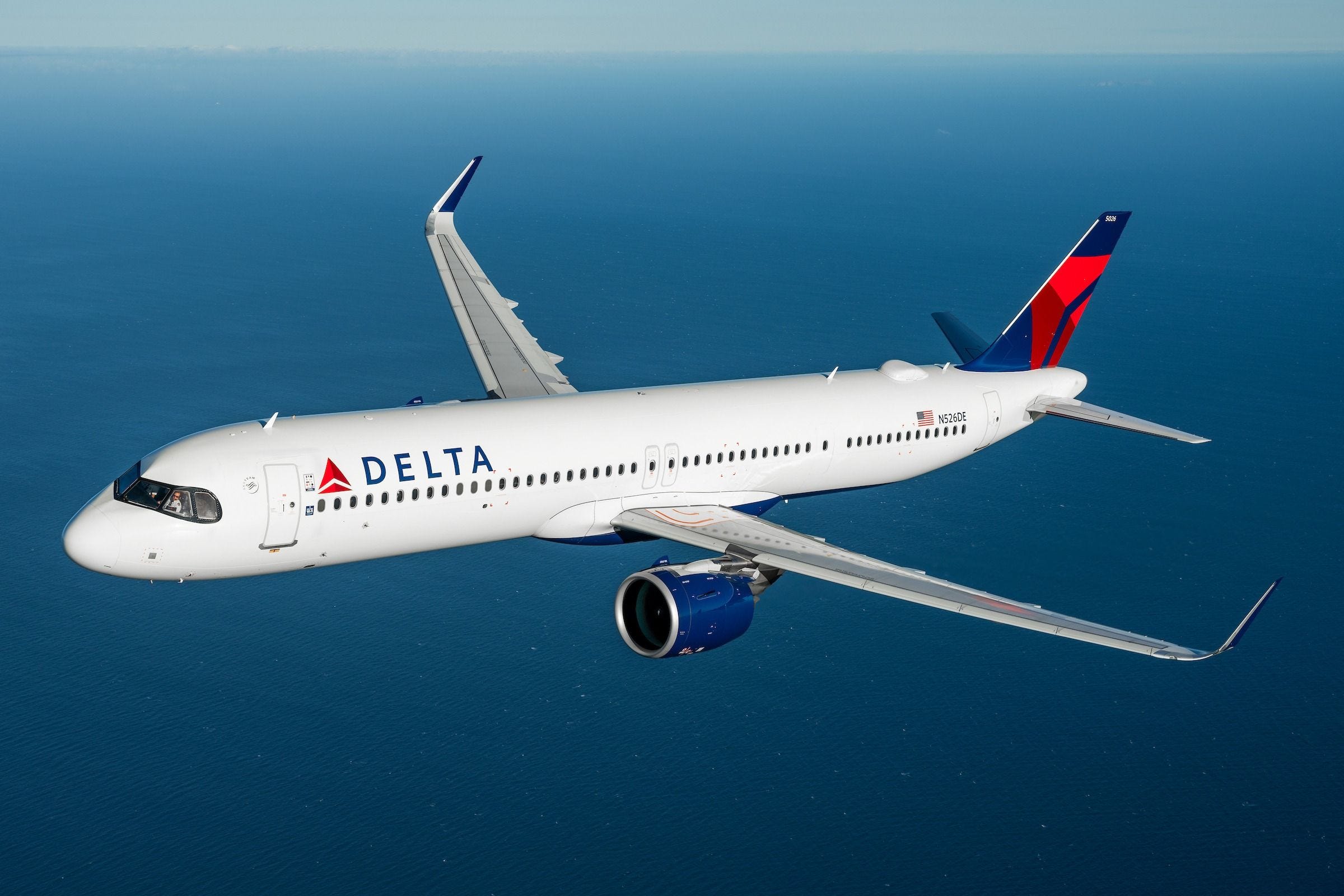
The airline retains options for 36 additional A321neos beyond this exercise, giving fleet planners meaningful optionality into the early 2030s.
Kristen Bojko, Delta’s vice president of Fleet, framed the exercise as a step to invest in a fleet that improves cost structure, supports sustainability goals, and preserves flexibility for network needs into the next decade.
The cumulative order book heading into H2 2026
Following the third order of the year, Delta’s aircraft commitments look categorically different from where they stood at the close of 2024.
DELTA ORDER BOOK (post-Feb 2026, per company disclosures)

Narrowbody on order  ...  232 aircraft
Widebody on order    ...   85 aircraft
—————————————————————————————————————
Aggregate backlog    ...  317 aircraft
Boeing share of book ...  130 airplanes (100 x 737-10 + 30 x 787-10)
Airbus share of book ...  approximately 200 aircraft (incl. A350-1000)
Those tallies were formally acknowledged in Delta’s Q1 2026 earnings materials, where the company confirmed it was advancing fleet modernization with 95 new aircraft orders across Airbus and Boeing product lines.
The Fleet Today: Composition
Total mainline size and average age
Delta’s mainline fleet sits at roughly 987 aircraft at the mid-point of 2026, with an average fleet age hovering around 15 years across the mainline portfolio.
That average age is a running conversation piece for Delta’s leadership because it is materially older than the fleets at United and American, and the current renewal wave is designed to bring that number down through the back half of the decade.
Narrowbody backbone
The narrowbody backbone in H2 2026 is a blend of Airbus and Boeing types.
On the Airbus side, the A220-100/300, A319, A320, A321ceo, and A321neo split the domestic and short-haul international schedule.
On the Boeing side, the 717-200, 737-800, 737-900ER, and 757-200/300 continue to move volume.
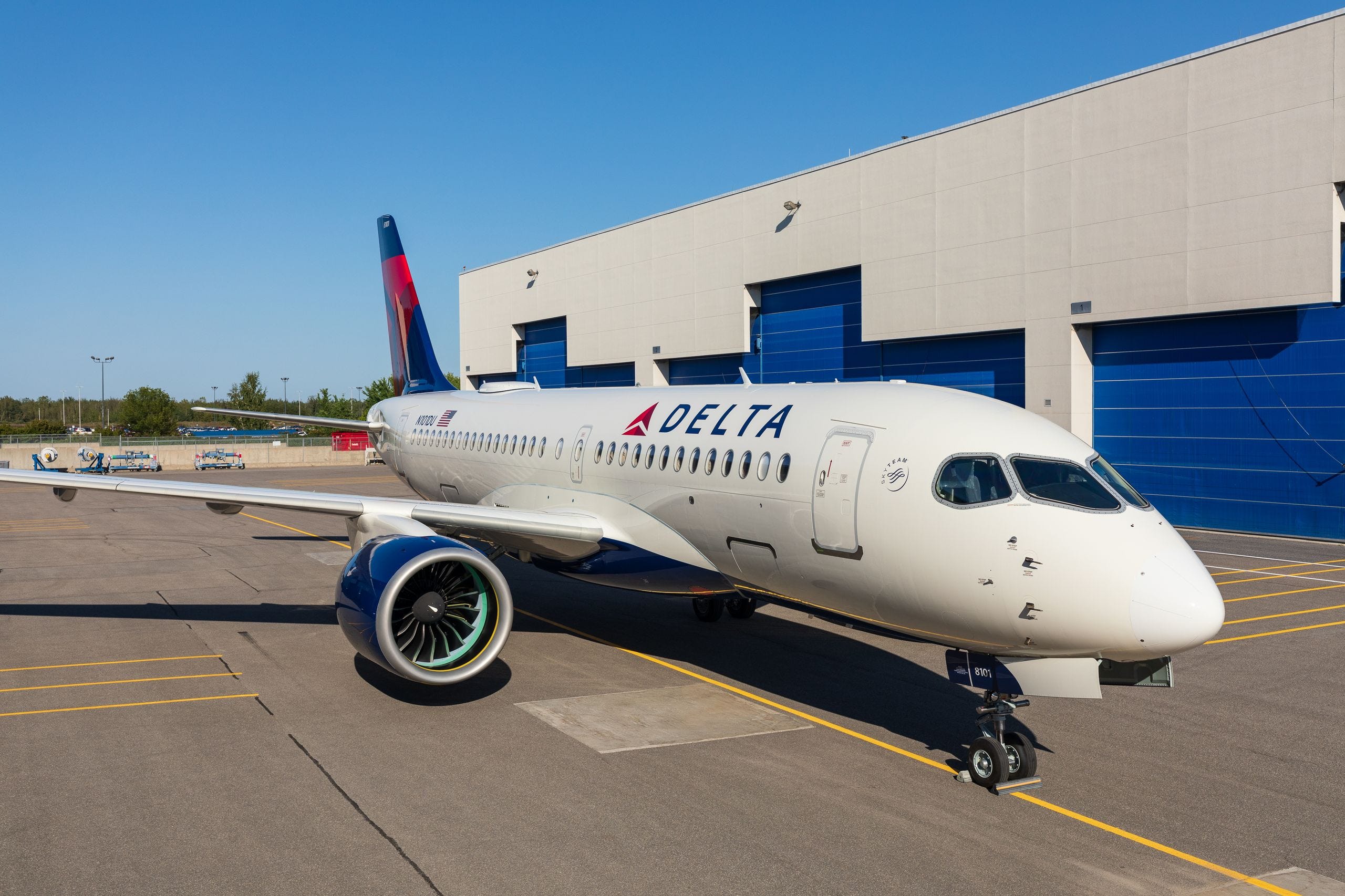
Delta operates the world’s largest passenger subfleets of the A220 and Boeing 717, and the A220 is now central to the airline’s short-haul mainline planning.
In 2026, Delta scheduled roughly 97,438 A220 flights, an average of nearly 267 A220 departures per day.
NARROWBODY OPERATING TYPES (mainline, mid-2026)

• Airbus A220-100 / A220-300
• Airbus A319-100
• Airbus A320-200
• Airbus A321-200 (ceo)
• Airbus A321neo   (92 in service; 189 total on the book)
• Boeing 717-200
• Boeing 737-800 / 737-900ER
• Boeing 757-200 / 757-300  (retirements underway)
The A321neo has become the highest-gauge next-generation narrowbody in Delta’s fleet.
It offers, per the company’s own filings, the lowest unit cost of any narrowbody in Delta’s fleet, and delivers 20 to 30 percent better fuel efficiency than the aircraft it replaces.
Widebody portfolio
The widebody portfolio has three distinct generations currently overlapping on Delta’s ramp.
The retiring generation is the Boeing 767-300ER and 767-400ER. The core widebody workhorse is the Airbus A330-200/300 and A330-900. The premium long-haul flagship remains the Airbus A350-900 until the A350-1000 arrives in early 2027.
The 787-10 is the newest committed type, and it is important to keep separate the fact that the aircraft has been ordered from the fact that Delta’s first 787-10 is not scheduled to arrive until 2031, according to commentary Delta commercial chief Joe Esposito delivered on the July 10 earnings call.
WIDEBODY OPERATING TYPES (mainline, mid-2026)

• Airbus A330-200 / A330-300
• Airbus A330-900   (fleet to grow to 55 with new order)
• Airbus A350-900   (28 in service, moving to 59 on order/delivered)
• Airbus A350-1000  (20 firm, first delivery early 2027)
• Boeing 767-300ER  (retirement by 2030)
• Boeing 767-400ER  (still in service post-2030 pending replacement)
• Boeing 787-10     (30 firm, first delivery 2031)
Regional fleet
Regional flying under the Delta Connection banner remains dominated by the Bombardier CRJ-550, CRJ-700, and CRJ-900, along with the Embraer E175.
The E175 continues to displace CRJ-900 flying on a growing set of routes, and Delta Connection began operating the E175 on new markets such as Aspen from Los Angeles and Atlanta, replacing older equipment on those thin routes.