


GE Aerospace enters 2026 not as a recovering industrial giant, but as a fully formed, pure-play propulsion powerhouse sitting at the center of global aviation’s most consequential growth cycle in decades.
With a $190 billion order backlog, record commercial engine deliveries, and a services business rewriting the economics of the MRO sector, the Cincinnati, Ohio-based company is executing on almost every front simultaneously.
Also Read:

But as this SWOT analysis will unpack, GE Aerospace’s strengths are mirrored by structural vulnerabilities, from concentrated Boeing exposure to unresolved geopolitical fault lines with China, that will demand as much strategic clarity as operational excellence in the years ahead.
Recommended - Read Full Reports


Read All Reports
Table of Contents
GE Aerospace at a Glance: The Pure-Play That Changed Everything
PART 1: STRENGTHS - What Makes GE Aerospace the Market’s Structural Winner
The LEAP Engine’s Unrivaled Market Lock-In
The Services Machine: A Recurring Revenue Annuity at Scale
The GE9X: The World’s Most Powerful Commercial Engine
FLIGHT DECK: Lean Operations as a Structural Competitive Moat
AI and Digital Transformation: Operational Leverage in Action
Defense & Propulsion Technologies: The Underappreciated Profit Engine
Technology Depth: CMC, Additive Manufacturing, and Advanced Materials
PART 2: WEAKNESSES - Where the Architecture Shows Stress Fractures
The Boeing Dependency: Indispensable but Inescapable
GE9X in Early-Phase Production Economics
Supply Chain Fragility Remains Structurally Unresolved
LEAP Durability Gaps in Hot and Harsh Environments
LEAP Program Concentration Risk
PART 3: OPPORTUNITIES - The Structural Growth Vectors Ahead
The MRO Super-Cycle: Years of Structural Demand Visibility
The CFM56 Extended Longevity: An Unexpected Revenue Multiplier
The RISE Program: Competing for the 2030s Single-Aisle Crown
Global Defense Spending Acceleration: A Multi-Year Tailwind
Commercial Aviation’s Sustained Global Passenger Growth
U.S. Manufacturing Investment Building for the 2030s
PART 4: THREATS - The Risk Architecture Around GE Aerospace’s Growth Story
The China Wildcard: Trade Wars and the COMAC C919 Dependency
Pratt & Whitney’s GTF Recovery and Market Share Ambitions
Regulatory Scrutiny and Certification Risk
Airframe Certification Dependencies Creating Revenue Timing Uncertainty
GE Aerospace’s 2026 Financial Guidance: What the Numbers Signal
Competitive Positioning: GE Aerospace vs. Pratt & Whitney vs. Rolls-Royce
GE Aerospace’s MRO Global Network: A Strategic Asset Beyond Engine Production
The GEnx: Widebody Services Revenue Already at Maturity
Workforce Strategy and Talent Pipeline: The Unseen Constraint
Sustainability Strategy: SAF Compatibility and the Aviation Net-Zero Pathway
My Final Thoughts
GE Aerospace at a Glance: The Pure-Play That Changed Everything
GE Aerospace formally became a standalone publicly traded company in April 2024 following the breakup of the former General Electric conglomerate. What emerged is a precision-focused enterprise with an installed base of approximately 49,000 commercial and 29,000 military aircraft engines, approximately 53,000 global employees, and deep manufacturing roots across the United States, Europe, and beyond.
The separation itself was a strategic masterstroke by CEO H. Lawrence Culp Jr. For years, GE Aerospace’s exceptional economics were obscured within a sprawling conglomerate - submerged under GE Capital liabilities, power division write-downs, and healthcare unit volatility. As a standalone entity, GE Aerospace’s clean financial profile - double-digit growth, expanding margins, and extraordinary free cash flow conversion - is impossible to miss.
The company operates through two primary reporting segments. Commercial Engines & Services (CES) encompasses the LEAP narrowbody engine family, widebody programs (GEnx, GE9X, Engine Alliance GP7200), and the full commercial aftermarket services business. Defense & Propulsion Technologies (DPT) serves global military customers with engines including the F110, F414, T901, and T700 families, providing a government-backed revenue base structurally less sensitive to commercial aviation cycles.
GE Aerospace — FY2025 Full-Year Results Snapshot
---------------------------------------------------------
Total Revenue (GAAP):         $45.9 billion  (+18% YoY)
Adjusted Revenue:             $42.3 billion  (+21% YoY)
Total Orders Received:        $66.2 billion  (+32% YoY)
GAAP Net Profit:              $10.0 billion  (+31% YoY)
Operating Profit:             $9.1 billion   (+25% YoY)
Operating Profit Margin:      21.4%          (+70 bps YoY)
Adjusted EPS:                 $6.37          (+38% YoY)
Free Cash Flow:               $7.7 billion   (+24% YoY)
FCF Conversion:               Exceeded 100%
Order Backlog (Year-End):     ~$190 billion
Commercial Engine Deliveries: 2,386 units   (+25% YoY)
LEAP Engine Deliveries:       1,802 units   (+28% YoY)
Defense Engine Deliveries:    635 units     (+~30% YoY)
CES Services Revenue:         $25 billion   (+26% YoY)
Employees Globally:           ~53,000
---------------------------------------------------------
Source: GE Aerospace Q4 & FY2025 Earnings Release, Jan 22, 2026
These numbers are not isolated to one strong quarter. They represent the compounding product of a multi-year operational transformation built around the “FLIGHT DECK” lean operating model and relentless supply chain rehabilitation. Chairman and CEO H. Lawrence Culp Jr. described 2025 as “outstanding,” citing revenue growth of 21%, EPS up 38%, and free cash flow conversion exceeding 100%.
PART 1: STRENGTHS - What Makes GE Aerospace the Market’s Structural Winner
The LEAP Engine’s Unrivaled Market Lock-In
The single most important commercial reality about GE Aerospace is this: the company, through its 50/50 joint venture CFM International with France’s Safran Aircraft Engines, controls the engine program that powers the two most-ordered commercial aircraft in history - the Boeing 737 MAX and Airbus A320neo family.
The LEAP-1B is the exclusive powerplant for every Boeing 737 MAX ever built or ordered. There is no alternative, no competing option, and no near-term prospect of one. On the Airbus A320neo family, the LEAP-1A commands approximately 76% market share vs. Pratt & Whitney’s GTF engine at 24%.
This is not merely a market position. It is a structural lock-in enforced by the physics of fleet-wide certification, multi-billion-dollar airline maintenance infrastructure investments, and the economic logic of single-type fleet standardization that airlines pursue obsessively.
The LEAP program’s durability roadmap is also advancing meaningfully. By end of 2025, the Reverse Bleed System (RBS) had been installed in 50% of LEAP-1A engines in service, and nearly 1,500 LEAP-1A durability kits had been shipped to customers globally. GE expects certification of the LEAP-1B durability kit in the first half of 2026, targeting more than a twofold improvement in time-on-wing - ultimately matching the legendary reliability standard set by the CFM56.
LEAP Program Market Footprint (as of early 2026)
---------------------------------------------------------
Aircraft Powered:           3,700+ in commercial service
Total LEAP Flight Hours:    30+ million hours logged
LEAP-1B Exclusivity:        100% of Boeing 737 MAX fleet
LEAP-1A Market Share:       ~76% of Airbus A320neo family
CFM LEAP Orders +
  Commitments:              Surpassed 40,000 units
Installed Base (2030):      Expected to triple vs. today
LEAP Deliveries 2025:       1,802 units (+28% YoY)
LEAP Deliveries 2026 est.:  ~2,072 units (+~15%)
2028 Delivery Target:       ~2,500 units
Fuel Efficiency vs. CFM56:  15% better fuel burn + CO2
---------------------------------------------------------
Source: CFM International, GE Aerospace Annual Report 2025
Since entering commercial service in 2016, the LEAP engine has delivered 15% better fuel burn and CO2 emissions than the CFM56. With more than 10,000 engines in backlog as of 2025, the pipeline of future demand for LEAP production and associated services extends well into the 2030s.
The Services Machine: A Recurring Revenue Annuity at Scale
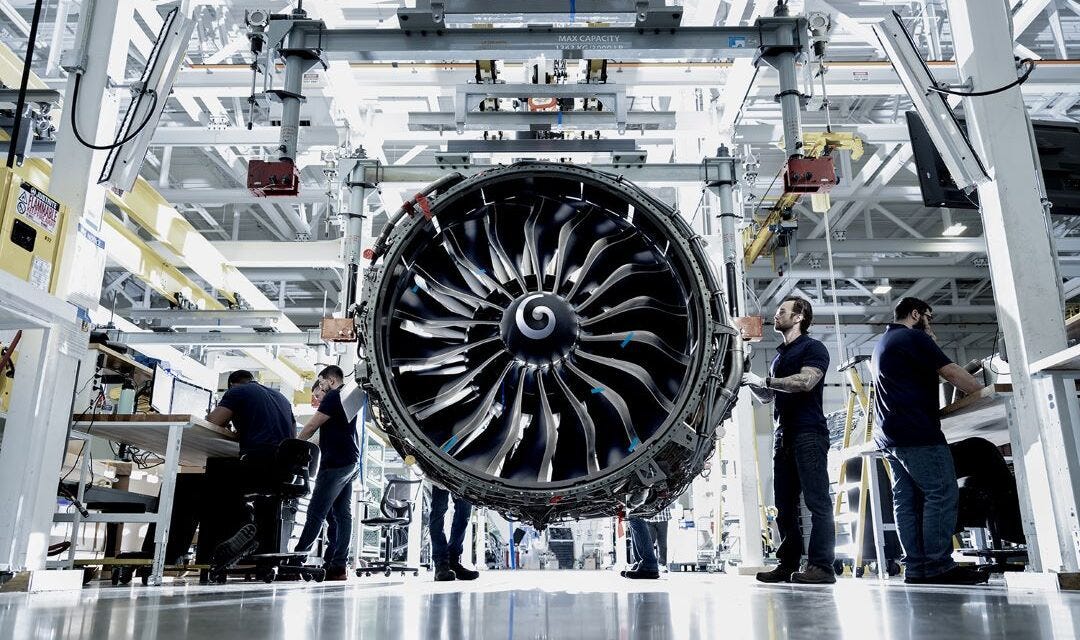
Perhaps the most underappreciated element of GE Aerospace’s business model is the sheer scale and structural growth of its aftermarket services division. Services represent more than 70% of commercial engine revenue - a proportion that compounds favorably as the installed base of LEAP engines grows with every new delivery.
Commercial services revenue surged 26% in full-year 2025 to $25 billion, driven by internal shop visits (+33% year-over-year in Q3 2025 alone), spare parts sales (up over 25%), and a structural tailwind: aging aircraft fleets are being kept in service longer than originally planned because new aircraft deliveries remain constrained by airframer production rate limitations.
GE now estimates that only approximately 2% of the global commercial fleet will retire in 2026, below its earlier projection of 2-3%. Every percentage point of fleet retirement that doesn’t happen translates directly into incremental MRO demand across GE’s 78,000-engine installed base.
The Services Revenue Compounding Logic
------------------------------------------------------------
Step 1: Each new engine delivery adds to the installed base
Step 2: Installed base generates shop visits every few years
Step 3: Shop visits require spare parts, labor, overhaul kits
Step 4: Delayed fleet retirements extend the MRO cycle window
Step 5: AI tools improve throughput, expanding shop capacity
Step 6: Wider work scopes per visit increase revenue per event

→ Services revenue is growing faster than equipment revenue
→ 78,000 engines currently supported in service globally
→ 2.3+ billion cumulative flight hours across engine portfolio
→ FY2025 CES services revenue: $25 billion (+26%)
→ Internal shop visits grew 33% YoY in Q3 2025
------------------------------------------------------------
Source: GE Aerospace Q3 2025, FY2025 Earnings Releases
The services flywheel is the true financial engine of GE Aerospace: equipment sells at tight margins initially, but every delivered engine creates a multi-decade revenue annuity through MRO, spare parts, and performance upgrades.
This economic model means GE’s value creation is not a linear function of new aircraft deliveries - it is a compounding function of every engine already flying.
The GE9X: The World’s Most Powerful Commercial Engine
The GE9X, purpose-built for the Boeing 777X, represents GE Aerospace’s most significant long-term widebody investment. As the most tested engine in GE Aerospace history — with more than 30,000 test cycles and 8,000 endurance cycles — plus over 1,600 hours tested specifically in hot and harsh environments, the GE9X has been subjected to the most extensive pre-service validation in commercial aviation engine history.
The Boeing 777-9 is now expected to receive FAA certification and achieve entry into service in 2026-2027. Qatar Airways placed what GE described as the largest widebody engine commitment in its history — more than 400 GE9X and GEnx engines. Korean Air committed to 28 additional GE9X engines in Q3 2025. Cathay Pacific expanded its GE9X order to more than 70 engines for 35 Boeing 777-9 aircraft.
The Boeing 777X backlog stood at 481 aircraft as of mid-2025, all exclusively powered by the GE9X. GE’s cost reduction roadmap targets a 30% cost reduction per unit by the 50th engine and another 30% reduction by the 250th engine, meaning program-level profitability will improve substantially as production volume scales through the late 2020s.
The GEnx, which powers more than 60% of the Boeing 787 fleet globally, continues to build on its widebody leadership position. IAG placed a firm order for 32 Boeing 787 aircraft powered by GEnx for British Airways in 2025, underscoring the program’s sustained commercial relevance.
FLIGHT DECK: Lean Operations as a Structural Competitive Moat
One of the least visible but most consequential structural advantages GE Aerospace holds over peers is its “FLIGHT DECK” lean operating model, adapted from the Toyota Production System and deployed across manufacturing, supply chain, and MRO. This management philosophy drives tangible, quantifiable results that are difficult to replicate without years of cultural embedding.
Material input from priority suppliers grew 40% year-over-year in 2025, reflecting seven consecutive quarters of sequential improvement. Total engine deliveries rose 26% year-over-year directly because of this supply chain improvement — demonstrating that FLIGHT DECK’s influence on the supply base translates proportionally into finished product output.
At GE’s Terre Haute, Indiana combustors and structures facility, targeted kaizen events increased average output to more than 470 pieces per week — a tenfold increase. At Celma, Brazil and GE’s Malaysia MRO sites, AI tools have delivered five-to-seven-day reductions in engine turnaround time. These are not aspirational metrics. They are verified operational outcomes embedded in active production systems.
AI and Digital Transformation: Operational Leverage in Action
GE Aerospace is deploying artificial intelligence as an active operational tool across manufacturing and MRO, not as a future-state ambition. Three programs are particularly material to near-term competitive positioning.
The AI-enabled Blade Inspection Tool developed at the GE Aerospace Research Center facilitates inspection of critical Stage 1 blades in half the time with improved accuracy. The AI-based material assistant predicts individual LEAP engine shop visit workscopes nine months in advance, enabling earlier parts ordering that compresses lead times and improves parts availability. The AI model was deployed to Celma and Malaysia in 2025, delivering those five-to-seven-day turnaround reductions.
GE also supports active digital twin deployments across tens of thousands of engines, enabling predictive maintenance that reduces unscheduled removals and delivers documented double-digit percentage reductions in unscheduled engine removals for select fleets. As GE looks to 2026, management views expanded AI deployment as an accelerator for FLIGHT DECK, reducing waste and freeing teams for higher-value customer work.
Defense & Propulsion Technologies: The Underappreciated Profit Engine
GE’s Defense & Propulsion Technologies (DPT) segment achieved 26% revenue growth in Q3 2025, reaching $2.8 billion, with 75% profit growth and 380 basis points of margin expansion. For full-year 2025, defense engine shipments rose nearly 30% to 635 units.
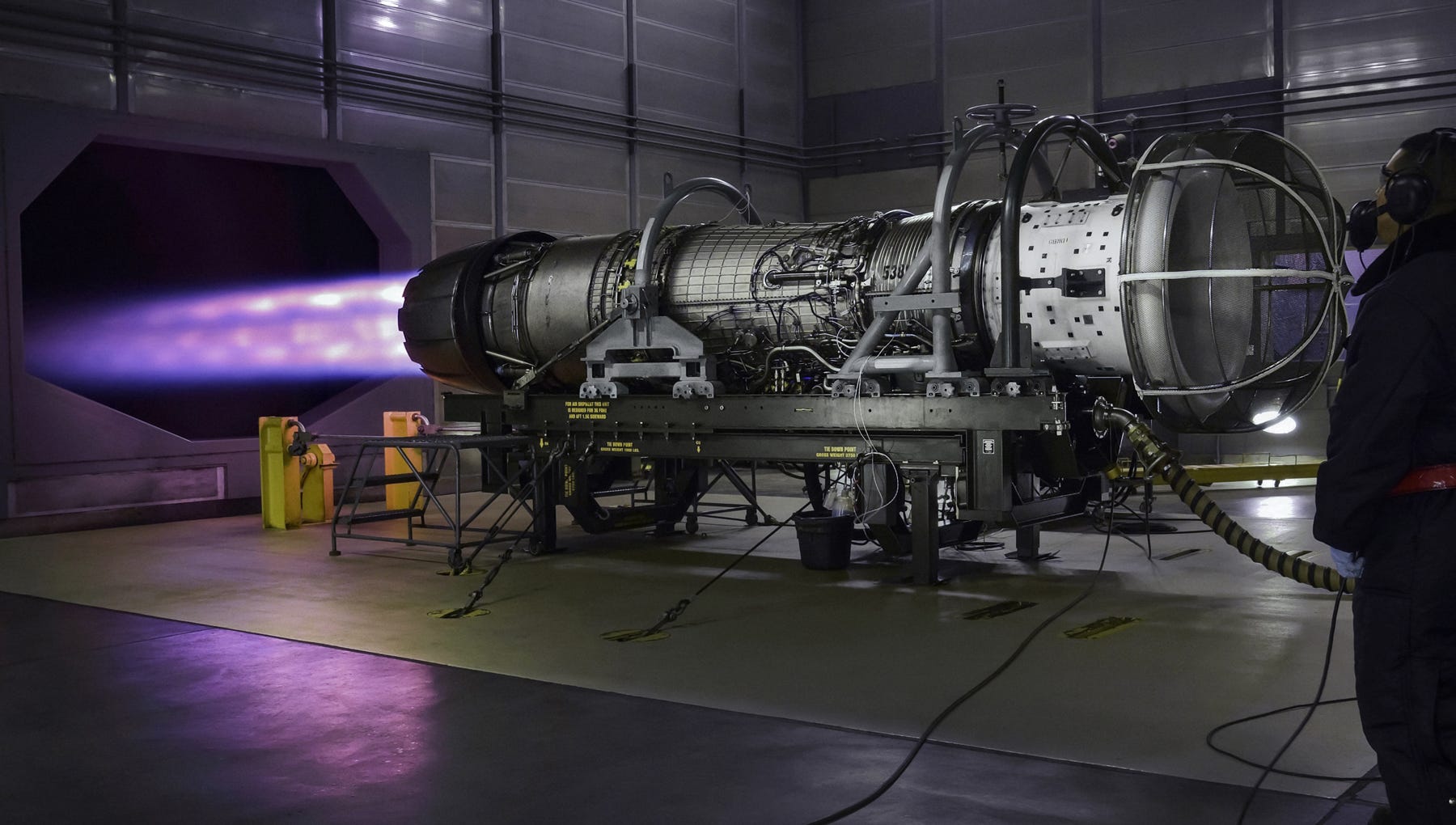
GE Aerospace engines power a broad portfolio of military programs: the F110 for F-15 and F-16 variants worldwide; the F414 for naval aviation; the T700 for UH-60 Black Hawk and AH-64 Apache helicopters; the T901 for the Army’s next-generation rotorcraft upgrade; and international programs including Turkey’s KAAN fifth-generation fighter. Bank of America’s Ronald Epstein specifically highlighted GE’s defense exposure as “underappreciated,” noting that DPT is well-positioned and that commercial operational excellence transfers effectively to defense production at scale.
DPT Segment Performance (Full Year & Recent Quarters, 2025):
---------------------------------------------
Q3 2025 Revenue:        $2.8 billion  (+26% YoY)
Q3 2025 Profit Growth:  +75% YoY
Q3 2025 Margin Exp.:    +380 bps YoY
FY2025 Deliveries:      635 engines   (+~30% YoY)
Key Military Engines:   F110, F414, T901, T700, GE38
Platforms Powered:      F-15, F-16, UH-60, AH-64, KAAN
International Wins:     Turkey KAAN (first F110 delivered 2025)
Revenue Characteristic: Government-backed,
                        counter-cyclical to commercial aviation
---------------------------------------------
Source: GE Aerospace Q3 & FY2025 Earnings Releases
Technology Depth: CMC, Additive Manufacturing, and Advanced Materials
GE Aerospace’s engineering capabilities represent decades of sustained R&D investment that competitors cannot replicate on any short timeline. Three technology domains are particularly material to long-run competitive positioning.
Ceramic Matrix Composites (CMC): GE Aerospace is the world leader in CMC application to commercial jet engines. CMC components are lighter than traditional metal alloys and maintain structural integrity at much higher temperatures, directly enabling improved turbine efficiency. GE’s proprietary CMC manufacturing capability is a core enabler of LEAP and GE9X performance and is protected by thousands of active aerospace patents.
Additive Manufacturing: GE pioneered 3D-printed metal components in commercial aviation engines, with the LEAP fuel nozzle being the first FAA-certified additive-manufactured commercial engine component. Additive manufacturing allows GE to produce geometrically complex components impossible to manufacture conventionally, improving performance and reducing part counts.
SAF Compatibility: GE and CFM conducted 100% Sustainable Aviation Fuel test flights in 2023-2024, demonstrating full compatibility with neat SAF. Existing LEAP and CFM56 engines are SAF-compatible without hardware modification, giving GE’s entire installed base an inherent alignment with aviation’s regulatory decarbonization trajectory.
PART 2: WEAKNESSES — Where the Architecture Shows Stress Fractures
The Boeing Dependency: Indispensable but Inescapable
GE Aerospace’s most consequential commercial vulnerability is its profound concentration in Boeing programs. GE is the sole engine supplier for the Boeing 737 MAX and the Boeing 777X. While this exclusivity is structurally advantageous under normal conditions, it converts directly into a liability when Boeing’s production rates are suppressed by regulatory intervention, labor action, or quality control remediation - as has repeatedly occurred through 2024 and 2025.
Boeing’s 737 MAX production rates are recovering gradually from the regulatory scrutiny and production quality investigations of 2024. Rates remain below plan, directly capping LEAP-1B delivery volumes and suppressing the equipment revenue component of GE’s CES segment. The 777X program’s prolonged certification process - originally expected to achieve entry into service years earlier — continues to defer GE9X revenue at the exact moment GE has committed manufacturing ramp costs and inventory.
Any further delays to the 777X entry into service, now expected in 2026-2027, directly impact GE’s revenue timing and complicate the GE9X program’s path to profitability. The Boeing relationship is simultaneously GE Aerospace’s greatest strength and its single most unhedgeable source of near-term volume risk.
GE9X in Early-Phase Production Economics
The GE9X, despite its technological pedigree, is generating meaningful financial headwinds in its production ramp phase. CFO Rahul Ghai acknowledged “a couple of hundred million dollars of profit headwind” from initial GE9X shipments in 2025, consistent with the standard economics of new aircraft engine programs where early unit costs substantially exceed mature-production economics.
This is structurally expected and well-understood — the GEnx followed a nearly identical cost curve before becoming a highly profitable franchise. But until GE9X deliveries reach the 50th and 250th unit cost-reduction milestones, the program will continue to dilute operating margins in the widebody segment.
Combined with the 777X certification delay compressing delivery volume, this creates a multi-year headwind on GE9X program economics that investors and analysts track closely.
Supply Chain Fragility Remains Structurally Unresolved
GE Aerospace made significant strides on supply chain rehabilitation in 2025, but the fundamental fragility of the aerospace propulsion supply chain has not been resolved. The West Jefferson, North Carolina expansion — a $53 million project adding 35,000 square feet of LEAP high-pressure component production capacity — is not expected to be completed for three more years from the announcement.
Despite 40% year-on-year growth in material input from priority suppliers in 2025, management itself acknowledged that sustaining this pace in 2026 will depend on whether suppliers can maintain alignment with airframer ramp-up targets. Specialized aerospace castings, titanium forgings, superalloy components, and heat-resistant materials involve limited qualified supplier networks that cannot be rapidly expanded through capital investment alone.
The F404-IN20 program for India’s HAL Tejas Mk-1A is the starkest recent illustration. Under a 2021 contract for 99 engines valued at roughly $716 million, GE had delivered only approximately five engines by late 2025. The dormant assembly line required complete supplier requalification.
A critical South Korean sub-vendor collapse further disrupted component availability. India’s Ministry of Defence imposed financial penalties for missed milestones - consequences with lasting implications for GE’s defense export reputation.
Supply Chain Risk Indicators (as of early 2026):
------------------------------------------------------------
Delivery Slot Backlog:      A320neo + 737 MAX ~10 years
West Jefferson Expansion:   3-year completion timeline
F404/HAL Tejas:             ~5 of 99 delivered by late 2025
Supplier Material Growth:   +40% (2025 vs. 2024)
2026 Sustainability Risk:   Depends on supplier pace
Specialized Material Risk:  Castings, forgings, superalloys
Single-Source Exposure:     Multiple Tier-2/3 sole suppliers
IATA/Oliver Wyman Estimate: $11B airline cost from SC
                            disruptions in 2025 globally
------------------------------------------------------------
Source: Forecast International, IATA/Oliver WymanLEAP Durability Gaps in Hot and Harsh Environments
GE’s own 2025 Annual Report is candid about the LEAP engine’s durability gap relative to the CFM56 in high-heat, high-dust operating environments. The LEAP-1A durability kit is explicitly designed to bring time-on-wing to “CFM56 levels” — language that confirms a performance gap still exists between the newer LEAP and its predecessor in real-world operations across the Middle East, South Asia, and tropical regions.
Airlines operating high-frequency routes in these environments have experienced higher-than-planned shop visit frequencies. This creates commercial friction: maintenance cost predictability - a key driver of airline engine selection decisions — is compromised when shop visits occur earlier than the original technical projections. GE expects LEAP-1B durability kit certification in the first half of 2026, but the improvement will take multiple years to propagate across the in-service fleet as engines come in for scheduled shop visits.
LEAP Program Concentration Risk
The inverse of the LEAP program’s dominance is a concentration risk that cannot be diversified away in the near term. GE’s heavy dependence on the LEAP program for growth creates vulnerability if competitive dynamics shift. Should Pratt & Whitney’s GTF Advantage platform recover its reputation and capture a higher share of new A320neo orders in future selection cycles, LEAP’s overwhelming current narrowbody dominance could see gradual erosion in the out-years.
A single-program failure would have outsized financial impact - a reality that management acknowledges through its investment in RISE as a successor platform and through the GEnx/GE9X widebody diversification.