


Executive Summary
General Dynamics closed the calendar 2025 with $52.6 billion in revenue, up 10.1%, and a record $118 billion firm backlog that translates to roughly two and a quarter years of work, with book-to-bill of 1.5x for the year.
The Aerospace segment, anchored by Gulfstream, delivered 158 business jets versus 136 in 2024, with the new G800 entering service after dual FAA and EASA certification in April 2025.
Defense segments are running near full capacity, with Electric Boat scaling Columbia and Virginia submarine production and Land Systems advancing the M1E3 Abrams next-generation tank and the Polish Abrams export program.
For 2026, management has guided to revenue of $54.3 to $54.8 billion and diluted EPS of $16.10 to $16.20, with completions capacity at Gulfstream and submarine industrial base throughput cited as the principal swing factors.
Recommended - Read Full Reports


Read All Reports
Table of Contents
Executive Summary
Introduction
Key Facts: General Dynamics
General Dynamics Company Overview
Corporate Identity and Operating Philosophy
Leadership and Governance
Geographic Footprint and Industrial Base
Key Aerospace and Defense Product Lines, Programs, and Services
Aerospace Segment: Gulfstream Plus Jet Aviation
Gulfstream G800: The New Range and Speed Benchmark
Gulfstream G700: The Volume Workhorse
Gulfstream G600: Quiet Cash Generator
Gulfstream G500: Mature Large-Cabin
Gulfstream G400: Re-Entering the Large-Cabin Mid-Range
Gulfstream G280: The Super-Midsize Anchor
Jet Aviation: The Aftermarket Engine
Marine Systems Segment: The Underwater Crown Jewel
Electric Boat: Columbia and Virginia Submarines
Bath Iron Works: Surface Combatants
NASSCO: Auxiliary and Commercial Shipbuilding
Combat Systems Segment: Tanks, Vehicles, and Munitions
Land Systems: Abrams, Stryker, and the M1E3
Ordnance and Tactical Systems
European Land Systems
Technologies Segment: GDIT and Mission Systems
GDIT: Federal IT and Mission Services
Mission Systems: Strategic Programs
General Dynamics Financial Analysis
Full-Year 2025 Performance
Quarterly Performance Cadence
Margin Analysis by Segment
Cash Flow and Capital Allocation
Dividend Trajectory
Revenue and Growth Drivers: General Dynamics
Backlog as the Engine
Aerospace Growth Drivers
Defense Growth Drivers
LTM Revenue Picture
Major Competitors
General Dynamics vs Lockheed Martin
General Dynamics vs Boeing Defense, Space & Security
General Dynamics vs Northrop Grumman
General Dynamics vs RTX Corporation
General Dynamics vs Huntington Ingalls Industries
General Dynamics vs Bombardier and Dassault in Business Aviation
General Dynamics Competitive Analysis and Moat
Industrial Base as a Structural Barrier
Program-Level Stickiness
Operational Discipline as a Competitive Advantage
Diversification Across Aerospace and Defense
2026 Outlook and Beyond
Management Guidance for 2026
Beyond 2026: The Multi-Year View
Financial and Commercial Implications
For Aviation Industry Stakeholders
For Defense Industry Stakeholders
Capital Allocation Implications
Key Risks with Probability Assessments
Risk 1: Submarine Industrial Base Throughput Misses
Risk 2: Gulfstream Completions Capacity Constraints
Risk 3: U.S. Government Budget Continuing Resolution or Shutdown
Risk 4: Foreign Military Sales Disruption
Risk 5: Business Aviation Demand Cyclicality
Risk 6: M1E3 Program Schedule or Scope Change
Risk 7: Cyber Security Incident at GDIT
General Dynamics SWOT Analysis
My Final Thoughts
Official Sources and Data
Introduction
General Dynamics finished 2025 with a backlog 30% larger than where it started the year, and that backlog now stands at $118 billion.
For an industrial that generated $52.6 billion in revenue last year, that is a remarkably long demand runway, and it changes the shape of every strategic conversation, from supplier pricing to capital expenditure to talent.
Also, Gulfstream just put the world’s longest-range business aircraft into service, Electric Boat is building the most expensive submarines the U.S. Navy has ever procured, Land Systems is on the cusp of producing the first all-new Abrams variant since 1980, and the Technologies group quietly absorbed nearly a billion dollars in new Navy command-and-control work in a single contract.
This in-depth analysis report unpacks each of those threads, explains the interplay between Gulfstream’s commercial cyclicality and the defense business’s contractual visibility, and lays out a 2026-and-beyond view.
Key Facts: General Dynamics
Headquarters: Reston, Virginia
NYSE Ticker: GD
Chairman & CEO: Phebe N. Novakovic
President: Danny Deep
Employees (worldwide): 110,000+
2025 Revenue: $52.6 billion
2025 Net Earnings: $4.2 billion
2025 Diluted EPS: $15.45
Year-end 2025 Backlog: $118 billion
Total Estimated Contract Value: $179 billion
Operating Segments: Aerospace, Marine Systems, Combat Systems, Technologies
Quarterly Dividend (declared March 2026): $1.59 per share
2026 Revenue Guidance: $54.3B to $54.8B
2026 Diluted EPS Guidance: $16.10 to $16.20The company describes itself as a portfolio of four discrete businesses serving business aviation, naval shipbuilding, land combat vehicles and weapons, and defense technology services.
The structure is intentional and unusual among large prime contractors, and it is central to the analysis that follows.
General Dynamics Company Overview
Corporate Identity and Operating Philosophy
General Dynamics is a global aerospace and defense holding company headquartered in Reston, Virginia, with operations spanning more than 70 countries. The company employs more than 110,000 people and reported $52.6 billion of consolidated revenue in 2025.
The corporate philosophy at the parent level is deliberately spare.
Each business unit retains operating autonomy, sets its own engineering and manufacturing standards, and is held accountable by Reston for cash conversion, contract performance, and program execution rather than for top-down strategy.
Corporate Structure (2026)
Parent: General Dynamics Corporation (NYSE: GD)
- Aerospace Segment
   - Gulfstream Aerospace Corporation (Savannah, GA)
   - Jet Aviation (Basel, Switzerland)
- Marine Systems Segment
   - Electric Boat (Groton, CT and Quonset Point, RI)
   - Bath Iron Works (Bath, ME)
   - NASSCO (San Diego, CA, and Norfolk, VA)
- Combat Systems Segment
   - Land Systems (Sterling Heights, MI)
   - Ordnance and Tactical Systems
   - European Land Systems (Madrid, Vienna, Bern)
- Technologies Segment
   - GDIT (Falls Church, VA)
- Mission Systems (Fairfax, VA)Leadership and Governance
Phebe N. Novakovic has served as chairman and chief executive officer since 2013 and is widely regarded as one of the most operationally focused chief executives in the prime contractor universe. Her 2025 total compensation was disclosed at $25.9 million, reflecting the financial performance the company posted during the year.
Danny Deep was named president of General Dynamics in 2024 after a long career running the Mission Systems business, and he has taken on increased visibility on quarterly calls as the chief operating voice for segment-level execution. Jason W. Aiken serves as executive vice president and chief financial officer with broad responsibility for capital allocation across the four segments.
In a notable industry development, the Aerospace Industries Association announced that Novakovic would chair the AIA board of governors in 2026, succeeding L3Harris CEO Christopher Kubasik. That position elevates General Dynamics’ voice on policy issues ranging from export controls to industrial base funding throughout the year.
Geographic Footprint and Industrial Base
General Dynamics operates one of the largest defense industrial footprints in the United States, with anchor facilities in Connecticut and Rhode Island for submarines, Maine for surface combatants, Michigan and Ohio for armored vehicles, Pennsylvania and Arkansas for ordnance, and Georgia for business aircraft.
International facilities span Spain, Austria, Switzerland, Germany, and the United Kingdom, primarily through the European Land Systems group and Jet Aviation network.
The company invested approximately $1.2 billion in capital expenditures in 2025, up 27% from 2024, with the bulk flowing into shipyard expansion and Gulfstream completions capacity. Management has signaled even higher investment in 2026, particularly to address completions throughput at Savannah where the G700 and G800 are now competing for hangar space with refurbishments and modifications.
This physical footprint is the single hardest asset to replicate in U.S. defense and a meaningful source of pricing power. The Electric Boat shipyard, for example, is one of only two yards in the United States capable of building nuclear-powered submarines, with the other being HII’s Newport News Shipbuilding operation.
Key Aerospace and Defense Product Lines, Programs, and Services
Aerospace Segment: Gulfstream Plus Jet Aviation
The Aerospace segment generated $13.11 billion in revenue and $1.75 billion in operating earnings in 2025, with operating margin of 13.3%. The bulk of that comes from new Gulfstream aircraft sales, with Jet Aviation contributing aftermarket services, completions, and fixed-base operations across a global network.
Aerospace 2025 Snapshot
Revenue: $13,110 million (up 16.5% YoY)
Operating Earnings: $1,746 million
Operating Margin: 13.3%
Aircraft Deliveries: 158 (136 large-cabin, 22 G280)
Orders: $15.5 billion (Q4: $5.1 billion)
Backlog: $21.83 billion
2026 Delivery Guidance: ~160 aircraft
2026 Revenue Guidance: ~$13.6 billion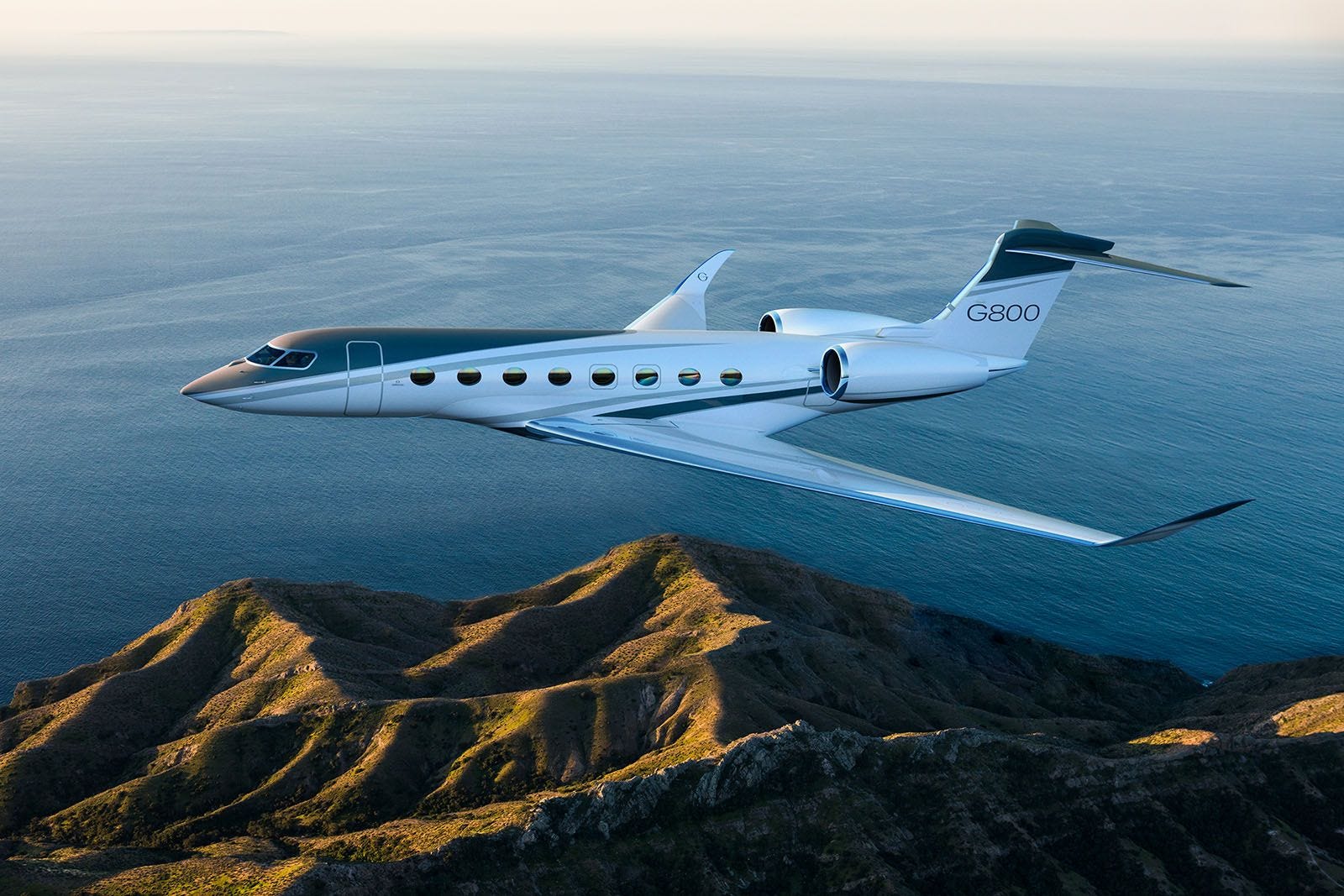
Gulfstream G800: The New Range and Speed Benchmark
The G800 is the most consequential aircraft Gulfstream has launched in the past five years and the centerpiece of the segment’s near-term growth. The aircraft received simultaneous FAA and EASA certifications on April 16, 2025, with performance figures that exceeded the original specifications announced when the program was launched in October 2021.
Gulfstream certified the G800 with a range of 8,200 nautical miles at long-range cruise of Mach 0.85, a 200-nautical-mile improvement over original projections. The aircraft can also fly 7,000 nautical miles at Mach 0.90 and 8,000 nautical miles at Mach 0.87, with a maximum operating Mach number of 0.935.
Gulfstream G800 Performance
Maximum Range: 8,200 nm at Mach 0.85
High-Speed Range: 7,000 nm at Mach 0.90
Maximum Mach: 0.935
Engines: Two Rolls-Royce Pearl 700
Cabin Altitude at FL410: 2,840 ft
Balanced Field Length: 5,812 ft
Landing Distance: 3,105 ft
First Customer Delivery: August 27, 2025
The first customer delivery took place on August 27, 2025 in Savannah, opening the order pipeline for what management has consistently described as the most demand-rich product in the lineup. Jefferies analysis covered by AIN noted that G800 sales drove a 71% jump in third-quarter Aerospace orders to $4.3 billion.
Gulfstream G700: The Volume Workhorse
The G700 entered service in 2024 and has become the volume large-cabin product in the lineup, with a maximum range of 7,500 nautical miles at Mach 0.85 and a top operating speed of Mach 0.935.
The aircraft uses the same Rolls-Royce Pearl 700 engines as the G800 and shares the wing, winglet, and Symmetry flight deck design language across the family.

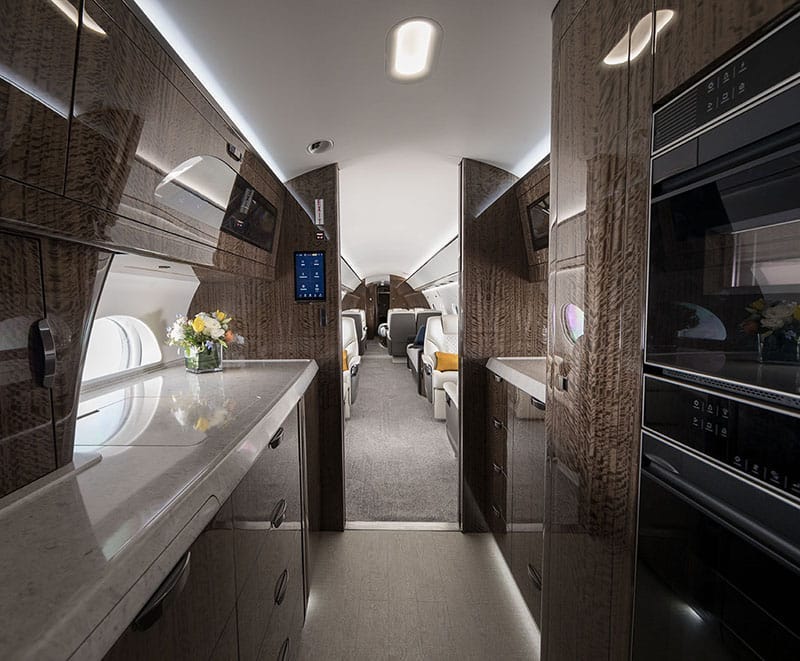
The G700 cabin offers up to five living areas in a length that exceeds 56 feet, and Gulfstream has emphasized the airframe’s industry-leading 100% fresh air system, plasma ionization air purification, and panoramic oval windows.
Gulfstream G600: Quiet Cash Generator
The G600 has matured into a steady-state cash generator for the segment, and Gulfstream marked the 200th G600 delivery during 2025. The fleet has accumulated more than 197,000 flight hours and 87,000 landings since service entry.
The aircraft was singled out by management on the Q4 2025 call as one of the three highest-demand products alongside the G700 and G800. Lower G600 deliveries in the fourth quarter were also flagged as a key driver of the 290-basis-point quarterly margin step-down to 12.7%, which the company attributed to mix and one-time factors.
Gulfstream G500: Mature Large-Cabin
The G500 sits between the G400 and G600 in the family, offering long-range cruise of Mach 0.85, high-speed cruise of Mach 0.90, and a maximum operating Mach of 0.925.
The aircraft entered service in 2018 and remains a mature, certified, and continuously updated product within the in-production lineup.
Gulfstream G400: Re-Entering the Large-Cabin Mid-Range
The G400 is the newest entry in the lineup and re-establishes Gulfstream in a market segment the company stepped back from when it ended G450 production.
The aircraft completed its first flight in 2024 and is currently in flight test, with management most recently indicating a first customer delivery target of early 2027.
Gulfstream G400 Performance
Maximum Range: 4,200 nm at Mach 0.85
Maximum Mach: 0.90
Engines: Two Pratt & Whitney PW812GA
Passengers: Up to 12
Cabin Length (excluding baggage): 36 ft 4 in
Cabin Altitude at FL410: 3,255 ft
Targeted Entry into Service: Early 2027
The G400 is powered by Pratt & Whitney PW812GA engines and uses the same Symmetry flight deck found in the rest of the family.
With ten panoramic oval windows, up to 2.5 living areas, and capacity for 12 passengers, the aircraft is designed to displace older Gulfstream G450 and Bombardier Challenger 650 deployments while opening up new transcontinental missions.
Gulfstream G280: The Super-Midsize Anchor
The G280 super-midsize is built in Israel by Israel Aerospace Industries and finished in Dallas. Twenty-two G280s were delivered in 2025, making the type the volume mid-cabin contributor to total aircraft deliveries.
Management has repeatedly stressed that the G280 backlog is healthy, but the strategic focus and the bulk of Aerospace operating earnings now sit firmly with the large-cabin family.
Jet Aviation: The Aftermarket Engine
Jet Aviation, acquired in 2008, runs maintenance, completions, fixed-base operations, and aircraft management across a global network.
The unit’s contribution to segment growth was explicitly cited by management in 2025, and the business provides a meaningful counter-cyclical hedge inside the Aerospace segment when new aircraft demand softens.
Marine Systems Segment: The Underwater Crown Jewel
Marine Systems generated $16.72 billion in revenue and $1.18 billion in operating earnings in 2025, with operating margin of 7.0%.
The segment is the largest revenue contributor inside the company and is anchored by three businesses: Electric Boat, Bath Iron Works, and NASSCO.
Marine Systems 2025 Snapshot
Revenue: $16,723 million
Operating Earnings: $1,177 million
Operating Margin: 7.0%
Backlog Growth: ~60% (segment-level)
Largest Programs: Columbia SSBN, Virginia SSN, DDG-51 Flight III, Auxiliary Ships
Electric Boat: Columbia and Virginia Submarines
General Dynamics Electric Boat, based in Groton, Connecticut and Quonset Point, Rhode Island, is the lead designer for the Navy’s Columbia-class ballistic missile submarine and a co-builder of the Virginia-class fast attack submarine.
The Columbia program is the highest priority project in U.S. shipbuilding. The first ship of the class, USS District of Columbia, is expected to begin patrols in 2030 and replace the Ohio-class boats that have carried the seaborne leg of the U.S. nuclear triad since the 1980s.
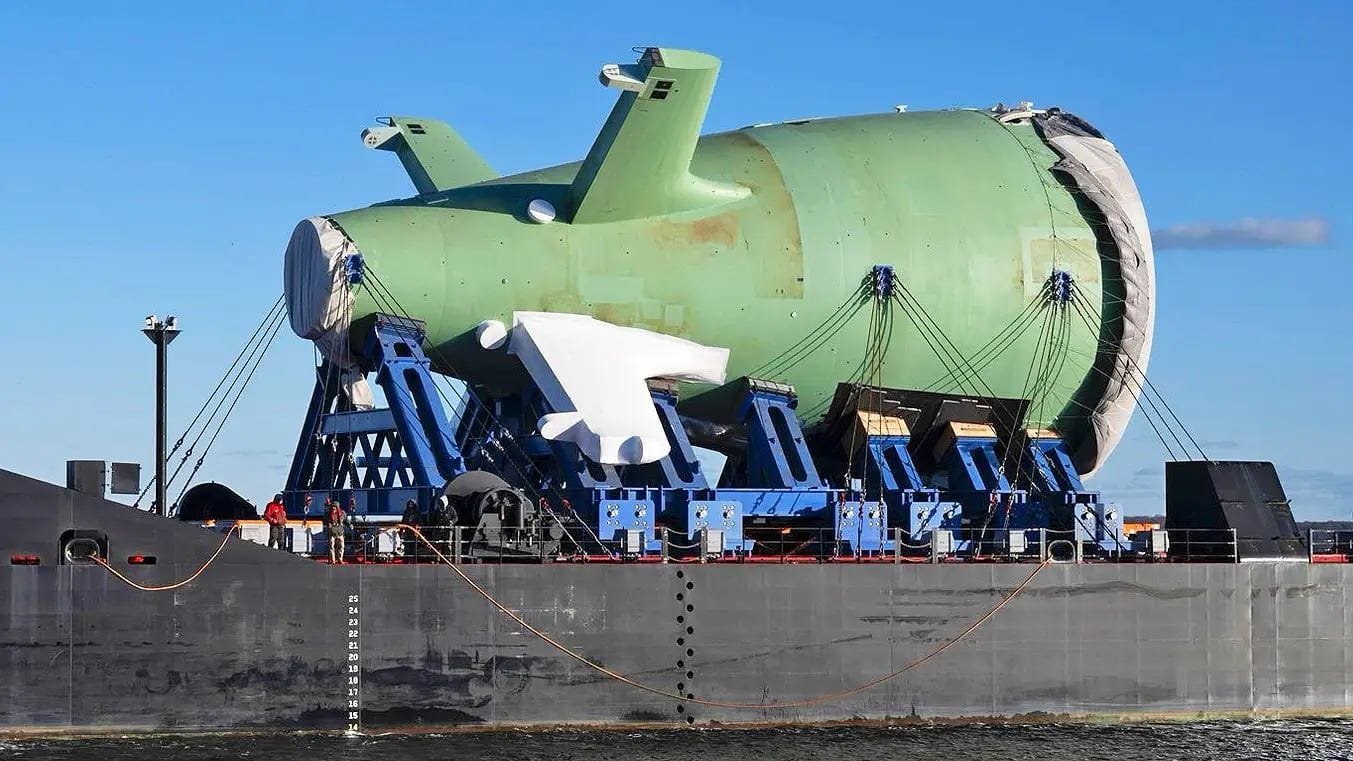
Electric Boat received a $15.4 billion modification covering Columbia-class construction work, and the yard has continued to bring industrial base capacity online, including a new floating dry dock in early 2026 that supports both Columbia construction and Virginia maintenance.
The Virginia-class program continues at a base rate of two boats per year, with Block V incorporating the Virginia Payload Module that nearly triples Tomahawk capacity. Electric Boat shares production of Virginia-class boats with HII Newport News under a teaming arrangement that has been in place since the early 2000s.
Bath Iron Works: Surface Combatants
Bath Iron Works in Bath, Maine builds the Arleigh Burke-class destroyer, the workhorse surface combatant of the U.S. Navy. The yard is currently delivering Flight III ships with the SPY-6 radar and is part of the broader DDG-51 multi-year procurement framework that runs through the late 2020s.
Bath continues to face throughput challenges, but management on the Q4 call described meaningful improvement in workforce stability and labor productivity during 2025.
NASSCO: Auxiliary and Commercial Shipbuilding
NASSCO in San Diego builds Navy fleet replenishment oilers, expeditionary sea bases, and large auxiliary ships, and has historically also produced Jones Act commercial vessels.
The yard is currently executing the John Lewis-class oiler program and has continuing work in the auxiliary ship category through the late 2020s.
Combat Systems Segment: Tanks, Vehicles, and Munitions
Combat Systems generated $9.25 billion in revenue and $1.33 billion in operating earnings in 2025, with the highest operating margin among the four segments at 14.4%. The segment is comprised of Land Systems, Ordnance and Tactical Systems, and European Land Systems.
Combat Systems 2025 Snapshot
Revenue: $9,246 million
Operating Earnings: $1,331 million
Operating Margin: 14.4%
Key Platforms: M1 Abrams, Stryker, Piranha, ASCOD, 155mm artillery rounds
Notable Foreign Sales: Poland (Abrams), Switzerland (Eagle), Spain (Pizarro)
Land Systems: Abrams, Stryker, and the M1E3
General Dynamics Land Systems, headquartered in Sterling Heights, Michigan, produces the M1A2 Abrams tank, the Stryker family of wheeled armored vehicles, and the AJAX armored fighting vehicle for the British Army.
The M1E3 program is the most strategically significant Land Systems development for the late 2020s. The U.S. Army awarded GDLS a $150 million contract on June 30, 2025 for engineering work to advance the M1E3, which features upgraded armor, reduced thermal and acoustic signatures, hybrid-electric propulsion, and a redesigned turret.
A Congressional Research Service in-focus report issued in December 2025 confirmed the program’s structure, and a first M1E3 prototype was delivered by the end of 2025. The M1E3 will be the first all-new Abrams variant in more than four decades.
The export side of Land Systems is equally active. The Polish Abrams program involves up to 250 M1A2 SEPv3 tanks and was followed in May 2025 by a framework agreement with WZM covering Polish industrial participation. The U.S. State Department also approved a $325 million Foreign Military Sale to Kuwait for Abrams sustainment during 2025.
Ordnance and Tactical Systems
General Dynamics OTS is the company’s munitions, ammunition, and weapons business, headquartered in St. Petersburg, Florida. The unit produces 155mm artillery rounds, mortar systems, propellants, fuzing, and small-caliber ammunition primarily for U.S. and allied forces.
OTS has been a direct beneficiary of the post-2022 step-up in artillery ammunition demand, and management has consistently flagged the unit as one of the most operationally challenged businesses in 2025 because of capacity expansion timing.
European Land Systems
European Land Systems brings together GDELS-Mowag (Switzerland), GDELS-Steyr (Austria), and GDELS-Santa Bárbara (Spain). The unit produces the Piranha and Eagle wheeled armored families, the ASCOD and Pizarro tracked infantry vehicles, and bridging systems used across NATO.
European Land Systems has benefited from the broad rearmament posture across NATO members, with order intake remaining elevated through 2025 across multiple national programs.
Technologies Segment: GDIT and Mission Systems
The Technologies segment generated $13.47 billion in revenue and $1.28 billion in operating earnings in 2025, with operating margin of 9.5%. The segment is comprised of two large operating units: General Dynamics Information Technology (GDIT) and General Dynamics Mission Systems.
Technologies 2025 Snapshot
Revenue: $13,471 million
Operating Earnings: $1,277 million
Operating Margin: 9.5%
GDIT Focus: IT modernization, cloud, AI/ML, cyber, mission services
Mission Systems Focus: Tactical comms, command & control, signals intel, fire control
GDIT: Federal IT and Mission Services
GDIT, headquartered in Falls Church, Virginia, is one of the largest federal IT services contractors in the United States. The unit provides cloud migration, AI and machine learning, cybersecurity, and mission systems engineering for the Department of Defense, intelligence community, civilian agencies, and the Department of Veterans Affairs.
GDIT was awarded a $988 million Navy C5ISR modernization contract in December 2025, one of the largest single Technologies awards of the year. The contract includes a one-year base and four one-year options plus a six-month tail, signaling multi-year revenue visibility for one of the segment’s larger anchor customers.
Mission Systems: Strategic Programs
General Dynamics Mission Systems builds tactical radios, command and control systems, signals intelligence, electronic warfare, and submarine fire control. The most strategically meaningful program is the Trident II D5 Strategic Weapon System Fire Control System.
In March 2026, Mission Systems was awarded a follow-on Trident II FCS contract with an initial value of $255 million and a potential value of $740 million if all options are exercised, with work running through December 2032. The contract also covers fire control system installation across the first three Columbia-class hulls and continued development of the Trident II D5 Life Extension 2 variant.
That single program connects three of the company’s segments, with Electric Boat building the boats, Mission Systems integrating the fire control system, and Technologies providing the broader IT and engineering wrap.
General Dynamics Financial Analysis
Full-Year 2025 Performance
General Dynamics reported full-year 2025 revenue of $52.6 billion, up 10.1% from 2024. Net earnings rose 11.3% to $4.2 billion and diluted EPS climbed 13.4% to $15.45.
General Dynamics 2025 Income Statement Highlights
Revenue: $52,550M (approx., up 10.1%)
Operating Earnings (segment): $5,531M sum
Net Earnings: $4,200M (up 11.3%)
Diluted EPS: $15.45 (up 13.4%)
Cash from Operations: $5,100M (122% of net earnings)
Capital Expenditures: $1,200M (up 27%)
Total Debt Reduction: $749M
Dividends Paid: $1,600M
Year-End Cash and Equivalents: $2,300M
The growth was unusually broad. All four segments grew revenue and earnings during the year, and book-to-bill exceeded 1.0x in every segment, a configuration the company has not posted in the same shape in several years.
Quarterly Performance Cadence
The quarterly pattern across 2025 reinforces the durability of the trend. Q3 revenue of $12.9 billion was up 10.6% with diluted EPS of $3.88 up 15.8%, and Q4 revenue of $14.4 billion was up 7.8% year over year, with diluted EPS of $4.17.
The Aerospace segment posted standout Q3 performance with revenue growth of 30.3% and 100 basis points of margin expansion. Aerospace book-to-bill in Q3 was 1.3x, while the defense segments collectively ran at 1.6x in the same quarter.
Margin Analysis by Segment
Segment operating margins in 2025 told a clear story about mix and operational leverage. Combat Systems remained the most profitable on a percentage basis at 14.4%, followed by Aerospace at 13.3%, Technologies at 9.5%, and Marine Systems at 7.0%.
2025 Operating Margin by Segment
Combat Systems: 14.4%
Aerospace: 13.3%
Technologies: 9.5%
Marine Systems: 7.0%
Marine Systems’ single-digit margin reflects the cost-plus, growth-phase nature of submarine industrial base work, where the company is investing aggressively in capacity ahead of the volume ramp.
Aerospace margins moved up 30 basis points for the year despite $41 million in tariff-related headwinds and a fourth-quarter step-down driven by G600 mix.
Cash Flow and Capital Allocation
Cash conversion was a defining feature of 2025. Operating cash flow of $5.1 billion represented 122% of net earnings, well above management’s typical target of 100%, with the fourth quarter alone delivering 137% conversion.
The company allocated capital toward $1.2 billion in capital expenditures, $1.6 billion in dividends, $749 million in debt reduction, and $568 million in tax payments during the year. Year-end cash and equivalents of $2.3 billion preserves flexibility for opportunistic share repurchase or M&A while maintaining the dividend trajectory.
Dividend Trajectory
The board declared a quarterly dividend of $1.59 per share on March 9, 2026, payable May 8 to shareholders of record on April 10. The new rate represents a 6% increase from the prior $1.50 quarterly rate.
That step-up extends a multi-decade record of consecutive annual dividend increases. The five-year compound annual growth rate of the dividend sits in the mid-single digits, broadly aligned with EPS growth.
Revenue and Growth Drivers: General Dynamics
Backlog as the Engine
The single most important number to understand the trajectory of General Dynamics is the backlog. The company ended 2025 with $118 billion in firm backlog and an additional $60.9 billion of estimated potential contract value from unfunded IDIQ ceilings and unexercised options.
Year-End 2025 Backlog Composition
Funded Backlog: $118 billion
Unfunded IDIQ + Options: $60.9 billion
Total Estimated Contract Value: $179 billion
Backlog Growth (YoY): +30%
Total Estimated Contract Value Growth (YoY): +24%
That 2.25-times-revenue backlog gives the company an exceptionally long demand runway and substantially de-risks the 2026 and 2027 revenue base.
Marine Systems backlog alone grew 60% during 2025, an acceleration that points to multi-year visibility on Columbia and Virginia submarine production.
Aerospace Growth Drivers
Within Aerospace, the order book was driven by three main products in 2025: the G800, G700, and G600. Total Aerospace orders of $15.5 billion translated to a 1.5x book-to-bill and pushed segment backlog to $21.83 billion.
The structural growth driver behind Aerospace is the replacement cycle for early-generation large-cabin and ultra-long-range aircraft. The G650 reached its production end in 2025, and a global installed base built up over a decade is now starting to recycle into new G700, G800, and G500 deployments.
Gulfstream 2025 Order and Delivery Mix
Total Deliveries: 158 aircraft
Large-Cabin Deliveries: 136 aircraft
G280 (Mid-Cabin) Deliveries: 22 aircraft
Q4 Deliveries: 45 aircraft
Aerospace Orders FY 2025: $15.5 billion
Q4 Aerospace Orders: $5.1 billion
2026 Delivery Outlook: ~160 aircraft
Management has guided to about 160 deliveries in 2026, with completions capacity at Savannah identified as the binding constraint rather than demand. That message implies demand could support more deliveries if the company can finish more aircraft per quarter, and the 2026 capex plans target precisely that bottleneck.
Defense Growth Drivers
On the defense side, three concurrent waves shape the growth profile. The first is the U.S. Navy’s submarine industrial base buildout, which involves both Columbia construction and a Virginia-class production cadence step-up.
The second is U.S. Army ground combat vehicle modernization, anchored by the M1E3 Abrams program and continued Stryker variants. The third is European rearmament, with Poland, Romania, Spain, and Switzerland all driving sustained order intake into Land Systems and European Land Systems.
The Technologies segment is benefiting from a parallel federal IT modernization wave, with GDIT’s $988 million Navy C5ISR award representative of the scale of single-contract opportunity available in the segment.
LTM Revenue Picture
On a last-twelve-month basis through year-end 2025, revenue stood at $52.6 billion against a 2024 figure of $47.7 billion. The 2026 guidance midpoint of approximately $54.55 billion implies another roughly 4% growth on top of the 2025 base.
When that growth is layered on top of a 30% backlog expansion, the typical pattern is that the topline guide is conservative relative to the contract base, and the actual constraint becomes execution rather than demand.
Major Competitors
The aerospace and defense competitor set for General Dynamics is segment-specific because no single peer competes across all four operating segments. The competitive landscape comprises:
Lockheed Martin Corporation (LMT): aircraft, missiles, defense electronics, space
RTX Corporation (RTX): aircraft engines, missiles, defense electronics
Northrop Grumman Corporation (NOC): aircraft, missiles, space, electronics
The Boeing Company (BA): commercial and military aircraft, defense, space
Huntington Ingalls Industries (HII): nuclear submarines, surface ships, mission technologies
L3Harris Technologies (LHX): communications, ISR, space, missiles
BAE Systems (BA.L): combat vehicles, electronics, naval ships
Bombardier Inc. (BBD.B): business jets (Global, Challenger families)
Dassault Aviation (AM.PA): Falcon business jets and military aircraft
Textron Aviation (TXT): Cessna Citation and Beechcraft business aircraft
General Dynamics vs Lockheed Martin
Lockheed Martin is the largest U.S. defense prime by revenue and the dominant supplier of fighter aircraft, missile defense systems, and space launch services.
Lockheed’s portfolio overlaps General Dynamics primarily in C4ISR through its Rotary and Mission Systems business and in submarine fire control through some integration roles, but the two companies are largely complementary rather than directly competitive at the platform level.
Where they overlap most directly is in federal IT services and command and control, where GDIT and Lockheed’s Sikorsky and missile defense engineering businesses bid for some of the same federal opportunities.
The cleanest comparison for investors is that Lockheed has a single dominant program in F-35 that drives much of its profile, while General Dynamics has a more diversified portfolio across submarines, business aviation, ground vehicles, and IT.
General Dynamics vs Boeing Defense, Space & Security
Boeing competes with General Dynamics in defense IT, weapons, and select unmanned platforms but is most distinct because of its dominant position in military rotorcraft and the KC-46 tanker.

Boeing’s commercial aviation business is a meaningful counterpoint to Gulfstream because Boeing Business Jets occasionally compete with the largest Gulfstream cabins for ultra-long-range head-of-state and corporate transport missions.
The structural difference is that Boeing’s defense business has been operating with margin pressure across multiple development programs, while General Dynamics’ segment margins have been stable or expanding. That dynamic translates to sharply different cash conversion profiles and dividend trajectories.
General Dynamics vs Northrop Grumman
Northrop Grumman is the closest peer to General Dynamics in revenue scale and product diversity, with a portfolio spanning aircraft (B-21), space systems, missiles, and defense electronics.

Northrop’s strategic position rests heavily on the B-21 Raider stealth bomber and the Sentinel intercontinental ballistic missile, both of which give it long-cycle program visibility comparable to GD’s submarine programs.
Northrop has no analogue to Gulfstream and no comparable presence in business aviation, but it competes head-on with General Dynamics Mission Systems in tactical communications, signals intelligence, and cyber programs.
From a governance and capital allocation perspective, both companies are generally regarded as among the most disciplined in the prime contractor universe.
General Dynamics vs RTX Corporation
RTX is the largest U.S. defense electronics and missiles supplier and also operates Pratt & Whitney, which supplies engines for the Gulfstream G400 and several other business and military aircraft.

RTX’s missile and defense systems unit is a significant competitor to General Dynamics Mission Systems and Combat Systems in select programs.
The interesting dynamic is that RTX is simultaneously a competitor and a key supplier to General Dynamics, as Pratt & Whitney engines power the G400, while Rolls-Royce powers the G700 and G800.
That dual relationship is typical of the prime contractor ecosystem and reflects the deep interdependencies among the major suppliers.
General Dynamics vs Huntington Ingalls Industries
Huntington Ingalls is the most direct competitor to Marine Systems because it is the only other U.S. shipbuilder that builds nuclear-powered submarines and aircraft carriers. HII and Electric Boat collaborate on Virginia-class production through a teaming arrangement that has been in place since 2003.
HII is the sole builder of U.S. nuclear-powered aircraft carriers, while Electric Boat is the lead designer for Columbia. The two companies are both partners and rivals, and the U.S. Navy has consistently preserved both yards as a deliberate industrial base policy.
General Dynamics vs Bombardier and Dassault in Business Aviation
In the large-cabin business aviation segment, Gulfstream’s primary competitors are Bombardier with the Global 7500 and Global 8000 and Dassault with the Falcon 8X and the upcoming Falcon 10X.
The Global 8000 is the closest direct competitor to the G800 on range and speed, while the Falcon 10X is positioned to compete with the G700 and G800 when it eventually enters service.
Large-Cabin Long-Range Competition (2026)
Gulfstream G800: 8,200 nm range, Mach 0.935 max
Bombardier Global 8000: 8,000 nm range, Mach 0.94 max (max design)
Dassault Falcon 10X: ~7,500 nm range (target, in development)
Bombardier Global 7500: 7,700 nm range
Gulfstream G700: 7,500 nm range, Mach 0.935 max
Gulfstream has consistently led on range certifications, on time-to-market for new variants, and on aftermarket support coverage, with Jet Aviation providing a globally distributed completion and service network.
Bombardier and Dassault remain credible product alternatives for buyers who prefer specific cabin geometries or supplier diversification, but Gulfstream has held the leading market position in large-cabin orders during 2025.