


Executive Summary
Jetstar Airways, the value-based subsidiary of the Qantas Group, delivered a record performance in fiscal year 2025, carrying 16 million domestic passengers and posting a 55 per cent increase in Underlying EBIT.
The carrier currently operates a fleet of 99 aircraft under the Jetstar Airways Australian Air Operator’s Certificate, supported by a multi-year fleet renewal that includes 19 delivered Airbus A321LRs and 12 Airbus A321XLRs scheduled to begin arriving in calendar year 2027.
Following the closure of Jetstar Asia on 31 July 2025, 13 Airbus A320 aircraft are being progressively redeployed across Jetstar Australia, Jetstar New Zealand, and QantasLink, releasing up to A$500 million of capital for the parent group’s core operations.
Strategic priorities for 2026 include the inaugural Melbourne to Colombo service from 25 August 2026, the rollout of refurbished Boeing 787-8 cabins with onboard Wi-Fi, and a foundational presence at the new Western Sydney International Airport.
Recommended - Read Full Reports


Read All Reports
Table of Contents
Executive Summary
Jetstar Company Profile: Key Facts
Jetstar Revenue and Financial Analysis
Headline Performance and the FY25 Inflection
Revenue Composition and the Drivers of Growth
LTM Performance and 1H26 Outlook
Cost Structure and Unit Economics
Key Services and Products Generating Revenue
Jetstar Fleet Analysis
Fleet Size and Composition Today
Aircraft Type Strategy and Configuration
The A321XLR Fleet Renewal Program
The Boeing 787 Refit Program
Fleet Strategy: Why It Matters
Jetstar Route Network Strategy and Major Destinations
Network Footprint at a Glance
The Australian Domestic Backbone
The International Network: Asia, the Pacific and Beyond
The Sri Lanka Launch: A Strategic Inflection
Network Adjustments and the Jetstar Asia Wind-Down
Major Operational Bases (Hubs)
The Melbourne Anchor
Sydney, Brisbane and the East-Coast Hubs
Auckland and the New Zealand Network
The Western Sydney Foundation
Jetstar Competitive Position
Major Competitors
Jetstar vs Virgin Australia
Jetstar vs Qantas Mainline
Jetstar vs Asian Low-Cost Long-Haul Competitors
Jetstar vs Trans-Tasman and Pacific Competitors
Operational Performance, Customer Experience and Distribution
Reliability and Punctuality
Distribution and the Qantas Frequent Flyer Bridge
Brand Positioning and Customer Communication
Sustainability, ESG and Aircraft Emissions Strategy
Fleet-Driven Emissions Reduction
Sustainable Aviation Fuel and Group Commitments
Workforce and Community
Strategic Outlook for FY26 and Beyond
Medium-Term Growth Map
What to Watch by Quarter
Capital Allocation and Group Discipline
Key Risks: Probability and Scenario Analysis
Risk 1
Risk 2
Risk 3
Risk 4
Risk 5
Risk 6
Risk 7
Risk 8
Risk 9
Risk 10
My Final Thoughts
Official Sources and Data
Jetstar Company Profile: Key Facts
Jetstar Airways operates as the low-fare carrier brand within the Qantas Group, a relationship that gives it both the scale of one of the largest aviation groups in the Asia Pacific and the operational independence required to serve a price-sensitive customer base.
The airline is headquartered in Melbourne, with operational bases distributed across Australia and New Zealand.
The airline was launched in 2003 as a carrier-within-a-carrier strategic response to the rapid rise of Virgin Blue (now Virgin Australia). Today the group brand has expanded into multiple regional joint ventures, although the core Australian operating entity, Jetstar Airways (IATA code JQ), remains the centre of gravity.
JETSTAR AIRWAYS - KEY FACTS (2026)

Legal name        : Jetstar Airways Pty Ltd
IATA / ICAO       : JQ / JST
Callsign          : "Jetstar"
Founded           : May 2003 (operations commenced May 2004)
Parent            : Qantas Airways Limited (ASX:QAN, 100% ownership)
Headquarters      : Collingwood, Melbourne, Victoria, Australia
Group CEO         : Stephanie Tully
Primary Hub       : Melbourne Tullamarine - Terminal 4
Fleet (JQ AOC)    : 99 aircraft + 3 on order/planned
Average Fleet Age : 10.8 years
Domestic Pax FY25 : 16 million (record)
Frequent Flyer    : Qantas Frequent Flyer (integrated)
Brand Position    : Low fares, point to point, two-class on widebody
The carrier sits inside a broader portfolio that also includes Jetstar Japan (a joint venture due to transfer to Japanese ownership) and the long-running QantasLink and Qantas mainline brands.
The relationship with the parent unlocks shared maintenance, technology platforms, codeshare distribution, and Qantas Frequent Flyer integration, all of which provide cost advantages that pure-play independent low-cost carriers struggle to match.
For airline industry stakeholders, the most important contextual fact is that Jetstar is no longer a small experimental brand.
It’s a strategic growth engine for one of the world’s most consistently profitable airline groups, with a deliberate mandate to expand both its Australian domestic footprint and its medium and long-haul international leisure network.
Jetstar Revenue and Financial Analysis
Headline Performance and the FY25 Inflection
Jetstar delivered what its parent described as one of its best-ever results in fiscal year 2025, the twelve months ending 30 June 2025.
Demand for value-based travel rebounded across both domestic and international markets, fuel prices eased relative to the prior year, and a fleet of newer narrowbody aircraft reduced unit costs.
The Qantas Group reported an Underlying Profit Before Tax of A$2.39 billion for FY25, with Group Domestic Underlying EBIT reaching A$1,518 million and Group International Underlying EBIT reaching A$903 million. Within this consolidated picture, Jetstar’s contribution accelerated meaningfully.
The single most important data point for stakeholders is that Jetstar delivered a 55 per cent increase in Underlying EBIT in FY25. This was driven by stronger seat factors, more efficient new aircraft, and an expansion of international flying.
JETSTAR FY25 PERFORMANCE INDICATORS

Underlying EBIT growth (Y/Y)        : +55%
Domestic passengers carried         : 16 million (record)
International passengers Y/Y growth : +25%
Seat factor improvement             : +2 percentage points
New international routes launched   : 11
New aircraft delivered (full Group) : 13 over two years
Jetstar Asia FY25 Underlying EBIT : -A$33 million (now closed)Revenue Composition and the Drivers of Growth
Jetstar’s revenue mix reflects a hybrid low-fare model.
Ticket revenue still dominates the top line, but the airline has steadily increased the share of revenue coming from ancillaries such as checked bag fees, seat selection, in-flight food and beverage purchases, and increasingly Jetstar Holidays packages.
The drivers of growth in FY25 were not subtle. Domestically, Jetstar absorbed demand left behind by the collapse of low-cost competitor Bonza in early 2024, while internationally it added 11 new routes during the financial year and saw 25 per cent passenger growth into Australia.
International strength was particularly visible into Japan, Thailand and South Korea, three markets where pent-up Australian outbound demand and a growing Asian middle class converged.
The lower fuel price environment in the second half of FY25 amplified margin gains.
LTM Performance and 1H26 Outlook
For the latest twelve months running through the first half of FY26 (the six months to 31 December 2025), the Qantas Group reported a continued strong trajectory.
The 1H26 result showed continued fleet expansion and progress on the integration of redeployed aircraft from Jetstar Asia into Australian and New Zealand operations.
It is important to flag two non-recurring items that affect period-to-period comparisons.
First, Jetstar Asia recorded a 1H26 underlying EBIT loss of approximately A$23 million before its 31 July 2025 closure, with closure-related expenses of approximately A$115 million.
Second, Cyclone Alfred in Queensland disrupted domestic operations and contributed an estimated A$30 million earnings impact to the broader Group during the late-FY25 period.
These factors should be screened out when assessing underlying Jetstar Australia performance.
Cost Structure and Unit Economics
Jetstar’s competitive moat in the Australian domestic market is its low cost per available seat kilometre, supported by single-class narrowbody operations, high seat density, point-to-point flying, and a young Airbus narrowbody fleet that is becoming progressively younger as new A321LRs replace older A320 ceos.
The airline’s operations team has also publicly committed to dramatic on-time performance improvements.
Jetstar’s New Zealand operation, for example, delivered an 85.1 per cent on-time record through August 2025. Reliability gains reduce passenger compensation costs and improve aircraft utilisation, both of which feed directly into unit economics.
JETSTAR UNIT ECONOMICS LEVERS - 2026

Lever                          Direction   Source
------                         ---------   ------
Fleet renewal (A321LR/XLR)     Down 15%+   New engine fuel burn
Single-class narrowbody        Down        High seat density
787 cabin refit                Up modest   New Business class adds yield
Onboard Wi-Fi (paid)           Up          New ancillary stream
Reliability program            Down        Lower disruption costs
A320 redeployment from 3K      Down        Avoided lease costs
Key Services and Products Generating Revenue
Jetstar’s revenue sources extend beyond core seat sales.
The airline operates the Jetstar Holidays packaging business, sells onboard food and beverage, participates in revenue share with the Qantas Loyalty programme, and has just launched two new ancillary products in 2026.
The first new product is BidCash, a cash-bid upgrade auction for Business Class on international 787 services. The second is the planned extension of points-based bidding for Qantas Frequent Flyer members, including a Classic Upgrade Reward style product and a Points Plus Pay model.
In-flight Wi-Fi is also being commercialised across the refurbished 787 fleet via a partnership with Viasat, with introductory pricing for Streaming-Plus from A$25 and Social Plus from A$20. Although individually small, these new revenue lines compound over a fleet operating tens of thousands of long-haul sectors per year.
Jetstar Fleet Analysis
Fleet Size and Composition Today
As of early May 2026, the Jetstar Airways operating entity (JQ) has a fleet of 99 aircraft on its certificate, with three additional aircraft on order or in planning.
The average fleet age sits at around 10.8 years, a number that is being pulled down each quarter as new A321LRs enter service and older A320 ceos rotate out or are reconfigured.
The composition is dominated by the Airbus A320 family, which the airline has standardised on for narrowbody operations since launch. The Boeing 787-8 Dreamliner provides the long-haul widebody capability for Asia and, from late 2026, a new long-haul service to Sri Lanka.


JETSTAR AIRWAYS (JQ) FLEET COMPOSITION - MAY 2026

Aircraft type           Fleet count       Role
-----------------       -----------       ----
Airbus A320-200ceo      ~50               Domestic + short intl
Airbus A320neo          ~5                Domestic, growing
Airbus A321-200ceo      ~6                Higher density domestic
Airbus A321LR (neo)     19                Med-haul intl + dom
Airbus A321XLR (neo)    On order: 12      From CY2027
Boeing 787-8            11                Long-haul intl
Total operational ~99Aircraft Type Strategy and Configuration
The Airbus A320-200 in Jetstar’s configuration carries between 180 and 186 passengers in a single-class layout, and remains the workhorse of the Australian domestic network.
The A321-200 stretches that capacity to 230 passengers, making it the preferred aircraft on high-density east-coast trunk routes such as Melbourne to Sydney and Sydney to Brisbane.
The Airbus A321LR (long range) variant carries 232 passengers in a single-class cabin and brings important new capabilities. The new CFM LEAP engines reduce fuel burn by at least 15 per cent and aircraft noise by 50 per cent, while the extended range allows flights up to 1,200 kilometres further than the prior A320/A321 ceos.
A321LR cabin features include award-winning ergonomic Recaro seats, overhead bins with 40 per cent more space, flip-down smartphone and tablet cradles, in-seat USB power, and colour LED lighting that adjusts through different stages of flight.
These specifications matter because they let Jetstar deploy the aircraft on routes such as Melbourne to Cairns, Gold Coast services, and Sydney to Bali, which were previously sub-optimal on the older A320s.
The A321XLR Fleet Renewal Program
The Airbus A321XLR is the next chapter of Jetstar’s narrowbody story.
In its definition by the manufacturer, the type offers a maximum range of up to 4,700 nautical miles (8,700 kilometres) depending on configuration, a 20 per cent lower fuel burn per seat, and a noise footprint that is 50 per cent lower than current generation aircraft.
Jetstar has 12 A321XLRs on order, with the first set to arrive in 2027. The airline has confirmed that these aircraft will feature a two-class cabin for medium-haul international travel, a structural break from Jetstar’s traditional single-class configuration on narrowbodies.
In parallel, Qantas mainline has placed an order for an additional 20 A321XLRs in August 2025, taking the Group’s total A321XLR backlog to 48 aircraft. The Group view is that the A321XLR family will replace older Boeing 737-800s at Qantas and provide range flexibility for both brands across new long, thin routes.
The Boeing 787 Refit Program
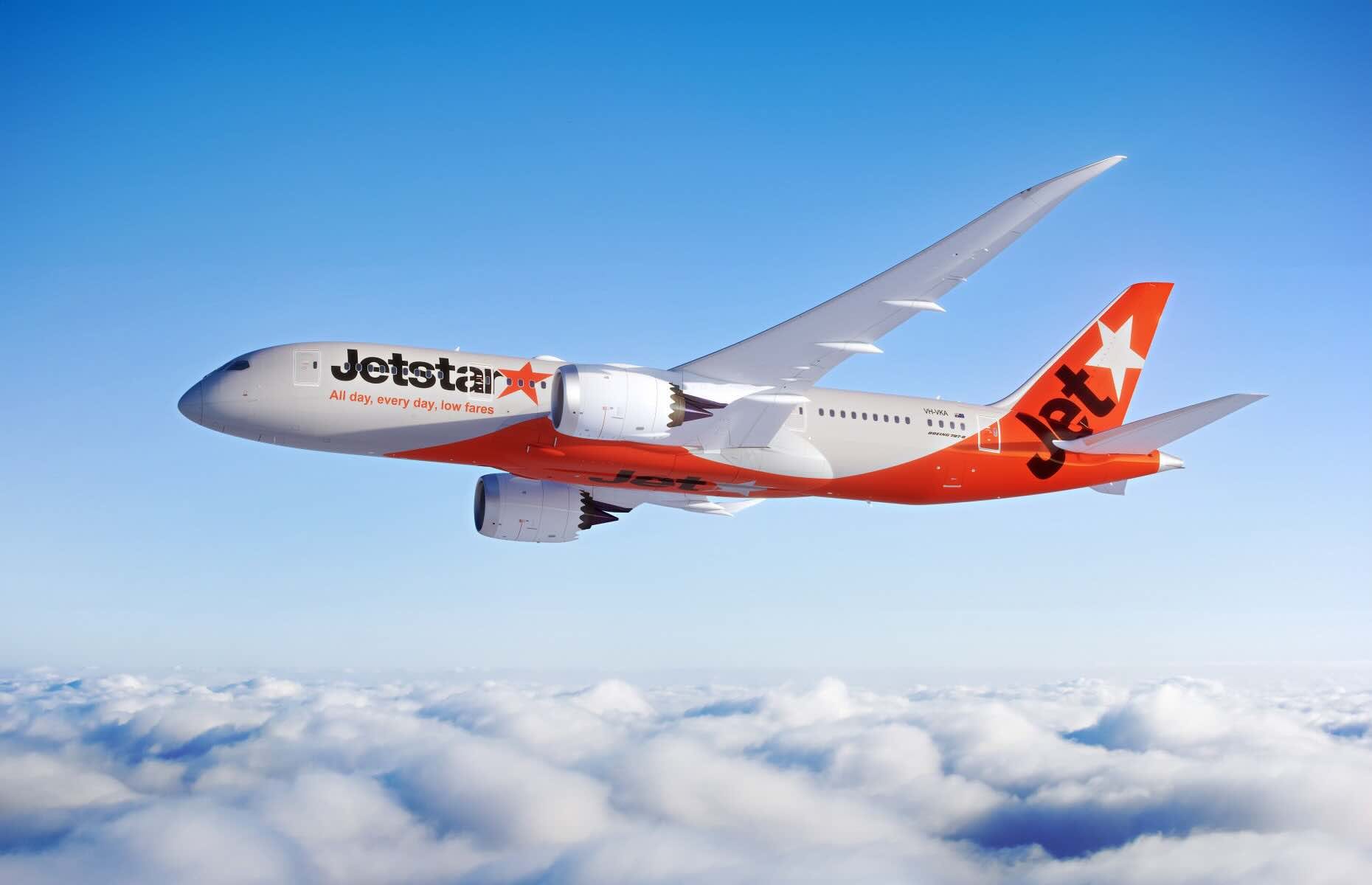
Jetstar’s 11 Boeing 787-8 Dreamliners are undergoing the most significant cabin transformation in their history, with the first refurbished aircraft operating its inaugural Melbourne to Phuket service on 7 April 2026.
The Business cabin has more than doubled, growing from 21 seats to 44 seats with a 38-inch pitch, seven-inch recline, six-way adjustable headrests, calf and footrests, bi-fold in-arm tray tables, seat back device holders and dual high-power USB-C charging points.
Economy has been refitted with all-new RECARO seating offering a 30-inch pitch and five-inch recline.
Onboard Wi-Fi has been added through a Viasat partnership, the same provider used on Qantas, and six lie-flat crew rest bunks have been installed at the rear. The crew rest bunks are operationally critical because they unlock flights of up to 16 hours, opening medium and long haul routes that were previously off-limits.
787-8 REFIT - BEFORE AND AFTER

                       Pre-refit       Post-refit
Business seats         21              44
Economy seats          314             281
Total seats            335             325
Seatback IFE           Yes             Removed (BYOD via Wi-Fi)
Onboard Wi-Fi          No              Yes (Viasat)
Crew rest              Limited         6 lie-flat bunks
Max flight duration    ~13 hours       Up to 16 hours
All 11 aircraft will progressively undergo the same refit, with the fleet transformation continuing through to late-2027. Until completion, customers may experience either configuration on any given service.
Fleet Strategy: Why It Matters
Jetstar’s fleet strategy is the operational expression of its commercial strategy. The single biggest insight for industry stakeholders is that Jetstar is moving away from a one-size-fits-all narrowbody plus a small widebody, and toward a tiered, range-segmented fleet.
Short domestic stage lengths are operated by A320s. Higher-density trunk routes get A321s. Medium-haul international and long, thin domestic flying is being shifted to the A321LR. Long-haul leisure plays out on the 787s, soon to be supplemented by the A321XLR for new mid-distance international routes.
This segmentation lets Jetstar match aircraft economics to mission, which is the discipline that has historically separated the most profitable low-cost carriers from those that simply chase growth.
The post-Jetstar Asia redeployment of 13 A320s into Australia and New Zealand also reduces reliance on more expensive leased aircraft.