


Dear Readers, Welcome to AviationOutlook.
Let’s analyze the topic in detail.
Executive Summary
Pobeda closed 2025 carrying roughly the same volume of passengers as the prior year, holding steady at about 13.4 million travellers within parent Aeroflot Group’s 55.34 million total, while sustaining a passenger load factor north of 92 percent across the network.
The fleet has stabilized at 42 Boeing 737-800 narrowbodies of average age 9.2 years, with no Boeing 737 MAX deliveries possible due to the 2022 sanctions regime, pushing the operator toward longer-term Russian-built MC-21 replacements under Aeroflot Group’s 2030 plan.
The route network covers about 40 airports across Russia, Belarus, Armenia, Uzbekistan and Turkey, anchored by primary base Vnukovo International Airport, with secondary hubs at Sochi and Anapa serving leisure flows.
Key forward risks for 2026 and beyond include parts and maintenance access for the Boeing fleet, payroll inflation across Aeroflot Group of 30.7 percent in 2025, airspace constraints over European Russia, and the gradual transition to Russian-built aircraft that remain in flight-test status.
Recommended - Read Full Reports


Read All Reports
Table of Contents
Executive Summary
Introduction
Pobeda Company Profile: Key Facts
Pobeda Revenue and Financial Analysis
Group-Level Revenue Context
Pobeda’s Revenue Profile
Revenue Growth Drivers
Key Services and Products
Pobeda Fleet Analysis
Fleet Size and Composition
Aircraft Type Strategy and Cabin Configuration
Fleet Age and Sustainment Strategy
Forward Fleet Plan and the Russian-Built Pivot
Pobeda Route Network Strategy and Major Destinations
Network Footprint Today
Domestic Network Structure
International Network Structure
Network Strategy Logic
Major Operational Bases (Hubs)
Vnukovo International Airport: The Primary Hub
Moscow Sheremetyevo: Secondary Capacity Base
Sochi Adler International Airport: Leisure Anchor
Anapa Vityazevo Airport: Seasonal Black Sea Base
Pobeda Competitive Position
Major Competitors
Pobeda vs. S7 Airlines
Pobeda vs. Aeroflot (Internal Group Competitor)
Pobeda vs. Ural Airlines
Pobeda vs. Rossiya Airlines
Aeroflot Group Internal Market Share
Operational Performance
Load Factor Discipline
Aircraft Utilisation
Passenger Growth Trajectory
Key Risks for 2026 and Beyond
Risk 1
Risk 2
Risk 3
Risk 4
Risk 5
Risk 6
Risk 7
Risk 8
Strategic Outlook for 2026 and Beyond
The Next Twelve Months
The Three-Year Window
The Long Game
Pobeda’s Place in the Wider Russian Aviation Industry
Sustainability and Operational Efficiency
Fuel Burn Profile
Ground Operations
Customer Experience and Brand Position
Distribution and Technology Stack
My Final Thoughts
Official Sources and Data
Introduction
Pobeda was launched on 16 September 2014 as Aeroflot’s answer to a question no other Russian aviation group had been able to answer commercially: can a true ultra-low-cost carrier survive inside a country whose geography, regulatory environment and seasonal demand swings actively penalise the LCC formula?
11 full operating years later, the answer is a qualified yes, with the caveat that the airline has been forced to deliver that proof entirely on a Boeing-only fleet whose spare parts pipeline closed in 2022.
This report walks through Pobeda’s 2025 closing figures, its 2026 trajectory under interim CEO Andrey Yurikov, the structural pressure on its 42 Boeing 737-800 aircraft, and the route network reshuffling that has followed the post-sanctions retreat from Europe.
It also looks at how Pobeda fits into the larger Aeroflot Group reporting structure that posted 902.3 billion rubles in 2025 revenue and adjusted EBITDA of 185.0 billion rubles.
You will find here a stress-tested view of where Pobeda stands going into the 2026-2030 window.
Let’s get started.
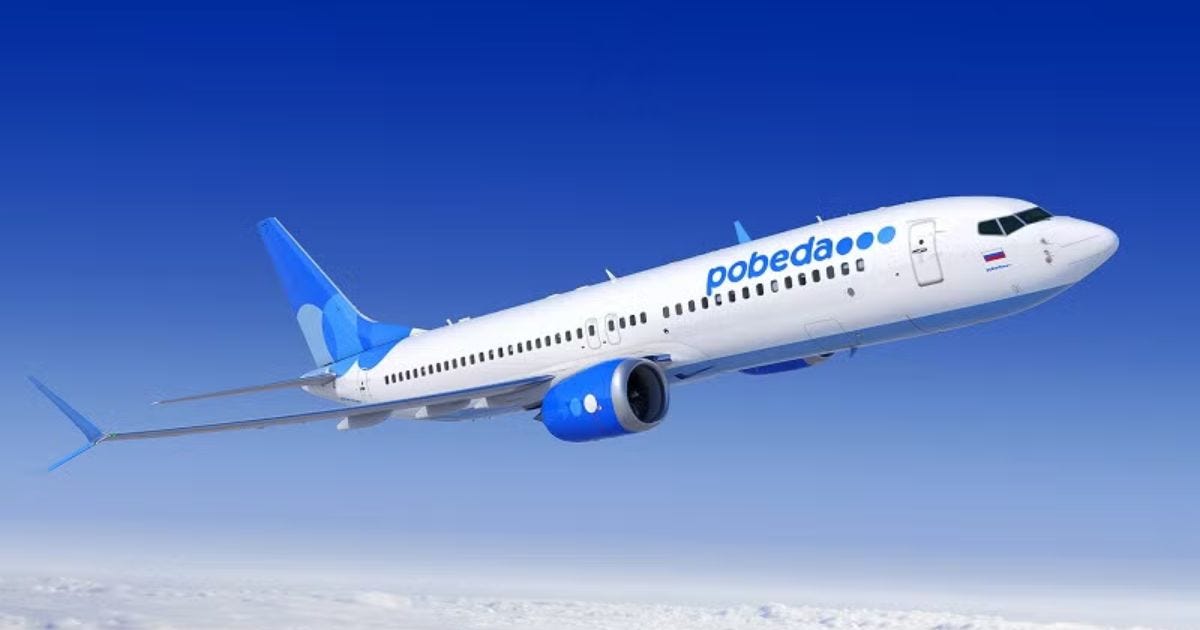
Pobeda Company Profile: Key Facts
Legal entity:          Budget Carrier LLC (Pobeda LCC)
Trading name:          Pobeda Airlines (Победа)
IATA / ICAO:           DP / PBD  (callsign: POBEDA)
Founded / first flt:   16 Sep 2014 / 1 December 2014 (VKO-VOG)
Parent:                PJSC Aeroflot (100% wholly owned)
Primary hub:           Moscow Vnukovo (VKO)
Secondary hubs:        Moscow Sheremetyevo (SVO), Sochi (AER), Anapa (AAQ)
Interim CEO:           Andrey Yurikov
Fleet:                 42 Boeing 737-800 (avg age ~9.2 years)
Destinations served:   ~40 airports across 4-5 countries (Mar 2026)
2025 passengers:       ~13.4 million
Headquarters:          Moskovskiy, Kievskoye Highway, 22nd km, Moscow Region
Press contact:         presscentr@flypobeda.ru
Official site:         flypobeda.ru
The airline operates under the formal corporate name Budget Carrier LLC and trades publicly as Pobeda, the Russian word for “victory”.
The brand was deliberately chosen by Aeroflot’s board in late 2014 to commemorate the 70th anniversary of the end of World War II in 1945, and the original red, white and silver livery has been retained without major change ever since.
Aeroflot owns 100 percent of Pobeda’s shares.
The carrier has no minority public float, no listed bonds of its own, and no separately disclosed audited IFRS statements.
Instead, its operating and financial performance is folded into the consolidated reporting of Aeroflot’s investor relations disclosures, which gives analysts visibility on passenger numbers, available seat kilometres and load factor at the segment level but limits the granularity available on Pobeda’s standalone unit costs.
Day-to-day leadership has been in transition. Long-serving General Director Dmitry Tyshchuk steered the airline through the most difficult years of the sanctions adjustment, and in late 2024 he was quoted by Interfax guiding for 2025 passenger growth of roughly 5 percent.
He has since moved on, with Andrey Yurikov stepping into the interim CEO role while Aeroflot Group conducts a permanent appointment process.
Pobeda Revenue and Financial Analysis
Group-Level Revenue Context
Because Pobeda does not file standalone IFRS statements, the financial story has to be told through Aeroflot Group’s consolidated disclosures.
The Group delivered total revenue of 902.26 billion rubles in 2025, up 5.3 percent against the 856.79 billion rubles reported for 2024.
Scheduled passenger services drove almost all of that growth, climbing 5.8 percent to 844.41 billion rubles. Cargo, by contrast, slipped 4.4 percent to 32.98 billion rubles as the freight market normalised after several years of unusual volatility.
Pobeda’s contribution within that mix is shaped by its low average ticket, but it punches well above its weight on volume. The carrier moved roughly 13.4 million passengers in 2025, which works out to about 24 percent of the 55.34 million passengers carried across the Group.
AEROFLOT GROUP IFRS REVENUE, RUBLE BILLIONS
2021:   377.2
2022:   612.2
2023:   612.2
2024:   856.8
2025:   902.3   (+5.3% YoY)
The 2024-to-2025 revenue gain is more modest than the headline traffic figures might suggest because yield growth slowed as domestic competition firmed up and ruble strength compressed international fare conversions.
Operating expenses rose faster than revenue at +8.6 percent, dragging adjusted EBITDA down from 237.59 billion rubles in 2024 to 185.04 billion rubles in 2025.
Pobeda’s Revenue Profile
Pobeda’s revenue model leans heavily on