


Welcome to AviationOutlook: The aviation newsletter built exclusively for decision-makers.
Stop skimming aviation news. Start reading aviation intelligence. Become a paying member and gain full access now.
As a paid member, you get access to:
200+ Reports - All major airlines + aerospace & defense companies (updated regularly).
Daily / Weekly - Deep-dive analysis & insights.
Monthly - Industry outlook reports.
In case you missed it, here are the latest analysis:
Starlux Airlines - Strategic Analysis and Outlook Report 2026 (Updated)
Allegiant’s Hyper-Seasonal Gamble Could Redefine How ULCCs Chase Profit
Check Out All Reports
Executive Summary
Royal Air Maroc (RAM) is executing the most aggressive expansion plan in its almost seven decade history, targeting a fleet growth from roughly 62 aircraft at the start of 2026 to 72 aircraft by year end, en route to a longer horizon target of 200 aircraft by 2037 tied to the 2030 FIFA World Cup that Morocco co-hosts with Spain and Portugal.
The carrier crossed 7.5 million passengers in 2025 with revenue approaching 20 billion Moroccan dirhams and cleared over 935 million dirhams in tax debt, marking a genuine financial turnaround after years of restructuring.
Network expansion in 2026 spans four continents, headlined by the first ever nonstop Casablanca to Los Angeles flight launched on 7 June 2026 and complemented by fresh services to Pointe-Noire, Tripoli, Beirut, Beijing Daxing, Toronto, London Stansted and Catania.
A landmark $15 billion tender for 188 aircraft plus 60 spare engines is still being adjudicated, with first deliveries from the tender expected in 2028 and Boeing widely tipped to secure the largest portion after Airbus withdrew its long-haul bid.
Are you a part of a team?
Equip your whole team with aviation intelligence. Consider “Group” or “Enterprise” plan.
Here’s what you get in this analysis report:
Royal Air Maroc Company Profile: Key Facts
Key Services, Products and Growth Drivers
Royal Air Maroc Fleet Analysis
Fleet Size and Composition
Fleet Age and Renewal Economics
Aircraft Deliveries in 2026
Aircraft Types Strategy and Configuration
Fleet Strategy and the 188 Aircraft Tender
Sub-Fleet Deep Dive
787 Dreamliner
737 Narrow Body Family
Embraer 190
Cargo and Regional
Route Network Strategy, Major Destinations and Analysis
Casablanca as a Superconnector
2026 Network Expansion: New Routes and Frequencies
Casablanca to Los Angeles: The Signature Route
The Long Haul Americas Push
The African Network
The European Backbone
The Asia Push: Beijing Daxing
The Middle East and Levant
Major Operational Bases (Hubs)
Competitive Position
Major Competitors
Royal Air Maroc vs Turkish Airlines
Royal Air Maroc vs Air France
Royal Air Maroc vs Ethiopian Airlines
Royal Air Maroc vs EgyptAir
Royal Air Maroc vs Gulf Carriers
Royal Air Maroc vs Low Cost Carriers in Morocco
Latest Strategic Contexts
The 2030 World Cup as a Strategic Deadline
The Digital and Loyalty Push
Financial Turnaround
Sustainable Aviation Fuel and Environmental Positioning
Codeshare and Alliance Depth
Government Policy and National Aviation Strategy
Automotive, Aerospace and Manufacturing Traffic
Diaspora Traffic Structural Growth
Key Risks
My Final Thoughts
Official Sources and Data
Introduction
Morocco’s flag carrier, Royal Air Maroc, is no longer the sleepy state airline of the last decade.
Between the arrival of a new Boeing 737 MAX-8 registered CN-RHR in August 2026 that pushed the fleet to a record 68 aircraft, the launch of the first direct Africa to West Coast US flight, and a $15 billion procurement war between Boeing and Airbus, Royal Air Maroc has transformed itself into one of the most closely watched growth stories in African aviation.
The stakes are unusually high. Morocco co-hosts the 2030 FIFA World Cup, its airport authority is building a futuristic new terminal at Casablanca Mohammed V, and the government has quietly greenlit an expansion pace that will require RAM to absorb up to 15 new aircraft per year from 2028 onward.
This deep-dive analysis examines the fleet strategy, route network, hub economics, competitive position and operational risks that will decide whether the carrier’s ambitions turn into durable performance or a costly overreach.
Let’s begin.
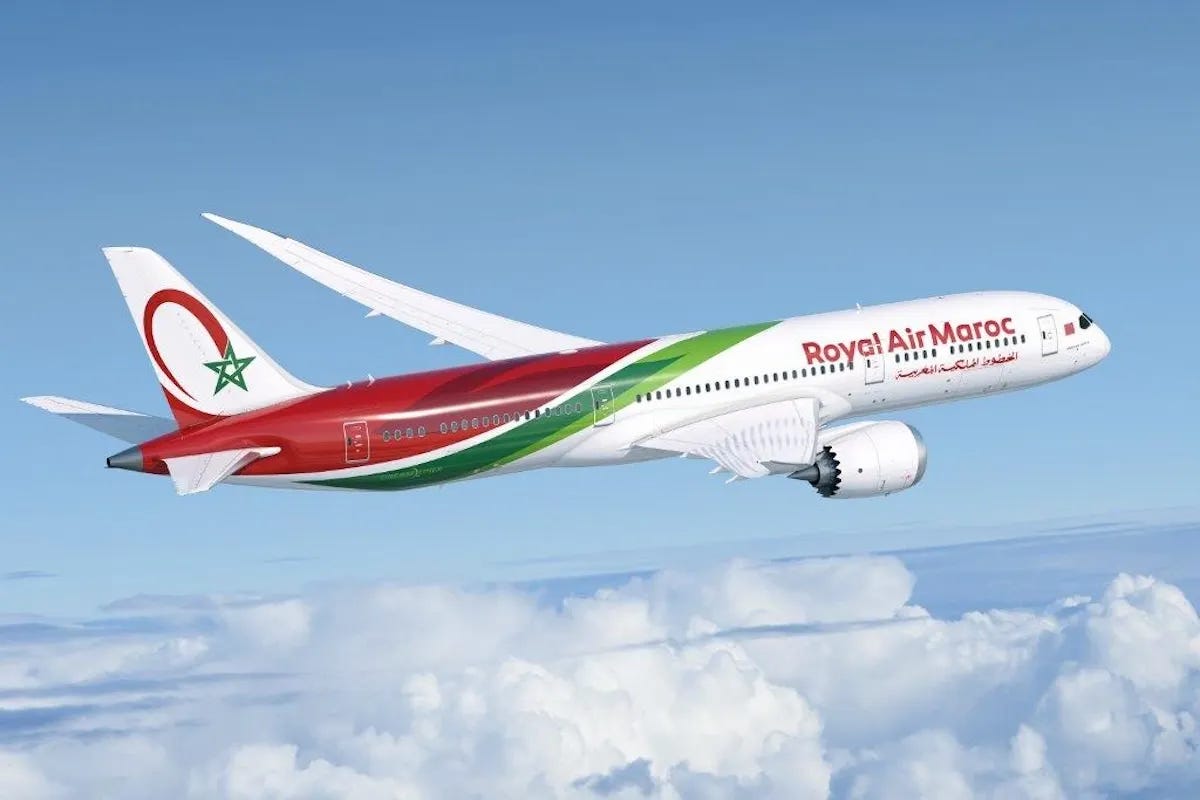
Royal Air Maroc Company Profile: Key Facts
Royal Air Maroc traces its origins to July 1953, formally taking its current name on 28 June 1957 when the newly independent Moroccan government consolidated the local air transport sector under a single state carrier.
The airline joined the oneworld alliance on 1 April 2020, becoming the first African member of a global airline alliance since Kenya Airways left in 2013.
Legal name           : Compagnie Nationale de Transport Aérien
                       Royal Air Maroc S.A.
IATA / ICAO code     : AT / RAM
Callsign             : ROYAL AIR MAROC
Headquarters         : Casablanca-Anfa, Morocco
Main hub             : Casablanca Mohammed V International Airport
CEO                  : Abdelhamid Addou (since 2016)
Ownership            : Government of Morocco 53.94%,
                       Hassan II Fund and other public entities
Founded              : 28 June 1957
Employees            : approx. 3,200 (group level)
Fleet size           : 68 aircraft (mainline)
                       6 aircraft (Royal Air Maroc Express)
Passengers 2025      : 7.5 million
Revenue 2025         : approx. MAD 20 billion
Alliance             : oneworld (since April 2020)
Loyalty programme    : Safar Flyer
The airline is majority government owned, with the Moroccan state controlling roughly 53.94% of the equity directly and additional shares held through the Hassan II Fund and other public sector vehicles.
That ownership structure explains both the airline’s role as an instrument of national economic policy and the willingness of Rabat to underwrite one of the largest single-carrier fleet plans in African aviation history.
The subsidiary Royal Air Maroc Express operates a small ATR-72 fleet on domestic and short-haul regional routes, and RAM Cargo provides dedicated freighter capacity out of Casablanca.
Together the group is organized as a lean holding structure with the mainline carrier as the dominant revenue engine and the subsidiaries acting as feeders or specialized operators.
Historical Context
The airline was born in the years immediately following Moroccan independence in 1956, at a time when the Kingdom needed a national aviation champion to support diplomatic outreach, business connectivity and the annual Hajj pilgrimage to Saudi Arabia.
Hajj charters were among the earliest operations, and remain a meaningful part of the seasonal network today.
Over the following decades, RAM built its identity around Boeing narrow body aircraft on European routes and Boeing wide bodies on transatlantic services.
The airline became the exclusive African link into New York in the early 2000s and has held a first mover advantage in United States nonstop connectivity for the wider region ever since.
The oneworld accession in April 2020 was a strategic turning point that arrived just as the pandemic hit.
The carrier had to defer many of the alliance benefits until traffic recovered, but from 2023 onward the sixth freedom flows through Casablanca have grown significantly, giving RAM a genuine third revenue leg alongside domestic diaspora traffic and inbound tourism.
Corporate Structure
The parent airline sits within a broader group that includes RAM Handling for ground services at Casablanca, Atlas Catering for inflight catering, and Aerotechnic Industries as a joint maintenance venture with Air France Industries and KLM Engineering & Maintenance.
This vertically integrated structure gives management levers to control cost and service standards in ways that a pure passenger airline could not.
Key Services, Products and Growth Drivers
Passenger Services and Cabin Products
Royal Air Maroc operates a two-cabin configuration on most of its fleet, with a business class cabin marketed as “Business Class” and an economy cabin branded “Economy”.
On the Boeing 787-9 Dreamliner, the layout offers lie-flat business class seats in a 1-2-1 configuration on the newer deliveries, positioning the carrier competitively against European and North American operators on transatlantic routes.
The airline flies from Casablanca to more than 90 destinations across Africa, Europe, the Middle East, the Americas and now East Asia. Through the oneworld alliance, Safar Flyer members can access more than 900 destinations served by alliance partners in 170 territories.
CABIN PRODUCTS BY FLEET TYPE (August 2026)

Boeing 787-9 Dreamliner  : Business (lie-flat 1-2-1), Economy
Boeing 787-8 Dreamliner  : Business, Economy
Boeing 737 MAX 8         : Business, Economy (156 or 189 seats)
Boeing 737-800           : Business, Economy
Embraer 190              : Single cabin regional configuration
ATR 72-600 (Express)     : Single class regional
Boeing 767-300F          : All cargo (Casablanca-based)
Ancillary revenue continues to build, with the carrier layering paid seat selection, extra baggage, priority boarding and a growing catalogue of Safar Flyer partner earn opportunities across banks, hotels and car rental brands.
The Safar Flyer programme now integrates with the oneworld status tiers, giving Platinum members oneworld Emerald status and matching benefits across British Airways, Iberia, American Airlines, Qatar Airways and Cathay Pacific lounges.
Inflight product upgrades have accelerated over the past 18 months.
The airline unveiled refreshed cabin interiors on its newer Dreamliner deliveries with modern seat shells, improved lighting cycles and updated inflight entertainment content.
The Touch Inflight Solutions partnership has become the technology spine of the passenger experience modernisation across long haul services.
Ground Product and Lounges
At Casablanca Mohammed V, RAM operates a dedicated lounge for business class passengers and Safar Flyer elite members in Terminal 2, with a separate transit lounge for passengers on long layovers.
The airline has stated a goal of expanding lounge capacity in line with the new terminal development at CMN, and additional partner lounges are accessed via oneworld reciprocity at hubs such as London Heathrow, New York JFK, Doha, Madrid and Paris Charles de Gaulle.
The 100% digital experience initiative at Casablanca has streamlined check in, bag drop and boarding for connecting passengers, reducing minimum connection times and improving the sixth freedom competitiveness of the hub.
Cargo Operations
RAM Cargo has been quietly rebuilding after the pandemic.
The division added a weekly Casablanca to Dakar freighter in early 2026 operated by a Boeing 767 freighter with a 45 tonne payload, joining an existing network that already served Brussels, Frankfurt, Abidjan, Bamako, Libreville and Douala with dedicated main deck capacity.
Belly cargo on the passenger fleet, in particular the 787-8 and 787-9 Dreamliners, remains a critical revenue stream on long-haul routes to New York JFK, Washington Dulles, Montreal, São Paulo and now Los Angeles. Moroccan automotive exports, aerospace components, textiles and fresh produce all feed the cargo revenue base, and the airline has been coordinating with Moroccan freight forwarders to build integrated logistics solutions.
The Casablanca to Dakar freighter launched in early 2026 operates every Friday and consolidates cargo flows that previously required transit through European hubs, cutting transit times for West African trade and creating margin for RAM Cargo at the same time.
Maintenance and Engineering
Royal Air Maroc’s maintenance backbone is provided in partnership with Air France KLM Engineering & Maintenance through Aerotechnic Industries at Casablanca, which specialises in narrow body base maintenance for the 737 family.
The airline has also strengthened its partnership with Safran for aircraft engine maintenance, with expanded capacity at Safran’s Casablanca-based facility.
The Safran partnership expansion supports both RAM’s own fleet and third party engine work, positioning Casablanca as a growing aerospace maintenance cluster within Africa and creating a defensible cost base for the airline’s engineering operations.
Pilot Training and Aviation Academy
RAM is investing directly in the pipeline of pilots and aviation professionals that its expansion will require.
In partnership with the International University of Rabat, the airline supports airline pilot training for cadets destined for its own line operations, with recurrent type training run through the airline’s own training centre in Casablanca.
Morocco has approved a draft decree establishing an Academy of Aviation Professions to be managed and created by Royal Air Maroc.
The academy will provide integration training for pilots, cabin crew, engineers and other specialised roles, addressing the industry wide talent bottleneck that is one of the most cited risks to fleet expansion plans.
Growth Drivers Shaping the Business
The single largest growth driver is Morocco’s role as co-host of the 2030 FIFA World Cup alongside Spain and Portugal. Morocco has already committed $4.2 billion in airport upgrades to prepare for the tournament, and RAM is positioned as the primary aviation beneficiary of this build-out.
Tourism inflow into Morocco has surged well ahead of the World Cup itself, and RAM’s home market recorded record visitor volumes in 2025.
Government policy explicitly ties the airline’s growth targets to a national tourism strategy that aims to lift arrivals to 26 million by 2030 with $8 billion in tourism sector investment.
STRUCTURAL GROWTH DRIVERS (medium term)

1. 2030 FIFA World Cup co-hosting (Morocco, Spain, Portugal)
2. Moroccan diaspora traffic across France, Spain, Belgium,
   the Netherlands, Italy and North America
3. Africa to Americas connectivity via Casablanca hub
4. Africa to East Asia connectivity via new Beijing route
5. Sixth-freedom traffic feeding into the oneworld alliance
6. Cargo growth from Morocco automotive and aerospace exports
7. Sustainable aviation fuel and modernised fleet economics
8. Government backed capital access for fleet financing
9. Aviation Academy pipeline for pilots and technical staff
10. Airports 2030 build out at Casablanca Mohammed V
A less visible but equally important driver is the oneworld alliance membership. Partnerships with American Airlines, British Airways, Iberia, Qatar Airways and Cathay Pacific have opened up a large flow of sixth-freedom traffic through Casablanca, especially from the United States and United Kingdom into West and Central Africa.
Sustainability is the newest strategic vector. RAM has already operated Morocco’s first carbon neutral flight to Europe using sustainable aviation fuel, and additional SAF trials have followed on selected intra-African and long-haul services.
Diaspora demand is one of the most underrated fundamentals in the RAM story.
Morocco has one of the largest expatriate populations in North Africa, with significant communities in France, Belgium, the Netherlands, Spain, Italy, Germany, the United Kingdom, the United States and Canada.
Annual summer traffic flows to Morocco from these markets generate a stable revenue floor for the airline and provide a demographic tailwind that will strengthen as the diaspora ages, saves and travels more frequently.