


Executive Summary
Shenzhen Airlines has moved through one of the most consequential ownership and capital restructurings in recent Chinese aviation history, with Air China confirming a 51% controlling stake alongside a new investor, Shenzhen Kunhang Investment Partnership, taking a 20.91% position as part of a larger RMB 16 billion equity financing round.
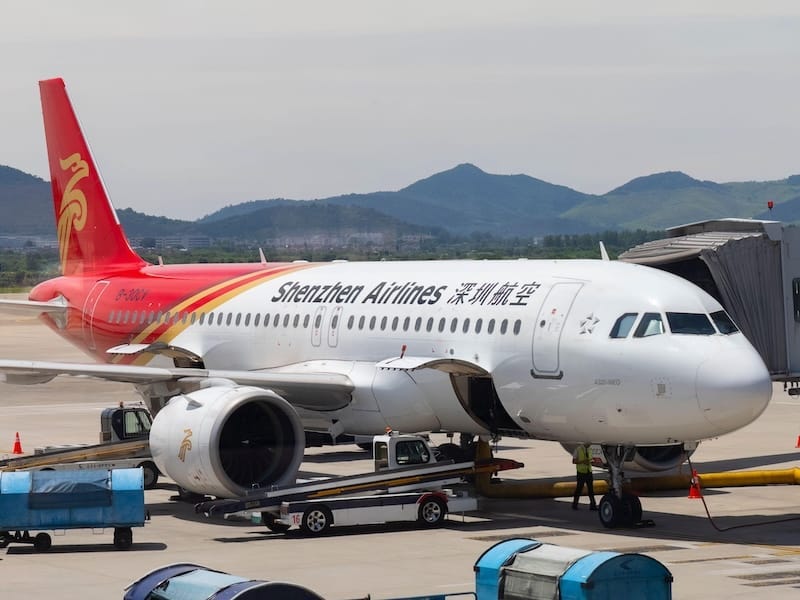
The carrier operated a fleet of 234 aircraft as of June 30, 2025, dominated by Boeing 737 and Airbus A320 family narrowbodies, with six Airbus A330-300 widebodies anchoring select long-haul services such as the new Shenzhen to Melbourne route.
Network scale reached roughly 320 routes (287 domestic, 33 international and regional), with annual passenger volume approaching 40 million and eight branches plus seven bases supporting a diamond-shaped national map that complements Air China’s northern strongholds.
Financial performance remains under pressure, with a first-half 2025 net loss of RMB 834 million that nonetheless narrowed by RMB 541 million year on year, reflecting improving load factors, falling unit fuel costs, and a disciplined international expansion push into Oceania and Southeast Asia.
Recommended - Read Full Reports


Read All Reports
Table of Contents
Executive Summary
Key Facts: Company Profile
Introduction
Business Overview
Corporate History and Ownership Architecture
Leadership and Management Bench
Financial Performance and Revenue Drivers
Core Services and Products
Fleet: In-Depth Analysis
Fleet Size and Composition
Narrowbody Workhorses: The A320 and 737 Families
Widebody Strategy: The A330-300 and the A350-900 Pipeline
Fleet Age, Utilization, and Economic Efficiency
Order Book and the Renewal Roadmap
Route Network, Major Destinations, and Strategy
The Scale of the Current Network
Domestic Network Backbone
International Expansion and the Melbourne Breakthrough
Regional and Southeast Asia Growth
The Star Alliance Dimension
Major Operational Bases (Hubs)
Shenzhen Bao’an International Airport (SZX/ZGSZ): The Anchor Hub
Secondary Operating Bases and Branches
Wuxi Shuofang (WUX): The East China Anchor
Guangzhou Baiyun (CAN): The Pearl River Delta Complement
Nanjing, Wuxi, Hangzhou, Kunming, Xi’an, Chongqing: The Mid-Tier Bases
Competitive Position
Major Competitors of Shenzhen Airlines
Shenzhen Airlines vs. China Southern Airlines
Shenzhen Airlines vs. Air China (Partner and Peer)
Shenzhen Airlines vs. Hainan Airlines
Shenzhen Airlines vs. Juneyao Airlines and Spring Airlines
Shenzhen Airlines vs. 9 Air and Shenzhen Donghai Airlines
Shenzhen Airlines vs. High-Speed Rail
Star Alliance Membership and Global Partnerships
The Star Alliance Integration
Codeshare Portfolio
Loyalty Program Integration
Commercial Strategy, Customer Experience, and Product
The Service Proposition
Digital and Distribution
Cargo Operations
ESG, Sustainability, and Fleet Efficiency
Fuel Efficiency Trajectory
Sustainability Commitments
Maintenance and Safety Culture
Kunming Airlines: The Strategic Subsidiary
Structure and Purpose
Strategic Role in the Group
Post-Recapitalization Roadmap and Strategic Priorities
The RMB 16 Billion Capital Plan
Strategic Priorities Through 2027
Key Risks with Probability and Scenario Analysis
Risk 1: Continued Domestic Yield Compression
Risk 2: Fuel Price Volatility
Risk 3: International Geopolitical and Bilateral Air Rights Risk
Risk 4: Widebody Induction Delay
Risk 5: Shareholder Governance Integration Friction
Risk 6: High-Speed Rail Substitution Continues to Deepen
Risk 7: Currency and USD-Denominated Lease Exposure
Distinctive Strategic Observations
Why the Air China Relationship is a Competitive Moat
The Shenzhen Municipal Re-entry is Strategically Meaningful
The A350 Induction is Product Transformation
The Carrier’s Balance Between Two Identities
Industry Context: The Chinese Civil Aviation Backdrop
Overall Market Recovery
The Big Three Dominance
The Domestic Aircraft Question
Final Positioning Assessment
Strengths
Weaknesses
Opportunities
Strategic Verdict
My Final Thoughts
Official Sources & Data
Key Facts: Company Profile
Legal Name           : Shenzhen Airlines Co., Ltd. (深圳航空)
IATA / ICAO / Callsign: ZH / CSZ / SHENZHEN AIR
Founded              : November 1992
Commenced Operations : 17 September 1993
Headquarters         : Bao'an District, Shenzhen, Guangdong
Main Hub             : Shenzhen Bao'an International Airport (SZX/ZGSZ)
Fleet Size           : 234 aircraft (mid-2025); ~202-204 in active service
Destinations Served  : 79+ cities across 16+ countries
Total Routes         : ~320 (287 domestic + 33 international/regional)
Annual Passengers    : ~40 million (run-rate)
President            : Wang Jie (appointed September 2020)
Parent Shareholders  : Air China (51%), Shenzhen Kunhang Investment (20.91%),
                       Shenzhen International Logistics (28.09%)
Key Subsidiary       : Kunming Airlines (80%)
Alliance             : Star Alliance (member since 29 November 2012)
Frequent Flyer       : PhoenixMiles (Air China)
Skytrax Rating       : 3-Star Airline
Registered Capital   : RMB 9.35 billion (post first-tranche financing)
Valuation Reference : RMB 5.48 billion (per Sept-2024 appraisal report)Introduction
Few Chinese carriers have absorbed as much boardroom drama, financial strain, and strategic reinvention in such a short window as Shenzhen Airlines has since mid-2025.
The airline serves the single most dynamic city in the Pearl River Delta, a commercial engine that handled 66.48 million passenger trips through its home airport in 2025, and it is now doing so with a fresh capital base, a new minority shareholder from the Shenzhen municipal state sector, and a widebody aircraft flying its flag to Australia for the first time in company history.
For airline industry stakeholders, Shenzhen Airlines matters for three overlapping reasons.
It’s the largest narrowbody operator inside Guangdong province, it is Air China’s most important operational lever in southern China, and it is the second mainland Chinese carrier admitted into Star Alliance. Each of those facts carries weight on balance sheets, route maps, and codeshare negotiating tables from Frankfurt to Tokyo.
Treat Shenzhen Airlines less as a regional curiosity and more as a test case for how mid-tier Chinese carriers survive when the country’s civil aviation system transported 770 million passengers in 2025, yet yields remain structurally compressed on most trunk routes.
Business Overview
Corporate History and Ownership Architecture
Shenzhen Airlines was incorporated in November 1992 as a joint-stock company linked to the city government and commercial investors, commencing commercial operations on 17 September 1993 with a small Boeing 737 fleet.
The carrier spent its first decade building the city’s domestic trunk network before becoming entangled in a high-profile corporate governance scandal involving former actual controller Li Zeyuan in the early 2010s.
Air China stepped in as the rescuer and long-term consolidator, gradually building a stake that reached a controlling 51% and integrating Shenzhen Airlines into the Air China Limited ecosystem. The second historical anchor shareholder, Shenzhen International Holdings, operated via its logistics subsidiary and for years held an effective 49% interest.
The ownership picture shifted materially in early 2026. A state-controlled limited partnership called Shenzhen Kunhang Investment Partnership subscribed to RMB 2 billion of new equity, securing a 20.91% stake in the first tranche of a broader RMB 16 billion recapitalization plan.
Kunhang is controlled by the Shenzhen Municipal State-owned Assets Supervision and Administration Commission, which effectively reinserts the home-city government into the shareholder register alongside Air China.
SHAREHOLDER TABLE (post first-tranche financing, Q1 2026)
---------------------------------------------------------
Air China Limited                    : 51.00%  (controlling)
Shenzhen International Logistics     : 28.09%  (reduced from 49%)
Shenzhen Kunhang Investment Partner. : 20.91%  (new entrant)
Registered Capital                   : RMB 9.35 billion
Reference Valuation (30 Sept 2024)   : RMB 5.48 billion
Governance : Board composition unchangedLeadership and Management Bench
The airline is led by President Wang Jie, who took over the corner office in September 2020 as the deputy party secretary and chief executive.
The chairmanship role rotates more closely with Air China appointees, reflecting the group’s operational integration, and historically senior Air China figures such as Cai Jianjiang have held the position at various points.
This dual-anchor governance model, one foot in Beijing and one foot in Shenzhen, is not incidental. It shapes where the carrier places new aircraft, how it prices feed traffic into Air China’s Beijing hubs, and how it structures codeshares with Lufthansa Group and ANA.
Financial Performance and Revenue Drivers
Because Shenzhen Airlines is not separately listed, investors and industry analysts rely on the interim financial report published by Shenzhen International Holdings, the minority shareholder, to track the airline’s segment results. The most recent disclosure showed a net loss of RMB 834 million for the first half of 2025.
Context matters here. That first-half 2025 loss was approximately RMB 541 million narrower than the first half of 2024 on a comparable basis, implying a loss-reduction pace of roughly 39%. Revenue trajectory continues to benefit from rising international yields, a steady recovery in Southeast Asian leisure demand, and the phase-in of more fuel-efficient A320neo equipment.
The airline is still operating in a challenging unit-revenue environment. Domestic trunk route yields remain under pressure from a combination of added capacity by peers and aggressive high-speed rail substitution on city-pair routes under 800 kilometers.
Revenue drivers split into several clear streams:
REVENUE DRIVERS - SHENZHEN AIRLINES
-----------------------------------
1. Domestic Passenger Operations
   - 287 routes connecting Pearl River Delta to all major Chinese regions
   - Core yield contributor despite rail substitution on short-haul
   - Business traffic: Shenzhen-Beijing, Shenzhen-Shanghai, Shenzhen-Chengdu

2. International & Regional Passenger Operations
   - 33 routes to Japan, South Korea, Southeast Asia, Europe, Oceania
   - Highest yield per ASK; growth driver post-capital raise
   - Anchor routes: Shenzhen-London, Shenzhen-Melbourne, Shenzhen-Bangkok

3. Belly-Hold Cargo
   - Operated via Shenzhen Airlines Cargo Co., Ltd.
   - Leverages Shenzhen Bao'an's 2.05 million tonnes/year cargo throughput
   - Melbourne A330 adds ~12,000 tonnes of annual belly capacity

4. Ancillary & Partnership Revenue
   - PhoenixMiles co-branded products with Air China
   - Codeshare revenue via ANA, Lufthansa Group JV
- Star Alliance interline settlementsCore Services and Products
On the passenger side, Shenzhen Airlines sells three cabin products. The narrowbody fleet is offered in a two-class configuration (business and economy), while the Airbus A330-300 widebodies operate a three-class layout with a dedicated premium business cabin featuring fully flat seats on long-haul sectors like London and Melbourne.
The cargo subsidiary, Shenzhen Airlines Cargo Co., Ltd., sells domestic and international air freight capacity predominantly out of Shenzhen, with some uplift from Wuxi and Nanjing bases. The airline’s Skytrax 3-Star product rating places it in the competent mid-tier category, behind the four-star positioning of Hainan Airlines but ahead of most second-tier Chinese peers.
Fleet: In-Depth Analysis
Fleet Size and Composition
The Shenzhen Airlines fleet has swung between roughly 198 and 234 aircraft across the past three years, depending on whether one counts storage, transfers, and subsidiary aircraft. The most authoritative current figure comes from the airline’s own strategic disclosure around the capital raise, which cited 234 aircraft as of 30 June 2025.
Third-party tracker Planespotters.net shows 204 aircraft actively listed under the Shenzhen Airlines callsign, plus eight on order or planned, reflecting slightly stricter inclusion criteria that exclude certain stored and in-transfer frames.
SHENZHEN AIRLINES FLEET COMPOSITION (H2 2025 - Q1 2026)
-------------------------------------------------------
AIRBUS NARROWBODY
 A319-100          : 5 aircraft (in-progress divestment)
 A320-200 (CEO)    : 76 aircraft (core narrowbody)
 A320neo           : 30 aircraft (growth sub-fleet)
 A321neo           : 6-7 aircraft (new additions)
 Subtotal Airbus NB: ~117 aircraft

BOEING NARROWBODY
 737-800 (NG)      : 71-76 aircraft (core narrowbody)
 737 MAX 8         : 14-15 aircraft
 Subtotal Boeing NB: ~85-91 aircraft

AIRBUS WIDEBODY
 A330-300          : 6 aircraft (long-haul flagship)
 A350-900          : 0 in service / 5 on order (from Air China transfer)
 Subtotal Widebody : 6 aircraft + 5 on order

TOTAL ACTIVE FLEET : ~204-234 aircraft (method dependent)
AVERAGE FLEET AGE : ~10.5 yearsNarrowbody Workhorses: The A320 and 737 Families
The narrowbody story sits at the heart of any credible assessment of Shenzhen Airlines. Roughly 205 of the 234 aircraft in the active or recently active fleet are single-aisle jets, which is consistent with a carrier whose economic rationale rests on dense domestic markets and regional international services of under six hours.
The Airbus A320-200 classic and A320neo, taken together, form the single largest sub-fleet, with approximately 106 aircraft in the family when the A319 and A321 tails are also counted. These aircraft dominate routes like Shenzhen to Beijing, Shenzhen to Shanghai Hongqiao, Shenzhen to Chengdu, and the dense Pearl River Delta to East China trunk market.
On the Boeing side, the 737-800 remains the mainstay, supported by 14 to 15 Boeing 737 MAX 8 frames that were delivered across 2018 to 2024 after a difficult certification pause. The MAX 8 additions give the carrier a roughly 14% unit-fuel advantage on medium-haul domestic city pairs versus legacy 737 Next Generation equipment.

NARROWBODY STRATEGY NOTES
-------------------------
- Airbus and Boeing balanced parallel sourcing reduces supplier risk
- A320neo and 737 MAX 8 are the designated fuel-efficiency engines of renewal
- Tender issued October 2025 for 8 additional A320/A321neo family aircraft
- Five A319-100s being divested as part of fleet simplification
- Operating bases align roughly 60% Airbus / 40% Boeing at Shenzhen Bao'an
- Pilot base split reflects this dual supplier structure
- Engine maintenance contract (2025-2027) with AFI KLM E&M covers CFM56/LEAPWidebody Strategy: The A330-300 and the A350-900 Pipeline
The widebody story is deliberately small and deliberately important. Shenzhen Airlines took delivery of its first Airbus A330-300 in 2017 and has since grown the sub-fleet to six aircraft, each configured in a three-class layout with around 284 total seats depending on specific tail.
These widebodies have been used for precisely the routes where narrowbody economics fall short. They operate select Shenzhen to Beijing and Shenzhen to Shanghai flagship rotations during peak hours, they anchor long-haul services like Shenzhen to London Heathrow, and from 22 December 2025 they have operated the new thrice-weekly Shenzhen to Melbourne service as flights ZH811/ZH812.
The Melbourne launch alone injects approximately 95,000 seats per year into the Shenzhen-Australia city pair and provides roughly 12,000 tonnes of annual belly cargo capacity into the Victorian import corridor. Load factor performance above 80% is widely reported to be the threshold that would trigger an up-gauge to daily service before the 2026 Canton Fair cycle.
The forward-looking widebody story belongs to the Airbus A350-900. Five frames are understood to be on order or planned for transfer from Air China’s extensive A350 book, aligning with the parent’s strategy of reallocating capacity inside the group. If delivered on schedule, they will materially expand Shenzhen Airlines’ long-haul reach toward Europe and the wider Asia-Pacific.
Fleet Age, Utilization, and Economic Efficiency
The average fleet age sits around 10.5 years, which is slightly older than pure comparables like Juneyao Airlines (closer to 7 years) but younger than legacy peers like China Eastern. This average is skewed upward by the 76 older A320-200 classics and the mature 737-800 NG frames, while the A320neo, A321neo, and 737 MAX 8 sub-fleets are all under five years old on average.
Average daily utilization for the narrowbody fleet has recovered to approximately 9.2 to 9.8 block hours per day in peak seasons, with the A330-300 widebodies now running above 12 hours per day thanks to the Melbourne schedule paired with domestic trunk duties during the overnight layover window.
Unit fuel cost, once the dominant challenge in 2022 and 2023, has moderated as global jet kerosene prices normalized and the neo sub-fleet expanded. Management has guided that fleet-wide fuel burn per ASK improved by a mid-single-digit percentage year over year in the first half of 2025.
Order Book and the Renewal Roadmap
The carrier formally signaled its renewal roadmap in two moves. The first was a public tender published via China’s Government Procurement Network in October 2025 for up to eight A320neo family aircraft. The second was the disposal of five A319-100s for fleet simplification and cost reduction.
Management has telegraphed that deliveries across 2026 will focus on frequency growth on existing routes rather than explosive network expansion. That is rational given the capital structure, the narrow-body-heavy product, and the need to preserve margin integrity during the post-recapitalization rebuild.
FLEET RENEWAL PRIORITIES (2026-2028)
------------------------------------
1. Phase out remaining 5 A319-100s  --> short-term fleet simplification
2. Induct 8+ A320/A321neo family     --> narrowbody densification & fuel savings
3. Accept 5 A350-900s (pending)      --> long-haul product step-up
4. Maintain MAX 8 ramp-up            --> Boeing narrowbody balance retention
5. Engine MRO consolidation          --> AFI KLM E&M contract 2025-2027
6. Cabin connectivity rollout        --> Wi-Fi on all A320/737 frames
Net capacity change guided at mid-single-digit ASK growth annually