


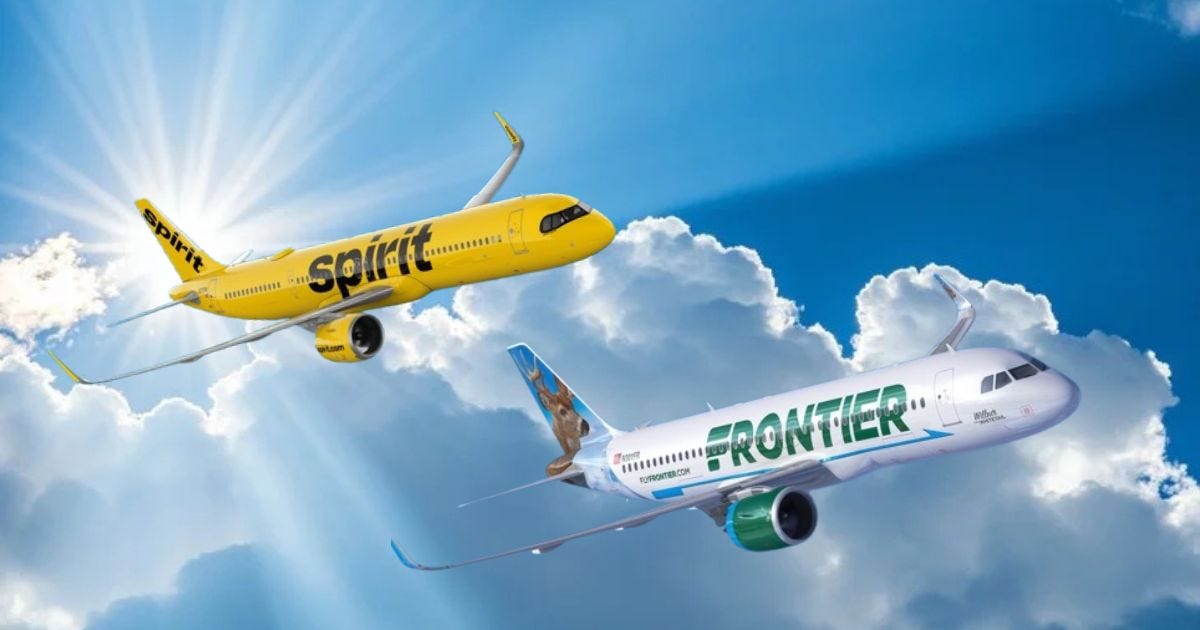
Spirit Airlines has reopened merger discussions with Frontier Group Holdings, marking the third attempt by these ultra-low-cost carriers to combine operations.
The negotiations, which could yield an announcement as soon as this month, represent a potential lifeline for Spirit as it navigates Chapter 11 bankruptcy proceedings filed in August 2025.
Bankruptcy Context and Emergency Financing
Spirit Aviation Holdings filed for its second Chapter 11 bankruptcy on August 29, 2025, seeking protection from approximately $1.6 billion in debt obligations. The airline has been hemorrhaging cash throughout its restructuring process, prompting the need for aggressive cost-cutting measures.
Just days before the merger talks surfaced, Spirit secured an additional $100 million in emergency debtor-in-possession financing on December 15. This financial injection brings the airline’s total bankruptcy funding to $575 million, providing a crucial runway to maintain operations through the holiday season while exploring strategic alternatives.
The bankruptcy court had previously approved a $475 million lifeline that included a $150 million investment from AerCap, one of Spirit’s largest aircraft lessors.
RESTRUCTURING ACTIONS TAKEN EARLIER BY SPIRIT:
- Headcount reductions across operations
- Exit from 14 airports nationwide
- Termination of more than 80 aircraft lease commitments
- 20% capacity reduction planned for 2026
- Furlough of approximately 600 pilots
Historical Merger Attempts and Failed Consolidation
The current discussions represent the third merger attempt between Spirit and Frontier.
The carriers initially agreed to merge in February 2022 in a $2.9 billion transaction. However, that agreement collapsed when JetBlue Airways launched a competing $3.8 billion bid that Spirit shareholders ultimately accepted.
The Spirit-JetBlue merger never materialized. Federal regulators sued to block the combination over antitrust concerns, and a U.S. District Court judge sided with the Justice Department in early 2024, citing monopolistic implications.
The blocked merger left Spirit financially vulnerable, and without the strategic partner it needed to compete effectively.
During Spirit’s first bankruptcy filing in late 2024, which the airline successfully exited in March 2025 after restructuring $795 million in debt, Frontier submitted at least two additional merger proposals.
Spirit rejected both offers, including a $2.16 billion bid, arguing that the terms were inferior to those previously negotiated and that Frontier had not provided adequate assurances it would complete the transaction.
Leadership Changes and Strategic Timing
The renewed merger talks coincide with a significant leadership transition at Frontier Airlines.
On December 15, longtime CEO Barry Biffle stepped down, with the company naming insider James Dempsey as interim chief executive. Biffle had reportedly expressed reservations about a full Spirit acquisition, concerned that absorbing the troubled carrier could destabilize Frontier’s balance sheet.
Industry sources told Reuters that Frontier Chairman Bill Franke met with Spirit CEO Dave Davis and Chairman Robert Milton in August, just before Spirit’s second bankruptcy filing. These high-level discussions laid the groundwork for the current negotiations, which have apparently gained momentum following the CEO change.
Industry Pressures Facing Ultra-Low-Cost Carriers
Both Spirit and Frontier operate as ultra-low-cost carriers, a business model facing intensifying operational challenges throughout 2025. Rising labor costs have eroded the historical cost advantages that ULCCs held over legacy carriers, creating significant margin compression.
KEY CHALLENGES FOR ULTRA-LOW-COST CARRIERS:
- Labor cost inflation reducing competitive advantage
- Network carriers matching discount fares on key routes
- Larger airlines leveraging loyalty programs to retain passengers
- Capacity additions by major carriers on ULCC-dominant routes
- Consumer preference shifts toward premium offerings
Major U.S. airlines have become increasingly aggressive in competing for price-sensitive travelers, matching ULCC fares while offering superior route networks and frequent flyer benefits.
This fare competition has squeezed the revenue premium that budget carriers once enjoyed, while their cost structures have simultaneously increased.
Strategic Rationale for Combination
A successful merger would create a larger ultra-low-cost carrier with enhanced scale to compete against dominant legacy airlines. The combined entity would add approximately 100 aircraft to Frontier’s existing fleet, significantly expanding route network options and operational flexibility.
For Spirit, the merger represents a credible exit strategy from bankruptcy protection. The airline has been evaluating all strategic options since October, including potential sale or merger scenarios to maximize stakeholder value.
Without a strategic combination, Spirit faces the challenging prospect of emerging from bankruptcy as a smaller standalone carrier in an increasingly difficult operating environment.
The transaction would also generate potential cost synergies through consolidated operations, combined purchasing power for aircraft and fuel, and the elimination of redundant administrative functions.
However, integration challenges remain significant, particularly given Spirit’s ongoing restructuring and fleet rationalization efforts.
My Final Thoughts
Despite the ongoing discussions, industry experts caution that talks remain fluid and could collapse without producing a definitive agreement.
The transaction would require approval from Spirit’s bankruptcy court, which must determine that any merger serves the best interests of creditors and stakeholders. Regulatory review from the Department of Transportation and potential antitrust scrutiny from the Justice Department would follow, though experts generally view a ULCC-ULCC combination as less problematic than mergers involving larger carriers.
Even if successfully completed, the combined carrier would face formidable competitive headwinds in an aviation sector where ultra-low-cost business models are under sustained pressure.
The merged airline would need to demonstrate it can achieve sustainable profitability while maintaining the cost discipline that defines the ULCC segment.