


Dear Readers, Welcome to AviationOutlook.
Let’s analyze the topic in detail.
Executive Summary
Super Air Jet has scaled from three secondhand Airbus narrowbodies at launch in August 2021 to an operating fleet exceeding 60 jets, making it one of the fastest fleet-scaling carriers in Southeast Asia despite Indonesia’s softer domestic demand environment.
The carrier serves 37 domestic and one international destination as of June 2026, anchored by Jakarta–Soekarno-Hatta with growing point-to-point traffic out of Denpasar, Balikpapan, Medan, Makassar, Surabaya, Yogyakarta, Batam and Semarang.
Passenger volume rose to 11.2 million in 2024, with 2025 trending toward the 11.4 million range, reflecting steady throughput growth even as the broader Indonesian market remains structurally below 2018 levels.
The carrier is exposed to fuel surcharge volatility, regulatory tariff caps, sister-brand cannibalization within the Lion Group multi-airline architecture and persistent on-time performance criticism that pressures its millennial-focused brand promise.
Recommended - Read Full Reports


Read All Reports
Table of Contents
Executive Summary
Super Air Jet Company Profile: Key Facts
Super Air Jet Performance Analysis
Last Twelve Months (LTM) Performance
Forward Guidance
Revenue Growth Drivers
Key Services and Products
Super Air Jet Fleet Analysis
Fleet Size and Composition
Fleet Age and Reasons Behind the Aging Profile
Aircraft Type Strategy and Cabin Configuration
Fleet Strategy Going Forward
Super Air Jet Route Network Strategy and Major Destinations Analysis
Network Scale and Composition
Major Domestic Destinations
International Destination Strategy
Route Network Selection Methodology
Frequency Strategy
Major Operational Bases (Hubs)
Primary Hub: Jakarta–Soekarno-Hatta International Airport (CGK)
Secondary Operating Bases
Kuala Lumpur as a Focus City
Competitive Position
List of Major Competitors
Super Air Jet vs Lion Air
Super Air Jet vs Citilink
Super Air Jet vs Indonesia AirAsia
Super Air Jet vs Batik Air
Super Air Jet vs Garuda Indonesia
Super Air Jet vs Pelita Air
Brand Identity and Customer Experience
Millennial Positioning
Service Quality Reality
Distribution and Digital Channels
Operating Environment and Regulatory Landscape
Indonesia as the World’s Future Fourth-Largest Aviation Market
Government Policy and Fare Regulation
Fuel and Currency Exposure
Macro Tailwinds and Headwinds
Tailwinds
Headwinds
Sustainability, Safety and Corporate Governance
Safety Record
Sustainability and SAF Adoption
Governance and Independence Claims
Workforce and Operational Footprint
Headcount
Maintenance and Engineering
Key Risks
Risk 1
Risk 2
Risk 3
Risk 4
Risk 5
Risk 6
Risk 7
Risk 8
Risk 9
Risk 10
Outlook for 2026 and Beyond
My Final Thoughts
Official Sources and Data
Super Air Jet Company Profile: Key Facts
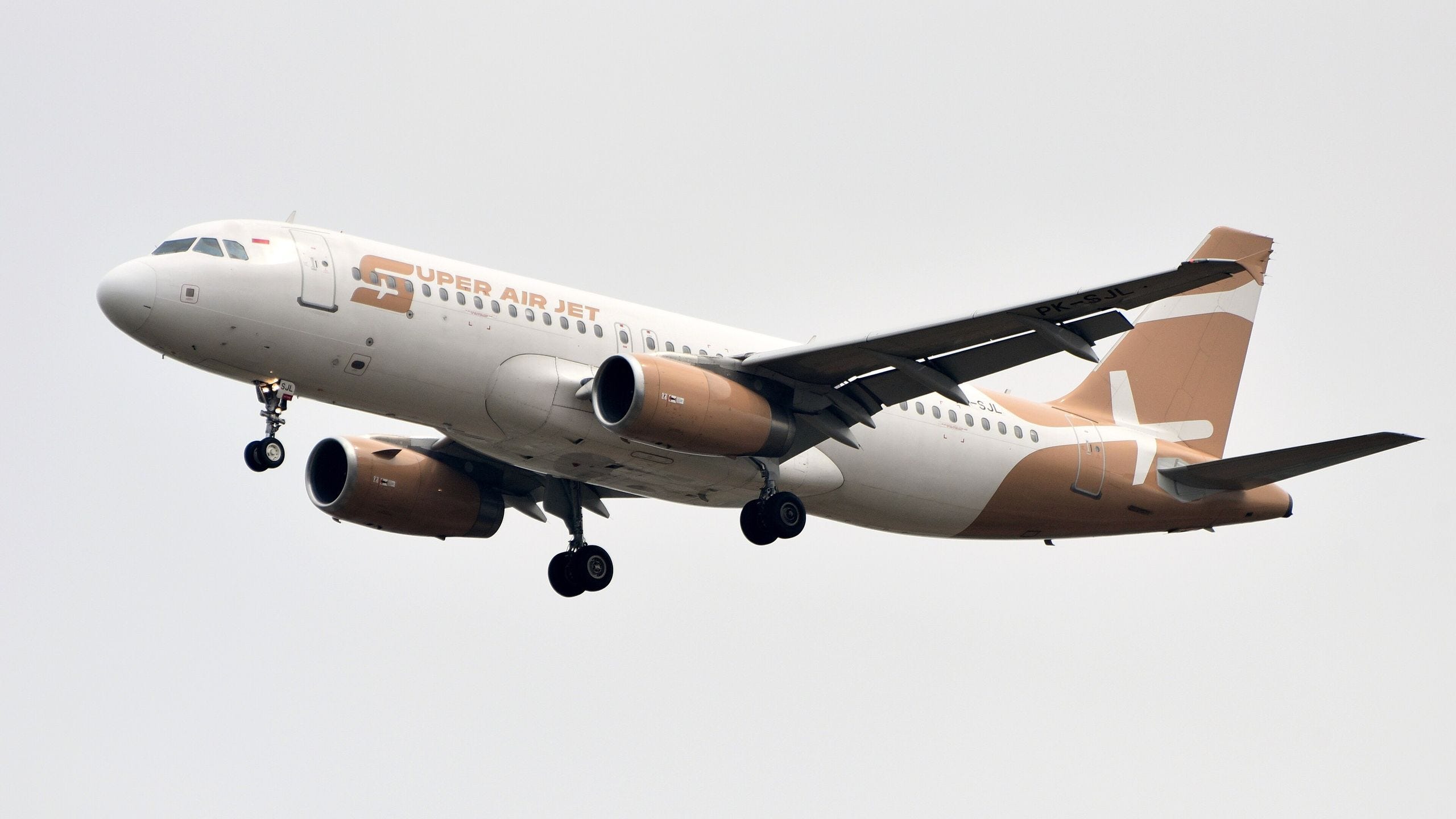
Super Air Jet (IATA: IU, ICAO: SJV, callsign “PROSPER”) is an Indonesian ultra-low-cost carrier headquartered in Jakarta with operations centered on Soekarno-Hatta International Airport (CGK).
The company was formally launched in March 2021 and received its Air Operator’s Certificate from the Indonesian Ministry of Transportation on 30 June 2021.
Commercial flying commenced on 6 August 2021 with an inaugural rotation from Jakarta to Medan and Batam. The launch was delayed approximately one month because of the country’s COVID-era Community Activities Restrictions Enforcement (PPKM) measures.
The carrier is led by President Director Ari Azhari, previously General Manager of Services at Lion Air Group. Financing traces to Lion Group founder Rusdi Kirana, though the airline insists on operating independently from Lion Air’s other brands.
SUPER AIR JET
─────────────────────────────────────────
IATA / ICAO Code        : IU / SJV
Callsign                : PROSPER
Founded                 : March 2021
First commercial flight : 6 August 2021
AOC issuance            : 30 June 2021
Headquarters            : Jakarta, Indonesia
Primary hub             : Soekarno-Hatta Intl (CGK)
President Director      : Ari Azhari
Backed by               : Rusdi Kirana (Lion Group founder)
Fleet type              : Airbus A320-200 (all-narrowbody)
Fleet count             : 60+ aircraft
Destinations            : 37 domestic + 1 international
Business model          : Ultra low-cost, point-to-point
The airline brands itself as the carrier of choice for “modern generations,” a positioning aimed squarely at Indonesia’s millennial and Gen Z travelers. It describes the proposition as “premium in-flight travel experience with high connectivity, reliability, and reasonably priced transportation.”
While the airline maintains it is operationally independent, corporate filings show Super Air Jet is majority-owned by PT Kabin Kita Top, whose ownership profile has been linked publicly to the Kirana family.
The carrier therefore plays an explicit role inside the Lion Group’s airline-within-airline architecture.
Super Air Jet Performance Analysis
Because Super Air Jet is a privately held Indonesian company that is not publicly listed and is not required to file quarterly statements under Indonesia’s OJK rules, the carrier does not publish audited 10-Q-style filings.
The headline metric most widely cited is annual revenue in the USD 100 million range for 2024, with a thin net profit margin reported near 2.9%.
These figures are consistent with the airline’s positioning as a volume-driven, low-yield operator.
Last Twelve Months Performance
Super Air Jet’s revenue is overwhelmingly generated from base passenger fares on short and medium-haul domestic flying. The carrier does not operate cargo-only aircraft, though belly cargo on its Airbus narrowbodies forms a small ancillary revenue stream.
Passenger throughput is the most reliable proxy for revenue trajectory.
The carrier carried 5.66 million passengers in 2022, 10.38 million in 2023 and 11.23 million in 2024. The 2025 projection sits at roughly 11.43 million, suggesting passenger growth has plateaued as the airline cycled through its initial route-expansion sugar high.
The flattening 2025 trajectory mirrors Indonesia’s wider market, where domestic capacity remained structurally 34% below 2018 levels. Persistent capacity discipline by Lion Group and Garuda Indonesia explains why pricing has hardened rather than slipping into a fare war.

SUPER AIR JET — PASSENGER VOLUME (T2RL)
────────────────────────────────────────
Year   Passengers   Status
2022   5,661,936    Reported
2023   10,381,042   Reported
2024   11,227,091   Reported
2025   11,434,272   Projected
Forward Guidance
Super Air Jet does not file quarterly earnings or issue forward-looking guidance in the manner required of US-listed carriers. The airline’s most recent operational performance signals come through Indonesia’s Central Bureau of Statistics (BPS) air-traffic data and the company’s own route announcements.
In July 2025, domestic Indonesian air passenger numbers grew 9.21% month-on-month to 5.5 million, suggesting that the second half of 2025 saw better-than-expected sequential traffic, which likely carried into early 2026 results.
Forward visibility for 2026 hinges on three regulatory developments. The government allowed airlines to raise fuel surcharges to 50% of the fare ceiling in April 2026, easing margin pressure from elevated avtur prices.
To offset price increases, regulators concurrently introduced a 60-day VAT exemption on economy fares to keep ticket prices accessible. Super Air Jet, as a pure economy-class operator, is structurally well-placed to harvest demand from this targeted relief.
Revenue Growth Drivers
The first growth driver is network densification rather than new market entry.
Super Air Jet has spent the past 18 months thickening its Jakarta-radial network, including the launch of six new domestic Jakarta routes in December 2024 to Jayapura, Kendari, Lubuklinggau, Palu, Sorong and Ternate.
DECEMBER 2024 JAKARTA EXPANSION (eff. 20 Dec 2024)
──────────────────────────────────────────────────
Route                       Frequency      Aircraft
Jakarta — Jayapura          1 daily        A320
Jakarta — Kendari           1 daily        A320
Jakarta — Lubuklinggau      1 daily        A320
Jakarta — Palu              1 daily        A320
Jakarta — Sorong            4 weekly*      A320
Jakarta — Ternate           1 daily        A320

*upgraded to daily from 1 March 2025
The second driver is the unlocking of new Indonesian airports.
Super Air Jet became the first airline to operate scheduled service at Kediri’s Dhoho Airport in East Java in 2024, an example of the carrier taking pioneer-route premium positioning when secondary-city infrastructure comes online.
The third driver is destination tourism.
Super Air Jet launched daily Jakarta–Labuan Bajo flights from 29 March 2026, tapping the Komodo National Park tourism corridor that has been prioritized as a Super Priority Tourism Destination by the Indonesian government.
The fourth driver is selective international expansion.
The airline began Indonesia–Malaysia flying in 2023 with Lombok and Surabaya routes to Kuala Lumpur, then added a Pekanbaru–Kuala Lumpur service from September 2023.
Key Services and Products
Super Air Jet offers a single-class economy cabin, point-to-point scheduled passenger transport, ancillary baggage products, belly cargo and ground handling at certain stations through Lion Group affiliates.
There are no premium cabins, no frequent flyer program of meaningful weight and no interline or codeshare agreements with global alliances.
The airline does not operate a frequent flyer program comparable to GarudaMiles, leaving repeat business reliant on price and schedule rather than loyalty inertia. This is a deliberate ultra-LCC choice that keeps unit costs low but limits revenue stickiness.
SUPER AIR JET — PRODUCT STACK
────────────────────────────────────────
Cabin classes        : Economy only
Seat pitch (A320)    : Standard ULCC pitch
Ancillaries          : Baggage, seat selection
                       in-flight purchases
Cargo                : Belly only
Loyalty              : None of meaningful scale
Distribution         : Direct web, OTAs (Traveloka,
                       Trip.com), GDS via Lion stack
Codeshares           : None
Alliance             : Unaligned