


British aerospace manufacturer Vertical Aerospace has completed the transformation from prototype developer to commercial aircraft producer with the unveiling of Valo, its production-ready electric vertical takeoff and landing (eVTOL) aircraft.
The London-based company presented the full-scale aircraft at an event in Canary Wharf, marking a substantial step forward for the UK’s aviation manufacturing sector.
Design Evolution from VX4 Prototype
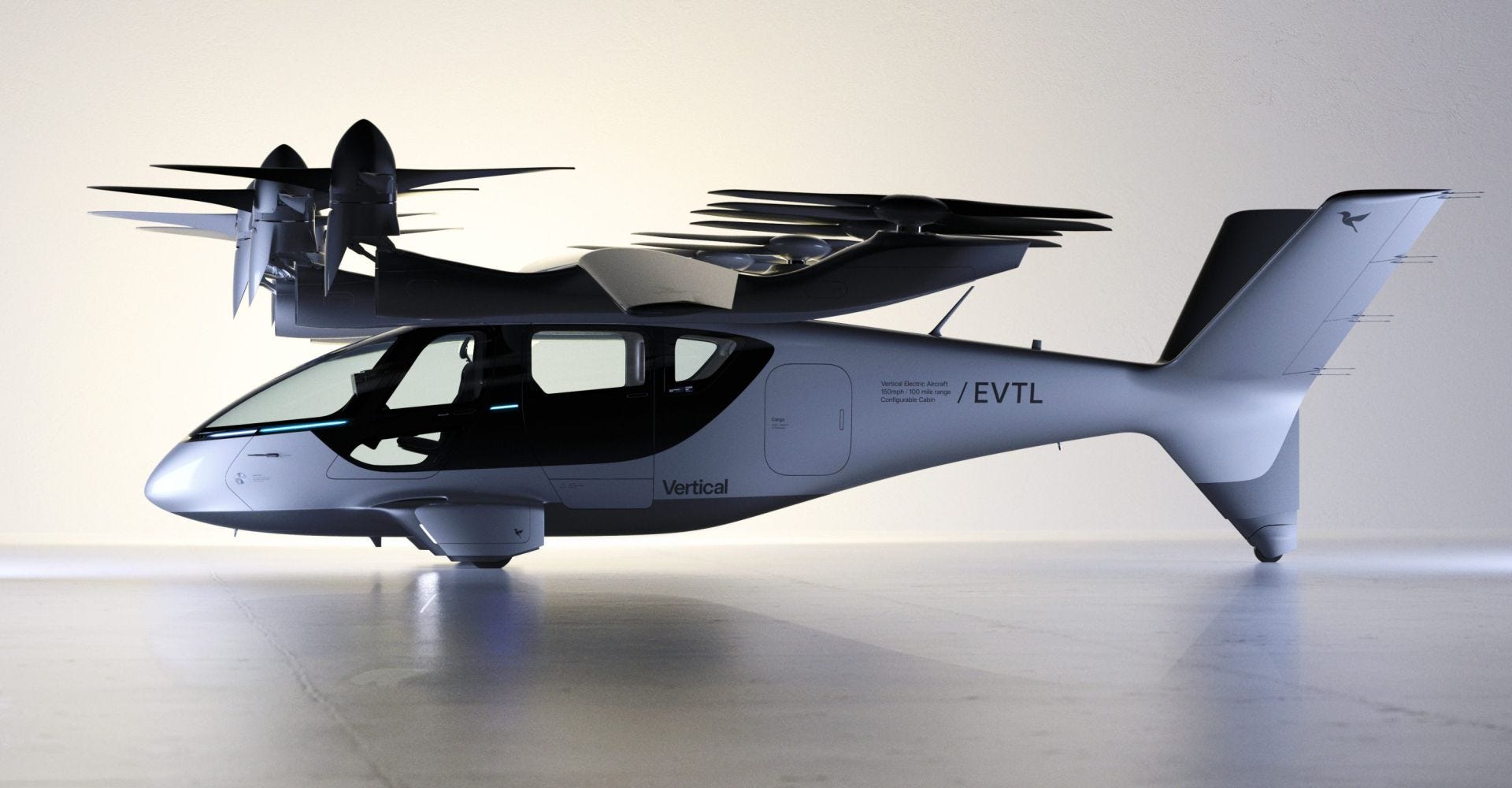
Valo represents the certification-intent version of Vertical’s VX4 prototype, incorporating multiple aerodynamic refinements developed through extensive flight testing at the company’s Kemble airfield site in southwest England.
The aircraft features significant design modifications, including a rounder, shorter nose profile compared to its predecessor, downward-curving wing tips, and notably more sculpted booms housing the electric propulsion units.
The most substantial changes appear in the empennage configuration. While retaining the V-tail architecture, Valo features a markedly lower tail assembly with an integrated tail wheel and smoother transition between the rear fuselage and tail surfaces.
These modifications enhance aerodynamic efficiency and reduce drag during cruise flight.
KEY SPECIFICATIONS

Range: Up to 100 miles
Maximum Speed: 150 mph
Operating Emissions: Zero
Noise Level: Less than 50 dBA in cruise
Cabin Configuration: 4 seats (expandable to 6)
Luggage Capacity: 6 cabin bags + 6 checked bags
Power System: Under-floor battery architecture
The aircraft’s development incorporated insights from aerospace partners, including Honeywell, Syensqo, and Aciturri.
These collaborations resulted in an upgraded propeller architecture, advanced materials selection, and redundancy systems designed to meet airliner-level safety standards.
Advanced Flight Control Systems Derived from Military Aviation
Valo incorporates what Vertical terms “unified control” technology, a flight control philosophy originally developed for military aircraft capable of vertical takeoff, specifically the Harrier and F-35 fighter jets.
Michael Cervenka, Vertical’s chief commercial and strategy officer, explained that this system allows pilots to execute consistent commands regardless of the aircraft’s position within the flight envelope.
The fly-by-wire technology processes pilot inputs through computer-controlled systems, maintaining aircraft stability during transitions between hover and forward flight. The dual sidestick controllers manage forward-backward movement and lateral positioning, while the unified control system automatically adjusts rotor and control surface configurations based on flight mode.
The aircraft features eight electric propellers, four of which are tilt-capable units.
This configuration provides enhanced maneuverability, allowing the aircraft to perform 360-degree rotations while hovering at extremely low altitudes in gusty wind conditions. This capability represents a significant advancement over conventional helicopters and other tilt-rotor designs.
Multiple redundant systems support continued flight operations if individual components fail.
The distributed propulsion architecture combined with multiple control surfaces allows the aircraft to maintain controlled flight even with the loss of a single propeller or control surface, a critical requirement for achieving the target safety certification level of 10^-9 (one catastrophic failure per billion flight hours).
Premium Cabin Configuration and Operational Flexibility
Valo’s interior design prioritizes passenger comfort and operational versatility.
The initial production configuration seats four passengers in a face-to-face arrangement, with panoramic windows providing expansive views.
A physical barrier separates the cockpit from the passenger cabin, with pilot-to-passenger communication facilitated through an integrated speaker system. This divider serves both privacy and safety functions, preventing passenger interference with flight controls.
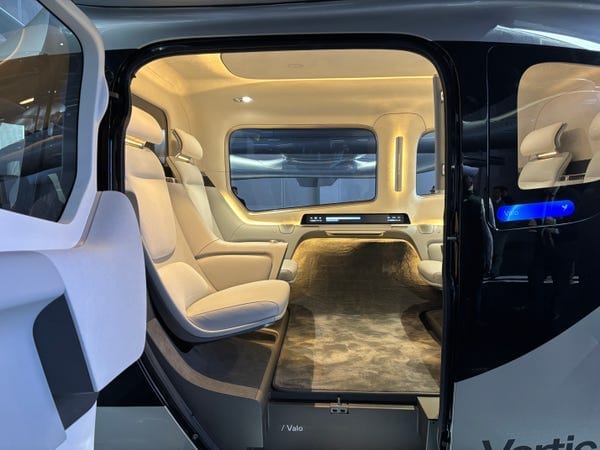
The cabin features wireless charging ports and a thin display screen showing flight information, including journey time and progress.
Vertical designed the cabin for expansion to six seats, with this higher-capacity configuration expected to be available from 2030. The flexible platform design also supports emergency medical services, cargo missions, and future variants, including hybrid powertrains and autonomous operations.
Responding directly to airline customer feedback, Valo incorporates what Vertical claims is the largest cargo hold in its class. The under-floor compartment accommodates six cabin-sized bags plus six checked bags, addressing a primary concern from potential operators about passenger luggage limitations on short-haul urban air mobility routes.
UK Network Development and Route Planning
Vertical also announced plans to establish the UK’s first electric air taxi network in partnership with Skyports Infrastructure and Bristow Group.
The proposed network will utilize existing infrastructure, including London Heliport, the Bicester Vertiport, and future vertiport locations within Skyports’ expanding UK network.
Bristow, which specializes in civilian helicopter operations, will manage aircraft operations.
INITIAL ROUTE NETWORK (Planned Operation: Early 2029)

London Hub Routes:
• Canary Wharf to Heathrow Airport: 12 minutes (vs 60+ minutes ground)
• London to Brighton
• London to Oxford
• London to Cambridge

Inter-City Connections:
• Oxford to Cambridge
• Regional links between major English cities

Service Profile:
• Dramatically reduced journey times compared to ground transport
• Zero emissions operation
• Noise levels below 50 dBA in cruise
• Premium service positioning
The network design emphasizes connections to Oxford and Cambridge, recognizing these cities’ roles in academic research and technology startup development. Transport infrastructure serving these locations is considered strategically important for supporting UK economic growth initiatives.
Vertical also announced an agreement with Héli Air Monaco, adding Mediterranean operations to the company’s commercial deployment plans. These routes would serve the French Riviera region, complementing the UK network with resort and business travel applications.
Certification Progress and Production Timeline
Vertical is pursuing concurrent certification with the UK Civil Aviation Authority and the European Union Aviation Safety Agency, targeting approval in 2028. The company will manufacture seven certification aircraft at its UK production facility to support final testing and regulatory validation processes.
The certification program builds on the VX4 flight test campaign, which has validated hover performance, thrustborne flight characteristics, and wingborne operations.
Vertical is also completing piloted transition flights, representing the critical maneuver where the aircraft transitions from vertical lift to forward flight modes.
A second VX4 prototype will join the test program shortly and will be fitted with a new hybrid powertrain for evaluation in 2026. Following completion of VX4 testing, production will shift entirely to the Valo configuration. Stuart Simpson, Vertical’s chief executive, characterized this transition as moving “from prototype developer to aerospace manufacturer.”
The UK CAA published its eVTOL delivery model in September 2025, providing the UK aviation industry with a defined pathway and timeline for commercial eVTOL operations. This regulatory framework confirms SC-VTOL as the certification basis and establishes clear requirements for initial commercial operations.
Vertical plans to produce 175 aircraft units annually by 2030, scaling to over 225 units per year as production matures.
The company is positioning itself as an original equipment manufacturer, similar to established aerospace companies, while leaving operational planning, route development, and fare structures to its airline and operator customers.
This business model contrasts with competitors who are developing integrated operations combining aircraft manufacturing with service provision.
Industry Positioning and Customer Commitments
Vertical has secured conditional purchase agreements from multiple commercial operators. American Airlines, Japan Airlines, and Bristow Group represent major customers who participated in the Valo unveiling event.
These operators provided direct input during the aircraft’s design refinement phase, particularly regarding cabin configuration, luggage capacity, and operational requirements.
Dmhnal Slattery, Vertical’s chair, stated that “Valo sets a new standard, bigger, safer and more capable than anything in the sector. It’s a breakthrough for aviation and a clear sign of the UK’s leadership in aerospace.”
The aircraft competes in a fast-developing eVTOL sector that includes manufacturers such as Joby Aviation, Beta Technologies, and Archer Aviation in the United States, along with multiple European and Asian competitors.
The 2028 certification target positions Vertical among the leading contenders for early commercial eVTOL operations.
The company’s UK manufacturing base and regulatory pathway provide a foundation for European operations, with validation processes planned for additional jurisdictions to support global deployment of the Valo platform.
Great deep dive on Vertical's production-ready design. What stands out is the unified control tech from military aviation, thats a huge differentiator versus competitors. Joby and Archer are moving fast but that fighter jet-derived control system could be key for handling transition flights more smoothly. The 2028 certification timeline puts them in a real race tho.