


Welcome to AviationOutlook: The aviation newsletter built exclusively for decision-makers.
Become an “Annual” member now & get this special discount offer.
As a paid member, you get access to:
200+ Reports - All major airlines + aerospace & defense companies (updated regularly).
Daily / Weekly - Deep-dive analysis & insights.
Monthly - Industry outlook reports.
In case you missed it, here are the latest analysis reports:
Embraer - Company Analysis and Outlook Report 2026 (Updated)
American Airlines’ Six-Route Europe Play: Yield Discipline or Widebody Overreach?
Check Out All Reports
Executive Summary
Vietnam Airlines reported its highest-ever annual revenue of more than VND 123 trillion in 2025, with consolidated after-tax profit of approximately VND 7.71 trillion, the strongest result in its history.
The carrier finalised a USD 8.1 billion order for 50 Boeing 737 MAX 8 aircraft on 18 February 2026, marking its first-ever single-aisle Boeing purchase and a strategic pivot in its narrowbody mix.
A widebody expansion plan adds up to 30 more Airbus A350-900 or 787-9 jets for delivery between 2028 and 2030, supporting the long-haul build-out from Hanoi, Ho Chi Minh City, and the new Long Thanh hub.
Network expansion in 2025 added 14 new international routes, including Copenhagen and India’s Bengaluru and Hyderabad, with Amsterdam, Phuket, and Milan launches scheduled across 2026.
Recommended - Read Full Reports


Read All Reports
Table of Contents
Executive Summary
Introduction
Vietnam Airlines Company Profile: Key Facts
Vietnam Airlines Revenue & Financial Analysis
Headline 2025 Results: A Record-Breaking Year
Q1 2026: Continuation of the Momentum
Revenue Growth Drivers
Key Services and Revenue Mix
Operational Output Behind the Numbers
Vietnam Airlines Fleet Analysis
Fleet Size and Composition
Fleet Age and Modernity
Aircraft Type Strategy and Cabin Configurations
Major New Order: 50 Boeing 737 MAX 8
Major New Order: Up to 30 Widebodies
Fleet Strategy: Three Pillars
The Pratt & Whitney GTF Headwind
Vietnam Airlines Route Network, Major Destinations & Strategy
Network Footprint Overview
International Strategy: 14 New Routes in 2025
European Network: 12 Direct Routes, 8 Cities
Northeast Asia: The Profit Engine
South Asia: India as a New Growth Frontier
United States: A 14-Hour Long-Haul
Australia and Oceania
Southeast Asia and Domestic
Major Operational Bases (Hubs)
Hub Architecture Overview
Hanoi Noi Bai (HAN)
Ho Chi Minh City Tan Son Nhat (SGN)
Long Thanh International Airport (LTH): The Game Changer
Da Nang (DAD) and Other Secondary Bases
Vietnam Airlines Competitive Position
Competitive Landscape Summary
Vietnam Airlines vs VietJet Air
Vietnam Airlines vs Bamboo Airways
Vietnam Airlines vs Pacific Airlines (Internal Competition)
Vietnam Airlines vs Sun PhuQuoc Airways
International Competition: SkyTeam Strength as a Moat
Other Strategic Considerations
Sustainability and SAF Adoption
Digital Transformation and Distribution
Cargo and the Belly-Hold Story
Codeshare Network Depth
Government Ownership and Capital Structure
Key Risks: Probability and Scenario Analysis
Risk 1
Risk 2
Risk 3
Risk 4
Risk 5
Risk 6
Risk 7
Risk 8
Risk 9
Risk 10
Strategic Outlook for 2026 to 2030
Capacity Trajectory
Long Thanh as a Re-Hubbing Catalyst
Premium Yield Defence
India and the New Asia Strategy
My Final Thoughts
Official Sources & Data
Introduction
Vietnam Airlines closed 2025 with the strongest operating year in its history, posting record revenue, record passenger volumes, and a freshly finalized order for 50 Boeing 737 MAX 8 aircraft.
The carrier is now restructuring around two existing megahubs and a new one at Long Thanh, while also pushing deeper into Europe, India, and the Pacific.
The next 12-24 months could be the most consequential period the flag carrier has faced since its post-pandemic recapitalisation.
This in-depth analysis report unpacks the fleet, the network, the hub strategy, the competitive position, and the realistic risks that follow.
Let’s analyze everything in detail.

Vietnam Airlines Company Profile: Key Facts
Vietnam Airlines Joint Stock Company is the national flag carrier of Vietnam.
Founded as a civil division of the Vietnamese Air Force in 1956, the company was formally established as a joint stock company on 27 May 1995, with subsequent restructuring placing the State as the dominant shareholder.
The airline trades on the Ho Chi Minh Stock Exchange under ticker HVN, having moved from UPCoM in May 2019. The Commission for the Management of State Capital at Enterprises and SCIC together hold the controlling government stake, with All Nippon Airways (ANA Holdings) as a long-term strategic partner.
Operationally, Vietnam Airlines is a full-service network carrier and a member of the SkyTeam global alliance, which it joined in June 2010. The carrier holds a Skytrax 4-star rating and was named among AirlineRatings’ Top 25 Safest Full-Service Airlines for 2026.
COMPANY FACTS
Legal Name        : Vietnam Airlines JSC
HQ                : 200 Nguyen Son, Long Bien, Hanoi
Founded           : 1956 (civil ops); 1995 (JSC)
Listing           : HoSE: HVN (since May 2019)
Strategic partner : ANA Holdings (Japan)
Alliance          : SkyTeam (since 2010)
Loyalty program   : Lotusmiles
Mainline fleet    : ~96 aircraft (mid-2026 baseline)
Subsidiaries      : Pacific Airlines, VASCO, VAECO, SKYPEC, NCS, VIAGS
The corporate group is broader than the mainline carrier alone.
Vietnam Airlines controls or holds significant stakes in a network of subsidiaries covering MRO (Vietnam Airlines Engineering Company, VAECO), inflight catering (NCS), ground handling (VIAGS), aviation fuel supply (SKYPEC), and two associated airlines (Pacific Airlines and VASCO).
The dual-airline group structure is critical to understanding competitive positioning. Pacific Airlines operates as a low-cost carrier under the same parent, while VASCO (Vietnam Air Services Company) handles regional turboprop service to small coastal and island airports such as Con Dao, using a fleet of ATR 72 aircraft.
For 2026, the carrier targets more than 29 million passengers, an increase of roughly 13.2% over 2025, with available seat kilometres planned to rise around 13% as the new narrowbody and widebody capacity ramps in.
Vietnam Airlines Revenue & Financial Analysis
Headline 2025 Results: A Record-Breaking Year
The 2025 financial year was the most profitable in Vietnam Airlines’ history. Consolidated revenue exceeded VND 123 trillion, equivalent to roughly USD 4.68 to 4.7 billion at end-of-year exchange rates, an increase of approximately 10% year-on-year.
Pre-tax profit for the consolidated group reached approximately VND 8,168 billion, while after-tax profit attributable to shareholders came in at over VND 7.71 trillion.
The parent company alone delivered a separate slice of the after-tax result, with VND 5.51 trillion attributable to Vietnam Airlines JSC’s parent shareholders.
2025 KEY P&L METRICS
Consolidated revenue       : ~VND 123 trillion (+10% YoY)
Pre-tax profit             : ~VND 8.17 trillion
Consolidated after-tax     : ~VND 7.71 trillion
Q4 2025 revenue            : ~VND 32.34 trillion (+12% YoY)
Q4 2025 pre-tax profit     : ~VND 540 billion
State budget contribution  : VND 3.29 trillion (+5% YoY)
The fourth quarter was particularly strong, with consolidated revenue of VND 32.34 trillion, up 12% year-on-year, and a Q4 pre-tax profit close to VND 540 billion.
Q1 2026: Continuation of the Momentum
The first quarter of 2026 confirmed that the 2025 turnaround was not a one-off. Consolidated revenue reached over VND 37,500 billion, with after-tax profit hitting VND 4,514 billion in the quarter alone.
That implies first-quarter operating leverage rolling through the income statement at an exceptional pace. Pre-tax profit of more than VND 4.5 trillion (USD 171 million) marks roughly 30% growth over the prior-year quarter.
Revenue Growth Drivers
Three structural factors are driving the revenue line.
The first is the international rebound. Vietnam Airlines added 14 new international routes during 2025, and international RPK growth materially outpaced domestic.
The second driver is yield improvement. Higher long-haul mix, a stronger SkyTeam connecting flow, and a tighter capacity environment in Vietnam (with several aircraft grounded across the industry due to engine issues) supported better unit revenue.
The third lever is fuel costs. The average Jet A1 price in 2025 came in below the elevated levels of 2022 to 2024, which the management team explicitly cited alongside international expansion as the two main margin drivers.
Key Services and Revenue Mix
Passenger transport remains the dominant revenue line, but the company also generates meaningful contribution from cargo, MRO services through VAECO, ground handling via VIAGS, in-flight catering via NCS, and aviation fuel supply through SKYPEC.
Subsidiaries are mostly profitable. The official annual report disclosure for 2025 covers operating subsidiaries with separate revenue and ROE figures, including VAECO and other group entities, each contributing diversification away from pure passenger ticket cyclicality.
Operational Output Behind the Numbers
The 2025 production base was substantial.
Vietnam Airlines operated 156.3 thousand flights, carrying 25.6 million passengers and over 340 thousand tons of cargo across its network, mainline plus the airline group’s subsidiary carriers.
Vietnam’s overall aviation sector hit a record 83.5 million passengers in 2025, up 10.7% year-on-year, with the Civil Aviation Authority of Vietnam projecting 2026 traffic of around 95 million.
Vietnam Airlines’ own 25.6 million carried implies a meaningful but no longer dominant share of the domestic plus international passenger pie when Vietjet and other operators are layered in.
2025 OPERATING METRICS (group-level)
Flights operated           : ~156,300
Passengers carried         : ~25.6 million
Cargo carried              : ~340,000 tons
2026 passenger target      : 29+ million
2026 ASK growth target : ~13%Vietnam Airlines Fleet Analysis
Fleet Size and Composition
Vietnam Airlines’ mainline fleet sits at 96 active aircraft, excluding the smaller turboprop fleet operated under the VASCO brand and the LCC fleet of Pacific Airlines.
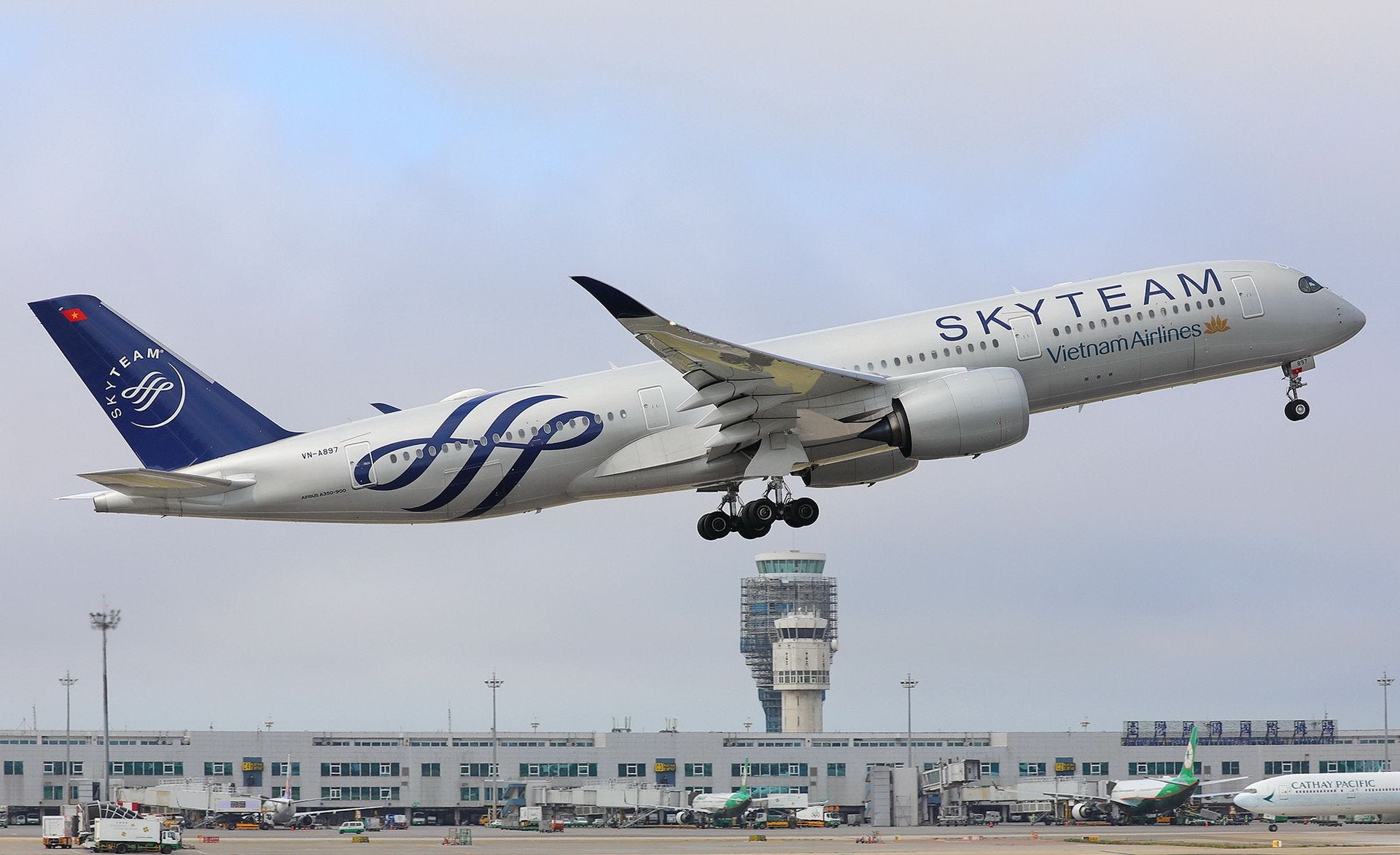
The mainline composition is built on four core types. The Airbus A321 family forms the narrowbody backbone, the Airbus A350-900 and Boeing 787-9 / 787-10 carry the widebody routes, and a small fleet of A320NEOs supplements regional capacity.


MAINLINE FLEET BY TYPE (active, mid-2026 baseline)
Airbus A321ceo            : ~51 aircraft
Airbus A321neo            : ~20 aircraft (incl. wet-leased)
Airbus A320               : ~3 aircraft
Airbus A350-900           : ~13 aircraft
Boeing 787-9 / 787-10     : ~17 aircraft
Total mainline            : ~96 aircraft
VASCO (ATR 72) : ~6 aircraftFleet Age and Modernity
The active mainline fleet is relatively young by Asian flag-carrier standards. According to Airfleets data, the average age of the A350-900 fleet is around 8.9 years, the 787 widebody fleet is around 8.2 years, and the A321 family averages around 11.9 years.
The youngest segment is the A320NEO sub-fleet, which has come into service most recently.
The widebody average in single-digit-year territory is a meaningful operational and financial advantage compared with several legacy carriers in the region.
Aircraft Type Strategy and Cabin Configurations
The Airbus A321 family is the workhorse for domestic trunks (Hanoi to Ho Chi Minh City, the so-called HAN-SGN shuttle, plus Da Nang, Phu Quoc, and the regional grid) and for short-haul international routes within Southeast Asia and into Southern China.
The A321neo’s role is to gradually replace older ceo airframes while extending range to medium-haul Asia. The A321 cabin is typically configured in a two-class layout, with Business and Economy zones and a narrowbody flat-out arrangement on selected aircraft.
For wide-body operations, the carrier deploys the Airbus A350-900 and Boeing 787-9 on its long-haul routes to Europe, Oceania, and the United States, while a small Boeing 787-10 sub-fleet provides extra-high-density widebody capacity on dense routes such as HAN-SGN and HAN-NRT.
The widebody product is built around three cabin classes on the A350 and most 787-9 frames, with Business, Premium Economy, and Economy. The 787-10s typically run a denser two-class layout focused on point-to-point capacity.
Major New Order: 50 Boeing 737 MAX 8
The single largest fleet decision of the past 18 months is the finalised order for 50 Boeing 737-8 aircraft, confirmed on 18 February 2026 with a list-price value of approximately USD 8.1 billion.
This is a strategic shift on multiple levels. It marks Vietnam Airlines’ first-ever single-aisle order from Boeing, ending a long-running narrowbody monopoly held by Airbus. It is also the first major Boeing narrowbody win against Airbus inside the Vietnamese flag carrier’s home turf.
The carrier has also signalled it will need up to 100 narrowbodies by 2035 to expand operations and replace existing aircraft. The 50 firm 737-8 frames represent half of that long-range narrowbody requirement, with the remainder still to be sourced.
BOEING 737 MAX 8 ORDER QUICK FACTS
Operator           : Vietnam Airlines JSC
Aircraft type      : Boeing 737-8
Quantity           : 50 firm
Order value        : ~USD 8.1 billion at 2025 list prices
Original MoU       : 2023 (signed during US-Vietnam state visit)
Final agreement    : 18 February 2026
Strategic role     : Modern narrowbody renewal + capacity for 2x air traffic by 2035
Major New Order: Up to 30 Widebodies
In parallel with the narrowbody decision, Vietnam Airlines disclosed in late 2025 that it would add up to 30 more wide-body jets, choosing between the Airbus A350-900 and the Boeing 787-9, with deliveries scheduled between 2028 and 2030.
This commitment runs alongside the carrier’s broader USD 10 billion long-term plan to add 30 widebodies by 2032, financed through a combination of purchase and leasing structures.
Fleet Strategy: Three Pillars
The first pillar is narrowbody renewal at scale.
The Boeing 737-8 is intended both to replace ageing A321ceo airframes and to supply growth capacity for new short and medium-haul international routes, particularly into Northeast Asia and India.
The second pillar is widebody expansion.
The 30 incremental long-haul aircraft are explicitly tied to Long Thanh’s commercial debut and to deeper coverage of Europe and Oceania.
The third pillar is fleet rationalisation around two OEMs.
By embracing both Airbus and Boeing on the narrowbody side (rather than remaining single-OEM), Vietnam Airlines acquires negotiating leverage and supply-chain resilience, at the cost of additional pilot-rating and maintenance complexity that VAECO will need to absorb.
The Pratt & Whitney GTF Headwind
Fleet strategy is also shaped by an external headwind. Pratt & Whitney’s PW1100G engine inspections forced the grounding of around 12 of 20 A321neos at one point in the past two years, with the carrier publicly disclosing the scope of the disruption.

By mid-December 2025, 13.1% of Vietnam’s national fleet was reported grounded due to the same engine supply-chain crisis, with Vietnam Airlines accounting for a meaningful share of the affected airframes.
The good news is that the engine situation is easing as PW supplies more spares and the inspection backlog clears. The Boeing 737-8 order, which uses CFM LEAP-1B engines, also reduces single-supplier engine risk going forward.