


Welcome to AviationOutlook: The aviation newsletter built exclusively for decision-makers.
Become an “Annual” member now & get this special discount offer.
As a paid member, you get access to:
200+ Reports - All major airlines + aerospace & defense companies (updated regularly).
Daily / Weekly - Deep-dive analysis & insights.
Monthly - Industry outlook reports.
In case you missed it, here are the latest analysis reports:
Embraer - Company Analysis and Outlook Report 2026 (Updated)
American Airlines’ Six-Route Europe Play: Yield Discipline or Widebody Overreach?
Check Out All Reports
Executive Summary
American Airlines crossed the 1,022 mainline aircraft mark as of March 31, 2026, and expects 49 new aircraft deliveries in 2026, down from an initial estimate of 55, trimming capital expenditure by nearly $300 million to roughly $4 billion for the year.
The carrier has 84 Airbus A321neos and five A321XLRs in service, with 120 additional A321neos and 35 more A321XLRs on order through 2032, alongside 93 Boeing 737 MAX aircraft in operation and 125 on order.
The 30-aircraft premium Boeing 787-9 order featuring the new Flagship Suite is entering peak delivery cadence, driving a projected more than 50% increase in lie-flat seats across international aircraft by decade’s end.
A June 2026 Request for Proposals was formally issued to Boeing and Airbus to replace the 47-strong 777-200ER fleet, positioning the Fort Worth carrier for a widebody selection decision that will shape the network for the next two decades.
Recommended Reports


Read All Reports
Table of Contents
Executive Summary
Introduction
The Fleet Composition at Mid-Year 2026
The A321XLR Rollout: American’s Single-Aisle Revolution
The Boeing 787-9 Premium Reset
The Widebody RFP: A Two-Decade Fleet Decision in Play
The 737 MAX Program Status
The A321neo and A320 Family Backbone
The 777 Fleet Retrofit Program
The Regional Fleet Overhaul
The 2026 Delivery Guidance and Capital Plan
Network Deployment of the New Fleet in H2 2026
Operational Reliability and Fleet Utilization
The Financial Envelope Around the Fleet Plan
The Centennial Year Context
The Competitive Fleet Positioning
The Sustainability Dimension
The Risks and Watchpoints for H2 2026
Beyond 2026: The 2027-2032 Outlook
My Final Thoughts
Introduction
American Airlines recently turned 100.
Behind the centennial livery on a lone Boeing 737 and the celebratory pajamas in Flagship Suite lies a far more consequential story: the largest, most complex fleet transition in the airline’s history is now visibly underway.
The Fort Worth carrier flew into the second half of 2026 with a fleet that is simultaneously the youngest among the U.S. legacy carriers and the largest by aircraft count.
Every widebody in the fleet is a Boeing, every narrowbody engine is a CFM LEAP or CFM56 variant, and every next-generation seat is being engineered around a single product philosophy called Flagship Suite.
The second half of this year is where the strategy stops being theoretical.
Fifteen A321XLRs are expected in the fleet by year-end 2026, retrofits on the A319, A320 and 777-300ER cabins are actively rolling out, and the widebody RFP that CEO Robert Isom confirmed at the June 10 shareholders’ meeting has narrowed the field to a straight Boeing 787 versus Airbus A350 contest.
This is the fleet plan that will define American’s competitive posture into the mid-2030s.
Let’s analyze everything in detail.

The Fleet Composition at Mid-Year 2026
American Airlines finished Q1 2026 operating 1,022 mainline aircraft, excluding three A321XLR aircraft that remained in temporary storage as of March 31.
That total sits on top of a regional network operated by wholly-owned subsidiaries Envoy Air, PSA Airlines and Piedmont Airlines, plus capacity-purchase carriers, bringing the total aircraft count under the American Airlines brand to 1,594.
To understand the scale, consider that American operated roughly 6,000 daily flights to more than 350 destinations in over 60 countries during 2025 and continues to do so through 2026.
The Composition Breakdown
American Airlines Group – Fleet Composition Snapshot (as of March 31, 2026)

Mainline aircraft (in service, excluding stored)     1,022
Aircraft in temporary storage (mainline A321XLR)         3
Regional fleet (owned/leased and CPA operators)        572
Regional aircraft in temporary storage (CRJ900)          2
Total Group operating fleet                          1,594
The composition confirms two structural realities the carrier has emphasized. First, American operates a broadly two-vendor mainline fleet split between Airbus A320-family narrowbodies and Boeing 737 MAX narrowbodies. Second, its widebody fleet is single-vendor: 100% Boeing.
That single-vendor widebody status is precisely what the current RFP is designed to reassess.
Fleet Age Positioning
American has repeatedly stated in official communications that it has “the youngest fleet of the legacy U.S. carriers.”
That claim is anchored primarily on three data points: the pace of 737 MAX and A321neo intake since 2019, the retirement of the entire Embraer E190 and Boeing 767 fleets in 2020, and the ongoing phase-down of remaining legacy Boeing 757 airframes.
The fleet age story is not uniformly young, however. The Boeing 777-200ER sub-fleet is approaching 25 years of age on average, which is the direct impetus for the current widebody RFP.
The Airbus A319 and A320 fleets, inherited from the US Airways merger, are also getting long in the tooth, though their extensive interior retrofit programs announced in June 2026 suggest these airframes remain part of the plan through at least the late 2020s.
The A321XLR Rollout: American’s Single-Aisle Revolution
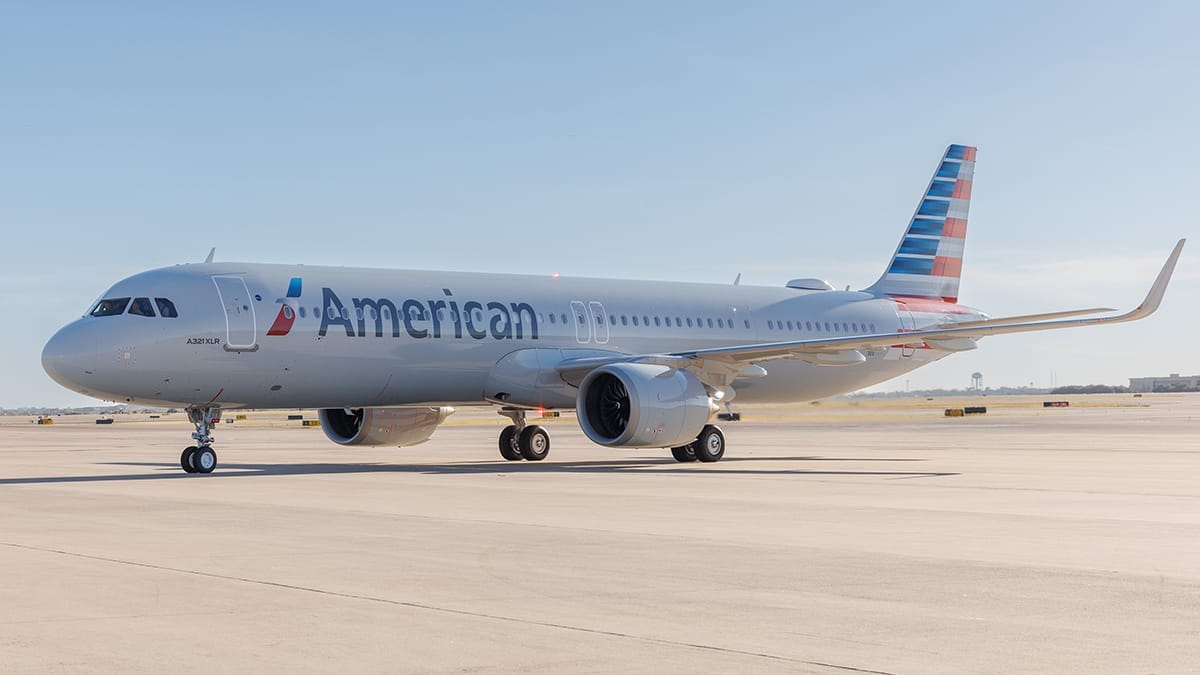
The Airbus A321XLR is the single most operationally consequential aircraft entering American’s fleet in 2026. It’s a range and product hybrid that transforms which markets are commercially viable from American’s hubs.
American became the first U.S.-based airline to operate the type when its inaugural revenue flight from JFK to LAX departed at 11 a.m. Eastern on December 18, 2025.
The Configuration Choice
The airline’s XLRs are configured with 155 seats in three classes, a deliberately premium-heavy layout: 20 Flagship Suite lie-flat seats, 12 Premium Economy seats, and 123 reimagined Main Cabin seats.
For context, that’s a lower seat count than most competitors’ A321neo configurations, reflecting American’s decision to bet that transatlantic and long transcontinental yields will support the premium-heavy math.
American Airlines A321XLR – Cabin Configuration

Flagship Suite (lie-flat, direct aisle access, doors)    20 seats
Premium Economy (winged headrest, wireless charging)     12 seats
Main Cabin (reimagined, seatback IFE, Bluetooth)        123 seats
Total                                                   155 seats
Every seat features high-speed satellite Wi-Fi and complimentary seatback entertainment with Bluetooth connectivity, consistent with the aircraft’s positioning as a premium narrowbody rather than a workhorse mainline replacement.