


Executive Summary
Austrian Airlines closed its financial year 2025 with revenue of €2.541 billion and an adjusted EBIT of €81 million, translating to a 3.2% margin that the carrier itself describes as approximately 50% below the European peer average.
The Vienna-based flag carrier transported around 15 million passengers during 2025, posted a 99.3% on-time departure rate, and was named the third most punctual carrier in Europe for the calendar year.
The airline is executing the most comprehensive fleet rollover in its history, with twelve Boeing 787-9 Dreamliners replacing the Boeing 767 and 777 fleets by 2028 and a complete Embraer 195 phase-out paired with 17 Airbus A320neo family deliveries.
The summer 2026 schedule introduces seven new short and medium-haul destinations, 113 short and medium-haul plus 20 long-haul destinations, capitalising on the simultaneous retreat of Wizz Air and Ryanair from the Vienna market.
Recommended - Read Full Reports


Read All Reports
Table of Contents
Executive Summary
Introduction
Austrian Airlines Company Profile: Key Facts
Austrian Airlines Revenue and Financial Analysis
Headline Numbers for Financial Year 2025
Revenue Composition and Drivers
Q1 2026 Performance and Trajectory
Position Within the Lufthansa Group Financial Framework
Cost Pressures and the Aviation Tax Issue
Austrian Airlines Fleet Analysis
Current Fleet Composition
Long-Haul Fleet Strategy: The Dreamliner Transition
Short and Medium-Haul Fleet Harmonisation
Fleet Age and Operational Implications
Cabin Configuration Strategy
Austrian Airlines Route Network Strategy
Network Footprint Overview
Seven New Destinations for Summer 2026
Capacity Reinforcement on Mediterranean Trunk Routes
Long-Haul Network Composition
Coolcation Strategy and Northern Europe Push
Eastern European Specialisation
Major Operational Bases (Hubs)
Vienna International Airport: The Single Hub
Hub Banking and Connectivity
Vienna Hub Investment and Lounge Programme
AIRail Train-Flight Integration
Austrian Airlines Competitive Position
Major Competitors
Austrian Airlines vs Ryanair / Lauda
Austrian Airlines vs Wizz Air
Austrian Airlines vs Eurowings
Austrian Airlines vs SWISS
Austrian Airlines vs Turkish Airlines
Austrian Airlines vs Middle Eastern Carriers
Austrian Airlines Strategy and Customer Experience
Strategic Priorities Under CEO Annette Mann
Service Quality and Awards
Sustainability Strategy
Cabin Product Roadmap
Cargo Operations and Auxiliary Revenue
Lufthansa Cargo Integration
Vienna’s Double Hub Cargo Strategy
Lufthansa Group Synergies and Restructuring Context
Group Restructuring Programme
Shared Functions and Procurement
Star Alliance Membership Value
Key Risks
Risk 1
Risk 2
Risk 3
Risk 4
Risk 5
Risk 6
Risk 7
Risk 8
Industry Outlook for 2026 and Beyond
Demand Trajectory
Capacity Outlook
Hub Position
My Final Thoughts
Official Sources & Data
Introduction
The story of Austrian Airlines in mid-2026 is not the story of an old flag carrier coasting on its national emblem.
It is, in plain terms, the story of a structurally constrained network airline trying to engineer a generational fleet transformation while its home airport simultaneously sheds low-cost capacity and absorbs a punitive tax regime.
For airline industry stakeholders watching the Vienna hub, the carrier represents a rare case study of a small but highly profitable Lufthansa Group subsidiary defending hub feed in a market where Wizz Air has fully exited and Ryanair has cut aircraft.
The 2026 season is therefore a live experiment in capacity recapture.
The numbers behind that experiment, paired with the airline’s own admission that its margin sits roughly half of the European average, make Austrian Airlines one of the most consequential operational stories within the wider Lufthansa Group restructuring agenda.
QUICK READ: WHY 2026 IS A PIVOT YEAR
- Third Boeing 787-9 entering scheduled service on 1 June 2026
- Embraer 195 fleet exiting; first A320neos under harmonisation programme arriving
- Wizz Air closed Vienna base on 15 March 2026
- Austrian Airlines adding 800+ extra European rotations to capture freed slots
Austrian Airlines Company Profile: Key Facts
Austrian Airlines AG, branded internationally as Austrian or AUA, is the national flag carrier of the Republic of Austria, with corporate headquarters at Vienna International Airport.
The company sits inside the Passenger Airlines segment of the Lufthansa Group, alongside Lufthansa Airlines, SWISS, Brussels Airlines and Eurowings.
The carrier was founded on 30 September 1957 through the merger of Air Austria and Austrian Airways. The first scheduled commercial flight, between Vienna and London, took place in early 1958, anchoring a network that today stretches from the Atlantic islands to East Asia.
Austrian Airlines is a member of Star Alliance, the world’s first global airline alliance, joined in 2000, granting customers reciprocal benefits across more than two dozen partner carriers.
The company is also fully integrated into Lufthansa Group’s joint corporate functions, distribution platforms and frequent flyer programme Miles & More.
KEY FACTS (2026)
- Founded: 30 September 1957
- Headquarters: Vienna, Austria (Office Park 2)
- IATA / ICAO codes: OS / AUA
- Parent company: Deutsche Lufthansa AG (Lufthansa Group)
- Alliance: Star Alliance (since 26 March 2000)
- CEO: Annette Mann
- COO: Stefan-Kenan Scheib
- Employees: 6,054 (as of 31 December 2025)
- Passengers carried 2025: ~15 million
- Total revenue 2025: €2.541 billion
- Adjusted EBIT 2025: €81 million (3.2% margin)
- Fleet (early 2026): ~68 aircraft (11 long-haul + 57 short/medium-haul)
- Daily departures: ~320 average
- On-time performance 2025: 99.3% departures on schedule
- Awards: Skytrax Best Airline Staff Service in Europe 2025
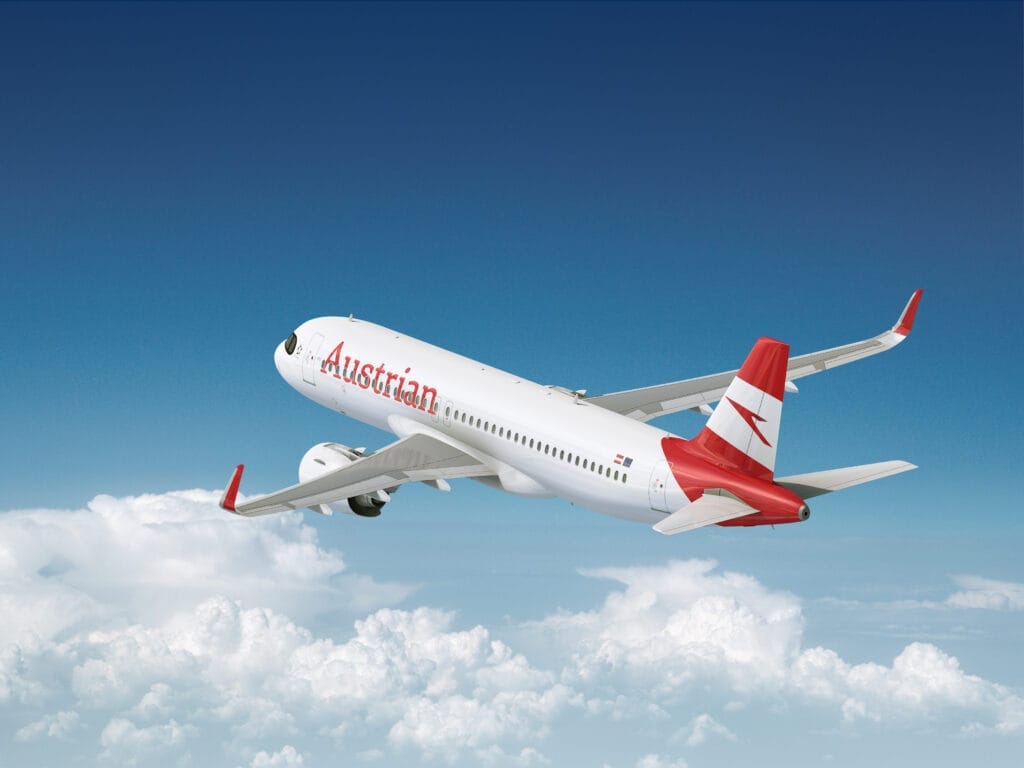
The carrier’s identity and brand are anchored in the red-white-red livery and the chevron tail fin, which together project a clear association with the Austrian national flag. The current uniform design has been in use for roughly three decades, with a new uniform reveal planned for 2027 to coincide with the company’s 70th anniversary.
Austrian Airlines plays an outsized role in the local economy.
It is the largest single employer in Eastern Austria, supports the inbound tourism industry, and operates the AIRail train-flight cooperation that links Linz, Salzburg and Graz directly into Vienna’s hub feed using ÖBB Railjet trains.
Austrian Airlines Revenue and Financial Analysis
Headline Numbers for Financial Year 2025
The audited 2025 full-year results, published by Austrian Airlines on 6 March 2026, revealed a year of disciplined growth in a competitive European market. Total revenue rose from €2.457 billion in 2024 to €2.541 billion in 2025, an increase of approximately 3% year over year.
Adjusted EBIT for 2025 was €81 million, compared with €76 million the previous year, representing a 7% improvement year-on-year. The adjusted EBIT margin of 3.2% remains well below the European industry average of approximately 6.8% projected by IATA for 2025.
CEO Annette Mann openly addressed this profitability gap in the annual results, characterising the spread as roughly 50% below the average for European airlines and pointing directly to location costs and aviation taxation as the primary drag on competitiveness.
FY 2025 FINANCIAL HIGHLIGHTS
- Total revenue: €2.541 billion (+3% YoY)
- Adjusted EBIT: €81 million (+7% YoY)
- Adjusted EBIT margin: 3.2%
- Available seat kilometres (ASK): 28.614 billion (+4% YoY)
- Load factor: 81.6% (+0.3 percentage points)
- Employees: 6,054 (-1% YoY)
- Punctuality: 99.3% on-time departures
- Passengers: ~15 millionRevenue Composition and Drivers
Austrian Airlines does not publish granular passenger revenue per region in its public release, but the underlying drivers are well understood within the Lufthansa Group framework. Traffic revenue, which represents fares and ancillaries from passenger flights, accounts for the overwhelming majority of total revenue at the carrier level.
Cargo revenues are recognised through Lufthansa Cargo, which fully markets Austrian Airlines belly capacity and integrates it into the Lufthansa Cargo network. This means cargo upside on Austrian aircraft flows through the Lufthansa Group Logistics segment rather than appearing directly in Austrian’s airline statement.
Ancillary revenue at Austrian has increasingly mirrored the Lufthansa Group’s three-tier short-haul fare model: Economy Light, Economy Classic and Economy Flex, with paid baggage, paid seat selection and paid catering on most short-haul flights.
Premium Economy on long-haul aircraft represents a meaningful yield uplift over standard Economy.
Q1 2026 Performance and Trajectory
The first quarter of 2026, traditionally the weakest period for European network airlines, was even more challenging than usual for the carrier. Austrian Airlines reported a Q1 2026 adjusted EBIT loss of €112 million, compared with a €111 million loss in Q1 2025.
Revenue in Q1 2026 rose roughly 5% year-on-year, but operating costs climbed 3.1% as a result of geopolitical disruption, persistent Middle East airspace restrictions and weather-driven irregular operations at the Vienna hub. The cancellation of Middle East connections has materially increased unit costs, according to CEO Annette Mann.
Despite the seasonal Q1 loss, management framed the period as broadly in line with expectations and reiterated the goal of significantly improving full-year financial results in 2026. The airline expects strong European leisure demand to drive Q2 and Q3 momentum.
Q1 2026 SNAPSHOT
- Revenue: ~€485 million (+5% YoY)
- Operating costs: €607 million (+3.1% YoY)
- Adjusted EBIT loss: €112 million (vs -€111m in Q1 2025)
- Capacity: Slightly higher ASK YoY
- Drivers: Middle East cancellations, Vienna weather disruptions, fleet transition costsPosition Within the Lufthansa Group Financial Framework
Within the Passenger Airlines segment of the Lufthansa Group in 2025, total segment revenue reached €30.576 billion, with adjusted EBIT of €1.087 billion and a segment margin of 3.6%. Austrian Airlines contributed roughly 8% of segment revenue and a meaningful share of operating profit at the airline-only level.
The Lufthansa Group as a whole reported record revenue of €39.6 billion in 2025, up 5% year-on-year, with the highest top line in company history. Austrian Airlines is consistently profitable on an annual basis, but the margin gap relative to SWISS in particular remains a key strategic issue.
Capital expenditure across the Passenger Airlines segment surged 24% in 2025 to €4.047 billion, reflecting the accelerated fleet renewal cycle that includes Austrian’s Boeing 787-9 deliveries and the long-delayed broader long-haul replacement programme.
Cost Pressures and the Aviation Tax Issue
Austrian Airlines management has been unusually vocal about the role of Austrian regulatory costs in suppressing local profitability. The reinstatement of the Austrian aviation tax has been cited by the carrier and by competitors such as Ryanair as a structural drag on Vienna’s competitiveness.
Personnel costs represent another significant line item, particularly after the collective bargaining agreement reached with cabin crew and pilots that grants an average 19.4% salary increase across approximately 2,400 flight attendants and around 1,000 pilots, phased in over three stages.
Fuel costs, jet fuel hedging and currency volatility remain managed centrally through Lufthansa Group treasury, providing Austrian with a smoother input cost profile than smaller standalone European carriers would experience.
Austrian Airlines Fleet Analysis
Current Fleet Composition
As of 31 March 2026, the Austrian Airlines mainline fleet comprises 68 aircraft split across two distinct operational tiers: a long-haul widebody fleet of 11 to 12 aircraft and a short and medium-haul narrowbody fleet of approximately 57 aircraft. The official fleet listing on Lufthansa Group is the authoritative source.
The long-haul fleet currently consists of two Boeing 787-9 Dreamliners, six Boeing 777-200ERs and three Boeing 767-300ERs.
The short and medium-haul fleet includes six Airbus A321ceo aircraft, 29 Airbus A320ceo aircraft, five Airbus A320neo aircraft and a residual Embraer 195 fleet that is being retired.


AUSTRIAN AIRLINES FLEET TABLE (Q1 2026)
Long-haul (widebody):
- Boeing 787-9 Dreamliner: 2 (294 seats: 26C/21W/247Y)
- Boeing 777-200ER: 6 (308 seats: 48C/260Y)
- Boeing 767-300ER: 3 (214 seats: 36C/178Y)

Short/medium-haul (narrowbody):
- Airbus A321-100/200: 6 (200 seats single class)
- Airbus A320-200: 29 (168 seats)
- Airbus A320neo: 5 (180 seats)
- Embraer 195: residual (being phased out)

Total mainline aircraft: ~68Long-Haul Fleet Strategy: The Dreamliner Transition
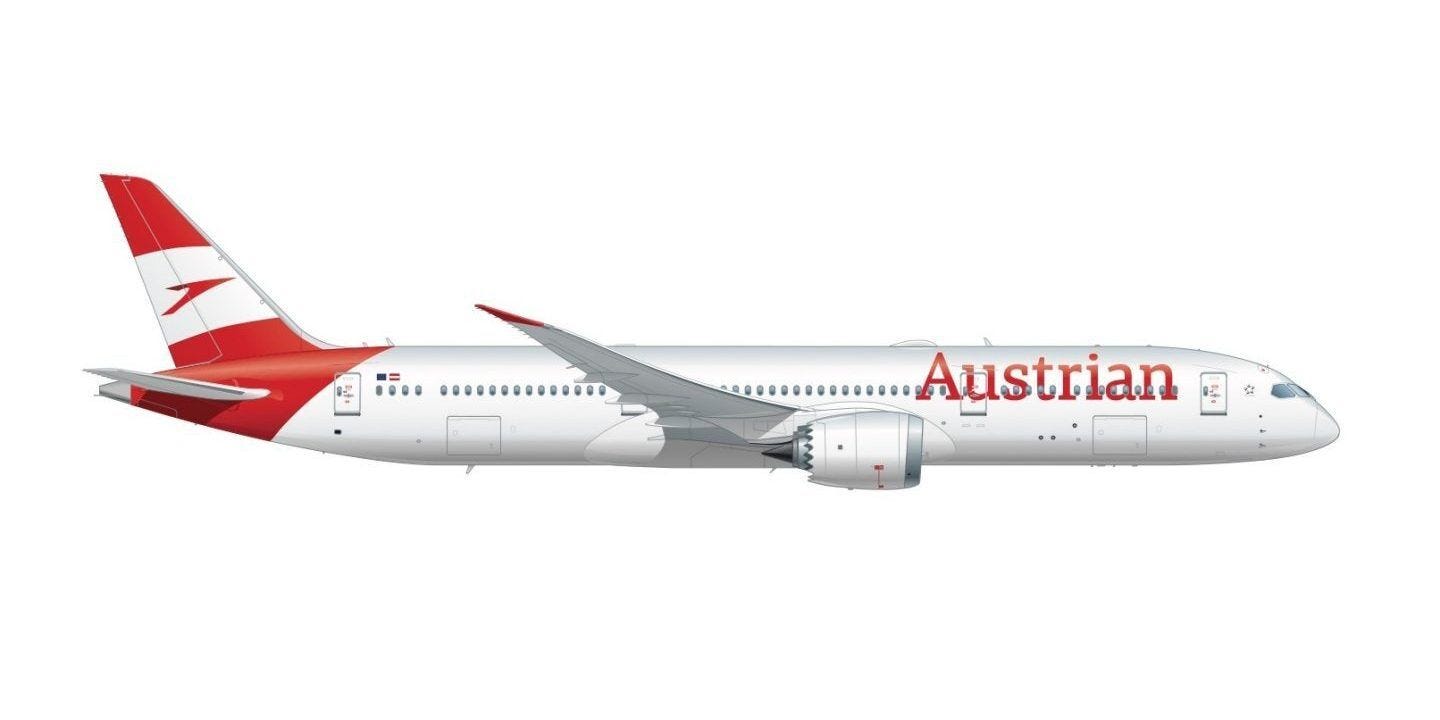
The transformation of the long-haul fleet is the centrepiece of Austrian Airlines’ capital programme. The carrier announced a long-haul renewal plan that replaces the entire Boeing 767 and Boeing 777 fleet with Boeing 787-9 Dreamliners by the end of 2028.
The first Dreamliner entered scheduled Austrian Airlines service in 2024, the second followed in summer 2024, and the third aircraft is scheduled to enter scheduled service on 1 June 2026 initially on the route from Vienna to New York Newark. The long-haul fleet is targeted to grow from 11 to 12 aircraft.
A total of three Boeing 787-9 deliveries are planned during 2026, with last aircraft scheduled for delivery in Q1 2027. By 2028, ten more Dreamliners will be added to the current two in service, bringing the total to twelve aircraft of this type.
The Austrian 787-9 cabin is configured for 294 seats with a clear three-class layout: 26 Business Class lie-flat seats, 21 Premium Economy seats and 247 Economy seats. The 87 seat Premium Economy gain compared with the legacy 777 layout meaningfully improves yield mix on transatlantic and Asian markets.
LONG-HAUL TRANSITION TIMELINE
- 2024: First two Boeing 787-9s entered service
- Q4 2025: Delivery slot for next 787-9 begins
- 1 June 2026: Third 787-9 enters scheduled service (Vienna - Newark)
- 2026: Three more 787-9 deliveries planned during the year
- 2026 onwards: Boeing 767 fleet reduction
- Q1 2027: Final 2026-batch 787-9 delivered
- By 2028: All Boeing 767s and 777s retired; 12 Dreamliners totalThe aircraft offers approximately 20% better fuel efficiency than the 767-300ER it replaces and unlocks new long-haul routes that were previously economically marginal under widebody operations. The 787-9 carries 294 passengers and offers a range of 14,010 kilometres at maximum takeoff weight.
Aviation Week reported that Austrian Airlines management has floated the possibility of expanding the long-haul fleet beyond the 12 Boeing 787-9s already confirmed, although no firm additional commitments have been made public.
Short and Medium-Haul Fleet Harmonisation
The narrowbody fleet is undergoing an equally significant transformation, although it is less visible to the travelling public.
The strategic objective is full harmonisation of the short and medium-haul fleet around the Airbus A320 family, eliminating the operational complexity associated with the Embraer 195 and reducing the spread of types within the A320 family itself.
Austrian Airlines plans to add 22 LEAP-powered A320neos, with the Lufthansa Group having approved the acquisition of 11 A320neo and six A321neo aircraft. Six new A320neo aircraft are expected to begin entering the fleet from summer 2026.
The Embraer 195 fleet is being phased out and partially redeployed to Air Dolomiti, the Lufthansa Group regional subsidiary based in Verona. Two Embraer aircraft had already left the Austrian Airlines fleet by the time of the 2025 annual results announcement.
SHORT/MEDIUM-HAUL FLEET RENEWAL PLAN
- Embraer 195: Full phase-out (transferred to Air Dolomiti where applicable)
- Airbus A321neo orders: 6 (Lufthansa Group approved)
- Airbus A320neo orders: 11 (Lufthansa Group approved)
- Total A320neo family additions: ~17 aircraft
- First six A320neos: From summer 2026
- Existing A320ceo fleet: Repaint programme contracted with Airbourne Colours
The fleet repainting programme awarded to Airbourne Colours for the existing A320 fleet signals a long-term commitment to retaining current generation aircraft alongside neo additions, smoothing the capital outlay over time.
Fleet Age and Operational Implications
The Austrian Airlines fleet today is one of the older within the Lufthansa Group passenger airlines, especially in the widebody segment where the Boeing 767-300ER fleet has been in service for decades. The Boeing 777-200ER fleet, while younger, is also approaching end of economic life relative to the Dreamliner.
Average fleet age across the carrier is expected to drop materially over the 2026 to 2028 window as new 787-9s and A320neos enter service in parallel. This will reduce maintenance burden, improve dispatch reliability and lower fuel burn per available seat kilometre.
The increased fuel efficiency, lower noise emissions and modern cabins of the new aircraft also align with Austrian Airlines’ stated commitment to halving net CO2 emissions by 2030 and operating CO2-neutral by 2050.
Cabin Configuration Strategy
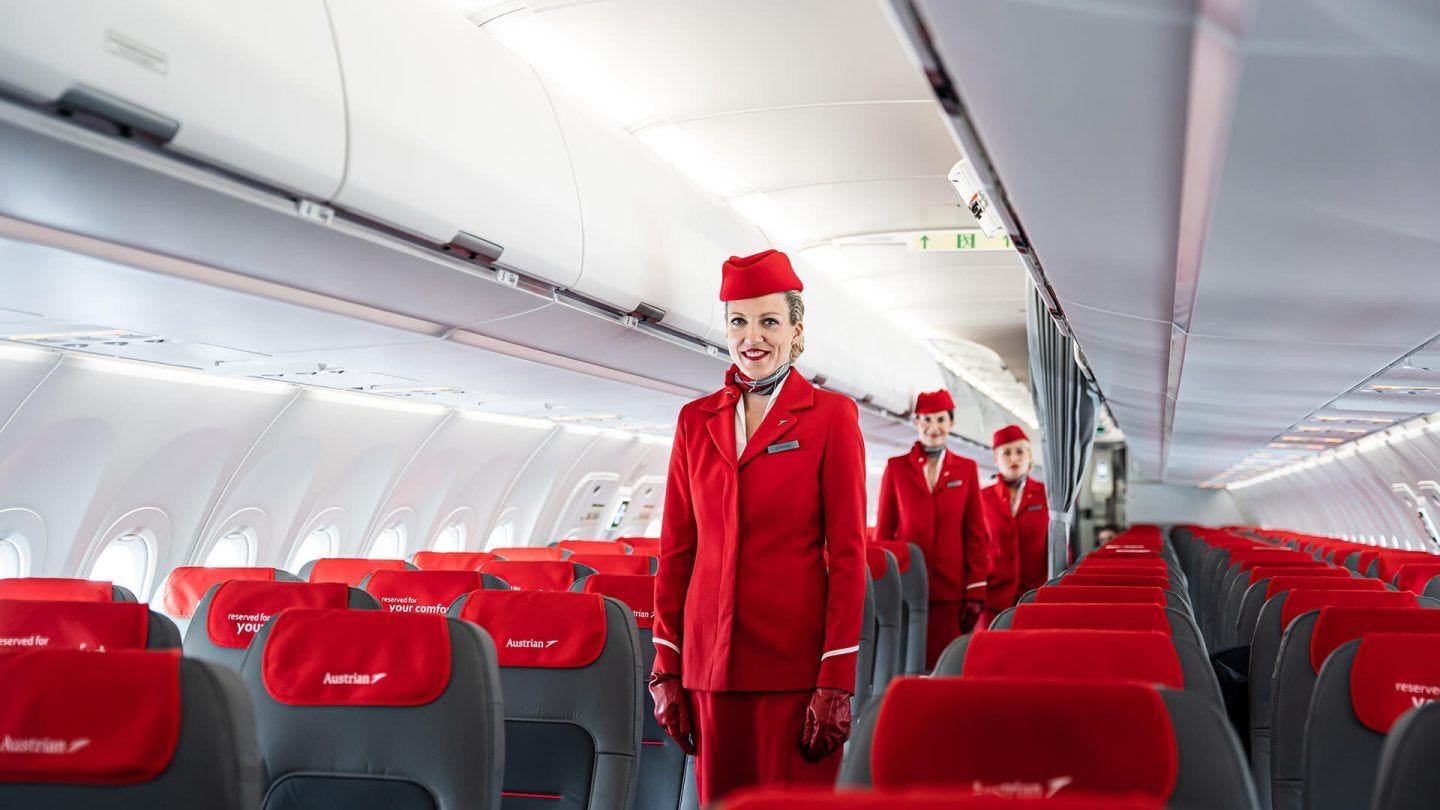
The Boeing 787-9 introduces a refreshed Business Class with direct aisle access and lie-flat beds, plus the relaunched Premium Economy product. The Premium Economy refresh and expansion is one of the most strategically significant cabin investments at the carrier, with further upgrades planned for next winter.
On Boeing 777-200ERs, the cabin is configured for 308 seats split between 48 Business Class and 260 Economy seats. The Boeing 767-300ERs offer 214 seats with 36 Business Class and 178 Economy. The narrowbody fleet operates a single-class economy layout for short and medium-haul markets.
Wet-lease aircraft from airBaltic have been retained to ensure capacity for the summer 2026 schedule, with two additional aircraft secured in time for the season.