


Dear Readers, Welcome to AviationOutlook.
Here are the major strategic aviation industry outlook from this week, to help you make informed decisions.
Recommended Reports


Read All Reports
1. Delta Air Lines Splits Its Premium Cabins Into Tiers
Delta has rolled out entry‑level business and first‑class fares that strip out several traditionally included perks such as pre-assigned seats, mileage earn, and lounge components on select international products.

The move preserves the seat but unbundles the experience, mirroring what has already happened at the back of the aircraft.
The context for this shift is unambiguous. Premium cabin revenue reached $5.4 billion in Q1, and premium is now competing head‑to‑head with main cabin revenue on quarterly totals.
For aviation executives trying to analyze this shift, the tell is not the fare change itself. It’s that the largest premium cabin operator in the country has decided the marginal price‑sensitive buyer is worth more than the marginal frequent traveler who now expects those perks included.
Watch for United and American if they’ll test similar tiering by Q4 2026. When Delta breaks unbundling ground, the rest of the mainline sector historically follows within two quarters.
Delta signal for stakeholders:
- Premium demand is elastic at the entry point.
- Bundled perks are being repriced as ancillaries.
- CPMs on premium seats may rise even as list fares fall.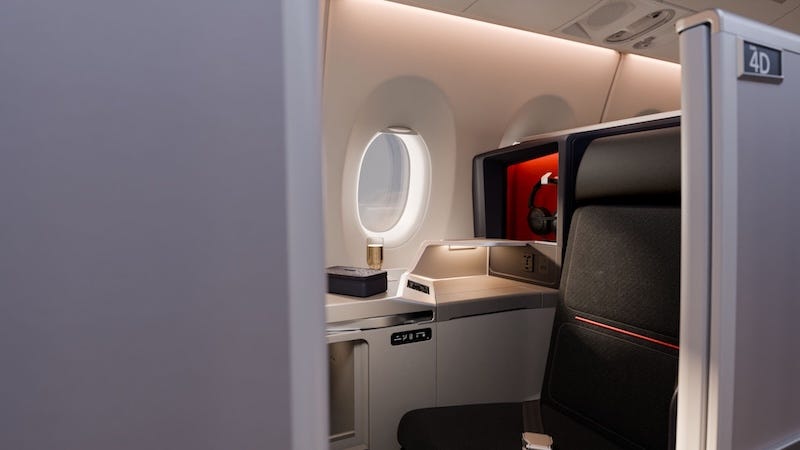
2. Boeing’s New 737 Assembly Line Starts Moving in Everett
Boeing began assembling a 737 MAX airplane on the new Everett “North Line”, marking the start of 737 production at the Everett site and the fourth 737 MAX final assembly line in the company’s manufacturing network.

The Everett line provides the physical capacity to eventually push the system rate higher.
For US airlines with 737 MAX orderbooks, this is the most consequential production news of the year. Southwest, United, Alaska, American and various leasing customers all have MAX deliveries stacked into the late 2020s. Everett coming online is what makes the 2027 and 2028 delivery profiles physically achievable.
The move also has aerospace workforce implications for the Puget Sound region. The Everett site had been transitioning away from the 747, 767 and 777 mix, and adding 737 restores a longer development runway for Everett employment.
3. UAE Certifies the World’s First Purpose‑Built Commercial Vertiport
The General Civil Aviation Authority certified a purpose‑built commercial vertiport located next to Dubai International Airport, giving Joby Aviation the infrastructure certification it needs to begin commercial eVTOL operations.

The precedent is significant because certification frameworks in most jurisdictions still treat vertiports as helipads with amendments.
A dedicated regulatory pathway, complete with turnaround procedures, passenger flow standards and integration with adjacent international airport operations, is now a live example the FAA and EASA should study.
Joby is targeting a Dubai launch in 2026 with Uber integration for ground transport bookings. Archer Aviation is running the parallel track in Abu Dhabi with its Midnight aircraft.
Why the UAE first?
- Single national regulator, no state or provincial layer.
- Public private co-investment in the physical site.
- Willing anchor tenant (RTA / Joby partnership).
- Existing airport authority absorbs air traffic integration.
US stakeholders in advanced air mobility should read this as a competitive checkpoint.
The commercial revenue clock