


Executive Summary
BAE Systems closed 2025 with Group sales of £30.7bn and a record backlog of £83.6bn, with the Air sector contributing £9.3bn in revenue and £1,108m in underlying EBIT, a 10% EBIT increase on a constant currency basis.
The Türkiye agreement, signed on 27 October 2025, is a contract worth approximately £8bn for 20 Tranche 4 Typhoons, expected to deliver around £4.6bn of value to BAE Systems, including its MBDA stake.
The Combat Air Flying Demonstrator, Britain’s first new piloted supersonic aircraft design in four decades, has a public 2027 first-flight ambition and underpins the trinational GCAP/Tempest in-service 2035 target.
The 2024 $5.55bn acquisition of Ball Aerospace, now operating as Space & Mission Systems, has materially repositioned BAE Systems against US space primes, lifting the Group’s exposure to space payloads, weather satellites and intelligence missions.
Recommended - Read Full Reports


Read All Reports
Table of Contents
Executive Summary
Introduction
Key Facts: Company Profile
BAE Systems Company Overview
A British prime that operates as a multi-domestic
The 2026 corporate footprint
Strategic identity in 2026
Key Aerospace Product Lines and Programmes
Eurofighter Typhoon: the cash engine of UK combat air
F-35 Lightning II: the world’s largest active fighter programme
GCAP and the Tempest demonstrator: the next-generation lever
Hawk Advanced Jet Trainer
FalconWorks and uncrewed systems
Electronic Systems and electronic warfare on flying platforms
Space & Mission Systems: the post-acquisition aerospace lever
BAE Systems Financial Analysis
Group-level performance
Air sector deep dive
Cash generation and capital allocation
2026 guidance
Revenue and Growth Drivers
Driver 1: Eurofighter Typhoon export pipeline
Driver 2: Sustained F-35 industrial cadence
Driver 3: Tempest design contracts ramping
Driver 4: Munitions volume on APKWS and beyond
Driver 5: Space & Mission Systems contribution
Major Competitors
BAE Systems vs Lockheed Martin
BAE Systems vs RTX Corporation
BAE Systems vs Northrop Grumman
BAE Systems vs Saab AB
BAE Systems vs Dassault Aviation
BAE Systems vs Leonardo
BAE Systems vs Airbus Defence and Space
Competitive Analysis and Moat: BAE Systems
What BAE Systems has that competitors do not
What competitors threaten
Maritime and Land context
The Air Sector in Context: A Multi-Decade Pipeline
Production capacity and industrial readiness
International partnerships
Mission systems and the AI dimension
Export sustainment and the recurring revenue tail
Financial and Commercial Implications
Implications for revenue trajectory
Implications for margin
Implications for cash conversion
Implications for capital allocation
Implications for the UK economy
Key Risks: Probabilities and Scenarios
Risk 1: GCAP cost or schedule slippage
Risk 2: Eurofighter export campaign losses
Risk 3: F-35 programme disruption
Risk 4: Supply chain capacity constraints
Risk 5: Geopolitical export licensing risk
Risk 6: Ball Aerospace integration execution
Risk 7: Macro defence budget pressures
BAE Systems SWOT Analysis
My Final Thoughts
Official Sources and Data
Introduction
A British prime contractor that two decades ago was viewed as a regional player has, in the space of three years, become the most aggressively scaled European participant in next-generation combat air, F-35 industrialisation, space payloads, and precision munitions.
The 2025 numbers from London tell that story in a way no narrative can.
A record £83.6bn order backlog, 10% sales growth to roughly £30.7bn, a £10.7bn Türkiye Typhoon win signed in late October, and a combat air flying demonstrator on track for first flight in 2027 reframe how investors, customers and competitors should think about BAE Systems heading into 2026 and the decade beyond.
Key Facts: Company Profile
COMPANY:        BAE Systems plc
HEADQUARTERS:   Farnborough, Hampshire, United Kingdom
CEO:            Charles Woodburn
LISTING:        London Stock Exchange (BA.); ADR: BAESY
FY2025 SALES:   c.£30.7bn (+10% YoY, constant currency)
FY2025 EBIT:    £3,322m (underlying)
FY2025 EPS:     75.2p (underlying)
FREE CASH:      £2,158m (FY2025)
ORDER BACKLOG:  £83.6bn (record)
ORDER INTAKE:   £36.8bn
EMPLOYEES:      c.108,000 globally; Air sector ~16,000 in UK
SECTORS:        Air; Maritime; Land; Electronic Systems;
                Platforms & Services (US); Cyber & Intelligence;
                Space & Mission Systems
KEY PROGRAMMES: Eurofighter Typhoon, F-35 Lightning II,
                GCAP/Tempest, Hawk, APKWS, MBDA (37.5% JV),
Hunter-class frigates, CV90, BradleyThe corporate identity was forged in November 1999 from the merger of British Aerospace and Marconi Electronic Systems. Today the Group sits among the world’s four largest defence contractors by revenue, behind only Lockheed Martin, RTX and Northrop Grumman.
It is, however, the only company in that quartet with deep industrial roots in both the United Kingdom and the United States, a structural moat that has become more valuable as European customers re-arm and as Washington tightens export controls.
BAE Systems Company Overview
A British prime that operates as a multi-domestic
BAE Systems plc is a multinational defence, aerospace and security company with operational bases on four continents.
Its legal centre is in the United Kingdom, but a meaningful share of revenue is generated through its US-incorporated subsidiary BAE Systems, Inc., which is run under a Special Security Agreement that allows it to access classified US programmes.
That dual structure is rare among non-American primes and gives the Group a pipeline into Pentagon programmes that European peers cannot easily match. It also explains why the Group can simultaneously bid for sensitive UK sovereign capability and for US classified electronic warfare work without conflict.
The Group’s seven sectors span land, sea, air, cyber and space, and they are managed as portfolio platforms rather than standalone businesses. Internal allocations of engineering capacity and capital are routinely shifted across sectors to chase the highest-return bid pipeline, a flexibility most pure-play primes do not enjoy.
The 2026 corporate footprint
Group revenue grew to a record level in 2025 with all sectors contributing positive growth. The 10% top-line expansion was supported by both organic volume increases and, importantly, the first full year of contribution from the acquired Ball Aerospace business.
The Group’s four-year guidance commentary from the Annual Report frames the medium term in remarkably confident language for a company of this size, citing strong demand visibility from European NATO members, the United States and Indo-Pacific customers.
BAE SYSTEMS GROUP – 2025 SECTOR REVENUE STACK
(Air sector is the largest single contributor)

Air . . . . . . . . . . . £9,299m
Maritime  . . . . . . . . £4,500m+ (UK maritime & land)
Land  . . . . . . . . . . £4,800m+ (Hägglunds, Bradley, BAE Systems Bofors)
Electronic Systems  . . . £8,200m+ (BAE Systems Inc.)
Platforms & Services US . £3,500m+ (combat vehicles, munitions)
Cyber & Intelligence  . . £2,000m+
Space & Mission Systems . £1,800m+ (full-year Ball Aerospace)
These figures are derived from the Group’s Annual Report disclosures and the Preliminary Results Announcement filed in February 2026; segmental sub-totals reflect rounding at the Group level.
Strategic identity in 2026
The Group’s strategic identity is no longer that of a UK-centric defence company with a US subsidiary. It now functions as an industrial alliance hub.
In Air alone, BAE Systems sits inside the four-nation Eurofighter consortium with Airbus and Leonardo, leads UK industrial work on the trinational GCAP programme, is the sole non-US contributor to F-35 final assembly content, and partners across MBDA with both French and Italian peers.
That level of cross-shareholder exposure is how it has simultaneously won major Eurofighter export campaigns and remained an irreplaceable F-35 partner to Lockheed Martin.
Key Aviation Product Lines and Programmes
Eurofighter Typhoon: the cash engine of UK combat air
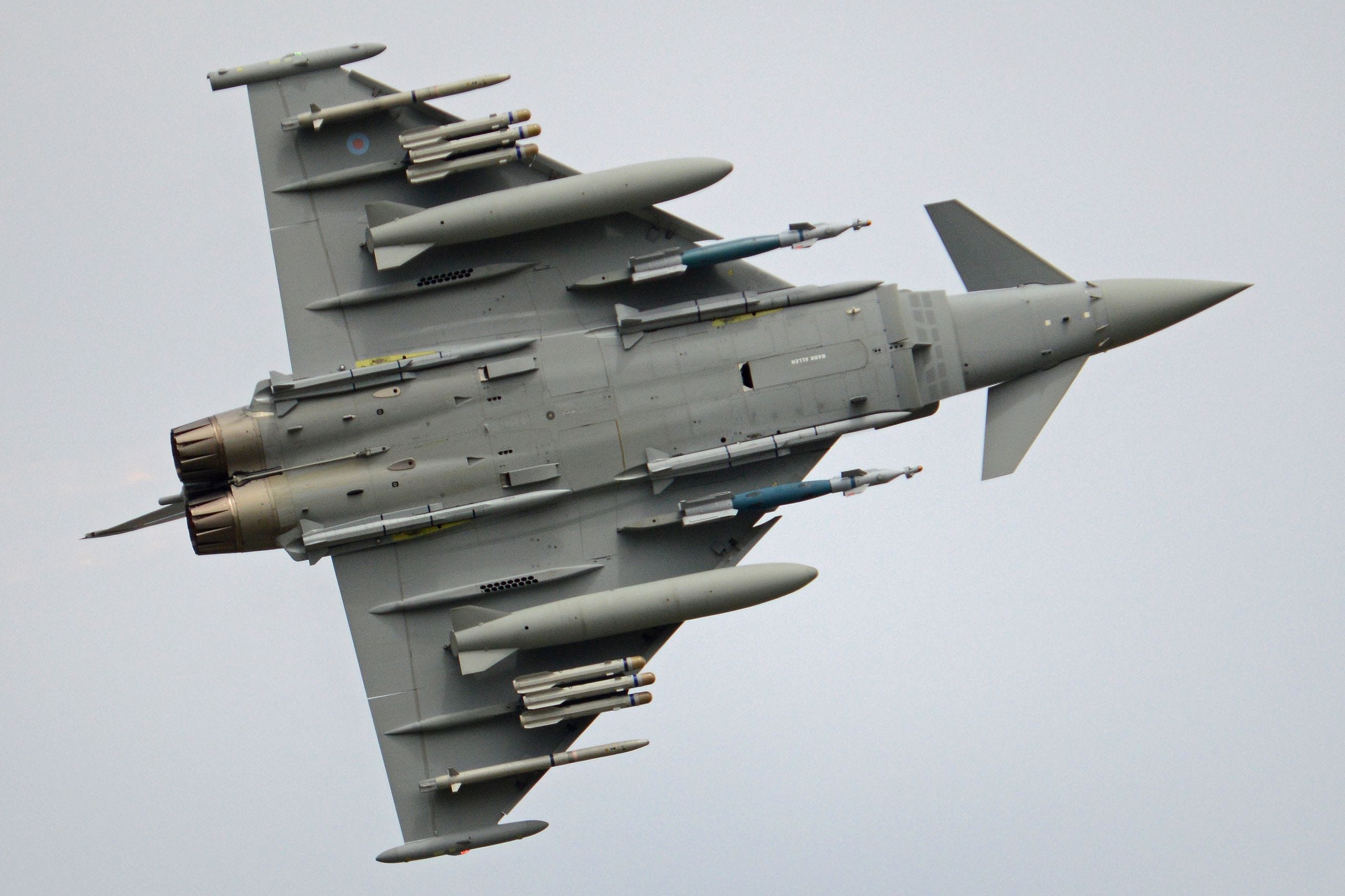
The Eurofighter Typhoon remains the single most important aviation programme in BAE Systems’ portfolio by both revenue and political importance. The Group is responsible for the front fuselage and final assembly at its Warton site in Lancashire and is the consortium partner for UK and export sustainment.
The 2025 commercial momentum on Typhoon was extraordinary. In June 2025, the Eurofighter consortium publicly committed to ramping production to 20 jets per year by mid-decade with an aspirational ceiling of 30 aircraft annually if the export pipeline materialised.
Then in October the £8bn Türkiye contract for 20 Tranche 4 aircraft validated that ambition. Ankara’s first delivery is scheduled for 2030, and BAE Systems has confirmed that it expects to recognise approximately £4.6bn from the deal including via its MBDA shareholding.
EUROFIGHTER TYPHOON – BAE SYSTEMS WORKLOAD CALENDAR

2025  Final RAF Tranche 4 builds + Italian/Spanish work
2025  Türkiye contract signed (£8bn / 20 aircraft)
2026  Ramp toward 20 aircraft/year cadence
2026  ECRS Mk2 radar £610m UK MoD contract
2028  Target sustained 20-30 aircraft/year subject to exports
2030  First Türkiye Typhoon delivery
2034+ Production likely tapers as GCAP enters service
A separate but strategically important contract was placed in early 2026: a £610m ECRS Mk2 advanced E-scan radar award that secures the next decade of UK Typhoon capability and creates further export opportunities.
The single most important fact about the Typhoon line is that the BAE Systems pipeline is now filled until first GCAP final assembly. This is not a marketing line, it is the central industrial argument of the Group’s 2026 outlook: there is no production trough.
That continuity is what keeps roughly 20,000 jobs in the UK supply chain, and it is also why London continues to treat Typhoon as a sovereign strategic capability rather than a legacy programme.
F-35 Lightning II: the world’s largest active fighter programme
BAE Systems is the sole non-US Tier 1 partner on the F-35 Lightning II, building the rear fuselage and empennage at Samlesbury for every airframe in the global fleet. The site also produces the F-35’s electronic warfare suite under a separate Electronic Systems contract.
The programme delivered a record 191 aircraft in 2025, the strongest annual delivery year in F-35 history, and Lockheed Martin has signalled an intent to maintain a sustained delivery cadence above 150 aircraft per year through 2026 and 2027.
Each rear fuselage is a substantial industrial output. The site is configured to produce more than two units per workday at full ramp, and BAE Systems’ total F-35 industrial life-of-programme value has been estimated by the company at greater than £20bn at current exchange rates.
The economic gravity of this work is significant for the Air sector EBIT margin. F-35 production builds run on long-term, fixed-price LRIP-style frameworks where margin expansion comes from learning-curve gains rather than price escalation, which structurally lifts return on sales as cumulative volumes grow.
F-35 LIGHTNING II – BAE SYSTEMS CONTENT

REAR FUSELAGE & EMPENNAGE ........... Samlesbury, UK
ELECTRONIC WARFARE SUITE ............ Nashua, NH, USA
ACTIVE INTERCEPTOR SYSTEM (AIS) ..... USA
LIFE-OF-PROGRAMME VALUE ............. >£20bn estimate
2025 GLOBAL DELIVERIES .............. 191 aircraft
PROGRAMME ANNUAL ECON. CONTRIBUTION . >$79bn US economy
The political risk on F-35 is well understood. Programme cost growth, software block delays and inventory issues at Lockheed Martin have all caused episodes of customer frustration. None of those challenges, however, undermine BAE Systems’ content; they affect the prime’s margin profile rather than the empennage subcontractor’s.
For the 2026 outlook, the read-across is clear. F-35 deliveries are projected to remain at or above 2025’s record, supporting Air sector volumes even as Typhoon production ramps in parallel.
GCAP and the Tempest demonstrator: the next-generation lever
The Global Combat Air Programme is the most ambitious aerospace project a UK prime has ever signed up to, and BAE Systems is its UK industrial anchor. The programme brings together the United Kingdom, Italy and Japan to deliver a sixth-generation manned fighter to enter service around 2035 and remain in service beyond 2070.
In July 2025, BAE Systems revealed the design for the UK’s first new piloted supersonic aircraft in four decades. The Combat Air Flying Demonstrator, with two-thirds of the airframe already built or in jig assembly, is targeting first flight in 2027 and is the most credible non-US sixth-generation flight test article currently disclosed.
That is the narrative that distinguishes GCAP from its rival Future Combat Air System. The GCAP industrial schedule is currently outpacing FCAS, which has continued to suffer disputes between Airbus and Dassault over workshare and intellectual property.
GCAP / TEMPEST – PROGRAMME MILESTONES

2018  Tempest concept first unveiled at Farnborough
2022  UK-Italy-Japan trilateral framework agreed
2023  Treaty signed in Tokyo formalising trinational structure
2024  Edgewing GIGO joint venture incorporated (UK/IT/JP)
2025  Combat Air Flying Demonstrator design revealed
2025  Major design contract awarded to UK industry team
2027  Demonstrator first flight target
2035  Target in-service date
2070+ Anticipated service life
The industrial structure was further consolidated by the creation of Edgewing, the trinational joint venture co-owned by BAE Systems, Leonardo and Japan Aircraft Industrial Enhancement Company. Edgewing is structured as a single design authority, a model intentionally borrowed from the lessons learned on Eurofighter and the difficulties of FCAS.
For BAE Systems, GCAP delivers an unusual combination: long-cycle development revenue today, plus an eventual production scale-up in the early 2030s precisely as Eurofighter production is winding down. That dovetail is the central long-term thesis on the Air sector.
It is worth acknowledging that scrutiny of the programme has intensified. The UK National Audit Office and parliamentary committees have raised questions about cost trajectory, and GCAP has been flagged in some governance reviews as schedule-stressed.
Those concerns are real but consistent with the early stage of any clean-sheet fighter; they do not change the strategic logic.
Hawk Advanced Jet Trainer
The BAE Systems Hawk has trained more than 25,000 fast jet pilots and remains in service with multiple air forces. The UK’s 28-strong Hawk T2 fleet is the cornerstone of UK Military Flying Training System fast jet training.
In March 2025, the UK confirmed it was examining alternative options for Hawk T2 replacement beyond the current £450m service contract. That has created uncertainty for the future of the line, although Hawk export work and sustainment continue to generate stable revenue across multiple international fleets.
The strategic question for 2026 and beyond is whether BAE Systems chooses to invest in a Hawk successor or partner with another prime on a clean-sheet trainer programme. The decision matters because trainer aircraft are the entry point for many countries before they buy frontline fighters.
FalconWorks and uncrewed systems
FalconWorks is the Air sector’s advanced concepts and rapid-prototyping division, modelled loosely on Lockheed Martin’s Skunk Works and Boeing’s Phantom Works. It houses the work on Tempest, autonomous collaborative platforms and a portfolio of uncrewed combat air systems intended to operate with manned platforms.
In late 2025, BAE Systems and Survice Engineering signed a framework agreement to collaborate on next-generation uncrewed air systems, reinforcing FalconWorks as the centre of the Group’s uncrewed pipeline. The product portfolio now includes attritable wingmen, intelligence-gathering UAVs and goal-based autonomy software.
This is the part of the Air sector most likely to surprise to the upside in the second half of the decade. Defence customers are pivoting capital toward affordable mass and FalconWorks is positioned to capture incremental UK and allied budgets.
Electronic Systems and electronic warfare on flying platforms
The Electronic Systems sector, headquartered in Nashua, New Hampshire, is the largest single sector of BAE Systems by revenue and the technical heart of the Group’s airborne electronic warfare and active interceptor work.
ES content runs on a remarkable range of US and allied flying platforms, including the F-35’s electronic warfare suite, the F-15EX active interceptor, the F-22 EW upgrades and a suite of helicopter self-protection systems. It is also the manufacturing home of the APKWS laser-guidance kit, an unusually high-margin precision munitions product line.
In February 2026 the Group announced the delivery of its 100,000th APKWS guidance kit, and a $1.7bn US Navy framework contract is funding continued production through the late 2020s.
For Air sector stakeholders, the importance of ES is indirect but material. ES content sells alongside Air sector platforms, particularly for export Typhoons and F-35 deliveries, and ES is the technical engine for the Group’s contributions to GCAP mission systems.
Space & Mission Systems: the post-acquisition aerospace lever
Space & Mission Systems is the sector formed from the February 2024 acquisition of Ball Aerospace. The deal closed in February 2024 for approximately $5.55bn, funded by a $4bn US bond issuance and existing facilities.
The newly integrated business gives BAE Systems exposure to weather-monitoring satellites, government space-based intelligence missions, electro-optical payloads and small satellite constellations, areas where the Group previously had only modest UK-only presence.
SPACE & MISSION SYSTEMS – KEY CAPABILITIES

WEATHER PAYLOADS .......... NOAA / NASA programmes
TELESCOPES ................ Past contributor to JWST (NIRCam)
SMALL SATS ................ NextGen, NEONSat platforms
ELECTRO-OPTICAL ........... Defense intelligence missions
ANTENNAS .................. Phased arrays, RF apertures
PRINCIPAL SITES ........... Boulder, Colorado (HQ), USA
FY2024 ACQUISITION COST ... ~$5.55bn (BAE Systems plc)
The aerospace strategic logic of Ball Aerospace was that the Group was over-indexed to traditional fixed-wing platforms and under-indexed to space, where US and allied budgets are growing fastest. Two years on, that thesis is largely playing out, with the sector reportedly tracking toward double-digit organic growth in 2026.
The acquisition also reset BAE Systems’ relationship with Northrop Grumman. As one industry observer noted, where the two firms were once partners, they are now direct competitors on space payloads and intelligence missions. That dynamic will shape the next several procurement cycles.
BAE Systems Financial Analysis
Group-level performance
The Group’s 2025 performance can be summarised in a single line: every sector grew, every sector improved EBIT, and the order book grew faster than revenue. That combination is unusual at this scale.
Group sales rose 10% on a constant currency basis to a record level, and underlying EBIT increased 12% on the same basis to £3,322m. Return on sales expanded by approximately 20 basis points to 10.8%, and underlying EPS grew 12% to 75.2p.
Free cash flow of £2,158m was both above the Group’s earlier 2025 guidance and consistent with the long-term commitment to convert at least 90% of operating profit to cash through the cycle.
BAE SYSTEMS – FY2025 FINANCIAL HEADLINES

SALES (UNDERLYING) .......... £30.7bn  (+10% cc)
SALES (IFRS) ................ £28,336m
UNDERLYING EBIT ............. £3,322m  (+12% cc)
OPERATING PROFIT (IFRS) ..... £2,925m  (+9%)
RETURN ON SALES ............. 10.8%    (+20 bps)
UNDERLYING EPS .............. 75.2p    (+12% cc)
FREE CASH FLOW .............. £2,158m
ORDER INTAKE ................ £36.8bn
ORDER BACKLOG ............... £83.6bn  (record)
SHAREHOLDER RETURNS ......... ~£1.7bn (full year)
SELF-FUNDED R&D ............. £407m
The gap between underlying sales (£30.7bn) and IFRS-defined revenue (£28.3bn) is mostly attributable to Eurofighter consortium accounting treatment and the Group’s pro-rata share of equity-accounted joint ventures, principally MBDA.
Air sector deep dive
The Air sector recorded sales of £9,299m in 2025 versus £8,549m in 2024, an increase of approximately 9% on a constant currency basis. Underlying EBIT was £1,108m versus £1,007m, a 10% rise on the same basis.
The Air sector return on sales sat at approximately 11.9%, the highest in the Group on a sector-level basis and a clear demonstration that the Typhoon and F-35 portfolios are operating with mature manufacturing efficiency.
The growth came from a combination of factors. Increased Typhoon work to support emerging export contracts, sustained F-35 build cadence, ramp on Tempest design contracts and additional in-service support volumes for existing Typhoon fleets in the UK, Saudi Arabia, Italy, Spain, Germany and Qatar.
AIR SECTOR – FY2025 vs FY2024

                          2025       2024     Change
SALES                  £9,299m     £8,549m     +9% cc
UNDERLYING EBIT        £1,108m     £1,007m    +10% cc
RETURN ON SALES         ~11.9%      ~11.8%   +10 bps
EMPLOYEES (approx.)    ~16,000     ~15,500    +3%
KEY UK SITES           Warton, Samlesbury, Brough, Hawarden
Cash generation and capital allocation
BAE Systems has historically run with a relatively conservative capital allocation framework, balancing dividends, modest buybacks and selected M&A. The Ball Aerospace acquisition was an unusual departure from that pattern but did not derail the underlying cash generation profile.
In 2025, the Group returned over £1.7bn to shareholders through dividends and an ongoing buyback programme, while continuing to deleverage from the post-Ball acquisition position. The interim 2025 dividend was raised by approximately 10% year on year.
For 2026, the Group has signalled continuing modest dividend growth and an ongoing buyback, alongside continuing reinvestment in production capacity for Typhoon, F-35, GCAP and munitions.
2026 guidance
The Group provided 2026 guidance using an exchange rate assumption of $1.32:£1, in line with the actual 2025 average exchange rate. On that basis, 2026 sales growth is anticipated in the high-single digits to low-double digits, with underlying EBIT growing in line.
The Air sector specifically is expected to grow above the Group average in 2026, supported by Typhoon ramp, F-35 volumes and incremental Tempest design contract revenue.
Margin expansion at the Group level is expected to be modest as the Group continues to absorb Ball Aerospace integration costs and ramp investment.
Revenue and Growth Drivers
Driver 1: Eurofighter Typhoon export pipeline
The Türkiye contract at £8bn for the customer (and roughly £4.6bn of recognised revenue for BAE Systems including MBDA) is the largest single Typhoon export deal of the modern era. It is also a template for what comes next.
The Saudi Arabia Tranche 4 follow-on, originally targeted at 48 aircraft, is the next major commercial decision. A possible Qatar follow-on, a possible Egypt opportunity and continuing discussions with Poland round out the credible 2026-2028 export campaign list.
If just two of those campaigns convert at Türkiye-style economics, the Air sector revenue trajectory through 2030 could support sustained mid-single-digit organic growth without reliance on either GCAP or US programmes.
Driver 2: Sustained F-35 industrial cadence
F-35 deliveries are expected to remain at the new normal of 150-191 aircraft per year, with potential upside as European customer fleets accelerate orders. Each rear fuselage delivered is incremental Air sector revenue at high margin given the maturity of the manufacturing learning curve.
Block 4 software upgrades, now expected through the 2025-2027 production lots, generate additional content for ES across electronic warfare and cockpit systems.
Driver 3: Tempest design contracts ramping
GCAP design contracts are now flowing in tranches, and the most recent UK design and engineering contract award signals that customer commitment to schedule is real. The contractual structure means the Air sector recognises milestone-based revenue ahead of any production deliveries.
By 2030 GCAP design revenue is expected to be a meaningful and growing single-digit percentage share of Air sector sales.
Driver 4: Munitions volume on APKWS and beyond
The 100,000th APKWS milestone in February 2026 came alongside continuing high US and allied demand for affordable precision munitions.
The $1.7bn US Navy contract framework provides a multi-year ceiling that is currently being drawn against at near-record monthly run rates.
Driver 5: Space & Mission Systems contribution
Full-year 2025 was the first complete annual contribution from the acquired Ball Aerospace business. Its programme pipeline is heavily weighted toward US government weather, intelligence and surveillance missions where budgets are projected to expand through 2030.
GROWTH DRIVERS – 2026 to 2030 INDICATIVE

1. Eurofighter exports . . . . . £4-8bn additional revenue
2. F-35 industrial cadence . . . £1-2bn cumulative organic
3. GCAP design ramp  . . . . . . £1-3bn over period
4. Munitions (APKWS+) . . . . .  £2-3bn over period
5. Space & Mission Systems . . . £4-5bn over period
6. Sustainment & support . . . . £3-4bn over periodMajor Competitors
Lockheed Martin (United States)
RTX Corporation (United States)
Northrop Grumman (United States)
General Dynamics (United States)
L3Harris Technologies (United States)
The Boeing Company (United States, defence segment)
Saab AB (Sweden)
Leonardo S.p.A. (Italy)
Dassault Aviation (France)
Airbus Defence and Space (Pan-European)
Rheinmetall (Germany)
MBDA (joint venture, partly BAE-owned)
The competitive set differs by segment.
In manned combat air, the most relevant peers are Lockheed Martin, Boeing and the European trio of Saab, Dassault and Airbus.
In electronic warfare and avionics, the main rivals are RTX, Northrop Grumman and L3Harris.
In space, the post-acquisition rivalry is principally with Northrop Grumman, Lockheed Martin and Maxar.
BAE Systems vs Lockheed Martin
Lockheed Martin operates at roughly twice BAE Systems’ revenue scale and is the dominant Western combat air prime through F-35, F-16 and the F-22 sustainment franchise.
The relationship between the two companies on F-35 is symbiotic rather than competitive, with BAE Systems being a long-term Tier 1 partner. In sixth-generation combat air, however, Lockheed Martin’s NGAD-led ecosystem is a direct competitor to GCAP for export customers in the late 2030s.
The structural difference is sovereign access.
Lockheed Martin can offer a US-controlled capability, while BAE Systems can offer a multinational alternative with broader technology transfer and industrial workshare. That trade is becoming more important to non-US customers concerned about US export licensing.
BAE Systems vs RTX Corporation
RTX is BAE Systems’ closest peer in scale and breadth, with deep exposure to engines (Pratt & Whitney) and missiles (Raytheon). It also runs major electronic warfare programmes that overlap with ES.

Where they diverge is platform integration. BAE Systems is primarily an airframe, electronic warfare and combat systems integrator, while RTX is more weighted to propulsion, missiles and air defence systems.
The two companies are competitors on missile contracts and electronic warfare, and partners on multiple munitions programmes.
BAE Systems vs Northrop Grumman
Northrop Grumman is the prime contractor for B-21 Raider and the lead on US ICBM modernisation. Its space business is the most direct US competitor to the new BAE Systems Space & Mission Systems unit.

The competitive overlap intensified materially after the Ball Aerospace acquisition closed. The two firms now compete head-to-head on US weather satellites, intelligence payloads and certain DoD constellations, where they previously partnered.
BAE Systems vs Saab AB
Saab is the primary European competitor on light combat aircraft via Gripen, on air defence radars and on certain air surveillance systems.
Saab’s industrial scale is roughly an order of magnitude smaller than BAE Systems, but it has been highly effective at competing on price for cost-sensitive Eurofighter rivals.
In 2025, Saab also announced association with the GCAP programme via Sweden’s industrial engagement, which moves Saab from pure rival to partial collaborator on next-generation combat air.
BAE Systems vs Dassault Aviation
Dassault Aviation is the principal Continental European fighter alternative to Eurofighter, manufacturing the Rafale. The Rafale and Typhoon have competed in numerous export campaigns, with mixed outcomes.
The deeper competitive dynamic lies in next-generation combat air, where Dassault leads the FCAS programme on behalf of France while struggling to align Airbus and Indra. As GCAP appears to be pulling ahead, Dassault risks losing its sixth-generation advantage to BAE Systems and Leonardo.
BAE Systems vs Leonardo
Leonardo is simultaneously a partner and a competitor. The two companies are partners on Eurofighter, GCAP and MBDA, but compete on helicopters, certain electronics and naval systems.
The collaborative dimension is more important than the competitive one. The success of Edgewing for GCAP depends entirely on the two firms being able to cooperate as a single design authority, which is the antithesis of FCAS internal politics.
BAE Systems vs Airbus Defence and Space
Airbus is BAE Systems’ Eurofighter consortium partner but its prime competitor in commercial-derivative defence aerospace, including A330 MRTT tankers, A400M transports and certain space systems.
In FCAS, Airbus is the lead industrial partner, which makes it a direct sixth-generation rival to BAE Systems. The two firms’ relative success on next-generation combat air will be one of the defining European industrial questions of the decade.