


Welcome to AviationOutlook: The aviation newsletter built exclusively for decision-makers.
Become an “Annual” member now & get this special discount offer.
As a paid member, you get access to:
200+ Reports - All major airlines + aerospace & defense companies (updated regularly).
Daily / Weekly - Deep-dive analysis & insights.
Monthly - Industry outlook reports.
In case you missed it, here are the latest analysis reports:
Embraer - Company Analysis and Outlook Report 2026 (Updated)
American Airlines’ Six-Route Europe Play: Yield Discipline or Widebody Overreach?
Check Out All Reports
Executive Summary
Breeze Airways ended the first half of 2026 with a fleet of 62 aircraft, an operating profit streak that now stretches beyond a single quarter, and 266 daily departures across 91 cities, making it the fastest-growing U.S. passenger carrier by percentage terms.
The airline received a U.S. flag carrier certificate from the FAA in September 2025 and used the credential to launch seven international routes into Mexico, the Caribbean, and Central America during the first half of 2026, becoming the first new American flag carrier in over a decade.
David Neeleman’s carrier has set 2027 as its IPO target, with a plan to reach a 400-aircraft all-Airbus-A220 operation, retire the last leased Embraer E190s by mid-2026, and pursue ETOPS certification to unlock Hawaii and, later, transatlantic flying.
The May 2026 collapse of Spirit Airlines reshuffled roughly 200 city-pairs across the country, and Breeze moved within hours to absorb Atlantic City and pieces of Fort Lauderdale, Tampa, and Las Vegas flying, cementing its status as the primary post-Spirit inheritor in mid-sized markets.
Table of Contents
Executive Summary
Introduction
Breeze Airways Company Profile: Key Facts
Breeze Airways Fleet Analysis
Fleet Size and Composition
Fleet Age and Its Strategic Significance
The Embraer E190 Phase-Out
Aircraft Configuration Strategy
Fleet Strategy Beyond 2026
Breeze Airways Route Network Strategy
The Point-to-Point Thin-Market Thesis
Network Scale as of August 2026
International Route Launches
Domestic Expansion in 2026
Transcontinental A220 Operations
The BreezeThru Product
Major Operational Bases (Hubs)
Breeze Airways Competitive Position
Major Competitors
Breeze vs. Frontier Airlines
Breeze vs. Allegiant Air
Breeze vs. Southwest Airlines
Breeze vs. JetBlue Airways
Breeze vs. Avelo Airlines
Strategic Context
TIME100 Most Influential Companies Recognition
Drew Brees Brand Ambassador Announcement
IPO Timeline
Pilot Contract Situation
Post-Spirit Reshuffle
Route Cancellations
Hawaii and Transatlantic Preparation
Key Risks for Breeze
My Final Thoughts
Official Sources & Data
Introduction
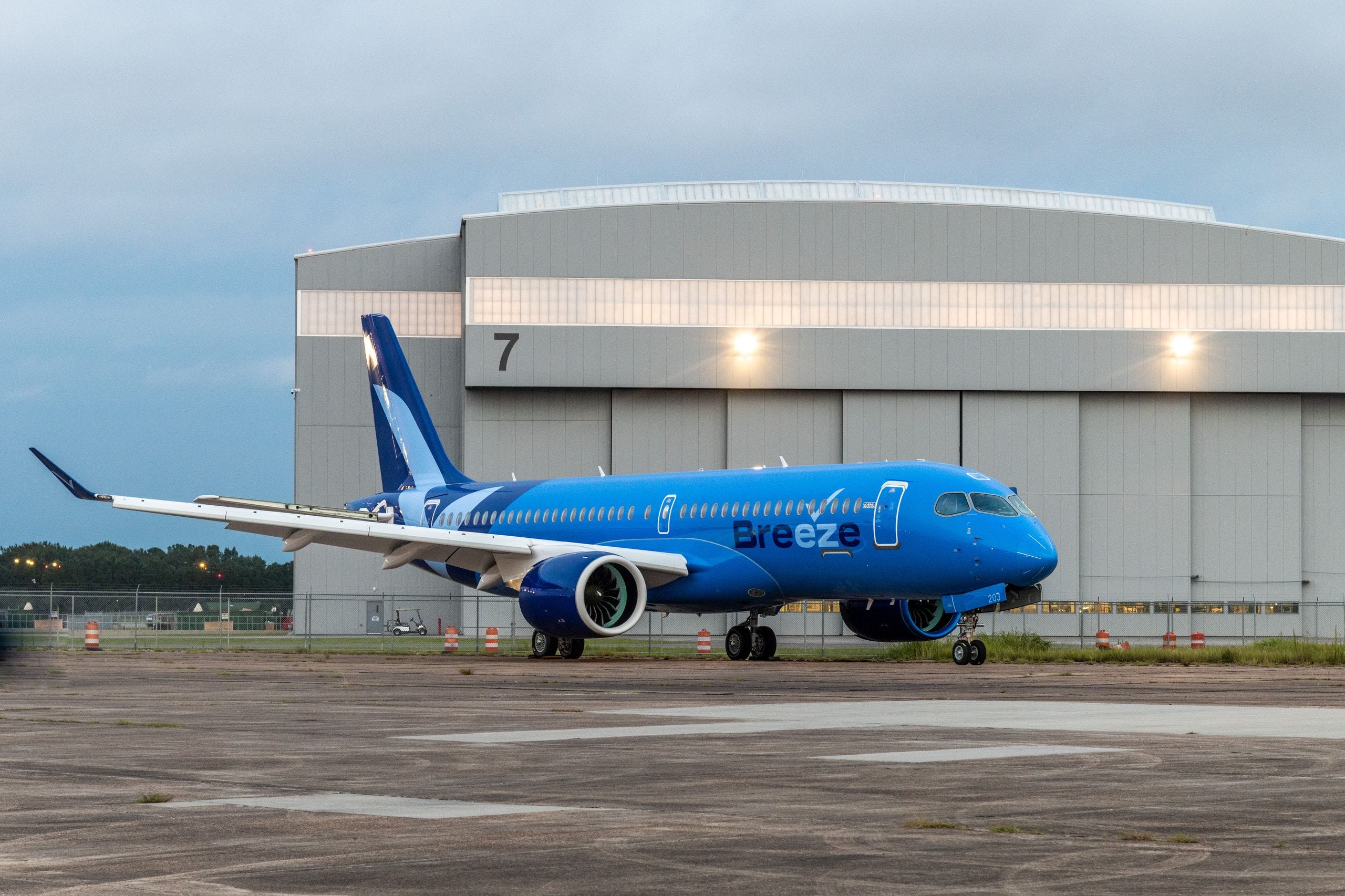
Five years after David Neeleman’s fifth airline start-up (after Morris Air, WestJet, JetBlue, and Azul) took off from Tampa with a used Embraer and a modest schedule, Breeze Airways has quietly become the most improbable success story in U.S. commercial aviation.
The May 2026 shutdown of Spirit Airlines cleared the field just as Breeze finished its transition to an all-A220 mainline fleet, ran its first back-to-back profitable quarters, and secured the federal certificate that lets it plant a U.S. flag on international departure boards.
The Breeze story is not the one Wall Street expected from a niche point-to-point airline flying secondary cities that legacy carriers had walked away from. Instead, the carrier turned “thin” markets into a growth model and used the A220-300’s range to fly transcontinental routes that most competitors consider uneconomic.
If you are trying to understand where the U.S. domestic map is headed after the ULCC shake-out, Breeze is now the reference case, not the outlier.
Let’s analyze everything in detail.
Breeze Airways Company Profile: Key Facts
Breeze Airways is a privately held, low-cost U.S. airline built around point-to-point service between medium and small cities that lacked nonstop options before it arrived.
The airline launched commercial operations on May 27, 2021.
COMPANY SNAPSHOT (as of 2026)
------------------------------------------------
Legal name:         Breeze Aviation Group, Inc.
Trading name:       Breeze Airways
IATA / ICAO:        MX / MXY
Headquarters:       Cottonwood Heights, Utah
Founded:            2018 (operations began May 27, 2021)
Founder & CEO:      David Neeleman
CFO:                Trent Porter
Ownership:          Private (Series B funded)
Business model:     Point-to-point, hybrid ULCC / value carrier
Primary fleet:      Airbus A220-300
Destinations:       91 cities across 5 countries
Daily flights:      ~266 (peak July 2026)
The carrier’s brand promise is compressed into a three-word tagline that pops up on every collateral piece: “Nice, new, and nonstop.”
That phrase does more work than it appears to, because it also defines the operating model: newer aircraft than the U.S. ULCC average, a friendly product with a paid premium cabin, and a network built almost entirely of routes no one else flies.
Trent Porter, a veteran of US Airways and Allegiant, handles the finance function and has become the public face of Breeze’s IPO conversations. Neeleman remains CEO and continues to describe himself as an aviation entrepreneur first and an operator second.

Breeze Airways Key Services and Products
Breeze’s product line is unusually broad for a carrier its size. The airline offers four fare bundles labeled Nice, Nicer, Nicest, and No Flex, arranged in ascending order of inclusions.
The Nicer bundle includes an extra-legroom seat, a personal item, a carry-on, one checked bag, and complimentary in-flight Wi-Fi on A220 flights.
Breeze Ascent, the airline’s premium cabin, is not simply a slightly wider seat. It is a Safran Z600 recliner in a 2-2 configuration with 39 inches of pitch, an adjustable headrest, a leg rest, and a water-bottle holster.
BREEZE ASCENT (First Class) - A220-300
--------------------------------------
Cabin config (V.1):     12 Ascent seats (3 rows, 2-2)
Cabin config (V.2):     36 Ascent seats (9 rows, 2-2)
Seat pitch:             39 inches
Seat width:             20.5 inches
Recline & leg rest:     Yes
Checked bags included:  Two
Wi-Fi:                  Complimentary
The Breezy Rewards loyalty program launched on January 1, 2026 with a full four-tier structure offering Wi-Fi and priority boarding benefits, replacing the simpler BreezePoints system that pre-dated it.
The Breeze Easy Visa Signature credit card rounds out the ancillary suite with a 10X earn on Breeze purchases.