- AviationOutlook
- Posts
- China United Airlines - Strategic Analysis and Outlook Report (2026)
China United Airlines - Strategic Analysis and Outlook Report (2026)
China United Airlines operates in a unique position within China’s expanding aviation sector.
As a low-cost subsidiary of China Eastern Airlines based at Beijing Daxing International Airport, the carrier has transformed from its military roots into a focused domestic player.
With intensifying competition and shifting market dynamics, understanding CUA’s strategic position becomes essential for industry stakeholders.
Also Read:
Table of Contents
Image source: en.wikipedia.org
Strategic Hub Operations at Beijing Daxing
The relocation to Beijing Daxing International Airport in September 2019 marked a pivotal transformation for China United Airlines. After 35 years at Beijing Nanyuan Airport, the carrier now operates from one of the world’s largest airport facilities.
For the 2025-2026 winter-spring season, Beijing Daxing handles approximately 979 daily flights. CUA serves as the anchor tenant, with operations spanning 130 domestic destinations and 40 international routes.
The airline has systematically expanded its network from this hub. International expansion includes new services to Japan and South Korea, with recent launches to Osaka, Fukuoka, and Shizuoka in Japan, as well as Cheongju, Jeju, Muan, and Seoul in South Korea.
CUA Hub Connectivity Overview
Primary Hub: Beijing Daxing International Airport (PKX)
Secondary Bases: Chengdu Tianfu, Foshan, Shijiazhuang, Wenzhou
Daily Operations: ~979 flights (airport-wide)
Domestic Reach: 130 destinations
International Network: 40 routes
Image source: commons.wikimedia.org
Fleet Composition and Operational Strategy
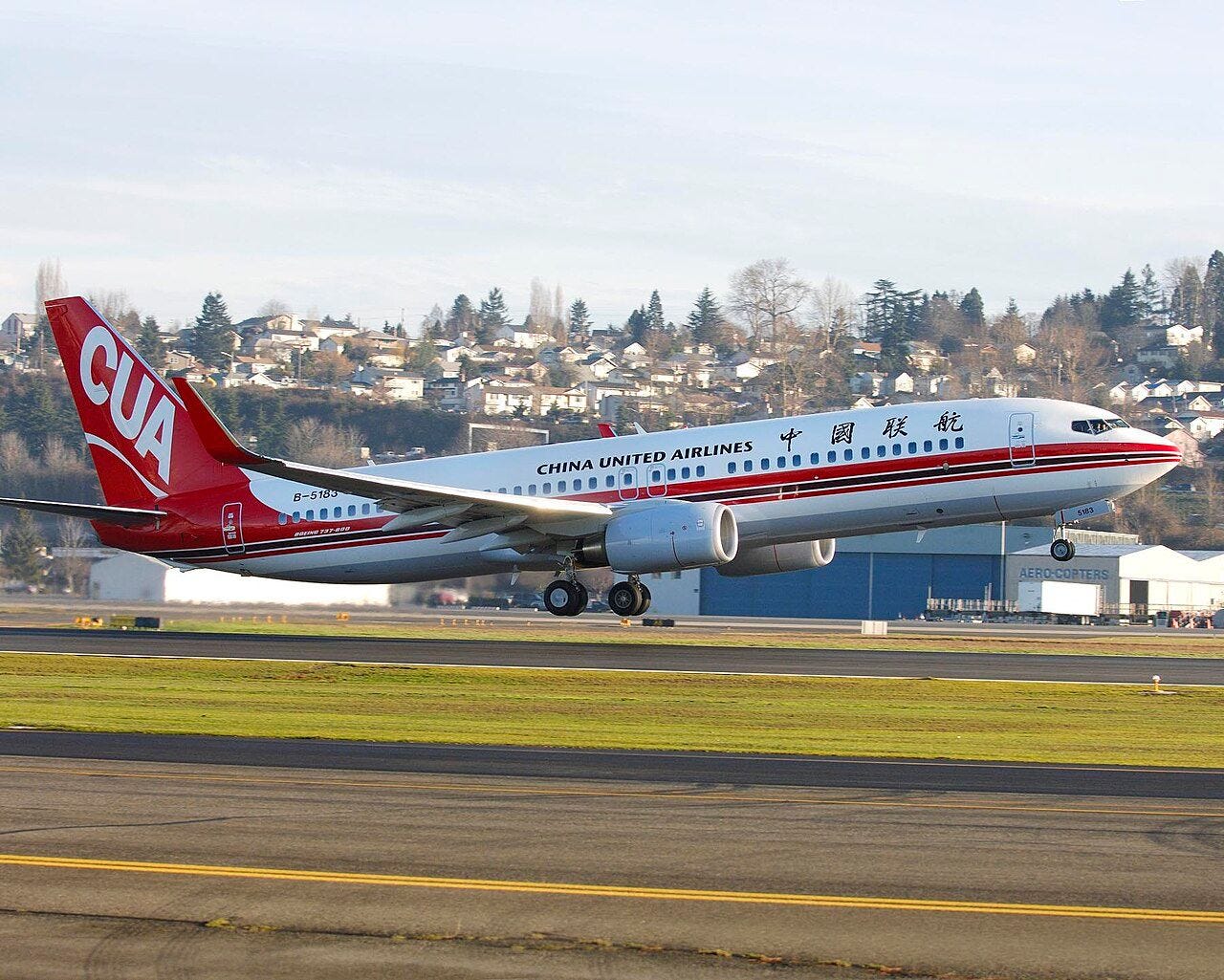
China United Airlines operates a streamlined fleet focused entirely on Boeing 737 aircraft. As of August 2025, the carrier maintains 60 aircraft in service.
The fleet comprises 5 Boeing 737-700s configured with 144 seats and 55 Boeing 737-800s with 186 seats each. This uniform fleet strategy delivers significant operational efficiencies through simplified maintenance, training, and crew scheduling.
Aircraft Type | Quantity | Seat Configuration | Role |
|---|---|---|---|
Boeing 737-700 | 5 | 144 seats | Secondary routes |
Boeing 737-800 | 55 | 186 seats | Primary operations |
Total Fleet | 60 | Average age: 9.7 years | All-economy configuration |
The carrier’s all-economy configuration aligns with its low-cost model. Unlike full-service competitors, CUA eliminates premium cabins to maximize revenue per flight.
Seven aircraft feature special liveries celebrating Chinese cities, including designs for Anshun, Baotou, Rizhao, Xingyi, Qingyang, Lianyungang, and Wuhu. These custom paint schemes enhance brand visibility while promoting regional tourism.
Low-Cost Carrier Positioning
China United Airlines operates within China’s expanding low-cost sector, competing primarily with Spring Airlines, West Air, and 9 Air. As of January 2025, Spring Airlines leads with 134 aircraft, followed by CUA with 56 in operational service, Lucky Air with 51, and West Air with 38.
The competitive dynamics favor airlines with scale and established network presence. Spring Airlines maintains its position as China’s largest low-cost carrier, while CUA leverages its Beijing Daxing hub advantage and China Eastern backing.
Chinese LCC Market Positioning (2025)
Spring Airlines: 134 aircraft - Market leader
China United Airlines: 56 aircraft - Beijing hub specialist
Lucky Air: 51 aircraft - Regional focus
West Air: 38 aircraft - Western China coverage
CUA’s strategy emphasizes point-to-point domestic connectivity with selective international expansion. The carrier benefits from China Eastern’s network integration while maintaining independent low-cost operations.
Pricing remains aggressive across the sector. All Chinese LCCs face pressure from both full-service carriers offering discount fares and regional competitors expanding capacity.
Financial Performance and Parent Company Support
China United Airlines reported $500 million in annual revenue for 2024, with a 7.1% profit margin generating $32 million in net profit. These figures reflect the carrier’s focus on cost discipline and operational efficiency.
As a wholly owned subsidiary of China Eastern Airlines, CUA benefits from substantial financial and operational backing. China Eastern, one of China’s “Big Three” carriers, provides access to capital, bulk purchasing advantages, and integrated network support.
The parent company’s resources enable CUA to weather industry volatility while maintaining growth investments. This relationship differentiates CUA from independent low-cost carriers facing greater financial constraints.
Financial Metric | Value (2024) |
|---|---|
Annual Revenue | $500 million |
Net Profit | $32.0 million |
Profit Margin | 7.1% |
Ownership Structure | 100% China Eastern Airlines |
CUA operates with approximately 2,100 employees globally, including around 350 pilots and 600 flight attendants. This lean workforce structure supports the low-cost model while maintaining operational standards.
Route Network Development
China United Airlines serves 87 destinations as of December 2025, predominantly within mainland China. The domestic network covers major population centers and secondary cities across the country.
Domestic operations include extensive coverage of eastern and southern China. Key routes connect Beijing Daxing with Guangzhou, Shanghai, Chengdu, Shenzhen, Hangzhou, and numerous provincial capitals.
International expansion targets nearby Asian markets. The carrier operates services to Japan (Fukuoka, Osaka, Shizuoka), South Korea (Seoul, Jeju, Cheongju, Muan), and Russia (Vladivostok).
Route planning prioritizes high-frequency domestic corridors where the low-cost model generates competitive advantages. Beijing’s strong business and leisure demand supports sustained operations.
CUA Network Highlights by Region
Domestic Coverage:
- East China: Shanghai, Hangzhou, Nanjing, Wuxi
- South China: Guangzhou, Shenzhen, Sanya, Zhanjiang
- Southwest China: Chengdu, Kunming
- Central China: Wuhan, Changsha
- North China: Hohhot, Baotou, Ordos
International Routes:
- Japan: Osaka, Fukuoka, Shizuoka
- South Korea: Seoul, Jeju, Cheongju, Muan
- Russia: Vladivostok
The airline maintains a unique competitive advantage through continued access to Chinese military airports, a legacy from its original establishment under the People’s Liberation Army Air Force in 1986.
Competitive Pressures and Market Challenges
China’s airline sector faces significant headwinds affecting all carriers. The “Big Three” airlines (Air China, China Eastern, China Southern) reported deeper first-quarter losses in 2025 amid intensifying competition and economic pressures.
Overcapacity represents a persistent challenge. Domestic routes experience aggressive fare competition as carriers chase market share. This pricing pressure directly impacts low-cost operators dependent on volume economics.
Consumer spending patterns remain uncertain. Economic conditions influence discretionary travel demand, creating revenue volatility for all airlines.
Market Challenge | Impact on CUA |
|---|---|
Overcapacity | Pricing pressure on domestic routes |
Economic headwinds | Reduced leisure travel demand |
Fuel price volatility | Operating cost unpredictability |
Regulatory environment | Route approval timing |
Competition intensity | Market share pressures |
International expansion requires navigating bilateral agreements and slot availability. While CUA has launched several new international routes, regulatory constraints limit growth velocity compared to domestic network expansion.
The carrier must balance growth ambitions with profitability requirements. Maintaining cost discipline while investing in network expansion creates ongoing strategic tension.
Operational Infrastructure and Service Model
China United Airlines maintains its headquarters and primary maintenance facilities at Beijing Daxing International Airport. The customer service center operates from Shijiazhuang, Hebei.
The operational model emphasizes efficiency and simplicity. Single aircraft type operations, all-economy configurations, and streamlined service offerings reduce complexity and costs.
Digital transformation initiatives focus on mobile booking, online check-in, and automated customer service. These investments reduce distribution costs while improving passenger experience.
Ground operations leverage China Eastern’s infrastructure and partnerships. This relationship provides access to superior facilities, equipment, and support services compared to standalone low-cost operators.
CUA Operational Model
Fleet Management:
- Single aircraft family (Boeing 737)
- Standardized maintenance procedures
- Centralized spare parts inventory
- Simplified crew training
Service Delivery:
- All-economy seating configuration
- Point-to-point network structure
- Digital-first customer interface
- Ancillary revenue optimization
Support Infrastructure:
- China Eastern MRO access
- Group purchasing advantages
- Shared technology platforms
- Integrated logistics support
The carrier employs approximately 350 pilots and 600 flight attendants, maintaining industry-standard crew ratios while optimizing productivity through efficient scheduling.
Technology and Digital Capabilities
China United Airlines invests in advanced flight planning technologies to maximize operational efficiency. Digital dispatch systems optimize fuel consumption, route selection, and schedule reliability.
Mobile applications provide comprehensive booking and travel management capabilities. Passengers can research routes, book flights, manage reservations, and access boarding passes through digital channels.
The carrier integrates with China Eastern’s technology platforms where beneficial, gaining access to sophisticated systems without duplicating development costs. This hybrid approach balances independence with resource efficiency.
Data analytics drive route planning, pricing strategies, and capacity management decisions. Understanding demand patterns enables more precise network optimization and revenue management.
Digital transformation extends to customer service operations. Automated chatbots, self-service portals, and integrated communication channels reduce labor costs while improving response times.
Outlook for 2026 and Beyond
China United Airlines enters 2026 with both opportunities and challenges ahead. The carrier’s strategic position at Beijing Daxing provides long-term competitive advantages as the airport develops into a major aviation hub.
Domestic network expansion will likely continue, focusing on underserved markets where low-cost service creates new demand. The carrier’s ability to operate from military airports offers unique route opportunities unavailable to competitors.
International growth faces greater constraints. Regulatory approvals, bilateral agreements, and slot availability will govern expansion velocity. Selective additions to Japan and South Korea routes appear most feasible given geographic proximity and demand profiles.
2026 Strategic Priorities
Network Development:
- Expand frequency on core domestic routes
- Add selective international services to Japan/Korea
- Develop secondary base operations
- Optimize Beijing Daxing connectivity
Operational Excellence:
- Maintain fleet utilization above industry average
- Continue cost discipline across operations
- Enhance digital customer capabilities
- Leverage China Eastern synergies
Financial Performance:
- Sustain profitability amid competitive pressures
- Protect market share in key corridors
- Grow ancillary revenue streams
- Manage fuel cost volatility
Fleet growth will depend on market conditions and profitability trends. While the current 60-aircraft fleet provides adequate capacity for existing operations, network expansion requires additional aircraft or higher utilization rates.
The relationship with China Eastern remains foundational to CUA’s strategy. Continued parent company support provides financial stability, operational resources, and network integration benefits that independent carriers cannot match.
Competition intensity will persist throughout 2026 and beyond. Spring Airlines continues aggressive expansion, while regional carriers target overlapping markets. Success requires operational excellence, cost discipline, and strategic network positioning.
Beijing Daxing’s development trajectory directly impacts CUA’s long-term prospects. As the airport grows toward its 100-million-passenger capacity target, opportunities for hub-based network expansion will increase substantially.
My Final Thoughts
China United Airlines occupies a distinctive niche within China’s aviation sector. The carrier combines low-cost operational efficiency with China Eastern’s financial backing and resource access, creating a hybrid model with unique competitive advantages.
The Beijing Daxing hub provides exceptional long-term potential. As this massive infrastructure investment matures, CUA’s position as anchor tenant should deliver sustained network opportunities and operational efficiencies.
Profitability in China’s domestic market requires exceptional cost discipline and strategic precision. CUA has demonstrated the ability to generate positive margins, but maintaining this performance amid intensifying competition and economic uncertainty presents ongoing challenges.
International expansion represents a measured growth opportunity rather than a core strategic priority. The carrier’s domestic network strength and cost structure align better with point-to-point Chinese operations than long-haul international services.
For 2026 and beyond, success depends on maintaining cost advantages, optimizing the Beijing Daxing hub position, and leveraging China Eastern’s support while navigating competitive pressures and market volatility.

Reply