


Executive Summary
Eurowings carried 23.7 million passengers across 170,000 flights in 2025, delivering a 99 percent reliability rate and winning the Skytrax “Best Low-Cost Airline in Europe 2025” title.
The airline, including its 50 percent stake in SunExpress, posted an Adjusted EBIT of €132 million in 2025, and its parent’s point-to-point segment operates with just under 5,500 employees across Germany, Malta, Austria, Czechia, and Sweden.
A full-scale fleet turnover is now locked in. 40 Boeing 737-8 MAX aircraft will arrive between 2027 and 2032, breaking an all-Airbus tradition and replacing aging A319s and older A320s.
The 2026 summer schedule expands the network to 150 destinations across 40 countries, with Düsseldorf alone serving 114 destinations and new medium-haul routes pushing into Tel Aviv, Dubai, Abu Dhabi, Jeddah, Amman, Erbil, Beirut, and Tbilisi.
Recommended - Read Full Reports


Read All Reports
Table of Contents
Executive Summary
Introduction
Key Facts: Eurowings Company Profile
Eurowings Business Overview
A Brief History That Explains Today’s Business Model
Current Business Model: What Eurowings Actually Does
Eurowings Financial Performance: The Most Recent Reported Numbers
The 2024-2025 Trajectory in Plain Numbers
Revenue Growth Drivers in 2026
Brand Recognition and Customer Indicators
Eurowings Holidays, the In-House Tour Operator
Leadership Transition, February 2026
Eurowings Fleet: In-Depth Analysis
Fleet Size and Composition
Why the A320 Family Still Matters in 2026
Fleet Age
Eurowings Fleet Strategy to 2032: The 737 MAX 8 Transition
Why a Boeing Order Inside an All-Airbus Airline Is a Big Deal
Cabin Strategy: The New Premium Middle-Haul Product
Eurowings Europe Fleet (Maltese AOC)
Fleet Utilization and Reliability
Eurowings Route Network, Major Destinations, and Network Strategy
The Summer 2026 Network at a Glance
New Routes for Summer 2026
The Medium-Haul Program
Capacity Reallocation: Germany Out, Mediterranean In
Base-by-Base Schedule Summary (Summer 2026)
Network Philosophy, Explained
The New Hanover-Glasgow Seasonal Route
Major Operational Bases (Hubs)
Düsseldorf Airport (DUS): The Primary Base
Cologne/Bonn Airport (CGN): The Secondary German Base
Hamburg, Stuttgart, Berlin, Hannover
Eurowings Europe Bases
Prague and Salzburg as Growth Bases
Eurowings Competitive Position
Major Competitors
Eurowings vs Ryanair
Eurowings vs easyJet
Eurowings vs Wizz Air
Eurowings vs Vueling
Eurowings vs Transavia
Eurowings vs TUI fly and Condor
Eurowings vs Discover Airlines (Intra-Group Positioning)
Eurowings vs SunExpress
Eurowings SWOT Analysis
Sustainability, Technology, and Customer Experience
Sustainable Aviation Fuel and Emissions
Digital and Distribution
Loyalty Program: Miles & More
Ancillary Products: BIZclass, BASIC, SMART, BIZ
Key Risks, With Probabilities and Scenarios
Risk 1
Risk 2
Risk 3
Risk 4
Risk 5
Risk 6
Risk 7
Risk 8
Growth Outlook Through 2026 and 2027
Capacity Plan
Financial Trajectory
Strategic Orientation
The Intra-Group Picture: Where Eurowings Sits Inside Lufthansa Group
What the 737-8 MAX Order Really Signals
Eurowings’ Position in European Low-Cost Rankings
What to Watch in 2026
My Final Thoughts
Official Sources and Data
Introduction
Eurowings enters 2026 with a fresh CEO, a massive fleet renewal contract, and record passenger numbers that have quietly reshaped how the Lufthansa Group thinks about short and medium-haul flying in Europe.
The airline is no longer trying to out-Ryanair. It’s instead building a distinct German “value carrier” identity, anchored around reliability, tourist-heavy routes, and a widening Middle East footprint.
For stakeholders tracking the European airline business, Eurowings is one of the most important case studies of 2026. It sits inside a group that generated a record €39.6 billion in 2025 revenue and is executing the largest fleet modernization in its own corporate history.
This analysis report goes deep into the numbers, the aircraft, the bases, the route map, and the risks that will define the airline over the next 12-18 months.

Key Facts: Eurowings Company Profile
Legal name          : Eurowings GmbH
Trading name        : Eurowings
Parent company      : Deutsche Lufthansa AG (100% owned)
Headquarters        : Düsseldorf, North Rhine-Westphalia, Germany
Founded             : 1 February 1990 (merger of NFD and RFG)
Operations start    : 1 January 1994
IATA / ICAO code    : EW / EWG  (call sign: EUROWINGS)
Maltese subsidiary  : Eurowings Europe Ltd (IATA: E6, ICAO: EWL)
CEO                 : Dr. Max Kownatzki (from 1 Feb 2026)
CFO                 : Kai Duve
Chair (Board)       : F. W. Weitholz
Employees (FY 2025) : ~5,500
Passengers FY 2025  : 23.7 million
Flights FY 2025     : ~170,000
Destinations 2026   : 150 in 40 countries
Adjusted EBIT 2025  : €132 million (incl. SunExpress stake)
Main hub            : Düsseldorf Airport (DUS)
Other German bases  : Cologne/Bonn, Hamburg, Berlin, Stuttgart, Hannover
European bases      : Palma de Mallorca, Prague, Salzburg, Graz,
                      Stockholm-Arlanda, Pristina
Frequent flyer prog : Miles & More
Recognition (2025) : Skytrax "Best Low-Cost Airline in Europe"Eurowings is defined inside the Lufthansa Group as the Group’s “value airline” for Europe.
It sits separate from the network carriers (Lufthansa Airlines, SWISS, Austrian, Brussels Airlines, ITA Airways) and also separate from the leisure carriers Discover Airlines and SunExpress.
That positioning matters because it drives every fleet, network, and pricing decision the airline makes. Everything in this report should be read through that lens.
Eurowings Business Overview
A Brief History That Explains Today’s Business Model
Eurowings was established on 1 February 1990 out of the merger of two German regional carriers, Nürnberger Flugdienst and Reise- und Industrieflug. It flew its first revenue services on 1 January 1994.
Lufthansa took an initial 24.9 percent stake in 2001, stepped up to 49 percent in 2004, assumed full control in 2005, and bought out the remaining shares in 2011. A full brand redevelopment into a low-cost carrier followed in 2015.
The 2020 pandemic-era downsizing stripped Eurowings of long-haul flying, and the leisure long-haul business was spun into what is now Discover Airlines. That restructuring is the single most important event shaping the current Eurowings business model.
Current Business Model: What Eurowings Actually Does
Eurowings now flies exclusively short and medium-haul point-to-point routes on aircraft from the Airbus A320 family.
It does not operate long-haul, it does not feed traditional Lufthansa hubs the way Lufthansa CityLine does, and it does not operate wide-body aircraft of any type.
The business has three distinct revenue engines. First, scheduled point-to-point flying to European leisure and city destinations. Second, a growing medium-haul offering to the Middle East and North Africa. Third, an ancillary-heavy tour operating business that the airline recently built in-house.
EUROWINGS REVENUE ENGINES (2026)
--------------------------------
1. Short-haul scheduled - the dominant volume driver
   - German domestic (shrinking) + intra-European leisure + city
2. Medium-haul scheduled - the growth driver
   - Gulf, North Africa, Levant, Eastern Mediterranean
3. Eurowings Holidays tour operating (launched 2024)
- Now covers 60 countries and ~16,000 hotelsEurowings Financial Performance: The Most Recent Reported Numbers
For the full year 2025, Eurowings (including its stake in SunExpress) generated an Adjusted EBIT of €132 million. That compares with more than €200 million reported for the same segment in full year 2024.
The year-on-year decline in reported earnings reflects margin compression caused by higher location costs in Germany, most visibly the increased air traffic tax, security fees, and air navigation charges. This is the central structural problem Eurowings has been flagging publicly since 2024.
At the Lufthansa Group level, 2025 total revenue hit a record €39.6 billion, with Adjusted EBIT of €1.96 billion. The Passenger Airlines segment closed at an 83.2 percent passenger load factor on capacity that grew 4 percent year-on-year, based on the parent’s consolidated reporting.
Eurowings itself is not a separately listed reporting segment in the annual report. Its results flow into the “Point-to-Point” portion of the Passenger Airlines segment, alongside its SunExpress equity stake, which is how the Group prefers to steer and disclose it.
The 2024-2025 Trajectory in Plain Numbers
EUROWINGS OPERATIONAL KPIs (FY)
-------------------------------
Metric              2024            2025
Passengers (m)      ~23.0           23.7
Flights             ~165,000        ~170,000
Employees           >5,300          ~5,500
Destinations        142 (summer)    150 (summer 2026 plan)
Countries served    26              40
Adj. EBIT (€m)*     >200            132
Load factor 9M      ~84%            84.6%
NPS (9M 2025)       n/a             42
* includes SunExpress stakeThe employee base grew by roughly 200 staff during the year to just under 5,500, which is a meaningful indicator for a cost-focused carrier. Growth in headcount has tracked the expansion of bases in Prague, Salzburg, and additional Middle East rotations.
The nine-month 2025 read gave the clearest mid-year progress picture. Eurowings carried 18 million passengers through September, a gain of over 600,000 versus the same window in 2024, with a Net Promoter Score of 42 and a reliability rate above 99 percent.
Revenue Growth Drivers in 2026
Four drivers are shaping the top line this year. The first is the full-year benefit from the medium-haul expansion that launched in the winter 2025/26 schedule, including the new Düsseldorf to Dubai service that began 13 December 2025.
The second is the larger summer 2026 scheduled program, with growth at every German base and at the Eurowings Europe bases in Prague, Salzburg, and Graz. The third is the Eurowings Holidays platform, which now bundles flights and around 16,000 hotels across 60 countries.
The fourth is the new premium seating product on A320neos. It keeps the traditional 3x3 economy cabin but introduces a 2x2 front-row layout with a blocked middle seat, sold as an upsell on business and popular leisure city routes and on Mallorca flying. It opens up a price point that Eurowings could not really access before 2026.
Brand Recognition and Customer Indicators
Skytrax named Eurowings the Best Low-Cost Airline in Europe 2025, which is a first for the carrier at this ranking. The airline also holds a four-star Skytrax rating.
About two-thirds of surveyed 2025 customers said they actively recommend Eurowings to others, per CFO Kai Duve’s December 2025 statement. Reliability above 99 percent is now the headline operational claim and sits meaningfully above most European low-cost peers.
Eurowings Holidays, the In-House Tour Operator
Eurowings Holidays is still a new venture, having launched in 2024, but it has scaled quickly. By the end of 2025 it offered trips to 60 countries in Europe and selected international destinations with around 16,000 hotels bookable on the platform, according to the airline’s own year-end release.
Low deposits, free rebooking, and low-cost cancellation are the consumer-facing differentiators. For the business, bundling flight and hotel raises basket value and reduces dependency on seat-only ancillary sales.
Leadership Transition, February 2026
The CEO change announced in late 2025 is one of the most important management events in recent Lufthansa Group history. Jens Bischof stepped down from the Eurowings Executive Board at the end of 2025 after more than five years at the helm and over 35 years across the wider Group.
Dr. Max Kownatzki, who spent nearly six years running SunExpress, became Chairman of the Executive Board of Eurowings on 1 February 2026. His background at Jetstar, Oliver Wyman, and earlier Eurowings commercial roles is a deliberate signal that the Group wants a closer commercial link between SunExpress and Eurowings going forward.
Kownatzki is also a licensed commercial pilot with a doctorate from St. Gallen, a combination that Carsten Spohr publicly referenced as a fit for the operational excellence agenda at the airline.
Eurowings Fleet: In-Depth Analysis
Fleet Size and Composition
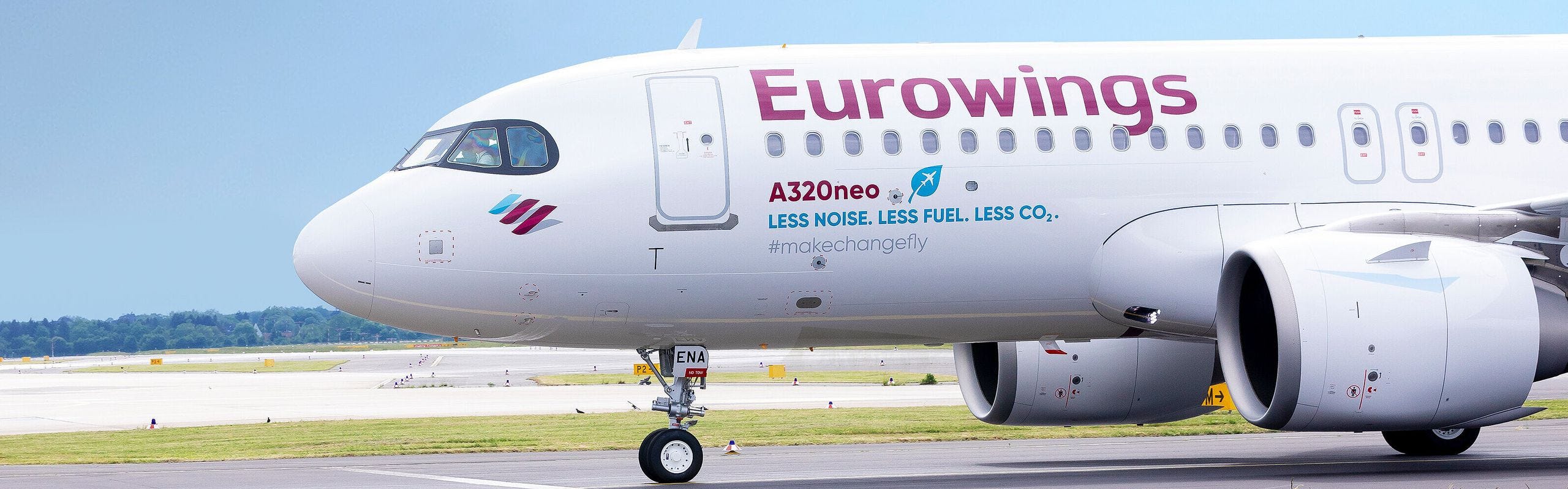
Eurowings is currently an all-Airbus operator of the A320 family. The published parent fleet data from the Lufthansa Group lists five aircraft sub-types for Eurowings GmbH.
EUROWINGS GMBH FLEET SNAPSHOT (31 MARCH 2026)
---------------------------------------------
Type           In service   Seats   Typical role
Airbus A319    Fleet count*  138    Domestic, short thin routes
Airbus A320    50            180    Core short/medium-haul workhorse
Airbus A320neo  8            180    Newer, premium-equipped
Airbus A321    6             226    High-density leisure
Airbus A321neo  5            232    Medium-haul Gulf and Levant
* A319 count varies by source and disposal phase
On top of the German AOC fleet, Eurowings Europe Ltd (the Maltese sister airline) operates its own 29 to 30 aircraft, split between six Airbus A319-100s and around 24 A320-200s as of the last published data.
The Eurowings Europe aircraft are used on routes marketed and sold by Eurowings, which is why the combined operating footprint is larger than the German AOC figure alone.
Why the A320 Family Still Matters in 2026
The A320 family is the backbone of short and medium-haul flying in Europe. For Eurowings it offers three things at once: seat capacity flexibility (138 to 232 seats), range up to 4,200 kilometers on the A321neo, and fleet commonality that keeps pilot training and maintenance costs predictable.
The A320neo and A321neo deliver roughly 15 to 20 percent better fuel burn per seat than the older A320-200s and A321-200s. That is what makes the Gulf medium-haul program possible without wide-body economics.
The older A319s are the weak link. They are smaller, burn more fuel per seat than newer narrowbodies, and are increasingly costly to keep airworthy as they age past the 20-year mark. That is exactly the segment of the fleet the 737 MAX order is designed to replace.
Fleet Age
Planespotters.net records an average Eurowings fleet age of around 14 years across the full book. That is older than Ryanair (which continues to take new 737-8200s straight from Boeing) and older than most of the Wizz Air A320neo-heavy fleet.
This age profile is a structural cost disadvantage that bleeds into fuel burn, maintenance, and reliability. It also explains why the Boeing MAX order is being marketed internally as “the largest fleet modernization in the company’s history” by the airline itself.
Eurowings Fleet Strategy to 2032: The 737 MAX 8 Transition
FLEET RENEWAL TIMELINE
----------------------
2025: Group allocates 40 x 737-8 MAX to Eurowings
2026: Continued A320neo/A321neo deliveries
2027: First 737-8 MAX delivery (Q3 2027)
2027-2032: 40 MAX 8s phased in
Parallel: Phase-out of A319s and older A320-200s
In January 2025, Lufthansa Group formally allocated the 40 Boeing 737-8 MAX aircraft it ordered to Eurowings. Deliveries are scheduled from Q3 2027 through 2032, per the airline’s own corporate release.
Each MAX 8 is being configured with 189 seats. That density sits between the current A320-200 (180 seats) and A321-200 (226 seats). It is a deliberate middle-seat count designed to substitute into the majority of current narrowbody missions.
Why a Boeing Order Inside an All-Airbus Airline Is a Big Deal
Eurowings has flown an all-Airbus short and medium-haul fleet for most of its recent history. Introducing the 737-8 MAX is a deliberate break from that pattern, and it has specific operational consequences.
It creates a second type rating inside the pilot base, which is a non-trivial training and rostering cost. It demands separate spares holdings, separate maintenance programs, and a different cockpit procedure set. No low-cost carrier does this lightly.
The decision is driven by Group-level economics. Lufthansa Group placed a very large single-aisle order in 2024 that included both Airbus A320neo-family frames and Boeing 737 MAX 8s. Allocating the MAX 8s to Eurowings lets the Group diversify its narrowbody supply risk while shielding Lufthansa mainline’s all-Airbus commonality.
Cabin Strategy: The New Premium Middle-Haul Product
At ITB Berlin 2026, Eurowings unveiled a new medium-haul premium standard. The concept moves away from the traditional 3x3 layout in the front rows of the A320neo and installs a 2x2 configuration instead, giving passengers more space and more privacy.
The product is being rolled out on selected business and leisure routes, with Mallorca, London, and other high-demand city pairs explicitly named in the airline’s announcement. It is being marketed as “Premium-BIZ” and sits above the existing BIZclass product.
CEO Max Kownatzki’s framing is revealing. He describes the product as “adapting industry standards to new customer expectations”, which is language pitched to a business traveler segment that pure ULCCs do not serve. Eurowings is quietly repositioning its A320neos as dual-purpose business/leisure aircraft.
Eurowings Europe Fleet (Maltese AOC)
The Maltese AOC fleet is a parallel operation to the German one. As of late 2025, it comprised approximately 30 aircraft: 6 A319-100s and around 24 A320-200s, all flown on routes scheduled and sold as Eurowings flights.
Eurowings Europe’s key bases are Palma de Mallorca, Prague, Salzburg, Graz, Stockholm-Arlanda, and Pristina. Vienna, the original base, is now a crew-only location without stationed aircraft.
Fleet Utilization and Reliability
Eurowings reports a fleet reliability rate above 99 percent for 2025 and a 72 percent on-time performance across 170,000 flights. Those figures are considerably above most European low-cost airline reference marks.
Utilization patterns shift by season. Maltese-registered aircraft see higher summer utilization at Palma de Mallorca and Graz, while German-registered aircraft peak twice, in summer leisure and around the Christmas/New Year window on Gulf and family-visiting routes.