Welcome to AviationOutlook: The aviation newsletter built exclusively for decision-makers.
Become an “Annual” member now & get this special discount offer.
As a paid member, you get access to:
200+ Reports - All major airlines + aerospace & defense companies (updated regularly).
Daily / Weekly - Deep-dive analysis & insights.
Monthly - Industry outlook reports.
In case you missed it, here are the latest analysis reports:
Embraer - Company Analysis and Outlook Report 2026 (Updated)
American Airlines’ Six-Route Europe Play: Yield Discipline or Widebody Overreach?
Check Out All Reports
Executive Summary
Garuda Indonesia posted a net loss of $323 million in FY2025, a 4.5x widening from $72.7 million the prior year, as revenues fell 5.9% to $3.22 billion and approximately 40% of the Group’s fleet remained non-operational at year-end.
Indonesian sovereign wealth fund Danantara injected Rp23.67 trillion (approximately $1.4 billion) in December 2025, but the funds were largely directed toward clearing legacy Pertamina fuel debts at subsidiary Citilink rather than new capacity expansion at the parent airline.
CEO Glenny Kairupan’s 2026 strategy centers on 11 operational transformation initiatives, targeting at least 68 serviceable Garuda aircraft and 50 Citilink aircraft by year-end, while a broader three-way merger with Citilink and Pelita Air is targeted for completion in H1 2026.
A separate Indonesia-US trade agreement includes a commitment to procure 50 Boeing aircraft valued at approximately $13.5 billion for Garuda, though financing structures remain under study and delivery timelines span years.
Recommended - Read Full Reports


Table of Contents
Executive Summary
The Reality Behind the Numbers: Why 2025 Was a Defining Year for Garuda Indonesia
Company Profile: Garuda Indonesia at a Glance
Key Financial Deep-Dive: Revenue, Cost Structure, and Loss Drivers
Revenue Performance: A Year of Contradictions
Cost Structure: Rigidity in the Face of Falling Revenue
Key Financial Figures at a Glance
Danantara’s $1.4 Billion Bet: What the Capital Injection Actually Did
The Injection Structure and Its Allocation
What the Injection Did Not Fix
Fleet Strategy and the Road to Operational Recovery
Current Fleet Composition
The 2026 Fleet Recovery Plan
The Long-Term Fleet Vision: 50 Boeing Aircraft and the $13.5 Billion Question
Network Strategy: Routes, Partnerships, and the 100-Route Ambition
Domestic Network: 37 Destinations and the Halim Strategy
International Network: Restoring and Expanding Key Corridors
The Japan Airlines Joint Business Agreement: A Watershed Partnership
Singapore Airlines Codeshare: Domestic Depth
Competitive Analysis: Garuda’s Position Against a Dominant Rival
Indonesia’s Domestic Market: Lion Air’s Fortress
Five-Forces Competitive Assessment
Regional Carrier Comparison: The Thai Airways Blueprint
Recent Developments: Key Inflection Points
Glenny Kairupan Takes the Helm: A Strategic Pivot to Maintenance-First
11 Strategic Initiatives for 2026: The Transformation Blueprint
Citilink and Pelita Air: The Three-Way Aviation Holding Merger
The French Court Ruling: A Small But Meaningful International Signal
INACA Pushes for a 15% Fare Cap Increase: Garuda’s Revenue Ceiling Problem
Key Risks: Probability Assessment and Scenario Analysis
Risk 1: Financial Sustainability
Risk 2: Operational Execution
Risk 3: Competitive Displacement
Risk 4: Regulatory and Currency Risk
Risk 5: Danantara Funding Continuity
Garuda’s Competitive Moat: What Remains When You Strip Away State Support
The Structural Advantages That Still Hold
The Structural Weaknesses That Need Addressing
2026 Outlook: What Needs to Happen for the Turnaround to Work
Primary Sources and Key Data References
My Final Thoughts
The Reality Behind the Numbers: Why 2025 Was a Defining Year for Garuda Indonesia
Garuda Indonesia entered 2025 carrying the ambitions of its post-bankruptcy restructuring, only to exit the year with its deepest financial wounds yet. Revenue contracted by 5.9% to $3.22 billion, while its core business, scheduled passenger services, bled a $228 million loss in a single fiscal year.
This is not simply a story of post-pandemic recovery lag. Indonesia’s aviation market was recovering. The problem was that Garuda could not capitalize on that recovery because roughly 40% of its Group fleet was grounded by end-2025 due to deferred heavy maintenance. The airline was organizationally configured for large-scale operations but operationally paralyzed.
Total passenger volumes fell 10.5% to 21.2 million, a stark decline at a time when regional competitors were adding seats, not shedding them. The gap between Garuda’s structural ambitions and its operational reality has rarely been wider.
Company Profile: Garuda Indonesia at a Glance
PT Garuda Indonesia (Persero) Tbk is Indonesia’s national flag carrier, operating under the ticker GIAA on the Indonesia Stock Exchange (IDX).
The airline is majority-controlled by the Indonesian government through Danantara, the state sovereign wealth fund, following the December 2025 capital injection that reduced the public float from approximately 27% to just 8%.
The airline currently employs approximately 10,910 people and operates across three primary business segments:
Flight Operations (scheduled and non-scheduled passenger and cargo transport),
Aircraft Maintenance Services (through its MRO subsidiary GMF AeroAsia), and
Other Operations (ground handling, catering, and information systems).
Headquarters: Jakarta, Indonesia
Hub: Soekarno-Hatta International Airport (CGK), Jakarta
Secondary Hub: Ngurah Rai International Airport (DPS), Bali
Alliance: SkyTeam
IATA Code: GA / Ticker: GIAA
Revenue (LTM FY2025): $3.22 billion
Net Loss (FY2025): $323 million
Operating Loss (FY2025): $354.3 million
Operable Fleet (as of late 2025): approximately 58 of 72 total aircraft
Domestic Routes: 37 destinations
Employees: 10,910
Key Financial Deep-Dive: Revenue, Cost Structure, and Loss Drivers
Revenue Performance: A Year of Contradictions
Garuda’s H1 2025 performance initially offered reasons for cautious optimism. H1 2025 revenue reached $1.548 billion, growing 4.48% year-over-year. Q1 2025 alone delivered $723.56 million, up 1.63% annually, with passenger revenue growing at an impressive 92.9%.
But by H2 2025, capacity constraints took full effect. As funding ran thin and more aircraft entered unscheduled downtime awaiting heavy maintenance checks, the airline was simply unable to fly enough seats to sustain its revenue base. The full-year outcome was a 5.9% revenue contraction to $3.22 billion.
The contrast between the strong early performance and the full-year collapse tells a precise story: Garuda’s problem is not demand. It is operational throughput.
Cost Structure: Rigidity in the Face of Falling Revenue
Operating expenses declined by only 0.17% against a 5.9% revenue fall, exposing the deep rigidity of Garuda’s cost base. The airline cannot meaningfully reduce costs in the short term, because its largest cost categories are either structurally fixed or actively increasing.
Maintenance costs surged 23% to $661.36 million, reflecting the steep “deferred maintenance penalty” that is universal in commercial aviation: every dollar of maintenance postponed during financial distress generates multiples in remediation costs later. Financial expenses rose 9.56% to $525.7 million, reflecting the ongoing burden of restructured debt obligations.
Late payment penalties jumped 700%, from $1.4 million to $11.1 million, a signal that vendor relationships were under severe strain even after the capital injection. Payments to key MRO vendors and fuel suppliers were still being delayed, prolonging aircraft downtime in a feedback loop that is difficult to break.
Key Financial Figures at a Glance
Full Year 2025 Financial Summary (Garuda Indonesia Group)
---------------------------------------------------------
Total Operating Revenue:        US$3.22 billion   (-5.9% YoY)
Operating Profit/(Loss):       (US$354.3 million)
Net Loss:                       US$322-323 million (+344% vs FY2024)
Prior Year Net Loss:            US$72.7 million
Maintenance Costs:              US$661.36 million  (+23% YoY)
Financial Expenses:             US$525.7 million   (+9.56% YoY)
Late Payment Penalties:         US$11.1 million    (+700% YoY)
Total Passengers Carried:       21.2 million       (-10.5% YoY)
Post-Injection Equity:          US$91.9 million    (marginally positive)
Danantara’s $1.4 Billion Bet: What the Capital Injection Actually Did
The Injection Structure and Its Allocation
On December 5, 2025, Danantara Indonesia completed a Rp23.67 trillion (approximately US$1.4 billion) capital injection into the Garuda Group. This followed an earlier shareholder loan of Rp6.65 trillion ($405 million) disbursed in June 2025.
The final December injection was structured as a capital increase without preemptive rights, which consolidated state control by reducing the public float from approximately 27% to just 8%. Critically, the allocation reveals how constrained the situation truly was.
Approximately 63% of the capital was redirected to Citilink, Garuda’s low-cost subsidiary, primarily to settle a three-year accumulated fuel debt owed to Pertamina.
The parent airline, Garuda Indonesia itself, received approximately Rp8.7 trillion ($524 million) for fleet recovery, a sum far below what is required to reactivate all 43 grounded aircraft in a fleet of that complexity.
What the Injection Did Not Fix
The Danantara capital raised equity to a marginally positive $91.9 million, but this cosmetic balance sheet improvement masked persistent operational dysfunction. Operating cash flow remained impaired, as evidenced by the continued surge in vendor late-payment penalties.
The intervention functioned primarily as a financial cleanup operation: settling legacy Pertamina obligations at Citilink and providing working capital headroom at the parent. It was not, by any objective measure, a forward-looking expansion strategy. Danantara’s own stated mandate carries a 7% return on assets target, signaling a shift toward commercial discipline rather than perpetual subsidy.
The injection did, however, buy time. Without it, Garuda would have faced the prospect of falling into negative equity, which would have triggered delisting risks on the IDX and further restricted access to commercial financing.
In that sense, December 2025 was a stabilization moment, not a recovery moment.
Fleet Strategy and the Road to Operational Recovery
Current Fleet Composition
Garuda Indonesia’s operable fleet is small and aging relative to its route ambitions. The airline currently operates a mix of:
Garuda Indonesia Fleet Composition (as of late 2025)
------------------------------------------------------
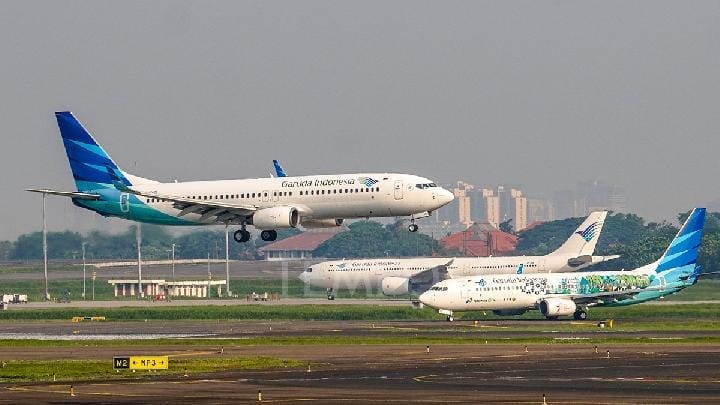
Boeing 737-800NG:         45 aircraft (primary domestic workhorse)
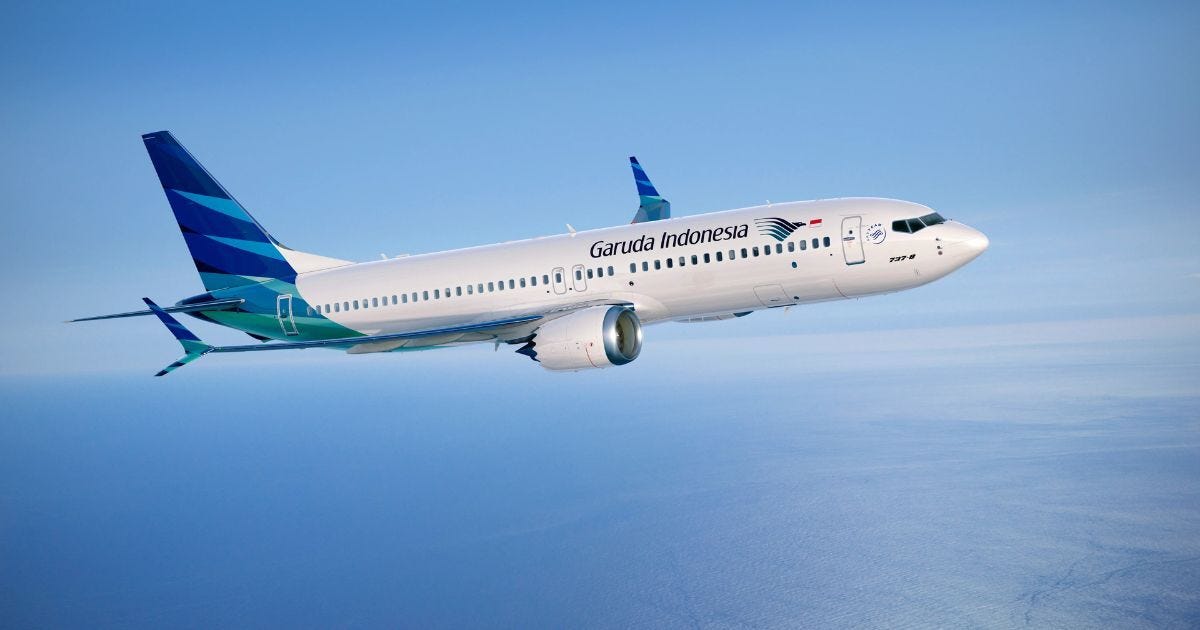
Boeing 737 MAX 8:          1 aircraft  (leased, delivered August 2025)
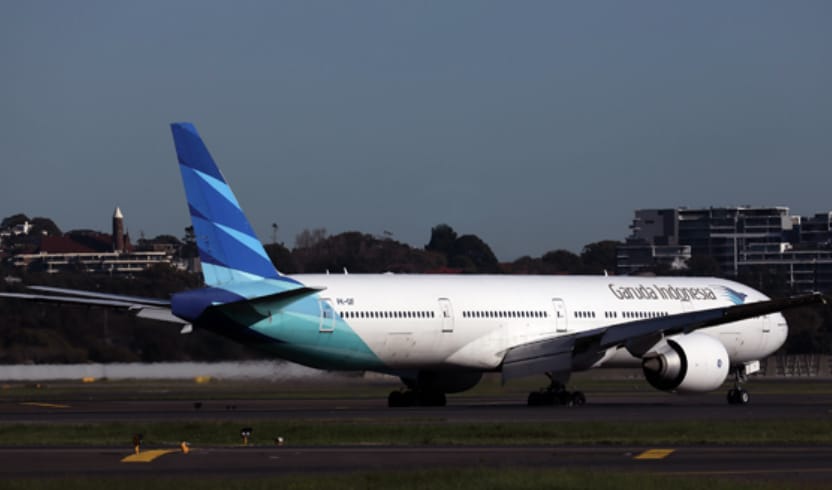
Boeing 777-300ER:          8 aircraft  (long-haul widebody)
Airbus A330-200/300:       approx. 10 aircraft
Airbus A330-900neo:        small number in service
---------------------------------------------------------
Total (approx.):          ~72 aircraft (Group-wide, including Garuda only)
Operational:              ~58 aircraft
Grounded:                 ~34 aircraft (approximately 40% of Group fleet)
The 2026 Fleet Recovery Plan
CEO Glenny Kairupan has made operational fleet recovery the single highest priority of 2026. Through the Danantara capital support, Garuda targets at least 68 serviceable aircraft by year-end 2026, up from approximately 58 operational aircraft in late 2025. Simultaneously, Citilink targets 50 serviceable aircraft by end-2026.
This recovery plan is backed by a structured maintenance acceleration program covering three aircraft types:
2026 Heavy Maintenance Acceleration Program
--------------------------------------------
Boeing 737-800NG:     Airframe heavy checks (multiple cycles)
Boeing 777-300ER:     Airframe heavy checks (widebody-specific)
Airbus A330:          Airframe heavy checks
Engine overhauls:     Multiple APU shop visits, landing gear overhauls
The new management’s 100-day transformation plan, launched after Kairupan’s appointment in late 2024, represents a firm operational deadline.
During the 2025-2026 holiday peak season, Garuda’s in-house MRO arm, GMF AeroAsia, supported 12,654 flights for the Group while maintaining readiness of up to 97 aircraft per day.
This operational demonstration proves the internal capability exists; the constraint is funding for spare parts and engine overhaul cycles.
The Long-Term Fleet Vision: 50 Boeing Aircraft and the $13.5 Billion Question
Embedded within the Indonesia-US Reciprocal Trade Agreement is a commitment to acquire 50 Boeing aircraft valued at approximately $13.5 billion for Garuda.
As of March 2026, no specific aircraft types have been formally designated, and three financing pathways remain under consideration: a direct Danantara capital injection, self-funded from company profits, or manufacturer credit through deferred payment structures.
The most recent actual fleet addition was a single Boeing 737 MAX 8 taken on lease in August 2025, introduced with a refreshed Garuda livery. This modest single-aircraft addition underscores the gap between headline commitments and the pace of actual fleet renewal.
As The Jakarta Post highlighted, the Boeing deal could represent a multi-decade commitment involving complex financing, maintenance ecosystems, and production timelines that stretch years into the future. Delivery slots for Boeing aircraft currently run up to seven years out.
Any determination that Garuda requires widebody versus narrowbody aircraft will materially affect the financial structure and route economics of the deal.
The airline is also actively engaging Embraer on regional aircraft, with CEO Kairupan meeting President Prabowo alongside Embraer representatives to discuss technology adaptation in Indonesian commercial aviation.
Network Strategy: Routes, Partnerships, and the 100-Route Ambition
Domestic Network: 37 Destinations and the Halim Strategy
Garuda Indonesia currently serves 37 domestic destinations across the Indonesian archipelago, a network constrained by fleet availability. The airline has been routing some Jakarta-Bali flights through Halim Perdanakusuma Airport rather than the congested Soekarno-Hatta International Airport, providing an alternative gateway for travelers in the capital.
The Jakarta-Samarinda route, launched in 2025, reflects Garuda’s renewed focus on connecting resource-rich East Kalimantan, a region of significant strategic importance given Indonesia’s new capital Nusantara project nearby. This route will continue expanding in 2026 as part of the domestic network optimization initiative.
The airline’s long-term target of 100 routes by 2029 represents ambitious growth from the current network, but this is explicitly contingent on fleet availability. Without a meaningful increase in serviceable aircraft, route expansion remains aspirational rather than executable.
International Network: Restoring and Expanding Key Corridors
The Jakarta-Doha route is among the most commercially significant restorations of 2025-2026.
Garuda returned to daily Jakarta-Doha operations in late June 2025 after a two-year pause triggered by Middle East geopolitical tensions. Doha is a critical commercial and transit hub, and this route directly taps into the growing demand between Indonesia’s Muslim-majority population and the Gulf.
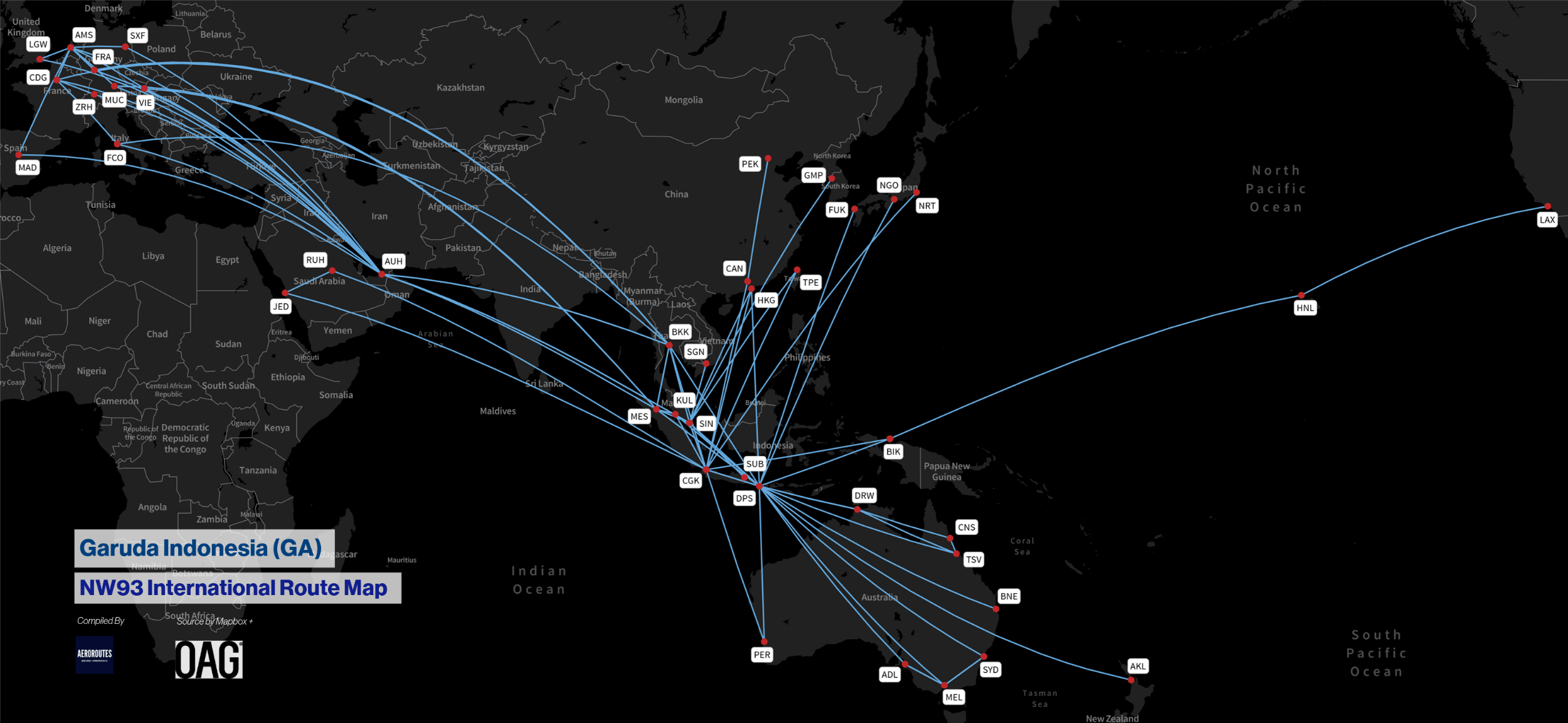
On the Australia corridor, Garuda is increasing Bali-Melbourne frequencies from 7 to 11 weekly flights in 2026, deploying larger aircraft on the route to capture the strong demand from both leisure travelers and the Indonesian diaspora in Australia.
Key International Network Developments (2025-2026)
----------------------------------------------------
Jakarta - Doha (QR hub):    Daily operations resumed June 2025
Bali - Melbourne:           Expanded from 7 to 11 weekly flights
Jakarta - Tokyo (Haneda):   Codeshare with Japan Airlines (from Apr 2025)
Bali (DPS) - Tokyo (NRT):   Codeshare with Japan Airlines (from Apr 2025)
Domestic Indonesia:         Codeshare with Singapore Airlines (from Sep 2025)
India-Indonesia routes:     Codeshare with IndiGo
The Japan Airlines Joint Business Agreement: A Watershed Partnership
On April 1, 2025, Garuda Indonesia and Japan Airlines officially launched their Joint Business Agreement (JBA), one of the most commercially significant airline partnerships in Southeast Asia in recent years.
The agreement was formally signed on October 3, 2024, following Japanese regulatory antitrust clearance. Indonesia’s competition authority KPPU set a precedent with this approval as the first antitrust clearance for a non-merger aviation JBA.
Under the JBA, both airlines cooperate commercially on routes between Japan and Indonesia, offering joint business common fares and coordinated schedules. KrisFlyer and GarudaMiles members began reciprocal earning and redemption on codeshare routes from February 4, 2025.
The partnership adds Denpasar-Narita and Jakarta-Haneda codeshare routes to Garuda’s connectivity toolkit, providing important traffic feed for Garuda’s thin widebody operations.
For a carrier struggling with limited fleet availability, JBA partnerships offer a capital-efficient way to appear larger than current operations allow.
Singapore Airlines Codeshare: Domestic Depth
In August 2025, Garuda Indonesia and Singapore Airlines deepened their commercial cooperation, expanding their codeshare to include domestic Indonesian routes from September 2025.
Singapore Airlines now offers SQ-coded flights to Indonesian domestic destinations operated by Garuda, including Denpasar-Labuan Bajo. Reciprocal lounge access was also launched.
This partnership is strategically intelligent for Garuda: SIA’s premium customer base values reliability, and Garuda’s domestic network gives SIA connecting depth it cannot economically self-operate.
For Garuda, the SIA codeshare provides commercial premium, particularly on connections through Singapore’s Changi hub.