


Dear Readers, Welcome to AviationOutlook.
The drone industry enters July 2026 with a stack of announcements that will still be echoing at year end.
Two American builders have been picked to produce the first operational Collaborative Combat Aircraft.
Ukraine is on pace to manufacture seven million military UAVs this calendar year.
Amazon, Wing, and Zipline are simultaneously scaling BVLOS deliveries in real neighborhoods rather than pilot corridors.
That combination of industrial scale, regulatory unlock, and battlefield validation is what makes this specific month a useful vantage point. The commercial and defense segments have stopped moving on separate tracks, and the same suppliers, chips, motors, and software stacks are now feeding both.
Let’s analyze everything in detail.
Executive Summary
The U.S. Air Force has moved both Anduril’s YFQ-44A Fury and General Atomics’ YFQ-42A into the production phase of Increment 1 of the Collaborative Combat Aircraft program, four months ahead of schedule, with Anduril’s Arsenal-1 factory in Ohio activating serial output.
Ukraine has publicly targeted 7 million military drones for calendar 2026, up from 4 million in 2025, while Russia is rebuilding and expanding its Shahed-style facility at Alabuga toward a stated goal of 1,000 long-range strike drones per day.
Wing and Walmart added seven more metros in June to a network that both companies say will exceed 270 delivery locations by 2027, while Zipline is now operating with a nationwide BVLOS waiver granted under the Trump administration’s June 2025 executive orders.
The FAA’s proposed Part 108 rulemaking on routine BVLOS operations remains in a reopened comment window that closed in early 2026, and drone operators, insurers, and airspace users are all preparing for a final rule that will restructure how commercial drones share U.S. airspace.
Recommended Reports


Read All Reports
Introduction
Two years ago, a working assumption in most Western capitals was that autonomous air power would arrive slowly, that Chinese consumer drones were an entertainment story, and that BVLOS delivery would remain a demonstration format.
Every one of those assumptions has been overturned inside a single fiscal quarter.
Anduril’s Fury has moved from prototype to production. Zipline is flying deliveries across state lines. And Ukrainian workshops are shipping more attack drones per week than most NATO militaries have fielded in their entire history.
This report is a snapshot of where the global drone industry stands entering July 2026.
It’s for people who actually build, buy, regulate, and operate these systems. The signal here is that industrial capacity, not concept validation, is now the constraint.
The pieces that matter this month are concrete.
A production contract from the Air Force. A $186 million Switchblade order. A June 1 billion dollar Ohio plant beginning to move hardware. A drone light show over Santa Monica Pier launched by the same industry that supplies police departments.
Each one is a data point in the same trend line, which is that drone hardware has completed its transition from novelty to infrastructure.
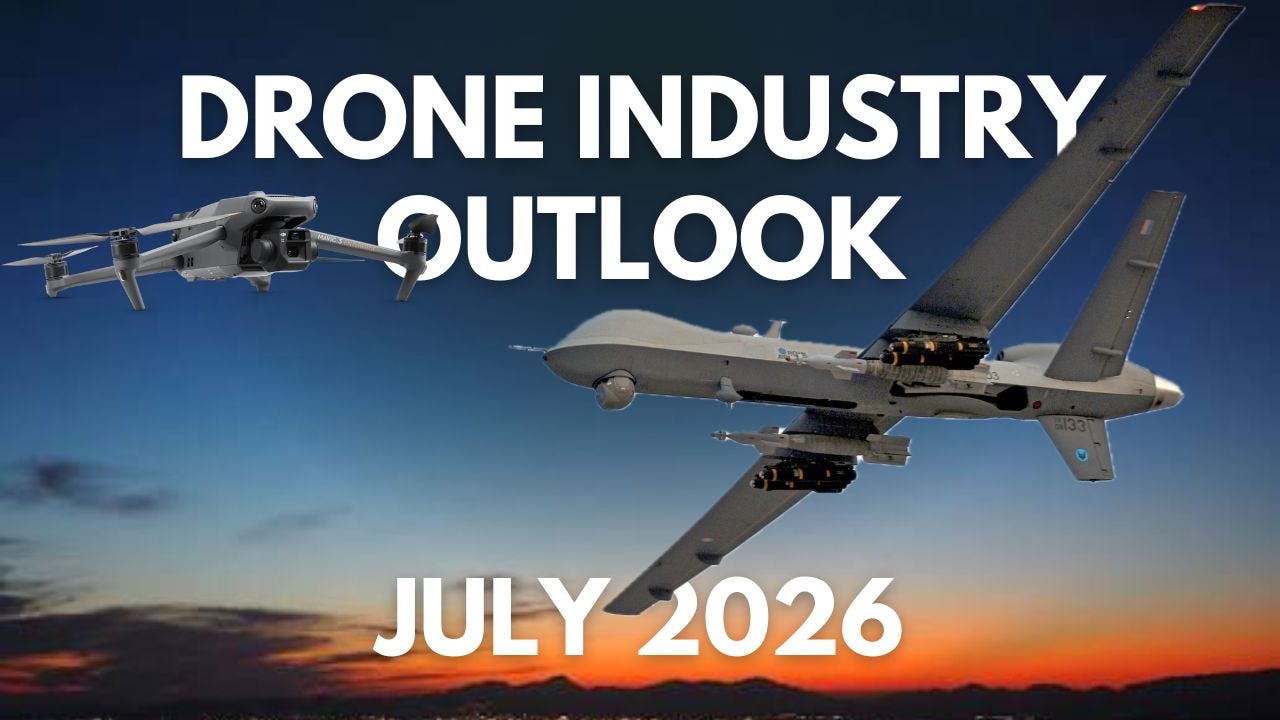
The Air Force Just Picked Its First Operational Combat Drones
On June 17, 2026, the United States Air Force announced production contracts for two Collaborative Combat Aircraft designs, Anduril’s YFQ-44A Fury and General Atomics’ YFQ-42A.
The decision came four months ahead of the service’s own schedule, which is an unusual outcome for major defense acquisition and worth reading closely.
Both platforms will now proceed into what the Air Force is calling Increment 1 of the CCA program. The winning aircraft are designed to fly alongside crewed fighters as loyal wingmen, carrying munitions, expanding sensor coverage, and absorbing risk that would otherwise be borne by pilots.
Anduril’s own statement described the award as a validation of a merchant-model defense company beating traditional primes in a head-to-head competition.
The company noted that Arsenal-1, its Ohio factory, had already begun airframe assembly ahead of the decision, betting that speed of manufacturing would matter more than paperwork.
YFQ-44A Fury (Anduril)
Type: Autonomous fighter-class CCA
First flight: 2025
Production start: March 2026 (Arsenal-1, Ohio)
Production contract: June 17, 2026
Facility employment target: ~4,000 by 2036

YFQ-42A (General Atomics)
Type: Autonomous fighter-class CCA
Ancestry: Derived from XQ-67A OBSS
Production contract: June 17, 2026The interesting operational story sits inside the industrial base.
Anduril is running a factory model in which airframes, motors, avionics, and mission software are all designed under one roof, with the same Lattice command layer being used across other product lines.
That vertical integration is a departure from the way primes have handled autonomy programs, where subsystems get bid out and integration risk is absorbed by the government.
General Atomics brings the opposite pedigree, decades of MQ-1 and MQ-9 operational history, plus the XQ-67A demonstrator that fed directly into the YFQ-42A architecture.
The Air Force choosing one of each is a deliberate hedge, keeping a legacy prime and a defense-tech insurgent both under contract.
For the industry, the second-order effects are more important than the platforms themselves.
Turbojet engine suppliers, ejection seat vendors, radar module houses, and mission software vendors all now have visible pull-through demand into the late 2020s. Suppliers who spent a decade waiting for someone to actually order autonomous jets in bulk finally have a call sheet.
The Marine Corps track deserves its own note.
Kratos and Northrop Grumman are advancing a MQ-58A Valkyrie variant for USMC loyal wingman missions, with the first operational Marine Corps MQ-58 drones expected to arrive in 2029.


Airbus and Kratos have also disclosed that a “europeanized” XQ-58 variant is targeted to fly before the end of 2026, opening a genuine transatlantic route for shared CCA hardware and adjacent munitions.
That matters because European air forces are staring at the same air-defense saturation problem and want a mid-cost autonomous strike option.
Anduril’s Arsenal-1 and the Reindustrialization of American Airframes
Anduril’s decision to build a hyperscale drone factory in Ohio, rather than in California or Texas, was not incidental.