


Executive Summary
Juneyao Airlines Group ended 2025 with 129 aircraft in operation. The mainline carrier operates 93 Airbus A320-family jets and 10 Boeing 787-9 widebodies, while its 9 Air subsidiary runs 26 Boeing 737 aircraft from Guangzhou, reflecting a clear dual-brand architecture.
First-half 2025 revenue came in at CNY 11.07 billion with net profit of CNY 505 million, and nine-month revenue reached CNY 17.48 billion, although nine-month net profit contracted 14.3% year on year as yield pressure from intense domestic competition bit into margins.
A $4.1 billion order for 25 additional Airbus A320-family aircraft was signed on 29 December 2025, cementing a narrowbody growth path through the late 2020s and reinforcing the carrier’s relationship with Airbus after earlier Boeing 787 delivery deferrals.
Juneyao is targeting full Star Alliance membership during its 20th-anniversary year of 2026, graduating from its current Connecting Partner status and opening a path to deeper commercial integration with carriers such as Lufthansa, ANA, Singapore Airlines, and United.
Recommended - Read Full Reports


Read All Reports
Table of Contents
Executive Summary
Introduction
Key Facts: Company Profile
Business Overview: Juneyao Airlines
Corporate Positioning: The HVC Doctrine
Revenue Base and Latest Financial Performance
Juneyao Air Revenue Growth Drivers
Cost Structure and Fuel Sensitivity
Key Services and Products
Group Structure: Dual-Brand Architecture
Juneyao Air Fleet: In-depth Analysis
Total Fleet Size and Age
Mainline Fleet Composition
Narrowbody Strategy: Airbus Loyalty Reinforced
The A321neo: Medium-Haul Bridge Aircraft
Widebody Strategy: Boeing 787-9 Only
Fleet Age, Utilization, and Efficiency
9 Air Fleet: Simplicity as Strategy
Juneyao Air Route Network, Major Destinations and Strategy
Overall Network Shape
Domestic Core
International Layer: Northeast and Southeast Asia
Intercontinental: The Seven-Point Long-Haul Map
The Helsinki Hub: Fifth Freedom Innovation
Oceania: Sydney and Melbourne
Secondary Hubs: Wuxi and Nanjing Build-Out
Major Operational Bases
Shanghai: The Home Fortress
Nanjing: The Original Second Base
Beijing Daxing and Other Secondary Operations
Guangzhou: The 9 Air Stronghold
Competitive Position
Juneyao vs. China Eastern Airlines
Juneyao vs. Air China
Juneyao vs. Spring Airlines
Juneyao vs. Hainan Airlines
Juneyao vs. Foreign Network Carriers
Juneyao vs. China Southern
Star Alliance Aspirations: From Connecting Partner to Full Member
Loyalty, Distribution, and Partnerships
Cargo and Mail Operations
Customer Experience and Cabin Product
Inflight Connectivity
Sustainability and Operational Efficiency
Digital and Ancillary Revenue Strategy
Key Risks with Probabilities and Scenarios
Risk 1
Risk 2
Risk 3
Risk 4
Risk 5
Risk 6
Risk 7
Strategic Opportunities and Catalysts
Comparison with Peer Group
Digital Infrastructure and Technology Strategy
Government Policy Environment
Financial Outlook Indicators
Industry Context: Chinese Aviation in 2026
Leadership and Governance
Long-Term Positioning: The 20th Anniversary Inflection
Technical Operations and Safety
Ancillary Business: JuneYao Auto
What Makes Juneyao Distinctive
What to Watch in 2026 and Beyond
My Final Thoughts
Official Sources and Data
Introduction
Juneyao Air has quietly built something unusual in Chinese aviation: a mid-sized privately owned full-service carrier that refuses to compete on price, refuses to abandon Shanghai, and refuses to behave like a low-cost upstart even as it owns one.
20 years after the Wang brothers received their operating license in 2005, the airline now flies 103 jets under the Juneyao brand, runs a 26-aircraft Boeing 737 subsidiary in Guangzhou, and has set its sights on becoming the first mainland Chinese airline to join Star Alliance as a full member.
This in-depth report analyzes the latest operational data, financial outlook, recent fleet and route announcements, competitive outlook, risks, and more, to paint a detailed picture of where the carrier sits heading into its 20th anniversary year.
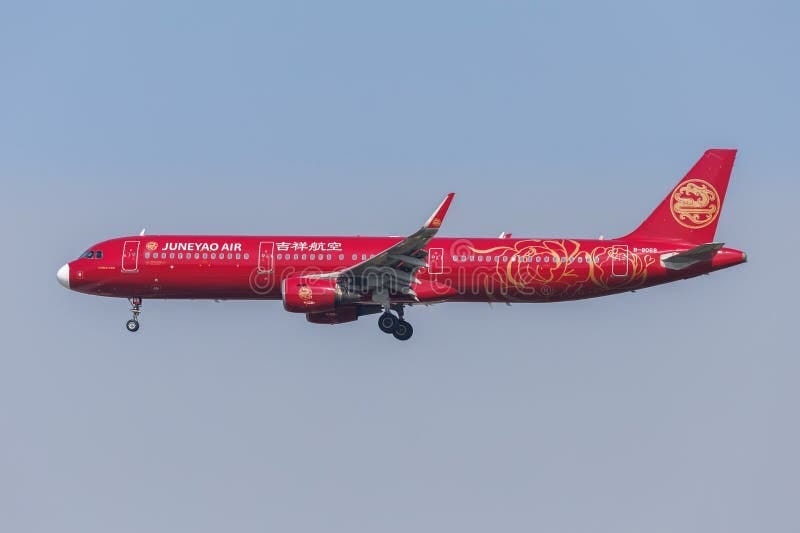
Key Facts: Company Profile
Company Name:       Shanghai Juneyao Airlines Co., Ltd.
Chinese Name:       上海吉祥航空股份有限公司
Stock Ticker:       603885.SS (Shanghai Stock Exchange)
IATA / ICAO / Call: HO / DKH / Air Juneyao
Founded:            30 June 2005
First Flight:       25 September 2006
Parent Group:       Shanghai Juneyao (Group) Co., Ltd.
Chairman:           Wang Junjin
CEO / GM:           Cheng Jiyu
Headquarters:       No. 80 Hongxiang Sanlu, Changning, Shanghai
Primary Hubs:       Shanghai Hongqiao (SHA), Shanghai Pudong (PVG)
Secondary Bases:    Nanjing (NKG), Beijing Daxing (PKX), Wuxi (WUX)
Subsidiary LCC:     9 Air (AQ) based at Guangzhou Baiyun (CAN)
Alliance Status:    Star Alliance Connecting Partner (since 2017)
Group Fleet Size:   129 aircraft (as of 31 December 2025)
Average Fleet Age:  Approximately 8.4 years
H1 2025 Revenue:    CNY 11.07 billion
9M 2025 Revenue: CNY 17.48 billionThe company is majority controlled by the Juneyao Group, whose founder Wang Junjin remains Chairman.
Wang co-founded the airline with brothers Wang Junhao and the late Wang Junyao. A recent shareholder disclosure noted that the controlling shareholder trimmed its stake to 43.74% from 46.74%, a move framed as portfolio rebalancing rather than a change in strategic control.
Business Overview: Juneyao Airlines
Corporate Positioning: The HVC Doctrine
Juneyao Airlines is not a typical state-affiliated Chinese carrier, nor is it a pure low-cost challenger.
The group’s stated strategic identity, repeated across its financial filings, is to be an “HVC” - a High Value Carrier. Management defines this as a carrier that delivers “leading service quality” on top of an “optimal cost structure,” without engaging in head-on price wars.
That positioning matters because it shapes everything downstream.
It shapes cabin configuration, fleet choices, and where the airline chooses to compete.
It also explains why Juneyao maintains a Prime Seat product on selected Airbus narrowbodies while operating a separate low-cost brand in 9 Air rather than watering down the mainline.
The company’s leadership has been consistent about refusing to chase price leadership.
Chairman Wang Junjin has publicly said that it is more important for a company to grow longer than to grow big, a phrase that appears across Chinese business media profiles of the founder and aligns with the airline’s unhurried capacity expansion.
Revenue Base and Latest Financial Performance
Juneyao’s revenue engine runs on three core streams: domestic passenger transport, international passenger transport, and cargo and mail. The company also earns ancillary income from its loyalty program and from aircraft sublease arrangements.
For the first half of 2025, the company reported operating revenue of CNY 11,067,182,245.21 and a net profit attributable to shareholders of CNY 505,492,241.40.
That was a year-on-year revenue increase of roughly 1.02%, a deceleration compared with the rebound growth of 2023 and 2024 and a clear signal that the domestic Chinese air travel market had entered a yield-compressed phase.
The nine-month picture through 30 September 2025 is even more instructive.
Total operating revenue reached CNY 17.48 billion, essentially flat year on year at negative 0.1%. Net profit slid to CNY 1.089 billion, down 14.3% from the same period of 2024.
Total assets were reported at CNY 49,894 million.
Juneyao Airlines Selected Financials

Period                 Revenue (CNY)        Net Profit (CNY)
H1 2024                ~10.96 billion       ~580 million
H1 2025                11.07 billion        505 million
9M 2024 (prior)        ~17.50 billion       ~1.27 billion
9M 2025                17.48 billion        1.089 billion
Q3 2025                6.41 billion         584 million

Source: Company interim and quarterly filingsThe Q3 2025 net profit figure of CNY 584 million represented a 25.3% decline year on year despite a traditionally strong summer travel period.
Management attributed the compression primarily to yield weakness on domestic routes and higher fuel costs, partially offset by improving load factors on international and regional segments.
Juneyao Air Revenue Growth Drivers
Several concrete growth drivers are visible in the operational data and commentary inside the company’s 2025 filings. The most obvious is international route capacity recovery, which gathered pace during 2024 and 2025 as China’s outbound travel market reopened.
International RPK grew faster than domestic RPK throughout the second half of 2025. The December 2025 disclosure showed international passenger turnover up 5.77% year on year, while domestic turnover edged up only 0.85%. That differential is not a one-month anomaly; it is the defining mix-shift of the year.
A second driver is wide-body utilization on intercontinental routes. The addition of Shanghai to Brussels, Shanghai to Athens, and Shanghai to Manchester via Helsinki has increased stage lengths flown by the 787-9 fleet, which in turn lifts ASK per airframe without needing to add aircraft.
A third driver, less discussed outside Chinese investment research notes, is the quality upgrade of route yields.
Through Q3 2025, the carrier focused on optimizing the structure of its international network, swapping thinner regional frequencies for higher-yield intercontinental stage lengths and adjusting Southeast Asia deployment toward destinations with stronger premium leisure demand such as Phuket, Penang, Denpasar, and Phu Quoc.
Cost Structure and Fuel Sensitivity
Jet fuel remains the single largest operating expense line for Juneyao, as it is for every Chinese carrier. Industry disclosures suggest that fuel accounts for roughly one-third of total operating costs for the three state-owned majors, and Juneyao tracks close to that ratio given its comparable narrowbody-heavy profile.
The sensitivity to fuel explains why, in April 2026, Juneyao joined Spring Airlines and other mainland carriers in raising domestic fuel surcharges in response to a spike in crude prices linked to Middle East tensions. Surcharges are an imperfect but immediate tool to partially offset input cost shocks while pricing contracts reset.
Currency exposure is the second pressure point. The Boeing 787 fleet is financed largely in US dollars, and leases on imported Airbus aircraft involve either dollar or euro components. A weaker yuan increases both lease obligations and fuel import costs, which is why the company explicitly flagged foreign exchange hedging in its 2025 interim report.
Key Services and Products
The Juneyao passenger product line is tiered around three clear propositions.
The first is the premium long-haul business class on the 787-9 Dreamliner. The cabin uses a 1-2-1 configuration with Thompson Vantage XL fully lie-flat seats, 29 business class seats, 295 economy seats, and an 18-inch personal touchscreen.
The second tier is the Prime Seat product on selected A320 and A321 aircraft, which provides a domestic premium experience without a full business class cabin. This is a unique positioning in the mainland Chinese market where true premium-economy products are rare on narrowbody types.
The third tier is standard economy, which remains the volume engine of the business.
The narrowbody cabin layout emphasizes practical pitch and standard inflight catering, sitting above the stripped-down low-cost model run by 9 Air.
The airline’s membership card scheme, Gratitude Card, and its integration with Star Alliance upgrade paths round out the retail loyalty architecture.
Group Structure: Dual-Brand Architecture
Under the holding company sit two distinct operating airlines. The flagship Juneyao Airlines operates a full-service model from Shanghai with 103 aircraft. Alongside it, the Guangzhou-based 9 Air operates as a pure Boeing 737 low-cost carrier, with 26 aircraft in service at year-end 2025 according to the group monthly disclosure.
The brand separation is deliberate. Juneyao management has consistently described the two airlines as serving different customer segments with strictly separated cost structures. That allows the group to participate in the price-sensitive leisure segment through 9 Air without contaminating the HVC brand equity of Juneyao itself.
Group Brand Architecture

Juneyao Airlines (HO)
  - Positioning: High Value Carrier (HVC)
  - Fleet: 93 A320 family + 10 B787-9
  - Base: Shanghai Hongqiao and Pudong
  - Target: Business and premium leisure

9 Air (AQ)
  - Positioning: Pure low-cost carrier
  - Fleet: 26 Boeing 737 family
  - Base: Guangzhou Baiyun
  - Target: Price-sensitive leisure

Beyond Aviation: JuneYao Auto (electric vehicle brand),
Juneyao Group retail, logistics, and hospitality
The parent Juneyao Group also holds interests outside aviation, including the dairy brand Juneyao, hospitality, retail, and an electric vehicle project.
In 2023, the airline itself formally entered the automotive segment by launching the JuneYao Auto branch, which acquired the financially troubled Yudo electric vehicle startup.
Juneyao Air Fleet: In-depth Analysis
Total Fleet Size and Age
At the close of 2025, the Juneyao group operated 129 aircraft across both brands. Of these, 103 belonged to the mainline Juneyao operation and 26 to 9 Air, per the December 2025 monthly operating disclosure.
By April 2026, most commercial databases report 103 to 105 aircraft on the Juneyao certificate with a small number on order or in transition.
The average fleet age sits around 8.4 years, young by global standards but slightly older than more recently launched mainland carriers that started with all-neo deliveries.
Mainline Fleet Composition
The Juneyao mainline fleet is almost perfectly split between Airbus A320-family narrowbodies and a small group of Boeing 787-9 Dreamliners. The airline reported the following breakdown as of 31 December 2025:
Juneyao Airlines Mainline Fleet (Year-End 2025)

Aircraft Type        In Service     Role
Airbus A320ceo       30             Domestic trunk
Airbus A320neo       22             Domestic and regional
Airbus A321ceo       27             High-density trunk
Airbus A321neo       14             Medium-haul international
Boeing 787-9         10             Long-haul intercontinental
Total                103            -

Source: Company December 2025 disclosureWithin 9 Air, all 26 aircraft are Boeing 737 family, split between 737-800 and 737 MAX 8 variants, which the subsidiary operates in all-economy single-class configuration.


Narrowbody Strategy: Airbus Loyalty Reinforced
Juneyao’s narrowbody strategy has been one of the most Airbus-loyal in China.
While larger flag carriers operate mixed Boeing and Airbus narrowbody fleets, the Juneyao mainline has stayed exclusively Airbus A320 family since inception.
That consistency generates measurable savings in training, maintenance, and spares pooling.
The company doubled down on this path at the end of 2025. On 29 December 2025, Juneyao filed a disclosure with the Shanghai Stock Exchange announcing the purchase of 25 Airbus A320-family aircraft for a total of approximately $4.1 billion at list prices.
The same day, Spring Airlines confirmed a parallel 30-aircraft order, taking the combined order from the two private carriers to 55 jets.
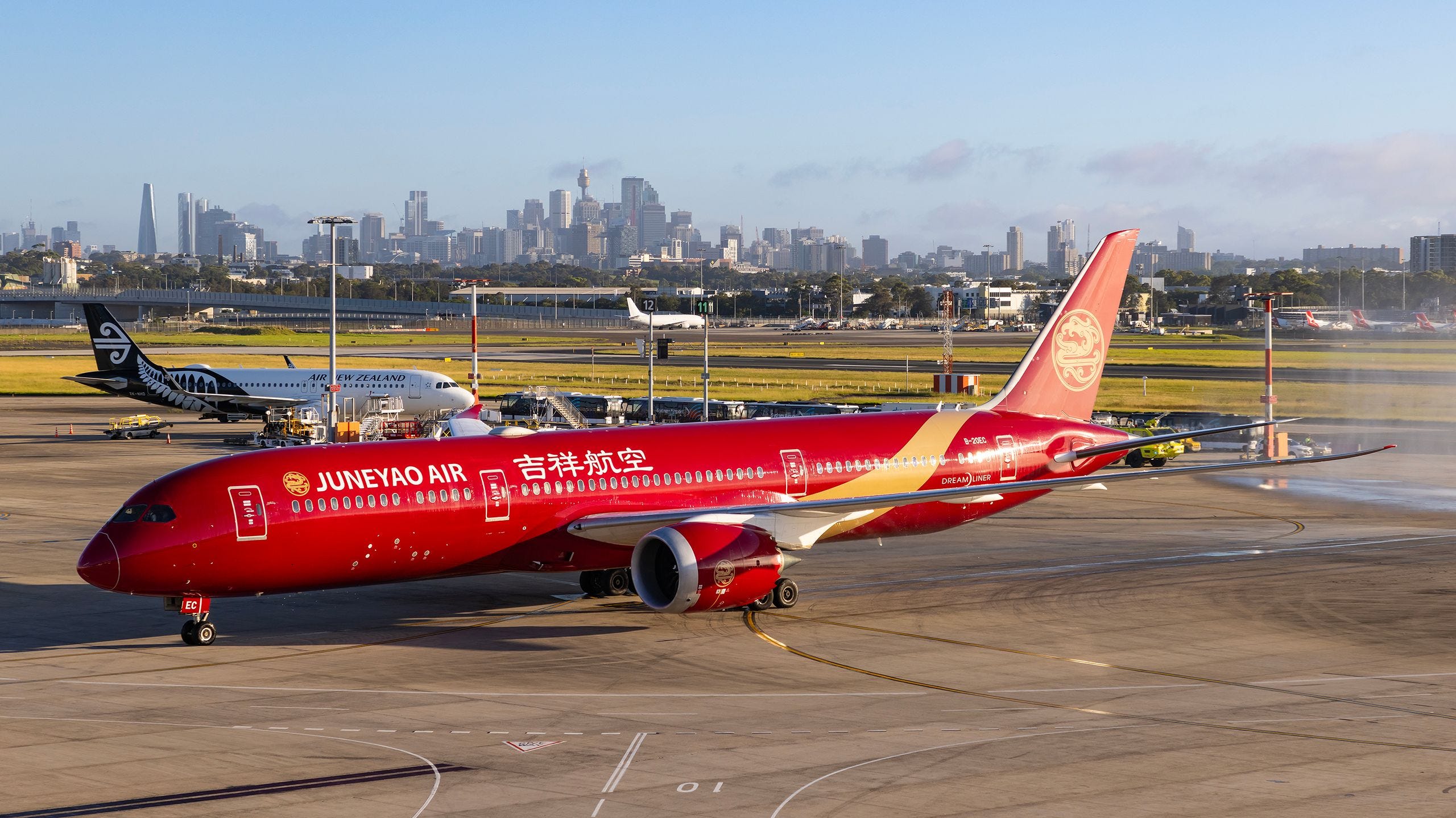
This is a significant commitment for a mid-sized carrier. The 25-aircraft order is effectively a multi-year capacity guarantee that will progressively replace older A320ceo aircraft while adding incremental growth capacity.
The A320neo and A321neo offer roughly 15% to 20% better fuel efficiency than the ceo generation, a meaningful lever for a carrier running on mid-single-digit operating margins.
The A321neo: Medium-Haul Bridge Aircraft
Inside the narrowbody mix, the A321neo plays an outsized strategic role. With 14 of the type already in the fleet, Juneyao uses the aircraft to open thinner international routes that are too small to justify a widebody but too far for a standard A320.
A321neo missions from Shanghai routinely extend to destinations such as Kobe, Fukuoka, Tokyo Haneda, Seoul, Bangkok, and Denpasar, where the aircraft’s extra range and fuel efficiency allow year-round operation with cost discipline. The carrier was an early recipient of A321neo aircraft delivered from the Airbus Tianjin final assembly line, which shortened delivery logistics considerably.
Juneyao’s A321neo cabin typically configures with a mix of Prime Seat forward rows and standard economy aft. That layout permits the airline to attract premium leisure travelers on medium-haul routes that historically would not have supported a two-class product on narrowbodies.
Widebody Strategy: Boeing 787-9 Only
On the widebody side, Juneyao has been deliberately conservative. The airline operates exactly 10 Boeing 787-9 Dreamliners, the same as the total confirmed in the H1 2025 report.
This is the smallest widebody fleet of any Chinese carrier flying intercontinental routes.
The fleet took its first 787 in 2018, and the last additions were originally scheduled for earlier in 2025.
However, trade tensions between China and the United States led the airline to defer a 787 delivery during 2025, a decision widely covered in industry media. That deferral is an important risk signal: it means Juneyao’s ability to add new widebodies is partially exposed to bilateral political dynamics beyond the airline’s control.
The cabin layout on each 787-9 features 29 lie-flat business class seats and 295 economy seats for a total of 324, slightly higher density than some European 787 operators because Juneyao uses the aircraft on a mix of ultra-long-haul and medium-haul Asian rotations rather than pure long-haul deployment.
Fleet Age, Utilization, and Efficiency
Juneyao’s reported average fleet age hovers in the mid-8 year range, a useful sweet spot. Aircraft are old enough to be fully depreciated on a majority of airframes, yet new enough that major heavy maintenance events are manageable and fuel burn remains broadly competitive.
Utilization varies by sub-fleet. Narrowbody aircraft run on relatively standard Chinese airline utilization of 9 to 10 block hours per day, while the 787-9 fleet runs higher on long-haul missions, typically 12 to 14 hours per day in peak summer schedules.
9 Air Fleet: Simplicity as Strategy
The 9 Air sub-fleet is a mirror image of the mainline. The subsidiary operates 26 aircraft, all Boeing 737 family. The fleet is configured in single-class high-density layout consistent with Chinese domestic low-cost operations.
The rationale for a pure 737 fleet at 9 Air is the same rationale that keeps the Juneyao mainline on Airbus: simplicity drives unit cost. By maintaining only one type across the low-cost arm, 9 Air avoids the training, spares, and maintenance complexity that typically plagues mixed narrowbody fleets.
Juneyao Group Consolidated Fleet (Year-End 2025)

Brand            Type            Count
Juneyao          A320ceo         30
Juneyao          A320neo         22
Juneyao          A321ceo         27
Juneyao          A321neo         14
Juneyao          Boeing 787-9    10
9 Air            Boeing 737      26
Group Total      -               129