


Executive Summary
Fleet Strength: Loong Air operates a 73-77 aircraft, all-Airbus A320 family fleet, with an average age of 6.8 years, and has firmed up six A321neo leases plus three A320neo leases for 2027 delivery.
Network Reach: The carrier serves 69 domestic and 12 international destinations across 11 countries, with Hangzhou Xiaoshan as the primary hub and a growing Shenzhen secondary base.
Strategic Catalysts: A landmark interline agreement with Emirates unlocking 22 Chinese cities, plus pre-listing guidance filed with the CSRC in November 2025, positioning the airline for a public market debut.
Operating Footprint: The airline now transports over 10 million passengers annually, operates branches in Northwest, Southwest, and Central-South China, and serves Japan, South Korea, Southeast Asia, South Asia, and Central Asia.
Recommended - Read Full Reports


Read All Reports
Table of Contents
Executive Summary
Loong Air Company Profile: Key Facts
Loong Air Revenue and Financial Analysis
Revenue Profile and Recent Financial Picture
Latest Operational and Earnings Indicators
Revenue Growth Drivers
Key Services and Products
Loong Air Fleet Analysis
Fleet Size and Composition
Fleet Age and Modernization Trajectory
Aircraft Types Strategy and Configuration
In-Depth Fleet Strategy
Loong Air Route Network Strategy and Major Destinations
Network Size and Geographic Spread
Domestic Network Strategy
International Network Strategy
Network Strategy and Hub Architecture
Major Operational Bases (Hubs)
Primary Hub: Hangzhou Xiaoshan International Airport (HGH)
Secondary Base: Shenzhen
Branch Operations: Northwest, Southwest, Central-South
Loong Air Competitive Position
Major Competitors
Loong Air vs. Spring Airlines
Loong Air vs. Juneyao Air
Loong Air vs. China Eastern Airlines
Loong Air vs. China Southern and Air China
Strategic Partnerships and Alliances
Codeshare Network
The Emirates Interline Partnership
Greater Bay Airlines Partnership
Loong Air Cargo and Cargo Heritage
IPO Preparation and Public Market Trajectory
Innovation and Cabin Experience
A321neo Premium Strategy
Digital and Loyalty Strategy
Sustainability and Environmental Strategy
Operational Safety and Regulatory Standing
Key Risks for Loong Air
Risk 1
Risk 2
Risk 3
Risk 4
Risk 5
Risk 6
Risk 7
Risk 8
Outlook for 2026 and Beyond
My Final Thoughts
Official Sources and Data
Introduction
While the world’s attention remains fixed on China’s “Big Three” carriers, a Hangzhou-based operator has quietly assembled one of the most agile narrowbody fleets in Asia.
Loong Air, the only home-based passenger and cargo airline of Zhejiang Province, just executed lease agreements for six new A321neos, inked an interline deal with Emirates that suddenly puts 22 Chinese cities on the Gulf carrier’s map, and filed pre-listing guidance with the China Securities Regulatory Commission.

This in-depth analysis breaks down every operational pillar that matters: the fleet (where Airbus dominates and Boeing has been quietly phased out), the route network (97 destinations and counting), the hub strategy (Hangzhou first, Shenzhen second, but with a Greater Bay twist), and the competitive dynamics versus Spring Airlines, Juneyao, and the state-owned giants.
Loong Air Company Profile: Key Facts
Loong Air, legally registered as Zhejiang Changlong Airlines Co. Ltd., is a privately founded carrier that has matured into a regional powerhouse over the past decade. The airline began its life not as a passenger operator but as a freighter outfit, a heritage that still shapes its dual-revenue model today.
The company was established on April 19, 2011 by Chairman Qihong Liu, with cargo operations beginning on August 9, 2012 using a single Boeing 737-300F.
Passenger services followed on December 29, 2013, with inaugural flights from Hangzhou to Chongqing and Hangzhou to Shenzhen.
COMPANY PROFILE
————————————————————————————————————
Legal Name        : Zhejiang Loong Airlines Co., Ltd.
Brand             : Loong Air (长龙航空)
IATA / ICAO       : GJ / CDC
Callsign          : LOONG AIR
Founded           : April 19, 2011
First Cargo Flight: August 9, 2012
First Pax Flight  : December 29, 2013
Headquarters      : Hangzhou Xiaoshan Int'l Airport
                    Xiaoshan District, Zhejiang
Chairman & Founder: Qihong Liu (刘启宏)
President         : Liu Yi
Fleet Type        : All-Airbus A320 family
Annual Passengers : 10 million+
Website           : www.loongair.cn
————————————————————————————————————The carrier holds the unique distinction of being Zhejiang Province’s only locally headquartered airline offering both passenger and cargo services, a strategic position that has earned it significant provincial-government backing.
Loong Air’s identity sits intentionally apart from the state-owned giants.
Where Air China, China Southern, and China Eastern represent Beijing’s industrial muscle, Loong Air positions itself as the agile entrepreneur of the Yangtze River Delta region.


The company describes its own ambition as building “a world-class aviation group” around four pillars: high-quality operations, group operations, intelligence, and internationalization.
Loong Air Revenue and Financial Analysis
Revenue Profile and Recent Financial Picture
Loong Air remains a privately held company, which means its detailed top-line and bottom-line numbers are not disclosed publicly in the way that Air China or China Eastern report quarterly.
The carrier has not yet completed its IPO, so granular revenue breakdowns are limited to what management releases through industry briefings and lessor partner communications.
What is verifiable from primary sources is the operational scale that drives revenue. The airline now transports more than 10 million passengers per year, a benchmark that places it firmly among China’s mid-tier carriers in passenger volume. This figure was confirmed in CDB Aviation’s July 2025 partner disclosure tied to the A321neo lease announcement.
For context on the macro environment that frames Loong Air’s revenue trajectory,
China’s civil transport airports handled nearly 1.53 billion passenger trips in 2025, up 4.8% year on year. Total passenger traffic across Chinese airlines reached 770 million in 2025, an increase of 5.5% over 2024.
Latest Operational and Earnings Indicators
Without quarterly filings, the closest proxy to a “latest quarterly” reading comes from the carrier’s pre-listing guidance registration.
Loong Air registered its IPO pre-listing guidance with the CSRC on November 17, 2025, a procedural step that demonstrates the company is preparing audited financial statements suitable for public-market disclosure.
The act of filing pre-listing guidance is itself a financial signal. Chinese regulators require sustained profitability and clean accounting before they permit retail capital raises, so the move suggests management is confident in trailing-twelve-month performance.
RECENT FINANCIAL & OPERATIONAL SIGNALS (2025-2026)
————————————————————————————————————————————————
Annual Passengers (most recent) : 10 million+
IPO Pre-listing Guidance Filed  : November 17, 2025
Funding Raised (private)        : ~USD 84.2M cumulative
Capital Source                  : Provincial gov't stakes,
                                  state-linked LPs
Key Investors                   : Shandong Port Group,
                                  ICBC Financial Asset Inv.,
                                  Hangzhou Capital,
                                  Zhejiang Financial Holdings,
                                  Guangdong Wens
————————————————————————————————————————————————
PitchBook tracks Loong Air as having raised approximately USD 84.2 million cumulatively, with investors including Shandong Port Group, ICBC Financial Asset Investment, Hangzhou Capital, Zhejiang Provincial Financial Holdings, and Guangdong Wens.
The presence of multiple provincial financial holding groups underscores the carrier’s role as a regional economic asset.
Revenue Growth Drivers
The first major growth driver is the surge in outbound Chinese travel from secondary and tertiary cities.
Hangzhou Xiaoshan handled 4.5 million passengers in October 2025 alone, up 5.9% year on year, with the full-year total surpassing 50 million for the first time in airport history.
That underlying hub traffic growth flows directly into Loong Air’s domestic narrowbody load factors. The carrier’s fleet of 174-seat A320s sits in the operational sweet spot for the high-frequency Yangtze River Delta corridor.
The second driver is international expansion beyond the historical Northeast Asia core. New service launches in 2025 included Xi’An to Bangkok with four weekly frequencies, Singapore to Zhangjiajie at thrice weekly, and Hangzhou to Vientiane in Laos.
The third driver is partnership-led traffic. The Emirates interline agreement, finalized in early 2026, exposes Loong Air’s domestic network to inbound traffic from Dubai’s vast sixth-freedom hub.
Key Services and Products
Loong Air’s product portfolio rests on three commercial pillars.
The first is full-service scheduled passenger transport on narrowbody equipment, with both single-class economy configurations on the A320 fleet and a two-class business plus economy offering on the A321neo subfleet.
The second pillar is cargo and logistics. The airline traces its origins to CDI Cargo Airlines, and the cargo division continues to operate, leveraging belly capacity across the passenger fleet and supporting Yangtze River Delta e-commerce flows.
The third pillar is ground handling and aviation services, where the airline supports both its own operations and third-party carriers at Hangzhou Xiaoshan.
SERVICE PORTFOLIO BREAKDOWN
————————————————————————————————————
Passenger Transport
  • Domestic full-service narrowbody
  • International short and medium haul
  • Business class on A321neo only
  • Single-class economy on A320 ceo

Cargo & Logistics
  • Belly-hold capacity (passenger fleet)
  • Heritage CDI Cargo freighter ops
  • E-commerce express linkages

Aviation Services
  • Ground handling at HGH
  • Maintenance support
  • Crew training operations
————————————————————————————————————
The differentiation in product layer is most visible on the A321neo subfleet, where Recaro supplied the CL4710 business class and BL3530SMART economy seats on the maiden flight of August 20, 2021.
The newest A321neo deliveries feature 8 business class seats and 202 economy seats, totaling 210 passengers.
Loong Air Fleet Analysis
Fleet Size and Composition
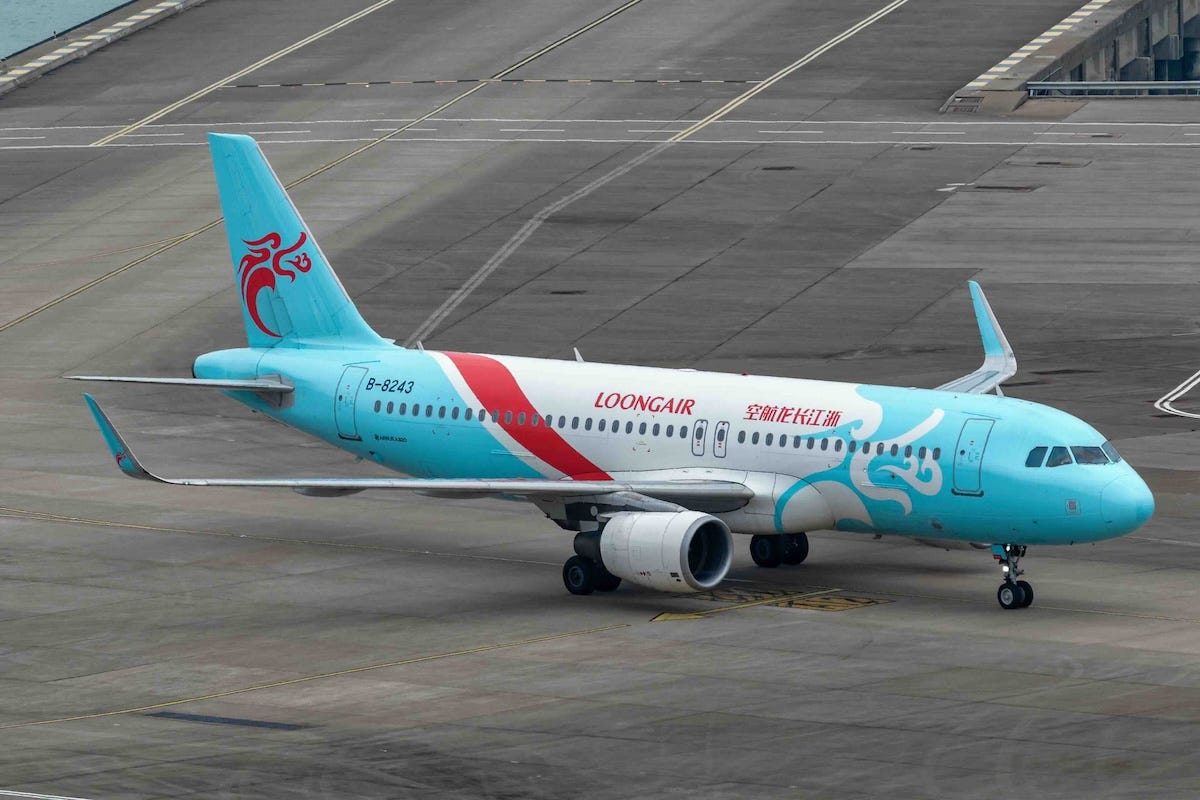
Loong Air operates one of the youngest all-Airbus narrowbody fleets in China. As of late 2025 and early 2026, multiple primary sources put the active fleet between 73 and 77 aircraft, with the variance driven by ongoing deliveries and rotations.

The official airline disclosure tied to the CDB Aviation lease places fleet size at 73 aircraft as of mid-2025. Planespotters tracks an active fleet of 77 aircraft with 2 on order and an average fleet age of 6.8 years.
LOONG AIR FLEET COMPOSITION (Nov 2025)
————————————————————————————————————————
Aircraft Type        In Service    On Order
Airbus A319-100           1             0
Airbus A320-200          27             0
Airbus A320neo           33             3
Airbus A321neo           12             0
————————————————————————————————————————
TOTAL                    73             3
————————————————————————————————————————
Avg Fleet Age            ~6.8 years
Fleet Type Strategy      Single-family
                         (Airbus A320 only)
————————————————————————————————————————Fleet Age and Modernization Trajectory
The average fleet age sits at approximately 6.8 years, which is substantially younger than the global Airbus A320 family average. This youth is a function of the airline’s relatively recent founding and its decision to skew aggressively toward the new-engine-option (neo) variants.
The neo share of the fleet is striking. Including A320neo and A321neo combined, the new-generation aircraft now account for roughly 45 out of 73 aircraft, or just over 60% of the operating fleet.
That fuel-efficiency tilt matters for unit costs. The CFM LEAP-1A engines on the neo variants deliver a 15-20% fuel burn improvement versus the previous-generation V2500 and CFM56 powerplants.
Aircraft Types Strategy and Configuration
Loong Air’s fleet strategy is built around a deliberate single-family commitment. The A319 is a legacy holdover from the early years, the A320 forms the backbone, and the A321neo is the upmarket and premium-focused growth lever.
The A319-100 in the fleet seats 134 passengers in a 2-class configuration with 8 business class seats and 126 economy. This single airframe is largely a transitional asset.
The A320-200 ceo fleet of 27 aircraft is configured in a single-class, all-economy layout with 174 seats. This high-density domestic configuration maximizes seat-mile economics on the dense Hangzhou-Shenzhen, Hangzhou-Chengdu, and Yangtze River Delta corridor routings.
CABIN CONFIGURATION BY TYPE
————————————————————————————————————
A319-100  : 8 Business / 126 Economy
            Total 134 seats
A320-200  : All-Economy 174 seats
A320neo   : 174 or 186 (high-density)
A321neo   : 8 Business / 202 Economy
            (newer config)
A321neo   : 16 Business / 184 Economy
            (legacy config)
————————————————————————————————————
The A320neo subfleet of 33 aircraft is configured at 174 seats in single-class, with one variant carrying 186 in higher-density configuration. The slight density variation reflects the carrier’s experimentation with cost-per-seat optimization on leisure routes.
The A321neo fleet is the most strategically interesting element. Two of the aircraft retain a legacy 16 business plus 184 economy layout for 200 seats total, while ten of the A321neos carry a refreshed 8 business plus 202 economy layout for 210 seats total, supplied by Recaro.
In-Depth Fleet Strategy
The single-family Airbus commitment is a deliberate cost play. Single-type fleets unlock significant savings in pilot type-rating, maintenance tooling, parts inventory, and crew scheduling complexity.
The recent lease agreements reveal management’s confidence in continued narrowbody capacity growth. The July 2025 CDB Aviation deal for six A321neos targets 2027 delivery, while the October 2025 BOC Aviation agreement adds three more A320neos with CFM LEAP-1A engines, also for 2027.
The combined effect of these two deals is roughly nine additional new-generation narrowbodies entering service in 2027, expanding the fleet to approximately 82 aircraft if attrition is zero.
The A321neo emphasis deserves particular attention. Each A321neo adds roughly 36 additional seats versus an A320 in equivalent two-class layout, and its 4,000 nautical mile range opens up routes to Southeast Asia, South Asia, and parts of the Gulf without widebody complexity.
The carrier also signed a letter of intent for 20 Airbus A220 aircraft in 2014, though this commitment has not converted into a firm order or delivery since. The A220 remains a theoretical option for thinner regional routes but is not part of the current operating plan.