


Executive Summary
Shanghai Airlines is a 100% Boeing operator, anchored by 57 Boeing 737-800s and a growing widebody division of Boeing 787-9 Dreamliners that handle the carrier’s flagship long-haul missions.
The airline functions as the brand-distinct domestic and regional arm of China Eastern Airlines, whose group-level revenue reached RMB 139.94 billion in 2025, providing balance-sheet support and procurement scale.
Network reach now spans 64 domestic and 16 international destinations across 11 countries, focused on Hong Kong, Macau, Taiwan, Japan, South Korea, Indonesia, Singapore, and Thailand, with selected long-haul flying to Melbourne, Casablanca, and Budapest.
Operating from dual hubs at Shanghai Pudong (PVG) and Shanghai Hongqiao (SHA), where the combined system handled over 135 million passengers in 2025, the carrier’s slot inventory is its most defensible competitive moat.
Recommended - Read Full Reports


Read All Reports
Table of Contents
Executive Summary
Shanghai Airlines Company Profile: Key Facts
Founding and Corporate Lineage
Shanghai Airlines Revenue and Financial Analysis
Parent Group Revenue Position
Revenue Growth Drivers
Key Services and Products
Cost Pressures and Yield Outlook
Shanghai Airlines Fleet Analysis
Fleet Size and Composition
Aircraft Types Strategy and Configuration
Fleet Strategy and Future Direction
Fleet Age and Renewal Pressure
Shanghai Airlines Route Network Strategy and Major Destinations
Domestic Network Architecture
International Network Architecture
Codeshare and Partner Network
SkyTeam Affiliate Status
New Route Launches and Network Expansion
Major Operational Bases
Shanghai Hongqiao International Airport (SHA)
Shanghai Pudong International Airport (PVG)
Tertiary Bases at Nanjing and Hangzhou
Shanghai Airlines Competitive Position
Major Competitors
Shanghai Airlines vs. China Eastern Airlines (Internal Brand Architecture)
Shanghai Airlines vs. Spring Airlines
Shanghai Airlines vs. Juneyao Airlines
Shanghai Airlines vs. Air China
Shanghai Airlines vs. China Southern Airlines
Shanghai Airlines vs. Cathay Pacific
Shanghai Airlines Cargo Operations
Onboard Product and Customer Experience
Regulatory and Strategic Context
Belt and Road and Bilateral Agreements
Sustainability and ESG Pressure
Key Risks
Risk 1
Risk 2
Risk 3
Risk 4
Risk 5
Risk 6
Risk 7
Risk 8
Strategic Outlook for 2026 and Beyond
My Final Thoughts
Official Sources and Data
Introduction
Shanghai Airlines, the wholly owned Boeing-only subsidiary of the China Eastern Air Holding Group, has spent the last sixteen years quietly evolving from a freshly absorbed regional rival into one of the most strategically important brand assets at Shanghai’s twin-airport system.

As of May 2026, the carrier sits at the intersection of state ownership, slot scarcity at Hongqiao, and a parent-driven push to capture more long-haul Yangtze River Delta traffic.
This in-depth analysis report dissects how Shanghai Airlines actually operates today, what its 90-aircraft Boeing fleet does day to day, where its 64 domestic and 16 international routes connect, and which competitors threaten its slot-rich position.
Shanghai Airlines Company Profile: Key Facts
The carrier remains one of the oldest commercial airlines in mainland China, having predated several of its current competitors by more than a decade.
It carries the IATA designator FM and ICAO designator CSH, with the radio callsign “SHANGHAI AIR” used across all flight operations.
Headquartered at Shanghai Hongqiao Airport, the airline trades on the corporate identity it built between 1985 and 2010, even though it now files financials inside the consolidated accounts of its parent.
This dual identity, brand independence with operational integration, defines almost every strategic question discussed in the rest of this report.
SHANGHAI AIRLINES: KEY FACTS (2026)
------------------------------------------------
Legal Name        : Shanghai Airlines Co., Ltd.
IATA / ICAO       : FM / CSH
Callsign          : SHANGHAI AIR
Founded           : December 30, 1985 (40 years of operations)
Parent Group      : China Eastern Air Holding Company
Holding Company   : China Eastern Airlines Corporation Limited
Headquarters      : Shanghai Hongqiao Airport, China
Hubs              : Shanghai Pudong (PVG) + Shanghai Hongqiao (SHA)
Fleet Size        : 90 aircraft (all-Boeing)
Average Fleet Age : 10.5 years
Alliance Status   : SkyTeam (affiliate via China Eastern)
Loyalty Program   : Eastern Miles (shared with parent)
Cargo Affiliate : China Cargo Airlines (group-level)The airline’s IATA membership profile lists it under airline code 774, North Asia region, with full SSIM compliance for global distribution.
It is one of three operating airline brands within the China Eastern Air Holding Group, sitting alongside the namesake China Eastern Airlines mainline operation and the all-COMAC subsidiary OTT Airlines, plus the cargo joint venture China Cargo Airlines.
Founding and Corporate Lineage
Shanghai Airlines was founded on December 30, 1985, during the early commercial aviation reforms of the People’s Republic.
It was the first commercial Chinese carrier funded by a municipal government and local enterprises rather than directly by the central state, an arrangement that gave it a distinctive Shanghainese commercial identity from day one.
The airline launched international services in 1997 and was successfully listed on the Shanghai Stock Exchange in late 2002. A cargo subsidiary followed in 2006, and on December 12, 2007, the carrier became the 19th member of Star Alliance, giving it a brief window of independent global alliance presence.
The defining corporate event came on June 11, 2009, when the merger announcement revealed China Eastern’s roughly 9 billion yuan acquisition. The transaction closed on February 8, 2010, and on November 1, 2010, the airline left Star Alliance to join its parent company in SkyTeam as an affiliate member.
Shanghai Airlines Revenue and Financial Analysis
Because Shanghai Airlines is a wholly owned, unlisted subsidiary, it does not publish standalone audited annual results. Its revenue, costs, and profit lines are folded into the consolidated reports of China Eastern Airlines Corporation Limited, the dual-listed Shanghai/Hong Kong holding entity.
To understand Shanghai Airlines’ financial position, this report uses parent-company filings to triangulate the segment performance. Operating data from China Eastern’s official monthly disclosures plus interim and annual reports provides a defensible picture without inventing numbers that the carrier itself does not publish.
Parent Group Revenue Position
China Eastern Airlines Corporation Limited recorded total operating revenue of RMB 139.94 billion for the full year 2025, up 5.9% year on year from RMB 132.12 billion in 2024. This represents the highest annual revenue in the group’s history.
Total operating costs of CNY 132.66 billion grew faster than revenue in 2025, which compressed margins despite the top-line gain. The group’s narrowing of net losses was confirmed in its 2025 interim report, which showed first-half operating revenue of RMB 70.213 billion.
Within that figure, Shanghai Airlines is one of three principal flying brands. The group does not break out subsidiary-level revenue by brand in its public statements, but the 90-aircraft fleet and dual-hub Shanghai concentration place Shanghai Airlines as a meaningful but minority contributor to consolidated turnover.
Revenue Growth Drivers
Three drivers shaped the 2025 revenue gain at the parent level, and Shanghai Airlines participated in all of them.
The first was the continued normalisation of Chinese international travel, with Shanghai’s two airports recording 42.85 million inbound and outbound passenger trips in 2025, a 17.9% year-on-year increase.
The second driver was domestic capacity discipline. With slot constraints binding hard at Shanghai Hongqiao, Shanghai Airlines redeployed seats toward higher-yielding routes rather than chasing volume.
The third driver was the launch of new long-haul services from PVG by the parent group, which feeds Shanghai Airlines through codeshare and through-fare arrangements.
PARENT GROUP REVENUE TRAJECTORY (CHINA EASTERN GROUP)
------------------------------------------------------
2023 FY  : RMB 113.74 billion (recovery year)
2024 FY  : RMB 132.12 billion (+16.2% YoY)
2025 FY  : RMB 139.94 billion (+5.9% YoY) — record high
2025 H1  : RMB  70.21 billion (interim)
Source : China Eastern Airlines official annual reportKey Services and Products
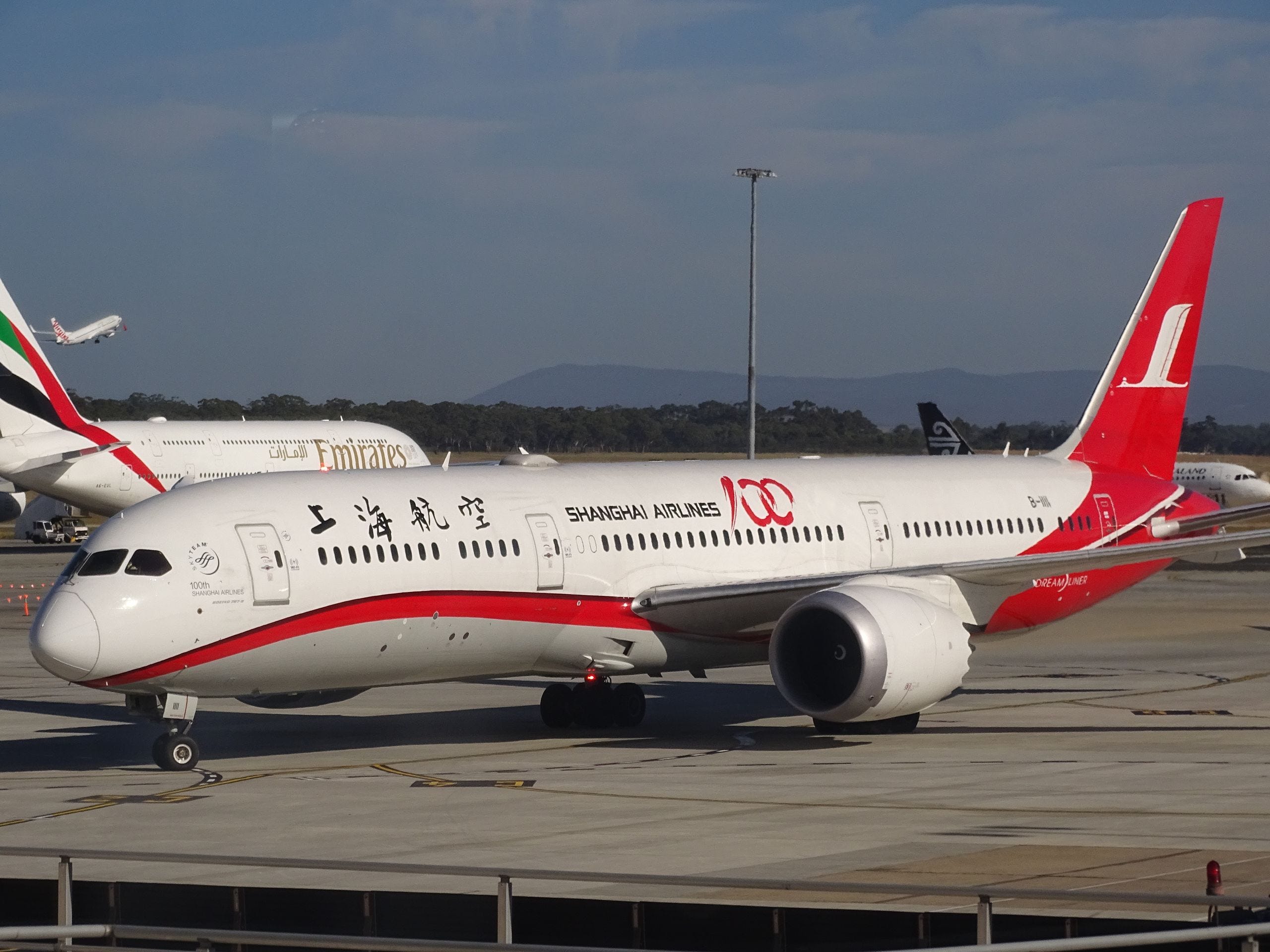
Shanghai Airlines operates a four-class onboard product on its widebody fleet that is branded distinctively from China Eastern. Its Boeing 787-9 Dreamliner is configured with 4 First Class seats, 26 Business Class seats, 28 Premium Economy seats, and 227 Economy seats for a total of 285 seats per aircraft.
The Premium Economy cabin, fitted with Collins Aerospace MiQ seats, is the same hardware used by Turkish Airlines, giving Shanghai Airlines a credible mid-tier product on long-haul missions. On the narrowbody Boeing 737 MAX 8, the configuration is 8 Business Class plus 168 Economy Class for a total of 176 seats.
Loyalty is integrated through the parent group’s Eastern Miles program, removing the need for a duplicate frequent flyer scheme. Cargo capacity belowdecks is sold through China Cargo Airlines, which forms part of the same holding company structure.
Cost Pressures and Yield Outlook
Cost discipline is the central financial story for the parent group, and by extension for Shanghai Airlines. Operating costs grew faster than revenue in 2025, with total operating costs reaching CNY 132.66 billion, putting downward pressure on the operating margin.
Fuel, lease costs on widebodies, and maintenance reserves on the maturing 737NG fleet are the three line items most relevant to Shanghai Airlines specifically. The carrier’s heavy 737 base is more than a decade old on average, which means heavy maintenance C and D check cycles are becoming a structural expense.
Yield management is being run on a Shanghai-system basis, with Shanghai Airlines and China Eastern sharing pricing tools across PVG and SHA. This integration has helped lift unit revenue on routes where the two brands previously competed for the same point-to-point demand.
Shanghai Airlines Fleet Analysis
Fleet strategy is where Shanghai Airlines diverges most clearly from its parent.
While China Eastern Airlines flies a mixed Airbus, Boeing, and COMAC fleet, Shanghai Airlines remains an all-Boeing operator, a deliberate brand and procurement decision dating back to its pre-merger era.


This single-manufacturer policy gives Shanghai Airlines tighter pilot pooling, simpler maintenance planning, and a clear identity within the parent group’s broader fleet matrix.
It also means the carrier has zero exposure to Airbus narrowbody training pipelines and avoids the certification complexity that mixed-fleet operators face.
Fleet Size and Composition
As of the most recent fleet database update on May 5, 2026, Shanghai Airlines operates 90 aircraft with an average fleet age of 10.5 years, hub-based at Shanghai Pudong. The composition reported in the carrier’s August 2025 disclosure remains the reference baseline for 2026 operations.
The fleet breaks down into 4 Boeing 737-700s, 57 Boeing 737-800s, 17 Boeing 737 MAX 8s, and 10 Boeing 787-9 Dreamliners. There are also 5 Comac C909 regional jets on order, the renamed ARJ21 family, although these have not yet entered the active line.
SHANGHAI AIRLINES FLEET MATRIX (May 2026)
-----------------------------------------
Type                In Service   On Order
Boeing 737-700              4          —
Boeing 737-800             57          —
Boeing 737 MAX 8           17          —
Boeing 787-9               10          —
COMAC C909                  —          5
-----------------------------------------
TOTAL                      88          5
Average Fleet Age      : 10.5 years
Boeing 737NG/MAX share : 86.4%
Widebody share         : 11.4%
The 88 aircraft listed as in service align with the Airfleets database, which records 78 Boeing 737NG/MAX airframes at an average age of 10.7 years and 10 Boeing 787s at 6.3 years, for a fleet-wide weighted average of 10.2 years.
Aircraft Types Strategy and Configuration
The Boeing 737-800 forms the backbone of the operation. With 57 frames, it serves the bulk of trunk domestic routes between Shanghai and Beijing, Guangzhou, Shenzhen, Chengdu, Chongqing, Kunming, and Xi’an, plus regional services to Japan, South Korea, and Southeast Asia.
The 17 Boeing 737 MAX 8 aircraft sit on top of the NG fleet as the next-generation narrowbody. Configured with 8 Business and 168 Economy seats, they offer a roughly 14% improvement in fuel burn per seat versus the 737-800, although they remain a minority of the narrowbody fleet given the slow pace of MAX deliveries to Chinese carriers since 2019.
The Boeing 787-9 Dreamliner is the carrier’s flagship long-haul aircraft. The fleet of 10 frames is dedicated to high-density Asian and selected long-haul missions, with the first 787 delivery marking the carrier’s 100th Boeing aircraft milestone in 2018.
A representative recent delivery is registration B-220G (MSN 63718), received on August 28, 2025, which extended the widebody fleet to its current 10-aircraft level. The remaining wide-body inventory consists entirely of 787-9s following the retirement of older Boeing 757s and Boeing 767s in earlier years.
BOEING 787-9 CABIN CONFIGURATION (SHANGHAI AIRLINES)
-----------------------------------------------------
First Class       :   4 seats
Business Class    :  26 seats
Premium Economy   :  28 seats   (Collins MiQ seat)
Economy Class     : 227 seats
-----------------------------------------------------
Total             : 285 seats
Cargo capacity    : 19,175 kg per aircraft
The 4-class layout is unusual for a Chinese carrier and is a legacy of Shanghai Airlines’ pre-merger premium positioning. It allows the carrier to compete on routes such as PVG to Budapest, where premium yields are sensitive to seat differentiation.
Fleet Strategy and Future Direction
The fleet strategy under parent guidance is built on three pillars.
The first is narrowbody continuity, with the 737 family retained as the single narrowbody platform rather than transitioning to Airbus, even though the parent group has placed 101 A320neo orders for around USD 15.8 billion at group level.
The second pillar is widebody consolidation around the 787-9. By keeping a single widebody type, Shanghai Airlines avoids the operational complexity that would come with introducing the A330 or A350 from the parent’s fleet, even though both types are available within the group.
The third pillar is the gradual introduction of the COMAC C909 regional jet, with 5 aircraft on order. This brings Shanghai Airlines into alignment with the group’s strategic direction of supporting indigenous Chinese aircraft, mirroring the path that OTT Airlines has taken as the C919 launch operator.
Fleet Age and Renewal Pressure
At 10.5 years average age, Shanghai Airlines runs an older fleet than several of its direct competitors. Spring Airlines and Juneyao Airlines, both operating predominantly newer A320 family aircraft, recently placed combined orders for 55 Airbus A320 family jets worth up to USD 8.2 billion, deliveries from late 2027.
The fleet age question is the most material strategic issue facing Shanghai Airlines over the next five years. Without further MAX 8 deliveries beyond the current 17, the carrier risks falling behind on per-seat fuel economy and per-seat CO2 metrics that are increasingly scrutinised by Chinese aviation regulators.
The parent group’s 2024 sustainability report confirms a group-wide commitment to environmental fleet renewal, but does not break out a specific Shanghai Airlines replacement schedule.