


Executive Summary
Tianjin Airlines operates a 99-aircraft fleet anchored by the Airbus A320 family, with widebody A330s reserved for select intercontinental missions and a long-running Embraer E-Jet contingent now being phased toward narrowbody trunk operations.
The carrier built its identity on regional connectivity inside China, today operating over 300 domestic routes supplemented by a small but expanding international footprint that touches London, Sydney, Moscow, Singapore, Phuket and Sihanoukville.
Operationally, the airline runs a multi-base network from Tianjin, Xi’an, Hohhot, Urumqi, Chongqing, Guiyang, Haikou and Dalian, leveraging eight regional anchors rather than one mega-hub.
As a member of the New HNA Aviation Group, Tianjin Airlines benefits from group scheduling synergies and a shared frequent flyer scheme, while continuing to navigate the post-restructuring environment that reshaped HNA following its court-supervised reorganization.
Recommended - Read Full Reports


Read All Reports
Table of Contents
Executive Summary
Tianjin Airlines Company Profile: Key Facts
Tianjin Airlines Revenue & Financial Analysis
Revenue Backdrop and the New HNA Aviation Group
Revenue Drivers and Service Mix
Macro Tailwinds for the 2025-2026 Cycle
Fuel, Cost Pressure and Margin Dynamics
Capital Structure and Financing Footprint
Tianjin Airlines Fleet Analysis
Fleet Size, Composition and Average Age
Narrowbody Backbone - A320 Family
Widebody Strategy - A330 Twinjets
Regional Workhorse - Embraer E-Jet Family
Aircraft Configuration and Cabin Approach
Fleet Strategy and Renewal Logic
Future Aircraft Pipeline Considerations
Tianjin Airlines Route Network, Major Destinations and Strategy
Network Shape and Reach
Domestic Strategy
International Network Highlights
The Chongqing-Moscow Resumption
The Sydney Operation and 2Q26 Adjustments
The Guiyang-Singapore Corridor
Southeast Asia and Northeast Asia
Codeshares and Alliance Posture
Major Operational Bases (Hubs)
Tianjin Binhai International Airport (TSN/ZBTJ) - The Home Hub
Multi-Base Network Architecture
Xi’an Xianyang International Airport
Urumqi and the Northwest
Hohhot, Chongqing, Guiyang, Dalian and Haikou
Tianjin Airlines Competitive Position
Major Competitors
Tianjin Airlines vs Hainan Airlines
Tianjin Airlines vs Spring Airlines
Tianjin Airlines vs Beijing Capital Airlines
Tianjin Airlines vs the Big Three
Tianjin Airlines vs China Express Airlines
Service Quality and On-Time Performance Posture
Brand Posture
Tianjin Airlines Fleet, Network and Strategy: Cross-Cutting Themes
How the Tianjin Free Trade Zone Shapes the Airline
Beijing-Tianjin-Hebei Integration and Aviation Demand
The HNA Aviation Group Synergy
Policy and Bilateral Air Traffic Rights
Sustainability and Aircraft Modernization
Digital, E-Commerce and Distribution
Safety, Operations and Service Quality
Safety Track Record
Notable Operational Incidents
Service Quality Recognition
Customer Experience Themes
Risk Analysis: Key Risks for Tianjin Airlines
Risk 1
Risk 2
Risk 3
Risk 4
Risk 5
Risk 6
Risk 7
Risk 8
Risk 9
Risk 10
Strategic Outlook for 2026 and Beyond
Where Tianjin Airlines Is Heading
A Realistic Capacity Profile
Long-Haul Posture
Group-Level Coordination
Technology and Customer Experience
My Final Thoughts
Official Sources & Data
Tianjin Airlines Company Profile: Key Facts
The carrier was incorporated in 2004 under the name Grand China Express Air, before rebranding and beginning scheduled operations as Tianjin Airlines on June 8, 2009. It has remained headquartered inside the passenger terminal building of Tianjin Binhai International Airport, in the Dongli District of the city.
The airline’s IATA designator is GS, the ICAO code is GCR, and the radio callsign is “BO HAI” - a nod to the Bohai Rim economic region the carrier was originally built to serve.
Its registered legal name is Tianjin Airlines Company Limited.
TIANJIN AIRLINES AT A GLANCE
- Legal name: Tianjin Airlines Company Limited
- IATA / ICAO / Callsign: GS / GCR / BO HAI
- Founded: 2004 (as Grand China Express Air)
- Operations launched: 8 June 2009
- Main hub: Tianjin Binhai International (TSN)
- Regional bases: 8 across China
- Parent: New HNA Aviation Group
- Frequent flyer program: Fortune Wings Club
- Headquarters: Dongli District, Tianjin
The airline has positioned itself as a regional anchor for the Bohai Rim, an economic cluster encompassing Beijing, Tianjin and Hebei.
Its parent group, the New HNA Aviation Group, emerged from the bankruptcy reorganization of the original HNA Group in 2022, which refocused the conglomerate on its core passenger and cargo aviation business after years of divestments.
Tianjin Airlines is part of the Fortune Wings Club, a shared loyalty program covering Hainan Airlines, Grand China Air, Tianjin Airlines, Hong Kong Airlines, Lucky Air, Capital Airlines and other group carriers, but it is not a member of any of the three global alliances.
Strategic partnerships are instead pursued through bilateral codeshares.
Tianjin Airlines Revenue & Financial Analysis
Revenue Backdrop and the New HNA Aviation Group
As a private subsidiary inside the New HNA Aviation Group, its results are absorbed at the group level, with parent Hainan Airlines Holding reporting 2025 operating revenue of approximately RMB 68.47 billion, up 5.0% year on year, and a return to a net profit of around RMB 1.98 billion after a loss in 2024.
These group-level numbers anchor expectations for Tianjin Airlines as a regional contributor.
The disclosure pattern is typical for Chinese carriers grouped under a single listed parent, where subsidiary unit economics are visible mainly through capacity metrics and route-level reporting rather than line-item P&L.
PARENT-GROUP REFERENCE (HAINAN AIRLINES HOLDING, 2025)
- Operating revenue: ~RMB 68.47 billion (+5.0% YoY)
- Operating costs: ~RMB 63.21 billion
- Net profit attributable to shareholders: ~RMB 1.98 billion
- Passengers carried (full year): ~34M+ (group-level disclosure)
- Source: 2025 annual results disclosure
Revenue Drivers and Service Mix
Like most Chinese non-Big-Three carriers, Tianjin Airlines earns the bulk of its revenue from scheduled passenger transportation, supplemented by ancillary charges (baggage, seat selection, on-board services) and a small but growing belly-cargo contribution on its A330 fleet.
Cargo at scale is handled by sister company Tianjin Air Cargo, which is operated separately under IATA code HT.
The carrier’s revenue mix is heavily weighted to domestic markets. Industry trackers indicate Tianjin Airlines flies more than 300 routes inside China against roughly 10 international routes, which means the trajectory of Chinese GDP growth, consumer travel demand and currency exchange rates are far more influential to the top line than long-haul yield trends.
Bookings cluster on Bohai Rim corridors (Tianjin, Beijing, Tangshan), western and northwestern China (Xi’an, Urumqi, Hohhot) and southwestern leisure markets (Chongqing, Guiyang, Haikou).
The airline’s growth strategy increasingly tilts toward harvesting outbound leisure flows from second-tier Chinese cities, which is also reflected in newer international launches.
Macro Tailwinds for the 2025-2026 Cycle
Civil aviation activity in China grew firmly through 2025.
The CAAC reported 770 million passengers carried in 2025 across the industry, up 5.5% year on year, while transport airports collectively handled 1.529 billion passenger trips, an increase of 4.8% versus the previous year.
This macro environment supports yields and load factors for regional players like Tianjin Airlines, especially those with strong second-tier city presence.
The Beijing-Tianjin-Hebei region’s GDP, the airline’s home economic base, reached 11.99 trillion yuan in 2025, expanding 5.4% year on year.
Fuel, Cost Pressure and Margin Dynamics
For a narrowbody-heavy operator, jet fuel typically represents the single largest operating cost, and the A320neo additions in the fleet directly target unit cost efficiency.
The recent reduction in widebody utilization, including the long-term storage of one A330 between September 2025 and February 2026 per public fleet trackers, also reflects ongoing capacity discipline at the route level.
COST FOCUS AREAS
- Jet fuel (largest variable cost component)
- Aircraft ownership / lease (mixed lessor portfolio)
- Crew + maintenance (multi-type fleet creates training overhead)
- Airport and navigation charges (heavy domestic exposure)
- Distribution (significant OTA reliance for leisure routes)
Capital Structure and Financing Footprint
Tianjin Airlines’ financing relationships extend beyond banks into specialized aircraft lessors.
In 2025, China Aircraft Leasing Group disclosed results for its key Tianjin-based financing arm, underlining the city’s status as a global aircraft leasing center and the embedded role of Tianjin Free Trade Zone leasing structures across Chinese airline balance sheets.
This dual exposure to bank loans and lease finance shapes the airline’s renewal pace and explains why the fleet appears in flexible “active / parked / on order” buckets across public databases.
Tianjin Airlines Fleet Analysis
Fleet Size, Composition and Average Age
Public databases place Tianjin Airlines’ active fleet in the 99-aircraft range with an average age of approximately 11.8 years, while broader counts that include parked airframes show a total managed pool of more than 130 aircraft.
The discrepancy reflects how many older Embraer E-Jets and select A330s sit in extended storage.
The composition is dominated by the Airbus A320 family, which forms the operational backbone for both trunk and secondary domestic routes.
Embraer E190s historically defined the airline’s regional positioning, and although they have been gradually parked, the airline still has more E-Jets on its certificate than almost any peer in the country.


INDICATIVE FLEET COMPOSITION (2026)
- Airbus A320ceo / A320-200: largest type, used for trunk routes
- Airbus A320neo (A20N): newer narrowbody, ~16 frames active
- Airbus A321: small contingent
- Airbus A330-200 / -300: limited widebodies for select long routes
- Embraer E190 / E195: regional jet pool, mix of active + stored
Note: counts reflect public fleet trackers as of 2026.Narrowbody Backbone - A320 Family
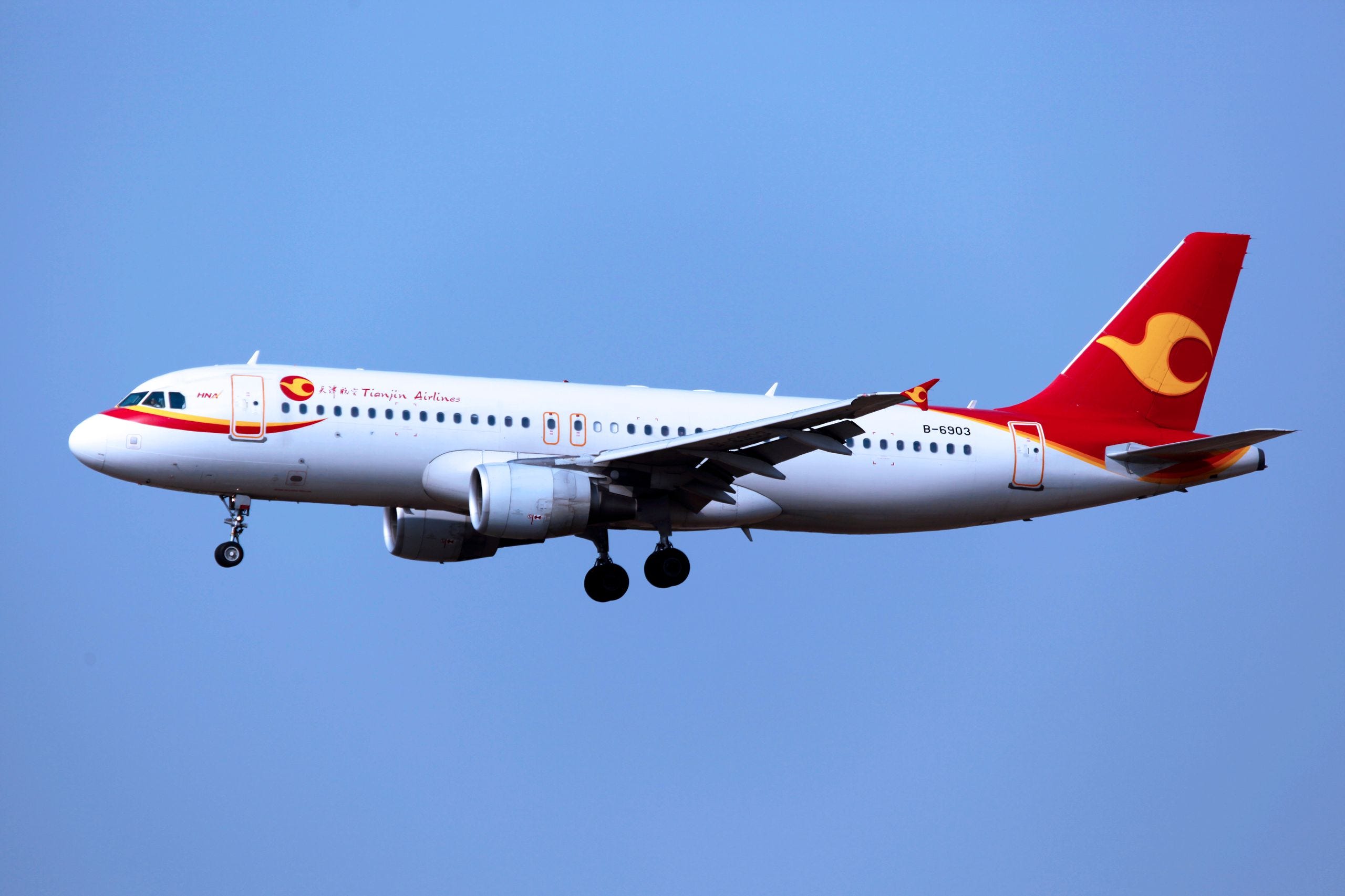
The A320 family is the workhorse for Tianjin Airlines, including both classic-engine A320-200s (CFM56 / V2500) and modern A320neos.
Active counts in third-party fleet trackers place the airline at around 32 active A320ceo aircraft and a significant block of A320neo deliveries feeding the renewal cycle.
The airline’s home city is, notably, also the site of the Airbus A320 Family Final Assembly Line in Tianjin, a strategic facility that delivered its 700th aircraft on July 8, 2024. Geographic proximity to a key Airbus manufacturing site reinforces an Airbus-leaning fleet identity for the carrier.
Widebody Strategy - A330 Twinjets
Tianjin Airlines was the launch customer for the first A330 widebody to roll out of the Airbus Completion and Delivery Center in Tianjin.
Today, only a handful of A330s remain in active rotation, with public registers showing an A330-243 (B-8776) stored from September 2025 to February 2026 before being returned to service.
Widebody utilization is highly selective. The A330s are deployed on routes where dual-class capacity, range and fuel-tank flexibility justify the cost premium, with seat counts typically split between business and economy.
Use cases include the Tianjin and Chongqing services to Moscow, Guiyang to Singapore, and the Xi’an to London Heathrow flagship.
Regional Workhorse - Embraer E-Jet Family
The Embraer 190/195 fleet was central to Tianjin Airlines’ founding identity as a regional carrier feeding short-and-thin routes to second-tier Chinese cities.
While many frames have moved into extended storage in recent years, the airline retains the largest Embraer E-Jet fleet in mainland China by registered count.
The E-Jet experience underpins Tianjin Airlines’ high-altitude and short-runway capability, which historically opened markets in Xinjiang, Inner Mongolia and Tibet plateau periphery operations.
As of 2026, the regional jet role is increasingly being fulfilled by smaller-gauge A320 turns.
Aircraft Configuration and Cabin Approach
Tianjin Airlines maintains a primarily two-class configuration on widebodies (business plus economy) and a flexible single-class economy or two-class layout on narrowbodies, with first or business cabins selectively offered on key trunk routes.
The carrier targets a value-oriented full-service positioning rather than a true premium offering, sitting between the price discipline of low-cost peers and the product investment of major flag carriers.
In practice, this translates into well-equipped cabins with seat-back pockets and overhead bins consistent with current Airbus deliveries, plus newer connectivity hardware on neo-generation airframes.
Fleet Strategy and Renewal Logic
The carrier’s renewal strategy can be summarized in three threads:
Re-platform narrowbody trunk operations on the A320neo family for fuel and unit-cost efficiency.
Prune older Embraer regional jets selectively as origin-and-destination economics on thin spokes weaken or as substitution by A320 turns becomes feasible.
Maintain a small, surgically deployed widebody A330 sub-fleet for showcase international missions, rather than a broad long-haul push.
FLEET STRATEGY HEURISTICS
- Narrowbody-first: A320neo dominates renewal capex
- Widebody-light: A330 used only where range / capacity earns its keep
- Multi-base, multi-type: maintains operational flexibility
- Storage discipline: parking older airframes preserves cashFuture Aircraft Pipeline Considerations
The HNA Aviation Group has historically placed group-level orders that feed multiple subsidiaries, including a framework agreement for COMAC C919 and ARJ21 aircraft.

While these orders are typically allocated across the group, Tianjin Airlines’ regional history makes it a logical candidate for some ARJ21 / C909 inductions over time.
Concurrently, additional A320neo deliveries appear to be feeding into the carrier through the Tianjin FAL pipeline, supporting a measured fleet replacement curve aligned with the recovery in Chinese domestic demand.