


Dear Readers, Welcome to AviationOutlook.
Tokyo just became the newest node in Europe’s most ambitious unmanned aircraft program.
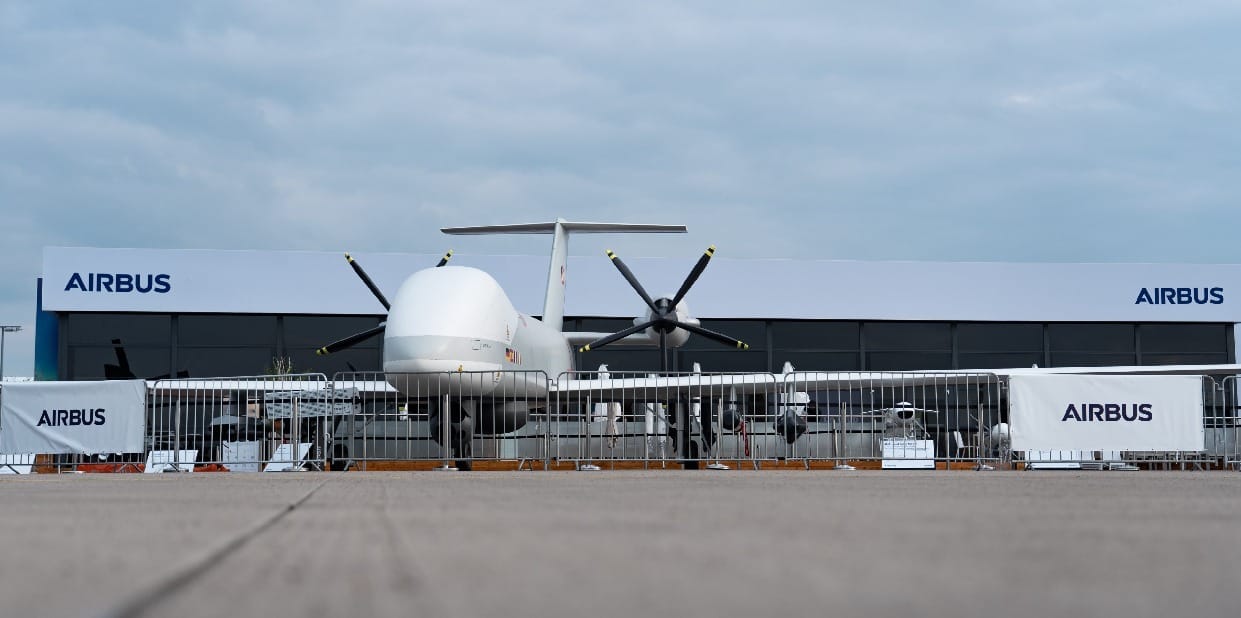
On June 26, 2026, Airbus Defence and Space and Kawasaki Heavy Industries signed a MoU to study a Japanese anti-submarine variant of the U950 Eurodrone.
The deal is preliminary, but the strategic intent behind it is sharp. Japan wants a long-endurance uncrewed maritime hunter, and Europe wants a sovereign customer beyond its four founding nations.
Let’s analyze everything in detail.
Recommended Reports


Read All Reports
What the MoU Actually Covers
The agreement gives both sides a structured runway to define the design, configuration, and industrial workshare for a Japan-specific Eurodrone. Under the terms, the companies will examine integration of Japanese sensors and effectors, including sonobuoys and torpedoes for hunting submarines.
Crucially, Kawasaki and Airbus will also study operational concepts that pair the drone with the Kawasaki P-1, the maritime patrol aircraft for which Kawasaki is the prime contractor.
That hints strongly at a manned-unmanned teaming (MUM-T) doctrine for the Japan Maritime Self-Defense Force.
MoU Snapshot (26 June 2026)
- Parties: Airbus Defence and Space + Kawasaki Heavy Industries
- Aircraft: U950 Eurodrone (ASW variant)
- Scope: design study, sensor/effector integration, Japanese workshare
- Operational concept: MUM-T with Kawasaki P-1 fleet
- Status: non-binding preliminary agreement
However, Tokyo has not committed yen to acquisition, and Airbus has framed the activity as exploratory rather than transactional.
Why Japan Is a Logical Partner
Japan has held observer status in the Eurodrone program since 2023, and Tokyo renewed that arrangement with OCCAR on June 10, 2026, at the ILA Berlin air show. That renewal preceded the Kawasaki MoU by just over two weeks.
The geography matters too. Japan oversees one of the largest exclusive economic zones in the Pacific and sits adjacent to a fast expanding submarine force operated by neighboring states.
The country already flies dozens of Kawasaki P-1 and Lockheed P-3 Orion maritime patrol aircraft. It has also fielded RQ-4B Global Hawks for long-range surveillance, but those platforms carry no weapons and cannot prosecute submarine targets.
Japan's existing ASW air assets
- Kawasaki P-1: four-engine jet, Kawasaki prime contractor
- Lockheed P-3 Orion: legacy turboprop, being phased down
- RQ-4B Global Hawk: long-range ISR, no ASW capability
- Future gap: persistent uncrewed ASW coverage
A maritime Eurodrone would close that capability gap.
It would also let crewed P-1 crews focus on higher-end tasks while drones screen larger ocean areas at lower hourly cost.
The U950 Eurodrone in Numbers
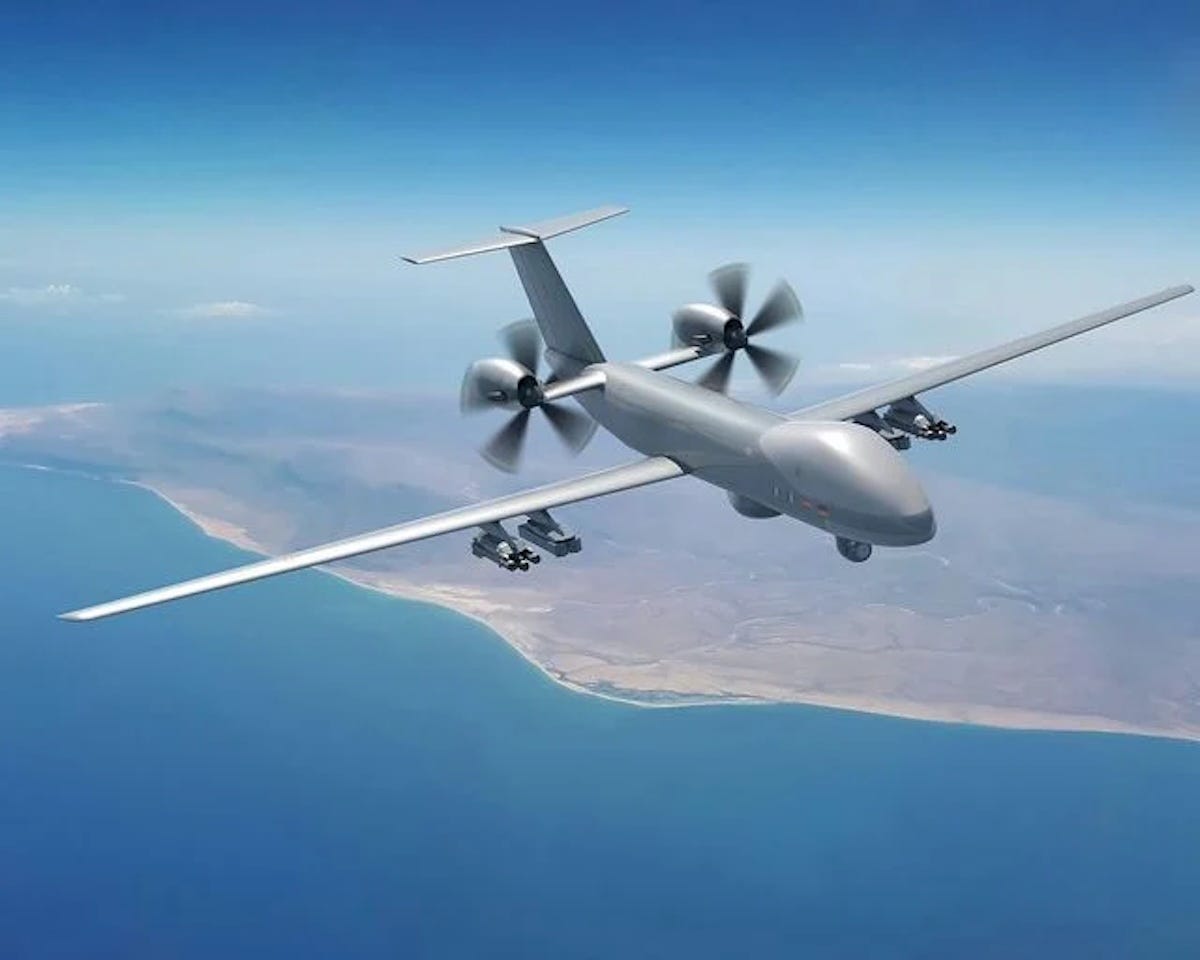
Airbus pitches the Eurodrone as a class above the General Atomics MQ-9, and the numbers back that claim. The twin-turboprop platform carries a mission payload of up to 2.3 tonnes excluding fuel, with maximum endurance of up to 40 hours.
Maximum takeoff weight sits around 13 tonnes, more than double the MQ-9 Reaper, and the wingspan and length both exceed the American competitor by several meters. First flight is scheduled for 2029.
U950 Eurodrone key specifications
- Configuration: twin-turboprop MALE RPAS
- Mission payload: up to 2.3 t (excluding fuel)
- Endurance: up to 40 hours
- First flight target: 2029
- Industrial Prime: Airbus Defence and Space (Germany)
- Major Subcontractors: Leonardo (Italy), Dassault Aviation (France),
  Airbus Defence and Space (Spain)
- Programme management: OCCAR
- Certification baseline: NATO STANAG 4671 Ed. 3
The aircraft is being designed natively for flight in non-segregated civil airspace, a regulatory edge that few competing MALE drones share.
That matters in Japan, where civilian air traffic density near naval operating areas is significant.
The European Order Book and Why Japan Helps It
Germany leads the four-nation program with 21 aircraft on order, Italy has ordered 15, while France and Spain have ordered 12 each.
France did remove acquisition funding from its latest military planning law, but Paris has formally stated it remains committed to the programme and may simply order later.
A Japanese variant would add export volume to a program whose unit economics depend on scale.
Airbus has been explicit that lessons from the Japanese ASW configuration will feed back into future European naval versions, making the partnership technically reciprocal rather than purely commercial.
Eurodrone partner-nation orders (publicly disclosed)
- Germany: 21 aircraft (lead nation)
- Italy:   15 aircraft
- France:  12 aircraft (acquisition timing under review)
- Spain:   12 aircraft
- Total:   60 aircraft (initial European baseline)
For Kawasaki, the upside is direct industrial participation in sensor integration and sustainment. That keeps Japanese technology, jobs, and supply chains inside the workshare.
Sovereignty, ITAR, and the Geopolitical Subtext
Airbus has built the Eurodrone with an explicit design goal of avoiding ITAR components, the U.S. International Traffic in Arms Regulations restrictions that can constrain how operators deploy American-origin equipment.
Jean-Brice Dumont, head of air power at Airbus Defence and Space, framed the philosophy plainly at ILA Berlin: the goal is not being dependent on a non-sovereign solution where a third party could ground the fleet.
For Tokyo, that sovereignty argument resonates.
Japan has been steadily diversifying defense procurement away from single-source dependence, and an ITAR-free maritime drone with deep Japanese industrial workshare fits that policy direction.
Operational Concept: Pairing the Drone with the P-1
The most strategically interesting line in the Kawasaki release is the reference to operational coordination with the P-1.
That is shorthand for manned-unmanned teaming, where a crewed maritime patrol aircraft acts as the mission orchestrator and drones extend the sensor net forward.
A P-1 with two or three Eurodrones tasked alongside it can cover orders of magnitude more ocean per sortie. Sonobuoy patterns can be laid by the uncrewed platform while the crewed aircraft retains weapons release authority and tactical decision-making.
Notional MUM-T workflow (illustrative, based on public statements)
1. P-1 launches with mission commander and tactical team aboard
2. Eurodrone(s) launched separately, vectored to assigned ocean box
3. Eurodrone deploys sonobuoy fields, relays acoustic data via LOS/BLOS links
4. P-1 cross-references data, prosecutes contact if classified hostile
5. Eurodrone remains on-station after P-1 returns to base (40 h endurance)
This concept is also being explored on the other side of the Pacific.
The General Atomics MQ-9B SeaGuardian recently demonstrated four sonobuoy pods, showing that uncrewed ASW is now a credible operational thread rather than a research curiosity.
What Has to Happen Next
The MoU is the start of a multi-year journey. Configuration definition, sensor integration studies, and workshare negotiations will dominate the next 12 to 24 months before any binding commitments emerge.
Japan’s Acquisition, Technology and Logistics Agency will likely run parallel evaluations against domestic and American alternatives.
A program-of-record decision is unlikely before the late 2020s, especially since the baseline Eurodrone has not yet flown.
My Final Thoughts
The most important word in this Airbus - Kawasaki Heavy Industries MoU is “workshare.”
Japan does not buy major platforms anymore without embedded industrial participation, and Airbus knows it.
This partnership also quietly answers a question Europe has been ducking for years: can a four-nation MALE drone designed around European sovereignty become a credible export product against the General Atomics MQ-9B?
Also, adding a technologically demanding ASW customer like Japan before first flight is an unusually confident bet.
For Kawasaki, the calculation is sharper still.
Its P-1 line will eventually need a force-multiplier, and codeveloping the unmanned half of that pair is more strategically valuable than buying a foreign drone outright.
The deal worth watching is not the one signed last week.
Instead, it’s the binding configuration agreement that either follows in 2027 or quietly fails to materialize.

