


Executive Summary
Chengdu Airlines, a Sichuan-based regional carrier with IATA code “EU” and ICAO code “UEA”, has transitioned from a quiet domestic operator into the strategic spearhead for COMAC’s homegrown C909 (formerly ARJ21) commercial program, supported by a fresh capital injection that took its registered capital to CNY 2 billion.
The carrier currently operates a fleet of 82 aircraft with an average age near 6.2 years, blending Airbus A319, A320ceo/neo and A321 narrowbodies with the largest Chinese-built C909 fleet in the world, and serves around 94 destinations heavily concentrated within mainland China.
During 2025 and into early 2026, Chengdu Airlines accelerated its international ambitions, opening services into Tajikistan, leasing two C909s to Vietnam’s VietJet under wet-lease arrangements, and supporting COMAC’s drive to push the C909 into Southeast Asia and Central Asia.
The airline operates from twin Chengdu hubs at Shuangliu (CTU) and Tianfu (TFU), inside an aviation cluster that crossed 90 million passengers in 2025, while competing against larger neighbours including Sichuan Airlines, Air China, China Eastern, China Southern and Loong Air for slots, talent and corporate traffic.
Recommended - Read Full Reports


Read All Reports
Table of Contents
Executive Summary
Chengdu Airlines Company Profile: Key Facts
Chengdu Airlines Revenue & Financial Analysis
Revenue Profile and Disclosure Status
Chengdu Airlines Revenue Growth Drivers
Key Services and Products
Revenue LTM Read-Through
Cost Structure Considerations
Chengdu Airlines Fleet Analysis
Fleet Size and Composition
Fleet Age Profile
Aircraft Type Strategy and Configuration
Fleet Strategy: From Airbus Reliance to Chinese Champion
C919 Question Mark
Fleet Risks: Engine and Supply Chain Exposure
Chengdu Airlines Route Network, Major Destinations + Strategy
Domestic Backbone
Strategic Filler Role
International Network Build-Out
Network Strategy: Three Concentric Layers
Major Destinations
Demand Patterns
Major Operational Bases (Hubs)
Chengdu Shuangliu International Airport (CTU)
Chengdu Tianfu International Airport (TFU)
Secondary Operational Bases
Chengdu Airlines Competitive Position
Key Competitors
Chengdu Airlines vs. Sichuan Airlines
Chengdu Airlines vs. Air China
Chengdu Airlines vs. China Eastern Airlines
Chengdu Airlines vs. China Southern Airlines
Chengdu Airlines vs. Loong Air
Chengdu Airlines vs. Hainan Airlines (C909 Future)
Chengdu Airlines vs. China Express
Codeshare and Alliance Position
COMAC Relationship: The Defining Strategic Pillar
Strategic Anchor for the C909
What This Means Operationally
Risks of the Tight Coupling
Operational Performance and Service Quality
On-Time Performance and Reliability
Service Quality and Skytrax Standing
Safety Record
Customer Demand, Catchment and Brand Position
Regulatory Environment and Government Backing
Sustainability and Environmental Profile
Pricing, Yield and Distribution Strategy
Talent and Organisational Capability
Cargo and Ancillary Operations
Digital Transformation and Customer Experience
Chengdu Airlines Future Outlook: 2026-2030
Fleet and Network Trajectory
International Versus Domestic Mix
Strategic Threats Ahead
Key Risks for Chengdu Airlines
Risk 1
Risk 2
Risk 3
Risk 4
Risk 5
Risk 6
Risk 7
Risk 8
Risk 9
Risk 10
My Final Thoughts
Official Sources & Data
Chengdu Airlines Company Profile: Key Facts
Chengdu Airlines is a Chinese passenger airline headquartered in Shuangliu District, Chengdu, Sichuan Province.
The carrier’s original entity was United Eagle Airlines, founded in 2004 by a former senior executive from Sichuan Airlines, and rebranded into the present Chengdu Airlines structure in 2010 after a tri-party restructuring.
The airline is a subsidiary of Sichuan Airlines Group at the operating level, but its capital base is dominated by China’s state-owned aircraft manufacturer COMAC, which uses Chengdu Airlines as its primary launch and lead operator partner for the ARJ21 / C909 family.
The carrier holds the IATA designator “EU”, the ICAO designator “UEA” and the radio call sign “United Eagle”, a legacy from its original brand identity. Operations cover scheduled domestic passenger services with a small but growing slate of international routes.
Key Facts - Chengdu Airlines (2026)
- Legal name:       Chengdu Airlines Co., Ltd.
- Headquarters:     1 Guangmu Road, Shuangliu District, Chengdu
- IATA / ICAO:      EU / UEA
- Call sign:        United Eagle
- Founded:          2004 (as United Eagle Airlines)
- Restructured:     2010 (rebranded as Chengdu Airlines)
- Chairman:         Tang Jin
- Parent:           Sichuan Airlines Group (operational)
- Major shareholder: COMAC (controlling stake post 2025 capital raise)
- Registered capital: CNY 2 billion (~USD 289 million)
- Primary hub:      Chengdu Shuangliu (CTU)
- Secondary hub:    Chengdu Tianfu (TFU)
- Fleet size:       82 aircraft
- Destinations:     ~94 (incl. domestic + international)
The airline’s chairman and legal representative is Tang Jin, who has held the chairman position since 2018.
The carrier’s official website is operated under cdal.com.cn, where booking, fleet and route information are published in Chinese and limited English channels.
Operationally, Chengdu Airlines is positioned as a hybrid full-service domestic airline with a regional jet specialism.
While it markets a single-class economy service on its narrowbody Airbus aircraft, its differentiator inside China is the heavy use of the 78-90 seat C909 jet for thin or politically strategic routes that larger carriers find unprofitable.
Chengdu Airlines Revenue & Financial Analysis
Revenue Profile and Disclosure Status
Chengdu Airlines is a privately held entity rather than a publicly listed company, meaning it does not publish quarterly investor decks or annual reports in the same format as China’s “Big Three” carriers.
Financial visibility comes primarily through Chinese corporate registration filings, COMAC parent disclosures, parent group references inside Sichuan Airlines documents and aviation-industry trade publications.
Public reporting in the past 12 months has been dominated by the carrier’s recapitalisation. Shareholders increased Chengdu Airlines’ registered capital by 194 percent to CNY 2 billion from CNY 680 million previously, with COMAC contributing the largest tranche.
The injection translated to roughly USD 91.76 million in fresh equity, with the CNY 634 million coming directly from COMAC. The deal was disclosed in early 2026 and effectively cemented COMAC’s controlling position over the airline.
Capital Structure Snapshot - Post-2026 Recapitalisation
- Pre-raise registered capital:   CNY 680 million
- Post-raise registered capital:  CNY 2 billion
- Increase:                       +194%
- COMAC injection (single tranche): CNY 634 million (~USD 91.76M)
- Stated use of proceeds: C909 fleet growth, international route expansionChengdu Airlines Revenue Growth Drivers
Three forces shape Chengdu Airlines’ top line.
The first is C909 utilisation, where industry tracking shows daily utilisation rates climbed sharply in 2024-2025, hitting a record daily utilisation rate of 15.88 hours for the type. Higher utilisation per aircraft directly increases ASKs and therefore revenue capacity for a fleet whose unit cost is fixed.
The second driver is international expansion. New routes to Tajikistan, the launch of cross-border C909 wet-lease activity with VietJet and additional Southeast Asia connections widen the airline’s revenue per passenger envelope, since international yields in Chinese carriers are typically higher than domestic averages.
The third lever is capital-funded fleet growth. With nine C909 jets in operation and additional deliveries staged over the next several years, the airline can grow seat capacity faster than the broader Chinese narrowbody market, which itself carried 770 million passengers in 2025.
Key Services and Products
Chengdu Airlines operates a single-cabin economy class product across its A319, A320ceo, A320neo and A321 fleet. The C909 fleet is configured in a 78 or 90-seat single-class layout depending on aircraft, which makes it well-suited to thinner regional pairs.
Ancillary revenue includes baggage fees, paid seat selection on certain fare classes and limited inflight retail. Cargo belly revenue contributes a small but recurring share of revenue, with Chengdu Shuangliu hosting a dedicated cargo precinct used by multiple carriers including Chengdu Airlines.
A more recent revenue stream comes from wet-lease and ACMI deals. Chengdu Airlines supplied two C909s to VietJet in April 2025, paused the contract briefly, then resumed the wet lease in late November 2025, providing recurring lease income and crew utilisation.
Revenue LTM Read-Through
Chengdu Airlines does not publish a clean LTM revenue figure, but readable industry data points provide a useful triangulation.
Aviation tracker NextFly reported that the carrier handled 10,483 arriving flights in October 2025 alone, up 6.39 percent year-on-year, indicating continued capacity growth into the back half of 2025.
COMAC and trade-press references point to nine C909s having transported over 700,000 passengers on more than 20 routes for Chengdu Airlines by the time of the recapitalisation announcement.
Combined with the larger Airbus narrowbody fleet, total traffic for the carrier in 2025 sat in the multi-million passenger range, embedded inside Chengdu’s 90 million-passenger hub footprint.
Cost Structure Considerations
A hidden but important factor in the airline’s economics is the price-controlled lease environment for the C909.
COMAC has historically priced ARJ21/C909 leases on terms favourable to launch operators, and the recent capital raise gives Chengdu Airlines additional working capital to absorb growth pains while the C909 fleet matures.
Fuel costs are managed centrally through Chinese state-aligned suppliers, while maintenance expenses on the C909 are mitigated by Chengdu Airlines’ role as the type’s launch operator, giving it engineering depth that smaller C909 customers must build from scratch.
Revenue Drivers Pyramid (Conceptual)
- Layer 1 (largest): Domestic narrowbody scheduled passenger
- Layer 2:           Regional C909 scheduled passenger
- Layer 3:           International scheduled passenger (Central Asia, SE Asia)
- Layer 4:           Wet-lease / ACMI fees from foreign C909 operators
- Layer 5:           Belly cargo + ancillary
Chengdu Airlines Fleet Analysis
Fleet Size and Composition
Chengdu Airlines flies a total fleet of around 82 aircraft, supplemented by a small order book on planned deliveries.
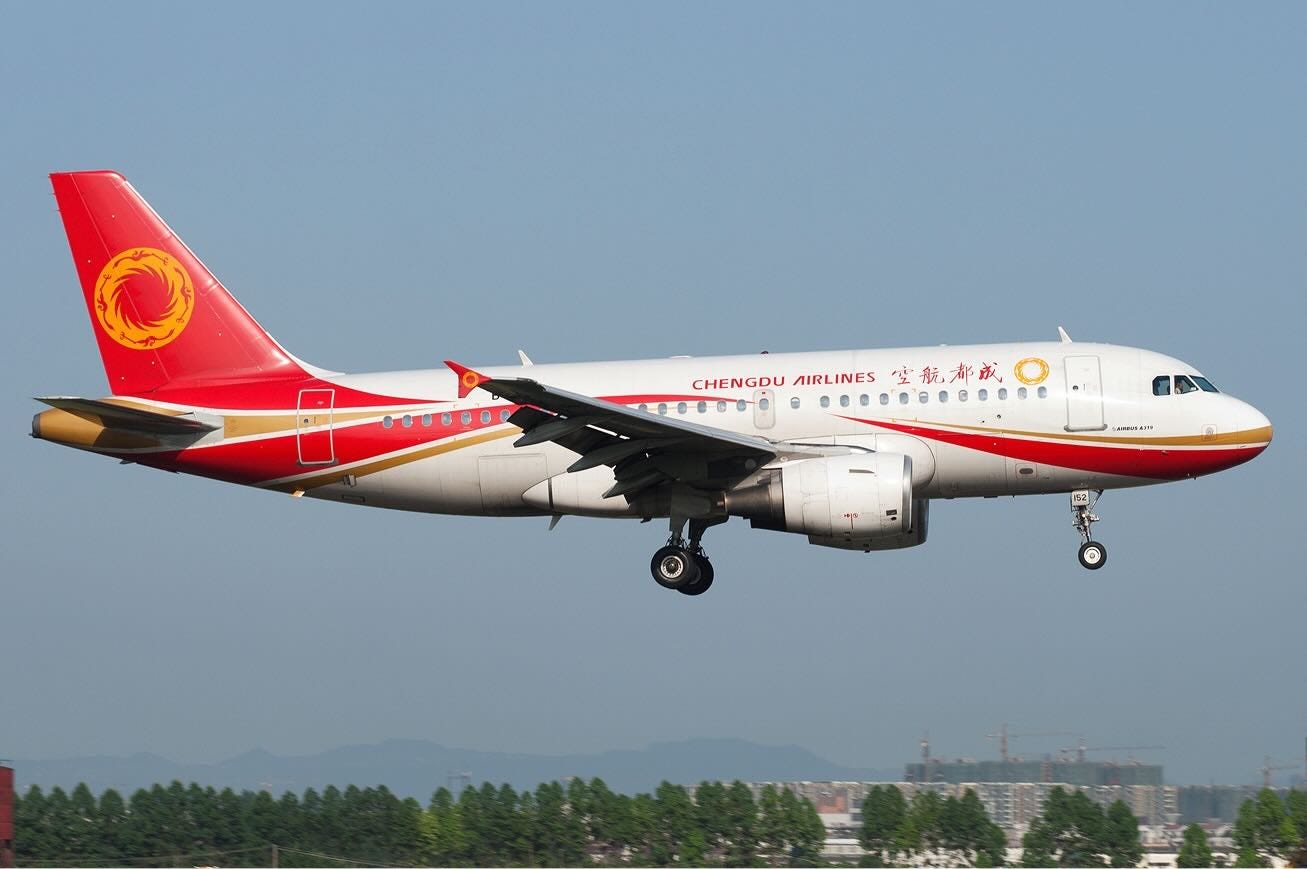
Aviation databases break the active fleet into roughly four Airbus A319-115 narrowbodies, 43 A320 family aircraft including A320ceo and A320neo, five Airbus A321 jets and 29 COMAC C909 (legacy ARJ21) regional jets.


This makes the carrier the world’s largest operator of the Chinese-built C909 by some distance, and one of the most diversified A320-family operators in western China. The A320ceo bulk has been the workhorse for years, while the A320neo and A321 portions reflect more recent fleet renewal.
Chengdu Airlines Active Fleet Composition (2026)
- Airbus A319-100:         4 aircraft
- Airbus A320ceo / neo:   43 aircraft
- Airbus A321-200:         5 aircraft
- COMAC C909 (ARJ21-700): 29 aircraft
- TOTAL:                  ~82 aircraft
- Average age:            ~6.2 years
- Order book / planned:    4 aircraft
Fleet Age Profile
The average fleet age sits near 6.2 years, placing Chengdu Airlines near the median for Chinese carriers. The youngest sub-fleet is the A321-200 group at around 1.4 years on average, reflecting recent deliveries used to up-gauge dense trunk routes.
The C909 fleet has been rolled out gradually since the first ARJ21-700 delivery in November 2015, giving Chengdu Airlines a deep institutional knowledge base for operating the type. The A319 sub-fleet is among the older parts of the operation, used selectively on shorter, lower-density city pairs.
Aircraft Type Strategy and Configuration
Each fleet type has a specific operational role.
The A319, with around 130-150 seats depending on configuration, is reserved for routes where slot constraints or runway limitations favour a smaller mainline jet. The A320ceo and A320neo, the operational centre of gravity for the airline, run high-utilisation domestic routes with around 178-180 economy seats.
The A321-200 jets cover dense trunk segments such as routes between Chengdu and Beijing, Shanghai or Guangzhou, where larger payloads improve unit economics. With around 200-210 seats in a single-cabin layout, they replace several daily A320 frequencies on key sectors.
The C909 fleet is configured at either 78 or 90 single-class seats, optimising the aircraft for short-haul regional pairings of 600 to 1,500 nautical miles. The aircraft has a range of about 2,225 miles and is suited to underserved second and third-tier city pairs.
Fleet Strategy: From Airbus Reliance to Chinese Champion
Strategically, the airline straddles two distinct fleet philosophies.
On the mainline side, it remains an all-Airbus operator like its parent Sichuan Airlines, leveraging shared MRO, training, and fleet planning advantages within the Sichuan Airlines Group’s 200-aircraft Airbus footprint.
On the regional side, the carrier is COMAC’s flagship customer for the C909 and a pivotal operator in shaping the type’s future. The C909 was rebranded from ARJ21 in late 2024, aligning it with the C919 and C929 wide-body program in COMAC’s family naming convention.
After the recapitalisation, the airline is expected to rapidly grow its C909 fleet over the medium term. COMAC’s stated objective with the funding is to use Chengdu Airlines as the launchpad for international C909 routes and to give the type credible global revenue service hours.
C919 Question Mark
Chengdu Airlines is not yet on the public delivery list for the larger COMAC C919 narrowbody. The 2026 industry forecast highlights 33 C919 deliveries expected across Air China, China Eastern and China Southern, with no Chengdu Airlines slot disclosed for the year.
Given COMAC’s controlling stake in Chengdu Airlines, however, industry observers expect the carrier to eventually become a C919 operator once the program scales beyond initial flag-carrier launch customers. COMAC’s overall production targets remain stretched, with the program likely to miss its 50-unit annual goal significantly.
Aircraft Type Mission Map
- A319-100: Short-haul, slot-restricted city pairs
- A320ceo:  Backbone domestic routes, high-frequency operations
- A320neo:  Same missions as A320ceo with lower fuel burn
- A321-200: Dense trunk routes (CTU-PEK, CTU-PVG, CTU-CAN)
- C909:     Thin regional pairs, second-tier cities, international
corridor pioneers (Tajikistan, Vietnam wet-lease)Fleet Risks: Engine and Supply Chain Exposure
The C919 program’s broader supply-chain difficulties are an indirect overhang for Chengdu Airlines because the carrier’s strategic alignment with COMAC means its long-term fleet roadmap is tied to Chinese aerospace manufacturing performance. Production gaps in Chinese narrowbody output could constrain Chengdu Airlines’ ability to grow beyond its current order book pace.
For the A320 family, China’s exposure to Airbus output is supported by the Tianjin assembly line expansion, giving Chengdu Airlines a relatively stable narrowbody supply outlook even as global Airbus delivery slots remain tight industry-wide.