


Executive Summary
L3Harris closed 2025 with $21.9 billion in revenue, a record $27.5 billion in orders, a 1.3x book-to-bill, and a record backlog, then immediately reorganized from four segments into three to align the portfolio with what Kubasik calls “the future of warfare.”
The company is pursuing a planned IPO of its Missile Solutions business in the second half of 2026 while keeping a controlling stake, alongside a $1 billion DoD strategic investment to scale solid rocket motor and tactical missile production.
A separate divestiture announced in January 2026 will sell a majority stake in the legacy space-propulsion (Rocketdyne) business to AE Industrial Partners for $845 million, with L3Harris retaining 40%.
Major 2025-2026 wins span the Tranche 3 Tracking Layer ($843M), Golden Dome interceptor work, the $465 million NOVA night-vision contract for the U.S. Army, and continued growth in Falcon IV tactical radios and counter-UAS systems.
Recommended - Read Full Reports


Read All Reports
Table of Contents
Executive Summary
Introduction
Key Facts: Company Profile
L3Harris Technologies: Company Overview
From Two Companies to “Trusted Disruptor”
The 2023 Aerojet Rocketdyne Acquisition
The 2026 Reality
Geographic Footprint and Manufacturing Base
Key Product Lines and Programs
Tactical Radios and the Falcon Franchise
Counter-UAS: VAMPIRE and the New Family
Night Vision: ENVG-B and NOVA
Space & Mission Systems: From Weather to Warning
Communications & Spectrum Dominance
Missile Solutions and the Arsenal of Freedom
L3Harris Financial Analysis
Headline 2025 Numbers
2025 Segment Contribution
2026 Guidance and the New Three-Segment Map
Capital Allocation and Shareholder Returns
Research & Development Intensity
Revenue and Growth Drivers
Driver #1: Missile Defense and Munitions Replenishment
Driver #2: Proliferated LEO and Missile Warning
Driver #3: International Demand and the 20% Target
Driver #4: LTM Performance and Operating Leverage
Major Competitors
L3Harris vs. Lockheed Martin
L3Harris vs. RTX Corporation
L3Harris vs. Northrop Grumman
L3Harris vs. BAE Systems
L3Harris vs. General Dynamics Mission Systems
Competitive Analysis and the L3Harris Moat
Moat #1: Vertical Integration in Solid Rocket Motors
Moat #2: Software-Defined Tactical Communications
Moat #3: Trusted Position with the Intelligence Community
Moat #4: Speed and Commercial Execution
Where the Moat Is Thinner
Key Programs, Wins, and Strategic Moves: A 2025 to 2026 Recap
The Shield Capital Partnership
Financial and Commercial Implications
Implication #1: Margin Mix Shifts Favorably
Implication #2: Capital Recycling Funds Growth
Implication #3: International Revenue Quality Improves
Implication #4: Backlog Coverage Provides Earnings Visibility
Key Risks: Probabilities and Scenarios
Risk 1: Federal Budget and Continuing Resolution Risk
Risk 2: Solid Rocket Motor Capacity Ramp Execution
Risk 3: Missile Solutions IPO Market Conditions
Risk 4: Tracking Layer Program Risk
Risk 5: Concentration in Solid Rocket Motors
Risk 6: Workforce and Clearance Pipeline
Risk 7: Geopolitical and Export Control
L3Harris SWOT Analysis
Outlook for 2026 and Beyond
Near-Term (2026)
Medium-Term (2027 to 2028)
Long-Term (2029 and Beyond)
My Final Thoughts
Official Sources and Data
Introduction
The defense electronics giant rarely makes the loud, headline-grabbing acquisitions of its larger peers, yet over the past 36 months, it has quietly become one of the most consequential names in U.S. national security.
With a $38.7 billion contractual backlog, a freshly redesigned three-segment structure, and a first-of-its-kind partnership with the Department of Defense to spin out a pure-play missile maker, L3Harris is no longer just the radio company that bought Aerojet Rocketdyne.
It’s becoming the connective tissue between America’s space, missile, and tactical communications domains, all while CEO Christopher Kubasik insists publicly that the company must operate at “commercial speed.”
L3Harris has historically been a messy story.
It made tactical radios, weather satellites, FAA control systems, night-vision goggles, and the kitchen sink of electronic warfare gear. After absorbing Aerojet Rocketdyne in 2023, that story got even messier.
However, in 2026, the company is methodically converging the spread.
Now, all converges into three segments.
One pure-play missile spin-out.
One propulsion divestiture.
One huge bet on space-based sensing for missile defense.
For anyone tracking where defense capital is flowing, this is the company to study, because its portfolio surgery is essentially a road map of where the Pentagon thinks the next decade of conflict will be fought.
This in-depth strategic analysis report walks through that full picture.

Key Facts: Company Profile
COMPANY: L3Harris Technologies, Inc.
TICKER: NYSE: LHX
HEADQUARTERS: 1025 W. NASA Boulevard, Melbourne, Florida 32919
CHAIRMAN & CEO: Christopher E. Kubasik
SVP & CFO: Kenneth Bedingfield
FOUNDED (in current form): June 29, 2019 (Harris + L3 Technologies merger)
EMPLOYEES: ~47,000 (2025)
2025 REVENUE: $21.865 billion
2025 ORDERS: $27.5 billion
BACKLOG (year-end 2025): record level (multi-year revenue coverage)
SEGMENTS (effective Jan 5, 2026):
  • Space & Mission Systems (SMS)
  • Communications & Spectrum Dominance (CSD)
  • Missile Solutions (MSL)
DIVIDEND: $1.25/quarter (raised in Q1 2026 from $1.20)
R&D INVESTMENT (2025): $536 million company-funded
L3Harris Technologies: Company Overview
From Two Companies to “Trusted Disruptor”
L3Harris Technologies was created by the all-stock merger of Harris Corporation and L3 Technologies on June 29, 2019.
Harris brought tactical radios, satellite payloads, and electronic warfare strength. L3 Technologies brought a sprawling portfolio of avionics, ISR aircraft modifications, training, and maritime systems.
The combined entity became, almost overnight, the sixth-largest U.S. defense contractor and the largest “merchant supplier” to the prime contractors. That positioning, supplying critical subsystems to peers like Lockheed Martin and Northrop Grumman while also competing as a prime, defines its strategic identity.
Kubasik has publicly branded the company “The Trusted Disruptor,” a language repeated in the March 2026 Company Overview brochure and across investor materials. It’s a deliberate effort to position the firm between traditional, slow-moving primes and Silicon Valley defense disruptors like Anduril and Palantir.

The 2023 Aerojet Rocketdyne Acquisition
The pivotal portfolio move was the $4.7 billion acquisition of Aerojet Rocketdyne, completed July 28, 2023.
That deal vertically integrated solid rocket motors, hypersonic propulsion, and liquid divert and attitude control systems into a company that had previously been a payload and electronics specialist.
The strategic logic was straightforward. The U.S. industrial base for solid rocket motors had collapsed to essentially two suppliers (Aerojet Rocketdyne and Northrop Grumman after its acquisition of Orbital ATK).
With munitions demand rising sharply due to Ukraine, missile defense, and Indo-Pacific deterrence, owning a propulsion supplier was both a defensive and offensive bet.
The 2026 Reality
By early 2026, L3Harris is operating in a defense environment defined by accelerated munitions replenishment, the Trump administration’s Golden Dome missile defense initiative, and growing demand for space-based missile warning and tracking. All three trends play directly to L3Harris’s strengths.
The company’s response has been to organize itself around those three trends. Kubasik described the January 5, 2026 reorganization as a step that “thoughtfully organizes common business models, technical capabilities and investment priorities.”
PRE-2026 SEGMENT STRUCTURE (4 segments)
- Space & Airborne Systems (SAS)
- Integrated Mission Systems (IMS)
- Communication Systems (CS)
- Aerojet Rocketdyne (AR)

POST-JAN 2026 STRUCTURE (3 segments)
- Space & Mission Systems (SMS) led by Sam Mehta
- Communications & Spectrum Dominance (CSD) led by Jon Rambeau
- Missile Solutions (MSL) led by Ken Bedingfield (also SVP & CFO)Geographic Footprint and Manufacturing Base
L3Harris is increasingly defined by its physical capacity, not just its IP. Major facility investments over the past 24 months include:
A $125 million expansion at the Fort Wayne, Indiana payload facility in 2025 to support missile-warning and missile-tracking spacecraft.
A $100 million expansion of the Palm Bay, Florida satellite integration facility completed in August 2025.
Multiple expansions at solid rocket motor sites in Camden, Arkansas and Huntsville, Alabama.
A groundbreaking on new advanced propulsion facilities in Arkansas in November 2025.
Each expansion is tied to a specific named program: Tranche 2 and Tranche 3 Tracking Layer satellites, Golden Dome interceptors, Standard Missile family booster motors, and GMLRS guided artillery.
Key Product Lines and Programs
Tactical Radios and the Falcon Franchise
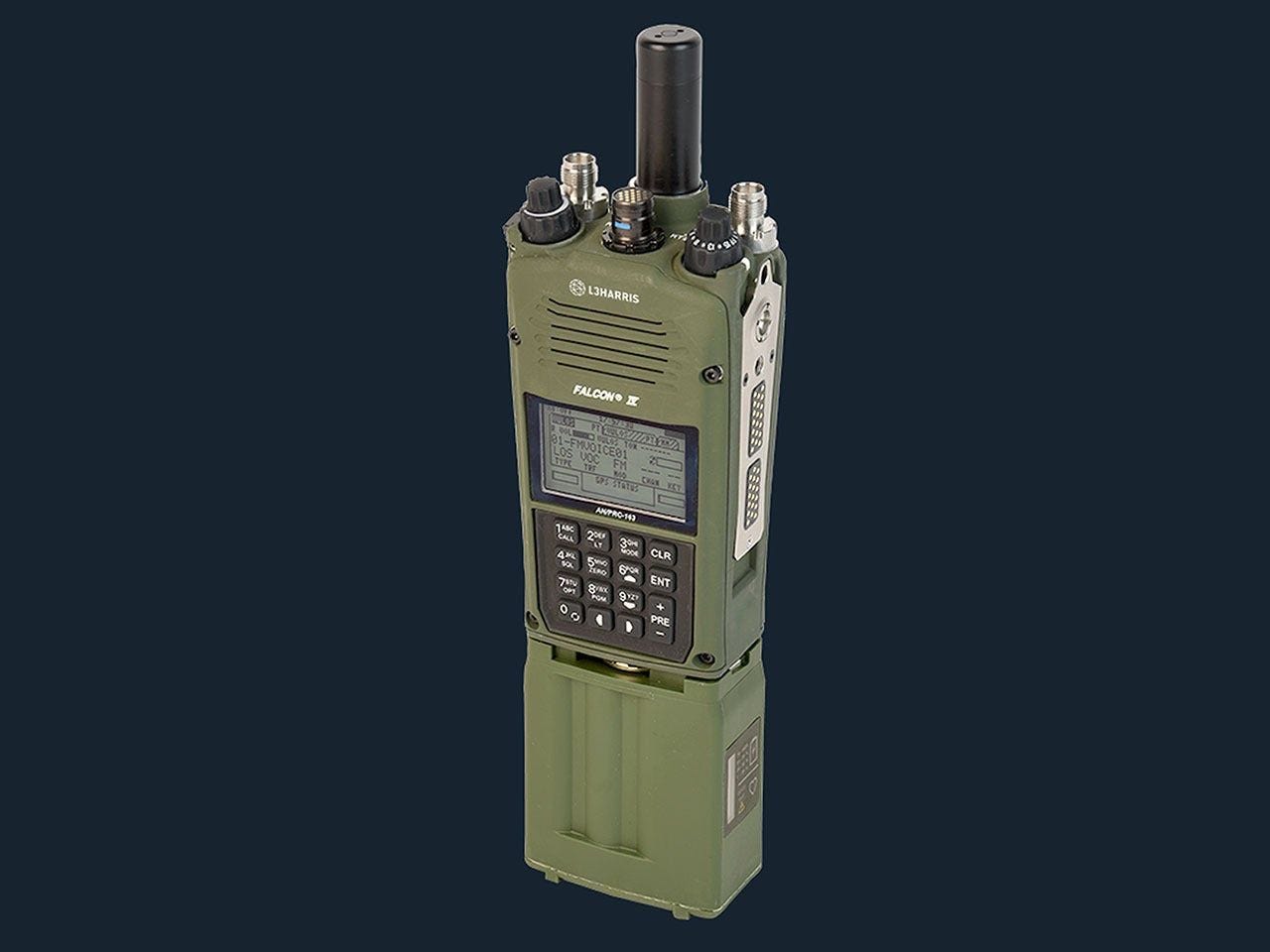
The single most recognizable L3Harris product family is the Falcon line of tactical radios. These are the radios on the backs of U.S. Army infantry, Special Operations Forces, and dozens of allied militaries.
The flagship is the AN/PRC-163 multi-channel handheld, part of the Falcon IV family. It supports simultaneous voice, full-motion HD video, and high-speed data on multiple waveforms in a single, soldier-portable form factor.
Falcon IV has become the de facto standard for the U.S. Army’s Two-Channel Leader Radio (TCLR) and Special Operations Command’s Next Generation Handheld Radio programs. Continuous orders against these programs run to hundreds of millions of dollars annually.
The franchise also extends into manpack and vehicular variants, plus the dismounted ground tactical antenna products that sit alongside the radios in the field.
FALCON FAMILY AT A GLANCE
- AN/PRC-163: two-channel handheld, simultaneous voice/data/video
- AN/PRC-167: multi-channel manpack
- AN/PRC-152A: single-channel wideband networking handheld
- AN/PRC-117G: long-haul wideband manpack (Falcon III legacy)
- Vehicular variants for armored and tactical wheeled platforms
- Crossbanding capability for joint and coalition interoperability
Counter-UAS: VAMPIRE and the New Family
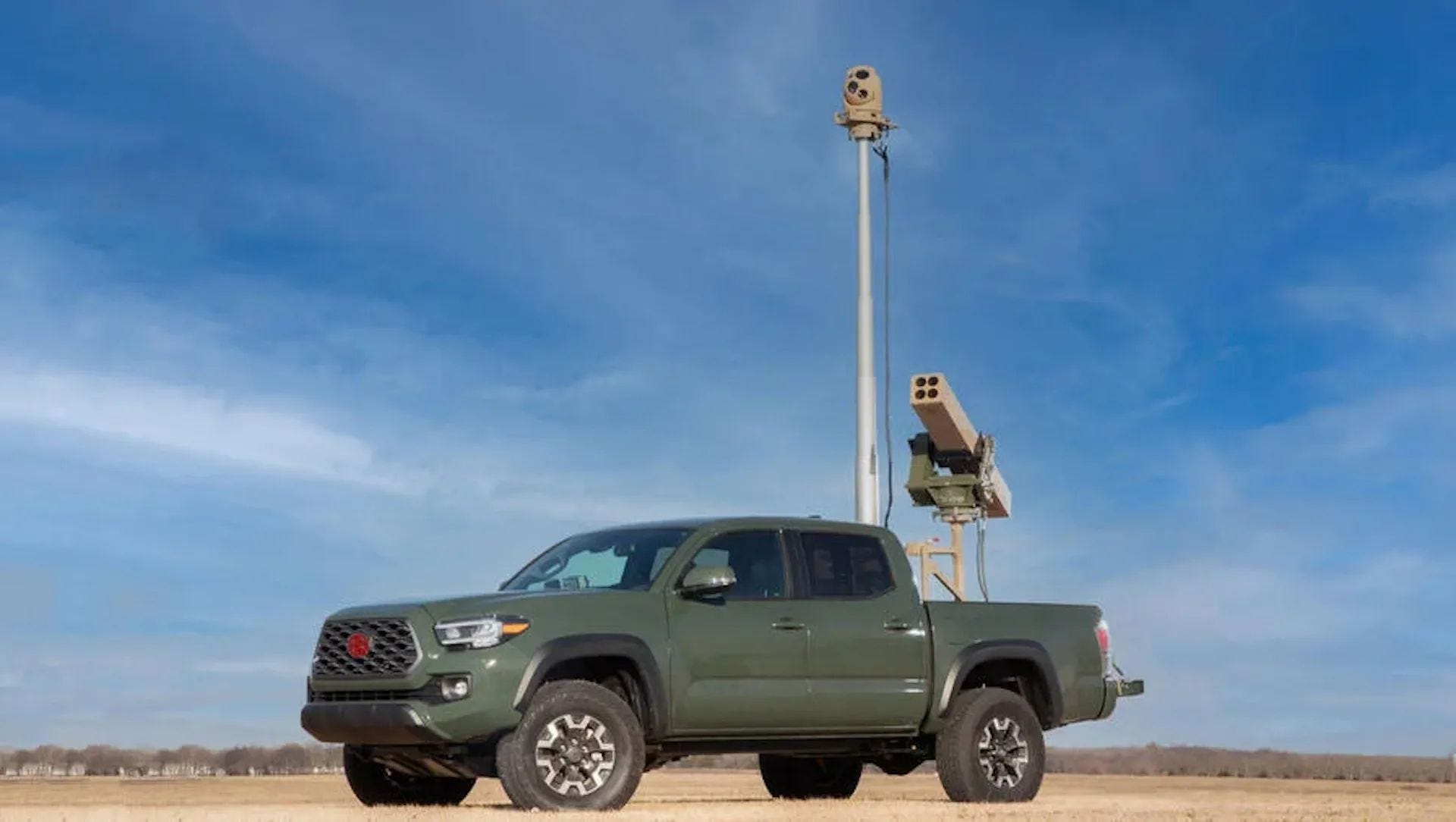
The Vehicle-Agnostic Modular Palletized ISR Rocket Equipment, or VAMPIRE, began as an urgent fielding to Ukraine and has since been productized into a full family. VAMPIRE pairs an ISR sensor turret with the Advanced Precision Kill Weapon System (APKWS) laser-guided 70mm rocket to defeat drones and surface targets.
The system was fielded in less than eight months, an unusually fast cadence for a defense capability, and Ukrainian forces have used it operationally against Iranian-designed Shahed-class one-way attack drones.
In late 2025, L3Harris expanded the family to include CASKET (Containerized Anti-drone System with Kinetic Effects Turret), a self-contained “VAMPIRE-in-a-box” for fixed and remote sites. The system has also been demonstrated mounted on the GM Defense Infantry Squad Vehicle.
This product family is strategically important because it sits at the intersection of two booming markets: counter-UAS and rapid-fielding “small wars” capability. Order activity has trended steadily upward since 2024.
Night Vision: ENVG-B and NOVA
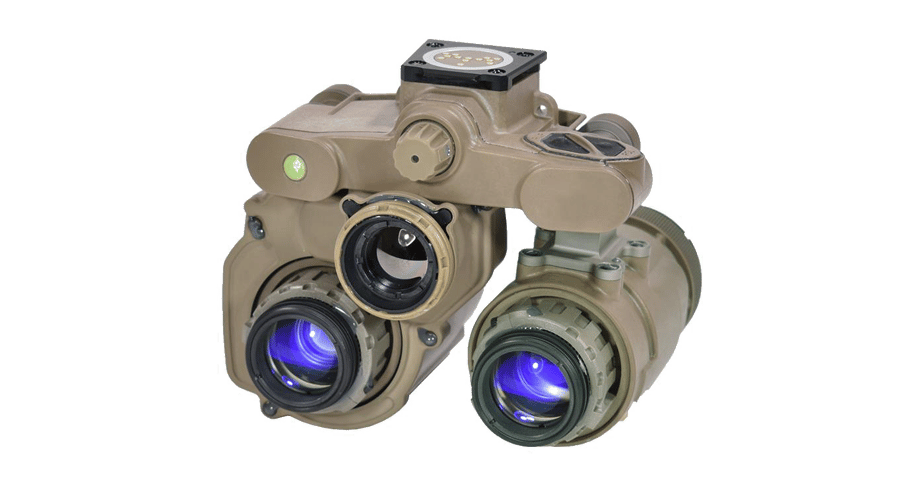
In April 2026, L3Harris secured one of the most consequential soldier-system awards of the year: a seven-year contract worth up to $465 million to supply the U.S. Army’s Binocular Night Vision Device (BNVD) under the next-generation NOVA program.
NOVA replaces older monocular and binocular goggles with a system designed around modularity, repairability, and lower lifecycle cost. The official L3Harris NOVA editorial briefing emphasizes that the device is intended to be “fixed, not replaced,” addressing one of the Army’s chronic complaints about earlier programs.
Alongside NOVA, the company received a $263 million order in January 2025 for additional ENVG-B units, which add a thermal channel and augmented-reality cueing for Stryker and infantry brigades.
NIGHT-VISION CONTRACT MOMENTUM
- 2021: ENVG-B initial production contracts
- Jan 2025: $263M ENVG-B follow-on production order
- Apr 2026: NOVA seven-year contract worth up to $465M
- Combined active backlog: among the largest in U.S. soldier-system optics
Space & Mission Systems: From Weather to Warning
The new Space & Mission Systems segment integrates the legacy Space & Airborne Systems business with Aerojet Rocketdyne’s space-propulsion unit (the part L3Harris is keeping after the AE Industrial transaction).
The crown jewel inside SMS is the proliferated low-Earth-orbit satellite work for the Space Development Agency. On December 19, 2025, the SDA awarded L3Harris an $843 million Tranche 3 Tracking Layer contract covering missile-tracking spacecraft for the next phase of the Proliferated Warfighter Space Architecture.

This builds on existing Tranche 1 and Tranche 2 awards, and the company has completed CDR (Critical Design Review) on its Tranche 1 Tracking Layer satellites. Tranche 1 deliveries are on the near horizon, with launches scheduled to follow.
SMS also includes longstanding programs in weather and environmental sensing for NOAA, classified intelligence-community work, and the FAA’s air traffic management modernization.
The MOSSAIC contract for U.S. Space Force ground systems received a $150 million renewal in April 2026, sustaining ground-based space surveillance sensor operations.
Communications & Spectrum Dominance
The CSD segment combines the legacy Communication Systems business with the electronic warfare and spectrum operations capabilities previously housed in IMS and SAS.
Under Jon Rambeau, the segment will own:
The Falcon family of tactical radios discussed above.
Software-defined waveform development and licensing (SINCGARS, SRW, MUOS, ANW2, TSM, and L3Harris-developed waveforms).
Airborne electronic warfare systems for the U.S. Navy’s EA-18G Growler and the next-generation EA-37B Compass Call.
Space-based RF sensing and ground-based signals intelligence systems.
Resilient public-safety and federal communications.
The strategic story for CSD is “spectrum dominance,” the idea that future conflicts will be won and lost by which side can communicate, sense, and deny across the radio frequency spectrum.
L3Harris has invested heavily in software-defined architectures that allow a single radio or sensor to operate across multiple waveforms, including waveforms developed after the hardware was fielded.
Missile Solutions and the Arsenal of Freedom
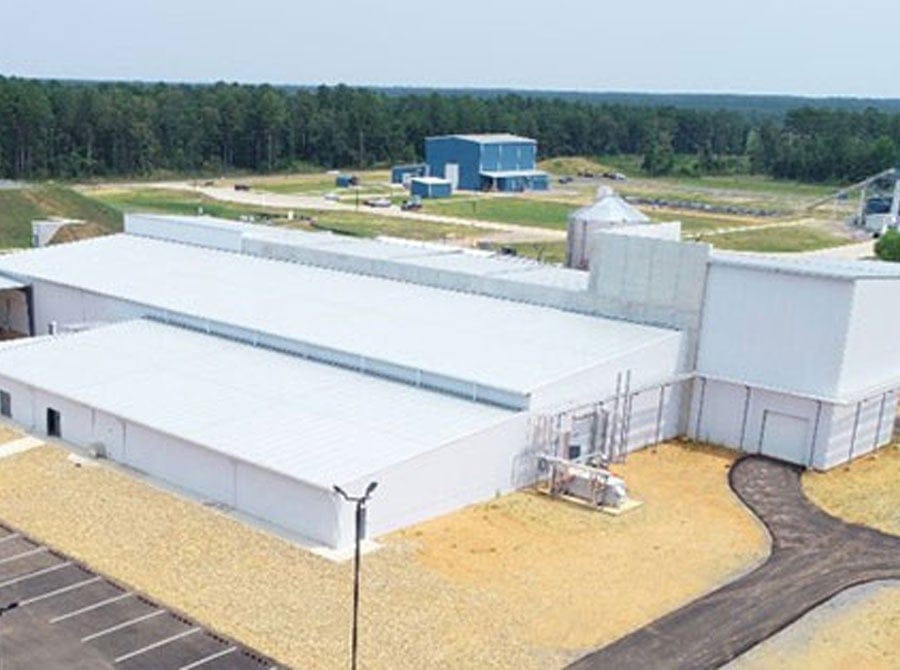
The Missile Solutions segment is the most strategically interesting piece of the new structure, because it is being built explicitly to be carved out.
On January 13, 2026, L3Harris announced an unprecedented partnership with the Department of Defense. Under the agreement, the DoD is committing approximately $1 billion in directed investment, with L3Harris targeting an initial public offering of Missile Solutions in the second half of 2026, while retaining a controlling interest.
The Missile Solutions portfolio includes:
MSL CORE PROGRAMS
- Solid rocket motors for Standard Missile-2/3/6, GMLRS, PAC-3, THAAD, Stinger
- Liquid Divert and Attitude Control Systems (DACS) for kill vehicles
- Hypersonic propulsion (boost and dual-mode ramjet)
- Tactical missile system integration (announced 2025)
- Solid rocket motors for the Artemis program and Atlas V/Vulcan
The $400 million contract for additional solid rocket boost motors and DACS for Golden Dome reinforces the centrality of this segment to U.S. missile defense.
The IPO logic is straightforward but novel: by creating a publicly traded pure-play, L3Harris (and the DoD) believes Missile Solutions will attract focused capital, talent, and management attention while continuing to scale the most capacity-constrained part of the U.S. munitions industrial base.
L3Harris Financial Analysis
Headline 2025 Numbers
The full-year 2025 results released on January 29, 2026 confirmed that L3Harris is converting its strong order book into both revenue and cash.
Reported revenue of $21.865 billion grew about 1% on a reported basis and 5% organically, after adjusting for the divestiture of the Commercial Aviation Solutions (CAS) business and the antenna business.
Adjusted segment operating margin reached 15.8%, up 40 basis points year-over-year, reflecting cost-takeout actions under the multi-year LHX NeXt productivity initiative. Non-GAAP earnings per share were $10.73 for the full year.
Cash performance was particularly strong. The company generated double-digit free-cash-flow growth, beat expectations despite the late-2025 federal government shutdown, and entered 2026 with significantly more financial flexibility than at any point since the Aerojet acquisition.
2025 Segment Contribution
Under the legacy four-segment structure used for 2025 reporting, the breakdown was as follows:
2025 SEGMENT REVENUE (legacy structure, $ millions)
- Space & Airborne Systems: $6,946M
- Integrated Mission Systems: $6,630M
- Communication Systems: $5,673M
- Aerojet Rocketdyne: $2,845M
- Corporate / eliminations: -$229M
- Consolidated total: $21,865M
These figures are drawn directly from the company’s Q4 2025 earnings release. Notably, Space & Airborne Systems revenue was roughly flat year-over-year, with the federal government shutdown delaying certain space contract milestones. CS and AR each grew solidly.
2026 Guidance and the New Three-Segment Map
The 2026 guidance, reaffirmed at the February 25, 2026 Investor Day, is the first to be expressed in the new segment structure:
2026 GUIDANCE (issued Jan 29, 2026)
Total revenue: $23.0B – $23.5B
- Space & Mission Systems: ~$11.5B
- Communications & Spectrum Dominance: ~$8.0B
- Missile Solutions: ~$4.4B
Diluted EPS (non-GAAP): $11.30 – $11.50
Free cash flow: ~$3.0B
The implied total of segment revenue ($23.9B) exceeds the consolidated guide because of inter-segment eliminations and corporate items.
Importantly, the guidance does not yet include the impact of the announced Rocketdyne stake sale to AE Industrial, which is expected to close in the second half of 2026 and will be reflected in an updated guide at that time.
The 2026 plan therefore rests on three pillars: organic growth in tracking-layer satellite deliveries, continued Falcon and EW radio momentum, and ramped solid rocket motor output across the missile-defense portfolio.
Capital Allocation and Shareholder Returns
L3Harris has materially shifted its capital-allocation profile since 2024. Net leverage from the Aerojet acquisition is now well within investment-grade tolerances, allowing the company to resume aggressive returns to shareholders.
The Board declared a $1.25 quarterly dividend in April 2026, payable June 26, 2026. That follows a roughly 4% increase from the prior $1.20 rate authorized in January 2026.
Share repurchases have also accelerated. According to share buyback data, L3Harris repurchased approximately $202 million of stock in the period ending January 2026, up sharply from the prior year.
2026 CAPITAL ALLOCATION FRAMEWORK
- Maintain investment-grade credit rating
- Quarterly dividend, growing in line with earnings
- Opportunistic buybacks (target: offsetting dilution at minimum)
- Disciplined, technology-focused tuck-in M&A
- Multi-billion-dollar capex on missile and space production capacity
- Optional capital release: Rocketdyne stake sale ($845M proceeds, H2 2026)
- Optional capital release: Missile Solutions IPO (H2 2026, retain control)Research & Development Intensity
R&D investment in 2025 totaled $536 million in company-funded R&D (about 2.5% of revenue), per the 2025 Annual Report. Customer-funded R&D and IRAD on government programs add a multiple of that figure on top.
This R&D intensity is below the 4% to 6% of pure-play technology companies but consistent with defense-electronics primes.
The ratio matters less than what is being funded: counter-UAS, AI-enabled mission systems, hypersonic propulsion, additive manufacturing for satellite thrusters, and modular open-systems-architecture (MOSA) software-defined platforms.
Revenue and Growth Drivers
Driver #1: Missile Defense and Munitions Replenishment
The most powerful structural tailwind for L3Harris is the multi-year U.S. and allied push to rebuild munitions inventories drawn down by Ukraine support, plus the buildup of new missile defenses in the Indo-Pacific.
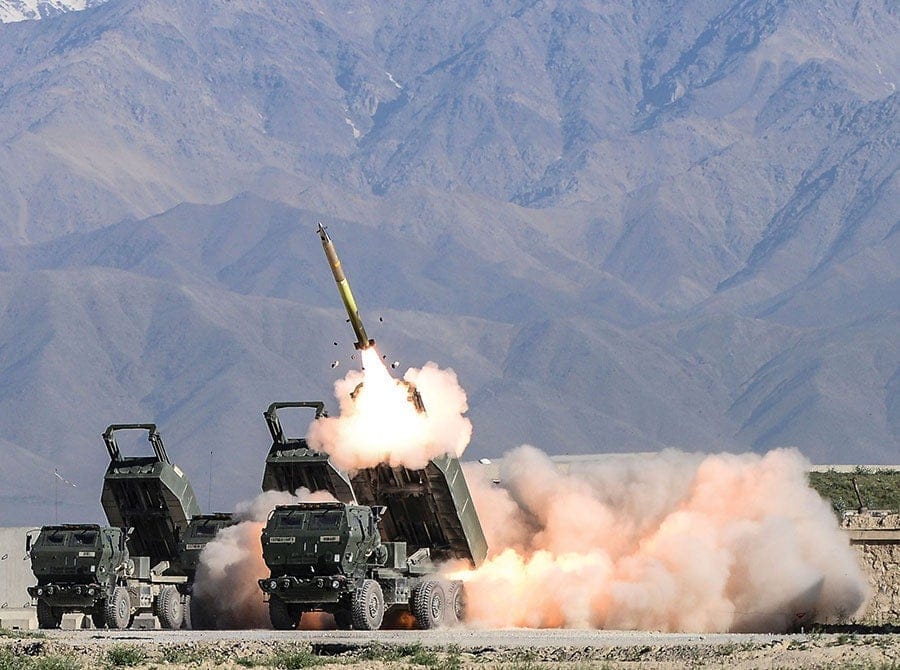
L3Harris is a meaningful supplier of solid rocket motors and DACS to most of the major U.S. interceptor and tactical missile programs. The $400 million Golden Dome contract and the $1 billion DoD investment in Missile Solutions are direct expressions of this tailwind.
Beyond defensive systems, the company has been awarded follow-on solid rocket motor contracts for the GMLRS precision-guided artillery system, one of the highest-volume tactical systems used by U.S. and allied forces.
Driver #2: Proliferated LEO and Missile Warning
The Pentagon’s transition from a small number of large geostationary missile-warning satellites to a proliferated constellation in low Earth orbit is the single biggest space-business inflection of the decade. L3Harris has positioned itself as one of the key tracking-layer providers.
Across SDA Tranche 1, Tranche 2, and now Tranche 3, the company holds multiple billion-dollar program awards. The Golden Dome architecture announced under the Trump administration is expected to layer additional space-based interceptor and sensor opportunities on top, with 12 firms recently selected for $3.2 billion of Golden Dome interceptor study work.
Even before Golden Dome interceptor production begins, the supporting tracking and fire-control sensor architecture is essentially L3Harris home turf.
Driver #3: International Demand and the 20% Target
Management has stated a target of 20% of revenue from international customers by end of 2025. Drivers include European NATO members rebuilding their stockpiles, Japan and Australia investing heavily under AUKUS-adjacent frameworks, and Middle Eastern customers modernizing tactical communications.
The Falcon IV radio family in particular has seen strong export momentum. Programs in the United Kingdom, Australia, Canada, the Nordics, Poland, and the Baltic states are all in various stages of fielding L3Harris tactical radios, often as replacements for older Falcon III generations.
Driver #4: LTM Performance and Operating Leverage
On a last-twelve-months basis as of year-end 2025, L3Harris generated $21.865 billion of revenue and approximately 15.8% adjusted segment operating margin. The company expects margin expansion to continue in 2026 as LHX NeXt productivity savings, integration synergies from Aerojet, and operating leverage on rising volumes flow through.
LTM FINANCIAL SNAPSHOT (year-end 2025)
- Revenue (LTM): $21.865B
- Adj. segment operating margin: 15.8%
- Non-GAAP diluted EPS (FY 2025): $10.73
- Orders (LTM): $27.5B
- Book-to-bill: 1.3x
- Backlog: record level
A 1.3x book-to-bill is unusually strong for a company of this scale and reflects the breadth of the demand backdrop. Notably, no single program accounts for an outsized share of orders, which reduces concentration risk.
Major Competitors
L3Harris does not compete with a single peer across its entire portfolio. The competitive set varies sharply by capability area. The most relevant publicly traded competitors are:
Lockheed Martin Corporation (NYSE: LMT)
RTX Corporation (NYSE: RTX), particularly the Raytheon and Collins Aerospace segments
Northrop Grumman Corporation (NYSE: NOC)
BAE Systems plc (LSE: BA.L)
General Dynamics Corporation (NYSE: GD), particularly the Mission Systems unit
Leidos Holdings, Inc. (NYSE: LDOS)
Leonardo S.p.A. (BIT: LDO)
Thales Group (Euronext: HO)
L3Harris vs. Lockheed Martin
Lockheed Martin’s Missiles and Fire Control segment competes directly with L3Harris in solid rocket motor supply (Lockheed is a major customer for L3Harris/Aerojet motors but also has its own competitive positioning) and in air-defense system integration.
In space, Lockheed Martin Space competes for missile-warning, missile-tracking, and classified spacecraft awards.
The key differentiator is scale and prime-system ownership. Lockheed integrates entire missile systems (Patriot, THAAD, Hellfire, JASSM, LRASM) and entire spacecraft buses, while L3Harris typically supplies critical subsystems and emerging proliferated-LEO buses.
This makes them simultaneously customer and competitor, an unusual but increasingly common arrangement in the modern defense ecosystem.
L3Harris vs. RTX Corporation
RTX is the closest direct comparable across the most capability areas. The Raytheon segment competes in missile defense interceptors, propulsion (where RTX is a major Aerojet/L3Harris customer for SM-2/3/6 motors), counter-UAS (RTX’s Coyote vs. L3Harris’s VAMPIRE), and space sensors.
Collins Aerospace, RTX’s avionics and communications arm, competes with L3Harris in tactical communications (although Collins is stronger in airborne networking, while L3Harris dominates ground tactical radios) and in mission systems integration. Hudson Labs notes that L3Harris explicitly lists RTX as a competitor in communications, ISR, and defense electronics.
The strategic difference: RTX generates roughly three times the revenue of L3Harris and includes the Pratt & Whitney engine business, which has no L3Harris analog. L3Harris is more focused, more electronics-centric, and arguably more agile in counter-UAS and tactical radios.
L3Harris vs. Northrop Grumman
Northrop Grumman is the most direct competitor in two specific arenas: solid rocket motors (where Northrop’s propulsion business and L3Harris/Aerojet are essentially the only two major U.S. suppliers) and proliferated-LEO satellites (where both companies hold SDA Tracking Layer awards).
Northrop also has stronger positions in strategic systems (B-21 Raider, Sentinel ICBM) and unmanned aircraft (Triton, Global Hawk legacy), areas where L3Harris does not compete directly.
Conversely, L3Harris is significantly stronger in tactical radios and night vision, where Northrop has limited presence.
L3Harris vs. BAE Systems
BAE Systems competes with L3Harris in electronic warfare, combat vehicle electronics, and avionics integration, particularly through its Electronic Systems sector in the United States. BAE’s GXP geospatial software competes with L3Harris’s geospatial offerings.
In international markets, BAE’s deeper European footprint gives it advantages in U.K. and continental EU programs, while L3Harris’s NATO interoperability emphasis on the Falcon family has grown its share among newer NATO members.
L3Harris vs. General Dynamics Mission Systems
General Dynamics Mission Systems competes most directly with L3Harris in tactical communications, space sensors, and undersea sensors.
GDMS’s WIN-T network and Hand-Held Manpack and Small Form Fit (HMS) tactical radios compete head-to-head with the Falcon family in U.S. Army programs.
L3Harris has historically held the larger share in ground tactical radios, while GD has been more competitive in fixed-site networking and submarine-related electronics.