


Executive Summary
Leonardo closed 2025 with €23.8 billion in new orders (up roughly 15% year-on-year), revenues of €19.5 billion, and a backlog approaching €45 billion, giving the Italian aerospace and defence champion roughly 2.3 years of forward visibility on its current production rate.
The acquisition of Iveco Group’s defence business for approximately €1.6 billion (closed March 2026) added a sixth division, Land Defence, that brought €1.37 billion of 2025 revenues and roughly 4,000 employees across Italy, Germany, Romania, and Brazil.
The 2026-2030 Industrial Plan targets €32 billion in annual orders, €30 billion in revenue, and €3.59 billion of adjusted EBIT by 2030, with cumulative free operating cash flow of €8 billion over the period.
Flagship platforms (Eurofighter Typhoon, AW139/AW149/AW249 helicopters, M-346 trainer, GCAP sixth-generation fighter, and the Michelangelo Dome integrated air defence system) anchor a portfolio that is increasingly weighted toward integrated multi-domain solutions rather than discrete platforms.
Recommended - Read Full Reports


Read All Reports
Table of Contents
Executive Summary
Key Facts: Leonardo Company Profile
Why Is Leonardo Relevant in 2026
Leonardo Company Overview
Origins, Identity, and the “One Company” Reorganisation
Ownership and Governance
Geographic Footprint and Customer Mix
Leadership Transition: The Cingolani Question
Key Product Lines, Programmes and Services
Helicopters Division
Civil and Commercial Helicopter Family
Military Rotorcraft
Helicopters Division Performance
Aircraft Division
Eurofighter Typhoon
Global Combat Air Programme (GCAP)
M-346 Master Trainer Family
C-27J Spartan Tactical Transport
ATR Joint Venture
Defence Electronics & Security Division
Leonardo DRS in the United States
Michelangelo Dome Integrated Air Defence
Cyber & Security Solutions Division
Aerostructures Division
Land Defence Division (New, 2026)
Space Activities
Financial Analysis: Leonardo
FY2025 Financial Snapshot
Segment Performance Detail
Balance Sheet, Cash Flow and Capital Allocation
2026 Guidance and 2030 Targets
Revenue and Growth Drivers
Demand-Side Tailwinds
Programme-Level Drivers
Services and Sustainment LTM Revenue
Geographic Growth Vectors
Major Competitors
Leonardo Competitive Landscape Overview
Leonardo vs. Airbus Defence and Space
Leonardo vs. BAE Systems
Leonardo vs. Thales
Leonardo vs. Rheinmetall
Leonardo vs. Lockheed Martin Sikorsky
Leonardo vs. Dassault
Competitive Analysis: Leonardo’s Moat
Sources of Competitive Advantage
Switching Costs and Installed Base
Technology and IP
Other Strategic Considerations
Strategic Partnerships and Joint Ventures
Sustainability and ESG Position
Digital, AI and the Davinci-1 Programme
Industrial Footprint Modernisation
Financial and Commercial Implications
Implications for Customer Programmes
Implications for Industrial Partners
Key Risks with Probability Assessment
Major Risks
High-Probability Scenarios
Moderate-Probability Scenarios
Low-Probability Tail Risks
Leonardo SWOT Analysis
Outlook for 2026 and Beyond
Base-Case Trajectory
Bull-Case and Bear-Case Markers
Watchlist for Industry Stakeholders
My Final Thoughts
Official Sources and Data
Key Facts: Leonardo Company Profile
Leonardo S.p.A. is an Italian global high-technology group, headquartered in Rome and listed on the Euronext Milan exchange under the ticker LDO. The Italian Ministry of Economy and Finance retains a 30.2% holding through direct ownership, anchoring the company as a strategic state-controlled enterprise.
The group employs roughly 54,000 people worldwide as of the latest filings, with major industrial footprints in Italy, the United Kingdom, the United States, Poland, and (post-Iveco) Germany, Romania, and Brazil.
LEONARDO S.P.A. AT A GLANCE
Founded:           1948 (as Finmeccanica; rebranded Leonardo, 2017)
Headquarters:      Piazza Monte Grappa 4, Rome, Italy
Chairman:          Stefano Pontecorvo
CEO & GM:          Roberto Cingolani (under political review, April 2026)
Listing:           Euronext Milan (LDO); FTSE MIB constituent
State holding:     ~30.2% (Italian MEF)
Employees:         ~54,000 (post-Iveco Defence integration)
2025 Revenues:     €19.5 billion
2025 New orders:   €23.8 billion
2025 Backlog:      ~€45 billion
Book-to-bill 2025: 1.2x
US subsidiary:     Leonardo DRS (NASDAQ: DRS)
The company runs an operating structure organised around five legacy business sectors (Helicopters, Defence Electronics & Security, Aircraft, Aerostructures, and Cyber & Security Solutions) plus the new Land Defence division created from the Iveco acquisition.
Leonardo also holds joint venture stakes in MBDA (25%, missiles), Thales Alenia Space (33%), Telespazio (67%), ATR (50%, regional turboprops), and Eurofighter GmbH (consortium partner).

Why Is Leonardo Relevant in 2026
The Italian group has crossed an inflection point that its peers in Europe are still chasing.
New orders climbed 15% in a single year, the backlog now approaches one full year of revenue at the 2030 target run-rate, and the Iveco Defence Vehicles deal has added land warfare scale that the company simply did not possess in 2024.
At the same time, the company is navigating an unusual political moment: the Italian government signalled in April 2026 that it intends to replace Roberto Cingolani, the architect of the current strategy, just three weeks after he unveiled the 2026-2030 industrial plan.
That contradiction (record execution, simultaneous leadership uncertainty) is the central tension shaping the year ahead.
For aerospace and defence stakeholders, the question is no longer whether Leonardo can grow alongside European rearmament.
The question is whether the operating model built since 2023, integrating digital, helicopters, electronics, and now land vehicles into a “One Company” architecture, will survive a CEO transition without losing operating discipline.
Leonardo Company Overview
Origins, Identity, and the “One Company” Reorganisation
The group traces its lineage to Finmeccanica, the post-war Italian state holding that consolidated Aermacchi, Agusta, Alenia, Selex, and OTO Melara under a single ownership umbrella.
The 2017 rebrand to Leonardo S.p.A. ended the old conglomerate model and replaced it with a single trading name, but operational integration lagged for years.
Under the current management team, the company has been systematically dismantling the “kingdoms” that the old divisions had become.
Each business line now reports through harmonised functional spines (engineering, supply chain, digital), allowing common platforms (radar, mission computers, communications) to be reused across helicopters, fixed-wing aircraft, and naval combat systems.
The result is a company that increasingly sells integrated defence architectures rather than standalone hardware, an important commercial distinction in a procurement environment where customers want sovereign multi-domain capability rather than discrete catalogue items.
"ONE COMPANY" REORGANISATION TIMELINE
2017: Finmeccanica rebrands as Leonardo S.p.A.
2023: Cingolani appointed CEO; "One Company" launched
2024: Cyber & Security Solutions division created
2025: Space JV MoU signed with Airbus and Thales
2025: Iveco Defence Vehicles acquisition announced
2026: Iveco deal closes; Land Defence division stood up
2026-2030: Industrial Plan targets €32B orders, €30B revenueOwnership and Governance
The 30.2% state stake makes Italy’s Treasury the controlling shareholder and effectively a co-strategist on every major contract or M&A move.
Free float consists of institutional investors (notably US, UK, and continental European asset managers) plus a meaningful Italian retail base that follows defence and dividend stories closely.
The Italian government’s holding gives Rome formal influence over board composition and a golden share through “poteri speciali” (special powers) legislation that applies to strategic assets. That framework explains why the potential Cingolani replacement is being discussed as a political decision rather than a board-level performance review.
The board approved a proposed dividend of €0.63 per share for 2025, a 21% increase from 2024 and the highest in the company’s recent history.
Geographic Footprint and Customer Mix
Italy remains the single largest customer geography, but the export mix has shifted markedly toward NATO Europe, the United Kingdom, the United States, and the Gulf Cooperation Council.
The UK presence is anchored by Yeovil (helicopters), Edinburgh and Luton (sensors and avionics), and the GCAP fighter programme; the US footprint runs through the publicly listed Leonardo DRS subsidiary, which itself reported $3.6 billion of revenue in 2025.
Polish operations centre on PZL-Świdnik (helicopter manufacturing) and Polish Air Force training assets. The Iveco transaction adds a heavy German engineering and test footprint, plus military truck and specialty vehicle production lines in Bolzano, Sete Lagoas (Brazil), and Brașov (Romania).
2025 REVENUE GEOGRAPHIC SPLIT (APPROXIMATE)
Italy:                     ~32%
Rest of Europe (incl. UK): ~28%
United States:             ~22%
Middle East:               ~10%
Asia-Pacific & Other:      ~8%
Source: Company FY2025 reportingLeadership Transition: The Cingolani Question
Cingolani took the helm in May 2023 from a background as a physicist and former minister for ecological transition.
Under his tenure, Leonardo invested in digitalisation, defence electronics and interconnected platforms, shifting the centre of gravity from traditional defence platforms toward systems integration and software-driven capability.
In April 2026, Italian press began reporting that Prime Minister Giorgia Meloni’s office was considering a replacement, with Lorenzo Mariani (Leonardo’s commercial director) and other internal candidates discussed alongside external names.
The discussion is taking place even though the Industrial Plan presented on March 12, 2026 was well-received by analysts and the share price had reached multi-year highs.
For industry stakeholders, the practical implication is execution risk on the GCAP work-share, the Iveco integration, and the proposed pan-European space joint venture, all of which depend on continuity in counterparty relationships that took years to build.
Key Product Lines, Programmes and Services

Helicopters Division
Civil and Commercial Helicopter Family
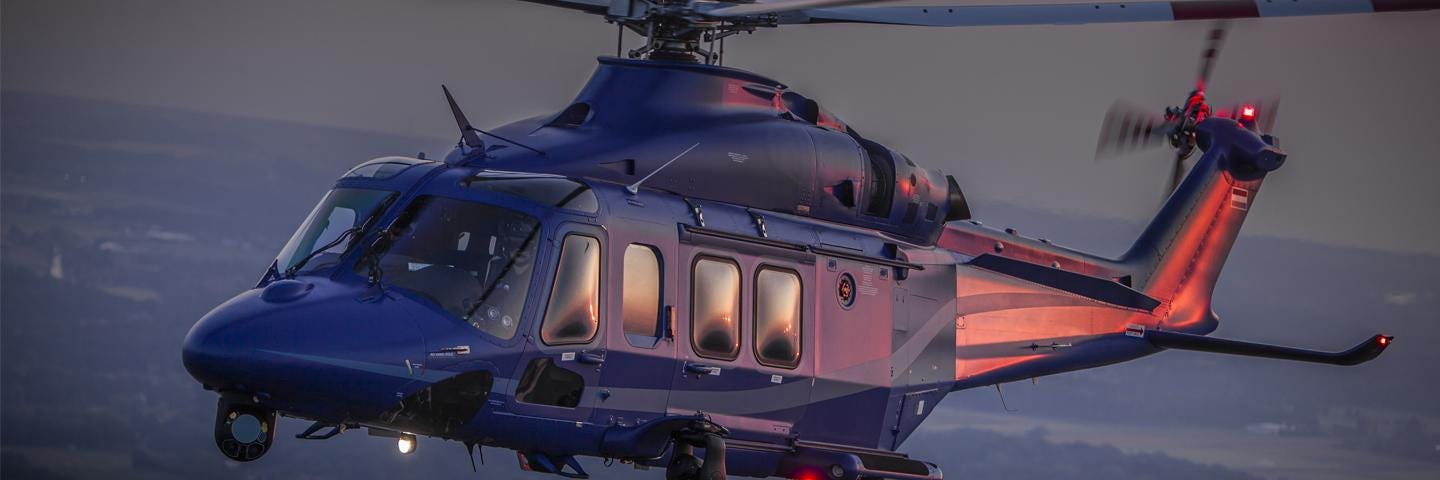
The Helicopters division is Leonardo’s single most identifiable global business and the largest helicopter manufacturer in Europe by deliveries.
The flagship AW139 super-medium twin remains the best-selling product in its class, with operators across emergency medical services, oil and gas, VIP transport, search and rescue, and law enforcement missions.
The wider AWFamily concept groups the AW169, AW139, and AW189 around shared cockpit philosophy, common training architecture, and aligned maintenance procedures.
That commonality is what allows large fleet operators (Bristow, Babcock, Falcon Aviation, Mubadala) to standardise pilot pools and reduce lifecycle cost.
LEONARDO CIVIL HELICOPTER PORTFOLIO (2026)
AW09:   Single-engine light, certified 2024
AW109 Trekker / GrandNew: Light twin
AW169:  Intermediate twin (4.8t MTOW class)
AW139:  Super-medium twin (7.0t class)
AW189:  Super-medium twin (8.6t class)
AW609: Civil tiltrotor (under FAA certification)Military Rotorcraft
On the military side, the AW101 (Merlin) heavy multi-mission helicopter, AW149 medium utility, AW159 Wildcat, and the new AW249 Fenice attack helicopter constitute the core of Leonardo’s land-services rotorcraft portfolio.
Italy formally launched the AW249 production phase for the Italian Army during 2025 alongside the NEES4 multi-platform contract.
The AW149 has had a particularly strong export year, with major contracts in Poland, the United Kingdom (selected as the New Medium Helicopter for the British Army), and additional Asian customers under negotiation.
NH90 deliveries continue through the NHIndustries consortium (Airbus Helicopters 62.5%, Leonardo 32%, Fokker 5.5%), with the helicopter equipping more than a dozen NATO and partner air arms.
Helicopters Division Performance
Helicopter division orders rose 5.1% in 2025 to approximately €6.2 billion, powered by the Italian AW249 contract, multi-platform fleet renewals in Asia, and continuing Falcon Aviation orders in the United Arab Emirates. Revenues were up double-digits and book-to-bill remained above 1.0x.
The division is now positioned as a structural growth engine rather than a cyclical play, with the order intake pattern looking less like the traditional offshore-driven cycle and more like a steady combination of public-sector multi-year frameworks plus a stabilising commercial base.
Aircraft Division
Eurofighter Typhoon
Leonardo holds 36% of the Eurofighter consortium and is the prime contractor for Italian deliveries, plus a major participant in radar (the Captor-E AESA radar sub-system) and electronic warfare.
The Tranche 5 production wave that started shipping in 2024 added Italian, German, and Spanish orders, while Türkiye and Saudi Arabia are advancing toward sale framework agreements.
Türkiye’s October 2025 announcement of a 20-aircraft order, paired with Germany’s parallel 20-aircraft Tranche 5 order, has extended the production line through the end of the decade. Discussions with Riyadh have been reset following London’s softening of historical political objections, with final contract talks potentially concluding within 2026.
For Italy specifically, the Air Force has confirmed orders for up to 24 additional Eurofighters as bridge capability to GCAP service entry in 2035.
EUROFIGHTER PROGRAMME ECONOMICS (LEONARDO SHARE)
Consortium share:        36%
Captor-E AESA radar:     Leonardo-led Eurofighter ECRS Mk2 (UK)
Recent customer wins:    Italy (24), Germany (20), Türkiye (20)
Next campaigns:          Saudi Arabia, Poland (under evaluation)
Service entry roadmap: Through 2040+ with Long-Term EvolutionGlobal Combat Air Programme (GCAP)
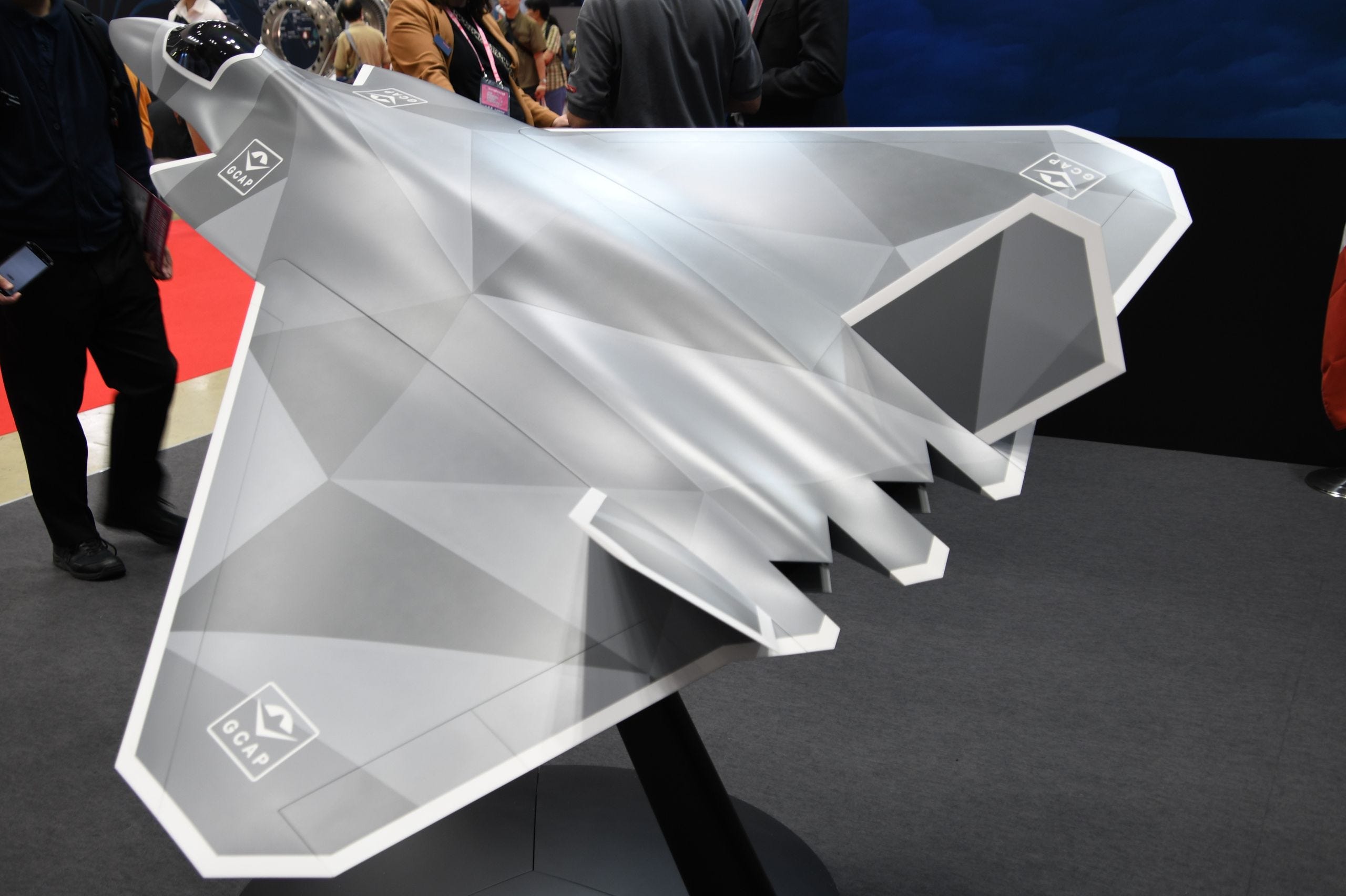
GCAP is the trilateral programme between the United Kingdom, Italy, and Japan, designed to field a sixth-generation crewed fighter by 2035.
The first international design contract was awarded to the Edgewing joint venture (BAE Systems, Leonardo, and Japan Aircraft Industrial Enhancement Co.) in April 2026, valued at approximately £686 million.
Leonardo’s role spans airframe co-design, the integrated sensor suite (jointly with the UK), mission systems, and substantial work-share on future combat air system effects, including loyal wingman drones and adaptive networks. The company has positioned its Cameri (Italy) and Edinburgh (UK) sites as anchor industrial centres for the programme.
Strategically, GCAP gives Leonardo a defined role in the post-Eurofighter European air dominance landscape, and the programme is now pulling ahead of FCAS (the rival Franco-German-Spanish project) on schedule discipline and political alignment.
M-346 Master Trainer Family
The M-346 advanced jet trainer is the export workhorse of Leonardo’s fixed-wing portfolio, with operators across Italy, Israel, Singapore, Poland, Greece, Qatar, and Azerbaijan.
The newer M-346F Block 20 light combat configuration, signed by Austria for 12 aircraft in December 2025, broadens the addressable market into combat-capable trainer operators.
Active campaigns include the United Kingdom Royal Air Force advanced jet trainer recompete and a high-profile Moroccan campaign where Leonardo is positioning the M-346 against the South Korean T-50 and other US-supplied alternatives. Indonesia selected the M-346 F Block 20 as a Hawk replacement at the 2024 Singapore Airshow, with deliveries phased through the late 2020s.
For the United States Navy Undergraduate Jet Training System programme, Leonardo partnered with Textron Aviation on the M-346N variant, a configuration tailored for carrier launch and recovery procedures.
C-27J Spartan Tactical Transport
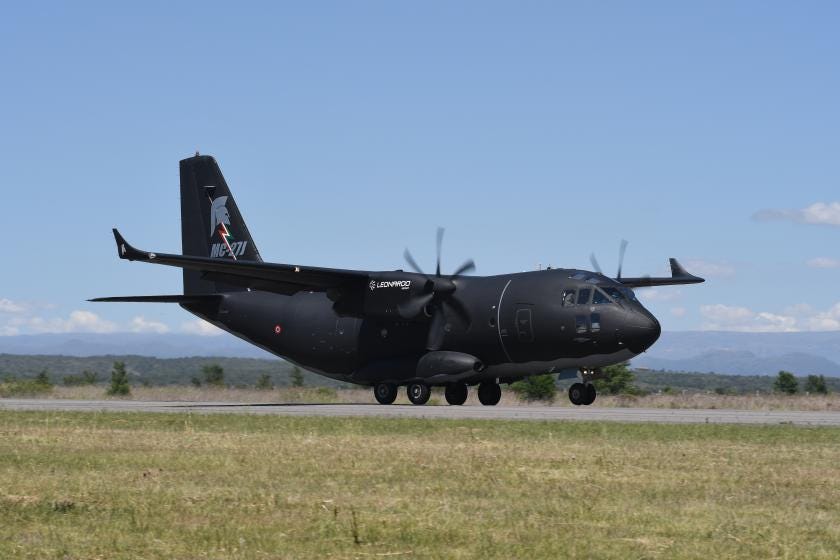
The C-27J Next Generation tactical airlifter is enjoying a second product life, helped by airframe upgrades, a fully digital cockpit, and growing maritime patrol variant interest.
Saudi Arabia formally ordered four C-27J Maritime Patrol Aircraft in February 2026, having previously procured two firefighting and MedEvac variants in mid-2025.
Slovenia received its first C-27J in 2024 and is evaluating a follow-on order alongside Italy. The Italian Air Force in December 2025 awarded Leonardo a multi-year performance-based logistics contract running 2026-2028 covering the C-27J fleet plus simulation training.
M-346 EXPORT BASE (CUMULATIVE THROUGH 2026)
Italy:        T-346A (training)
Israel:       Lavi (M-346)
Singapore:    M-346
Poland:       Bielik (M-346)
Greece, Qatar, Azerbaijan, Turkmenistan
Austria:      12 x M-346F Block 20 (2025 contract)
Indonesia:    M-346F Block 20 selected (2024)
United States Navy: M-346N campaign with Textron AviationATR Joint Venture
Leonardo holds a 50% stake in ATR alongside Airbus, with the joint venture producing the world’s most-delivered regional turboprop family. ATR delivered 32 aircraft in 2025, below its initial guidance because of supply-chain constraints, but recorded strong order intake and is targeting a 20% delivery uplift in 2026.
The launch of two EU Clean Aviation programmes during 2025 positions ATR to develop a hybrid-electric successor configuration that fits both the regional commuter market and an emerging “thin-route” demand pattern in North America.
Defence Electronics & Security Division
The Defence Electronics & Security division is the highest-margin part of the group and the core of Leonardo’s “system-of-systems” identity. It encompasses radar, electronic warfare, optronics, secure communications, naval combat systems, and the air-traffic management business.
Q3 2025 defence electronics revenue grew 12.4% year-on-year, with EBITA expanding faster than revenue thanks to programme mix and operating leverage.
Major product lines include the Kronos family of AESA radars, Janus dual-band radar, the LYRA family of electro-optical systems, and the BriteCloud expendable active decoy.
DEFENCE ELECTRONICS & SECURITY KEY PRODUCT FAMILIES
Radar:            Kronos AESA, Janus, OSPREY, Vigilance
EW:               BriteCloud, Praetorian, Helios
Optronics:        LYRA-10, ATOS, ATTILA
Combat systems:   Athena (naval combat management)
ATM:              VAA-9000, area surveillance radars
Avionics:         Mission computers, FLIR systems
Leonardo DRS in the United States
Leonardo DRS is the publicly listed (NASDAQ: DRS) US subsidiary that operates as a defence electronics, ground vehicle electrification, and integrated mission systems supplier.
Its 2025 revenue of $3.6 billion was up from $3.0 billion in 2024, with full-year free cash flow of $227 million.
DRS is increasingly the vehicle through which Leonardo executes major US government programmes, particularly the US Army’s hybrid-electric drive train work, advanced sensing, infrared search-and-track systems for surface ships, and combat networking.
The US Navy in 2025 awarded the company a contract worth up to $462 million for combat networking hardware.
Michelangelo Dome Integrated Air Defence
The Michelangelo Dome was unveiled in November 2025 as Leonardo’s response to the lessons of Ukraine and the wider need for layered air defence in Europe.
The architecture is conceived as a multi-domain integrated defence system inspired by Israel’s Iron Dome but extended to cover ballistic, hypersonic, drone-swarm, and cyber-physical threats.
In December 2025 Leonardo committed to develop and deliver the first four Italian next-generation radars for long-range ballistic defence. The Italian government has signalled an aim to have the system fully operational by 2028, and the programme is designed to be exported to NATO partners.
Cyber & Security Solutions Division
The Cyber & Security Solutions division was formally separated from Defence Electronics & Security to give it independent strategic focus and a clearer P&L identity. Q3 2025 revenue rose 19.0% year-on-year to €532 million, with EBITA surging on the back of operating leverage in managed-security service contracts.
The division operates Italy’s primary government Computer Emergency Response Team services, delivers secure communications for NATO infrastructure, and supports air-traffic control modernisation in multiple European countries.
Davinci-1, the high-performance computing platform built with Leonardo’s own supercomputing investments, anchors AI-enabled threat detection and digital twin services.
CYBER & SECURITY SOLUTIONS — BUSINESS LINES
- Secure communications (military, government, critical infra)
- Cyber managed security services (MSS)
- AI/HPC platform (Davinci-1 supercomputer)
- Digital twin / mission system simulation
- ATM cybersecurity (linked to Eurocontrol contracts)
- Public safety integration (smart city, border surveillance)
Aerostructures Division
Aerostructures has been Leonardo’s structural underperformer for several years, weighed down by Boeing 787 fuselage section production economics and lower commercial widebody volumes.
The division has been the target of an aerostructures joint-venture deal that the CEO has guided to close by mid-2026.
The intended structure would see Leonardo retain an initial 50% stake in a new international JV, with a partner contributing complementary widebody and narrowbody capabilities.
The objective is to break the commercial cycle dependency and extract value from the Grottaglie and Foggia Italian plants.
Land Defence Division (New, 2026)
The Land Defence division was created in March 2026 following the closing of the Iveco Defence Vehicles transaction. The acquired business reported €1.37 billion of 2025 revenues and operates across six manufacturing sites with roughly 4,000 employees.
Product lines include the Centauro II wheeled tank destroyer, Lince light multi-role vehicle, the new VBM Freccia, the LMV 2 next-generation light multi-role, and a portfolio of medium and heavy military trucks.
The strategic logic is to combine Leonardo’s existing OTO Melara turret and naval gun know-how with Iveco’s vehicle platforms under a single integrated land prime contractor.
LAND DEFENCE DIVISION KEY PRODUCT LINES (POST-IVECO)
Wheeled vehicles:    Centauro II 8x8, VBM Freccia 8x8
Light tactical:      Lince, LMV 2
Trucks:              M250 family, ASTRA heavy haulers
Turrets/guns:        HITFACT, OTO 76/62 Super Rapid
Combat systems integration: Land C2 software (legacy DEFS)
Space Activities
Leonardo’s space business runs through two joint ventures: Telespazio (67%) for satellite services, and Thales Alenia Space (33%) for satellite manufacturing. Both have been outperforming the broader European space market, which has struggled with launch capacity constraints and a slower-than-expected commercial demand recovery.
In October 2025 Airbus, Leonardo and Thales signed a Memorandum of Understanding to create a leading European space company by combining their space activities.
The proposed three-way merger would consolidate ~€10 billion of space revenues under a single European prime, with regulatory clearance and final structure expected to be defined through 2026.
In December 2025, Leonardo and Telespazio signed a strategic agreement with Intuitive Machines for lunar communication and navigation services, positioning the group for the cislunar economy.
Financial Analysis: Leonardo
FY2025 Financial Snapshot
Leonardo’s full-year 2025 results, approved by the Board on March 12, 2026, confirmed that the company beat its updated guidance across all key performance indicators.
The headline figures are characterised by sustained order intake, robust revenue growth in every division, and meaningful debt reduction.
FY2025 KEY FINANCIALS — LEONARDO S.P.A.
New orders:            €23.8 billion (+15% vs 2024)
Revenues:              €19.5 billion (+11% like-for-like)
EBITA:                 €1.79 billion (+22%)
EBITA margin:          ~9.2%
Net result (adj.):     ~€840 million
Free Operating CF:     ca. €1.11 billion
Net Debt:              ca. €0.8 billion
Backlog:               ca. €45 billion
Book-to-bill:          1.2x
Proposed dividend:     €0.63/share (+21% YoY)
Source: Leonardo FY2025 Preliminary Results
The 11% organic revenue increase is particularly significant because every division grew double-digits, ending years of internal mix dependency where Defence Electronics had been carrying weakness in Aircraft and Aerostructures.
Segment Performance Detail
Helicopters delivered approximately €6.2 billion of orders and double-digit revenue growth, with margin expansion driven by VVIP-mix orders and AW139 production economics. Defence Electronics & Security continued as the highest-margin contributor, supported by the radar and EW order book and the Eurofighter Captor-E production ramp.
Aircraft division revenues benefited from Eurofighter Tranche 5 deliveries and M-346 production for Austria and other customers. Cyber & Security Solutions grew 19% in Q3 2025 and continued to scale faster than the group average through the full year.
Aerostructures remained loss-making but with improving cash performance ahead of the planned JV transaction, and the new Land Defence segment will start contributing on a pro forma basis from Q2 2026.
2025 REVENUE BREAKDOWN BY DIVISION (PRELIMINARY ESTIMATES)
Helicopters:                  ~€6.0 billion
Defence Electronics & Security: ~€8.4 billion
Aircraft:                     ~€3.4 billion
Cyber & Security Solutions:   ~€2.0 billion
Aerostructures:               ~€0.9 billion
(Discontinued/eliminations):  ca. -€1.2 billion
Group total: €19.5 billionBalance Sheet, Cash Flow and Capital Allocation
Net debt reduced to approximately €0.8 billion from €2.4 billion at end-2023, a remarkable de-gearing for a long-cycle defence prime. The improvement came from a combination of customer advances, working capital discipline, and operating leverage on stable capex.
Free operating cash flow reached €1.11 billion in 2025, up 88% over three years according to the company’s own scorecard. The cash conversion now allows the company to fund the Iveco acquisition (~€1.6 billion) without putting the investment-grade rating at risk.
Capital allocation priorities articulated in the 2026-2030 plan are: (1) organic capacity investment, (2) selective bolt-on M&A in cyber, electronics and unmanned, (3) the European space JV, and (4) progressive dividends with a target payout ratio in the 30-35% range.
2026 Guidance and 2030 Targets
The 2026 financial guidance set by the Board provides a clear stepping-stone to the longer-term 2030 ambitions. Orders are expected to reach approximately €25 billion in 2026 from €23.8 billion in 2025, with revenues forecast at €21 billion and adjusted EBIT of €2.03 billion.
The 2026-2030 Industrial Plan targets cumulative orders of €142 billion through 2030, annual orders of €32 billion in the terminal year, revenues of €30 billion, and adjusted EBIT of €3.59 billion. Cumulative free operating cash flow of €8 billion is expected over the period, with target leverage (Net Debt/EBITDA) capped at 0.8x in 2028.
LEONARDO INDUSTRIAL PLAN MILESTONES
                    2025A    2026E    2030E
Orders               €23.8B  €25B     €32B
Revenue              €19.5B  €21B     €30B
Adj. EBIT            €1.79B  €2.03B   €3.59B
FOCF                 €1.11B  €1.1B    ~€2B
Net Debt/EBITDA       0.4x    <0.8x    <0.8x
Source: Leonardo FY2025 release & 2026-2030 PlanRevenue and Growth Drivers
Demand-Side Tailwinds
The single biggest driver behind Leonardo’s growth trajectory is the structural shift in European defence spending. NATO’s 2024-2025 commitment to a higher GDP-share defence target, the EU’s ReArm Europe and SAFE financing instruments, and Germany’s debt-brake reform have created an addressable market that simply did not exist five years ago.
Italy’s defence budget trajectory toward the NATO commitment level translates directly into multi-year demand for Eurofighter, AW249, Centauro II/Freccia upgrade programmes, and the Michelangelo Dome. The defence market is projected to expand at a structurally higher rate through 2030 than at any point since the late Cold War.
Programme-Level Drivers
GCAP, the Eurofighter long-term evolution, AW249 and AW149 production ramps, and the Michelangelo Dome roll-out are the four product-led growth drivers that the company itself highlights.
Each is multi-decade in duration and combines platform sales with attached services, sensors, and software upgrades.
The Iveco integration adds a fifth driver in land vehicles, and the proposed European space JV would add a sixth growth lever in satellite manufacturing and services. The cyber business is the seventh, supported by the Italian government’s National Cybersecurity Agency framework and EU NIS2 directive enforcement.
Services and Sustainment LTM Revenue
Approximately 34% of Leonardo’s Aircraft division revenue in the first nine months of 2025 came from services, demonstrating the importance of after-market and through-life support to the financial profile.
The Italian Air Force’s recent performance-based logistics deal for the C-27J fleet exemplifies the move from transaction-based MRO to long-term availability contracts, which carry higher margins and smoother revenue recognition.
RECURRING-REVENUE FLYWHEEL
Step 1: Win the platform contract (e.g., AW149 for UK Army)
Step 2: Lock in 20-30 year sustainment under PBL terms
Step 3: Add capability upgrades (radar, EW, datalinks) every 5-7 years
Step 4: Cross-sell into integrated air defence (Michelangelo Dome)
Step 5: Renewal cycle, repeat
Geographic Growth Vectors
The fastest-growing customer geography in 2025 was the broader Middle East, driven by Saudi Arabia (C-27J Maritime Patrol), the UAE (helicopters), and Qatar (training aircraft). Continental European procurement is accelerating now that German and Polish budgets have flowed through into orders.
The United States remains a significant geography through the Leonardo DRS subsidiary, but the parent company faces structural barriers to direct major-platform sales because of “Buy American” rules.
The strategy is therefore to capture US growth through DRS sub-system content and through second-tier US partnerships on programmes like the M-346N.
Major Competitors
Leonardo Competitive Landscape Overview
Leonardo competes across more end-markets than almost any other European prime, which means the competitor set is unusually wide. The relevant competitors break out by segment as follows.
LEONARDO COMPETITORS BY SEGMENT
Helicopters:         Airbus Helicopters, Sikorsky (LMT),
                     Bell Textron, NHIndustries (partner)
Eurofighter / GCAP:  Dassault (Rafale), Saab (Gripen),
                     Lockheed Martin (F-35), Boeing (F-15EX),
                     Sukhoi/UAC (Su-35/57)
Trainers:            KAI T-50, Boeing T-7A, Aero L-39NG,
                     Pilatus PC-21
Defence electronics: Thales, BAE Systems, Hensoldt,
                     Northrop Grumman, RTX (Raytheon)
Space:               (Pre-merger) Airbus, Thales themselves
Land vehicles:       Rheinmetall, KNDS, BAE Systems Hägglunds,
                     General Dynamics European Land Systems
Leonardo vs. Airbus Defence and Space
Airbus is roughly three times Leonardo’s size in defence and space combined, with €13.4 billion of 2025 space revenues alone. Airbus dominates European military airlift (A400M), large helicopters (H225M, H160M), and orbital infrastructure manufacturing.
Leonardo’s competitive advantage versus Airbus lies in three areas: the Eurofighter consortium (where Leonardo holds the Captor-E radar lead), the helicopter mid-segment (where the AWFamily outsells Airbus’s H145/H160 in commercial markets), and the integrated air defence niche where Leonardo’s Michelangelo Dome has no direct Airbus equivalent.
The proposed three-way space merger would partially neutralise the Airbus space scale advantage by combining Thales Alenia Space, Telespazio, and Airbus Space and Defence into a single European prime.
Leonardo vs. BAE Systems
BAE Systems is Leonardo’s closest peer by business model: both are diversified European primes with significant US footprints, both are major Eurofighter consortium members, and both anchor GCAP.
BAE is roughly twice Leonardo’s revenue scale and carries a stronger US Department of Defense direct-prime position.

Where Leonardo competes on equal footing is helicopters (Leonardo’s only competitor on AW101/Merlin sustainment), the GCAP programme (where Italy and the UK have parallel work-share rights), and the European naval combat-system layer. BAE’s advantage lies in submarine combat systems, land combat platforms, and US Navy ship programmes.
The two companies have a long history of co-operation through Eurofighter and now Edgewing GCAP, and the practical positioning is that they compete on prime opportunities while cooperating on the multinational programmes that drive both their backlogs.
Leonardo vs. Thales
Thales of France is the closest peer in defence electronics, particularly radars, electronic warfare, optronics, and secure communications.

The two companies are partners in the proposed European space merger and in MBDA, but they compete head-to-head in radar (Sea Fire vs Kronos), naval combat systems (Tacticos vs Athena), and air-traffic management.
Thales is roughly comparable in defence electronics revenue but stronger in transportation security and commercial avionics. Leonardo is stronger in airborne radar (Captor-E) and integrated multi-domain air defence (Michelangelo Dome).
Leonardo vs. Rheinmetall
Rheinmetall is the new strategic comparator following the Iveco acquisition.
The German group’s projected sales growth of up to 45% per year makes it the fastest-growing major European defence company, with particular strength in artillery ammunition, main battle tanks (Leopard 2 production), and 30mm autocannons.
Leonardo’s land-defence offering (Centauro II, Freccia, LMV 2) does not directly compete with Rheinmetall’s Leopard or Boxer at the heavy end, but it does overlap on wheeled combat vehicles, military trucks, and turrets.
The two companies are now in a dual cooperate-and-compete relationship: cooperating on Italian Army contracts where Rheinmetall has been the technology partner on the new tank programme, but competing for export campaigns in Brazil, the Middle East, and Eastern Europe.
RHEINMETALL VS. LEONARDO LAND DEFENCE (2026)
                    Rheinmetall    Leonardo (post-Iveco)
2025 Defence rev:   ~€11.7B        ~€8.4B (DEFS) + €1.4B Land
Tank platforms:     Leopard 2      None (KF51 partnership)
Wheeled IFV:        Boxer, Lynx    Centauro II, Freccia
Ammunition:         Yes (155mm)    No (limited)
Air defence:        Skyranger      Michelangelo Dome
Geographic core:    DE, EU, US     IT, EU, US, Latin America
Leonardo vs. Lockheed Martin Sikorsky
Sikorsky competes against Leonardo Helicopters across heavy lift (CH-53K vs. AW101 sustainment), medium utility (UH-60 vs. AW149 in the UK New Medium Helicopter campaign), and VVIP transport.
Lockheed Martin’s advantage is the F-35 ecosystem, where Leonardo participates as a Final Assembly and Check Out partner at Cameri but does not lead the platform.
The competitive answer for Leonardo is to position GCAP as the European sovereign alternative for sixth-generation air dominance and to keep helicopter prices and lifecycle costs below Sikorsky in export campaigns.
Leonardo vs. Dassault
Dassault Aviation is the principal European competitor on Eurofighter export campaigns through the Rafale. India, Indonesia, Egypt, the UAE, and Greece have all chosen the Rafale over the Eurofighter in recent years, making it a meaningful competitive threat for Italian and Spanish industrial work-share.
The competitive logic is becoming GCAP versus FCAS at the next-generation level rather than Eurofighter versus Rafale at the current-generation level, with GCAP currently leading on schedule discipline and political alignment.