Executive Summary

  • Strong Financial Performance: Pratt & Whitney delivered $8.4 billion in Q3 2025 sales, representing 16% year-over-year growth with adjusted operating profit of $751 million, demonstrating robust operational recovery.

  • GTF Advantage Engine Launch: The company is implementing durability improvements achieving 90-95% enhancement with first production engines entering service in 2026, doubling on-wing time in challenging environments.

  • Military Portfolio Expansion: Secured $1.6 billion F135 sustainment contract and developing new 500-1,800 pound thrust engines for Collaborative Combat Aircraft and munitions applications.

  • Next-Generation Technology Investment: Advancing rotating detonation engines, adaptive-cycle propulsion, and hydrogen combustion technology to define future aerospace propulsion.

Also Read:

Table of Contents

Key Facts: Company Profile Snapshot

Corporate Overview

Company Name:        Pratt & Whitney
Parent Company:      RTX Corporation (formerly Raytheon Technologies)
Headquarters:        East Hartford, Connecticut, USA
Founded:             1925 by Frederick B. Rentschler
Employees:           ~45,000 (2025)
Market Position:     World's second-largest commercial aircraft engine manufacturer
Market Share:        35% of commercial aircraft engine market

Business Segments

Segment

Focus Areas

Key Products

Commercial Engines

Commercial aviation propulsion

GTF family (PW1100G, PW1500G, PW1900G), V2500

Military Engines

Defense and military aviation

F135, F119, F100, F117, TF33

General Aviation

Business and regional aircraft

PT6 turboprop, PW500, PW800

Aftermarket Services

MRO and lifecycle support

EngineWise, Fleet Management Bureau

Image source: en.wikipedia.org

Revenue Performance and Growth Drivers

Q3 2025 Financial Highlights

Pratt & Whitney demonstrated exceptional financial performance in the third quarter of 2025, signaling a strong recovery trajectory and operational excellence across all business segments.

Sales Growth Analysis

The business unit generated $8.423 billion in sales, up 16% compared to the prior year. This growth was driven by balanced expansion across all major segments.

Commercial original equipment (OE) sales increased 5%, primarily from higher large commercial engine deliveries and favorable product mix from Pratt & Whitney Canada. Commercial aftermarket sales surged 23%, reflecting increased shop visit activity and parts demand as the GTF fleet matures.

Military sales rose 15%, predominantly driven by F135 engine program volume. This includes deliveries associated with the Lot 18 contract awarded during the quarter.

Profitability Metrics

Financial Metric

Q3 2025

Q3 2024

Change

Sales

$8,423M

$7,239M

+16%

Operating Profit

$751M

$557M

+35%

Adjusted Operating Profit

$751M

$597M

+26%

Operating Margin

8.9%

7.7%

+120 bps

The company achieved adjusted operating profit of $751 million, up 26% year-over-year.

The improvement was driven by higher commercial aftermarket volume, military program deliveries, and operational efficiencies, which offset increased original equipment deliveries and higher administrative expenses.

LTM Revenue Analysis

For the last twelve months (LTM) ending September 30, 2025, RTX Corporation reported total revenue of $85.988 billion, representing 8.79% year-over-year growth.

Pratt & Whitney contributed approximately 37% of RTX’s consolidated revenue, making it the largest business segment within the corporation. This translates to approximately $32 billion in annual revenue for Pratt & Whitney on an annualized basis.

Revenue Growth Drivers

Commercial aviation recovery continues to fuel growth. Global air traffic has returned to pre-2020 levels, driving demand for new aircraft deliveries and increasing shop visit requirements for existing fleets.

The GTF engine family, despite challenges, represents a significant growth engine. Since entering service in 2016, GTF engines have saved operators billions of gallons of fuel and reduced noise footprint by up to 75%, creating strong market demand.

Defense spending increases globally support military engine programs. The F-35 Lightning II production ramp continues with multiple international customers joining the program, driving F135 engine demand.

Aftermarket services provide recurring revenue. As the installed base of GTF and legacy engines grows, maintenance, repair, and overhaul activities generate high-margin recurring revenue streams.

Key Product Lines and Programs

Commercial Aviation: GTF Engine Family

PW1100G-JM for Airbus A320neo Family

The PW1100G-JM powers the Airbus A320neo family, offering operators up to 16% better fuel efficiency compared to previous-generation engines. The engine has accumulated millions of flight hours across hundreds of aircraft worldwide.

Major customers include IndiGo, Spirit Airlines, Frontier Airlines, Wizz Air, and JetBlue Airways. The engine competes directly with CFM International’s LEAP-1A, with approximately 60% of A320neo orders selecting the competing powerplant.

PW1500G for Airbus A220

Originally developed for the Bombardier CSeries, the PW1500G exclusively powers the Airbus A220 family. This engine demonstrates exceptional efficiency for the 100-150 seat market segment.

Airlines operating the A220 with PW1500G engines include Delta Air Lines, Air Canada, JetBlue Airways, and multiple European carriers. The engine provides 15% fuel burn advantage over previous-generation aircraft in this category.

PW1900G for Embraer E2 Jets

The PW1900G powers Embraer’s E190-E2 and E195-E2 regional jets. In November 2025, Embraer announced that PW1900G engines achieved a significant milestone in operational reliability.

Customers include Azul Brazilian Airlines, KLM Cityhopper, and multiple regional carriers seeking fuel-efficient regional jet operations.

GTF Advantage: Next-Generation Durability Enhancement

Technical Improvements

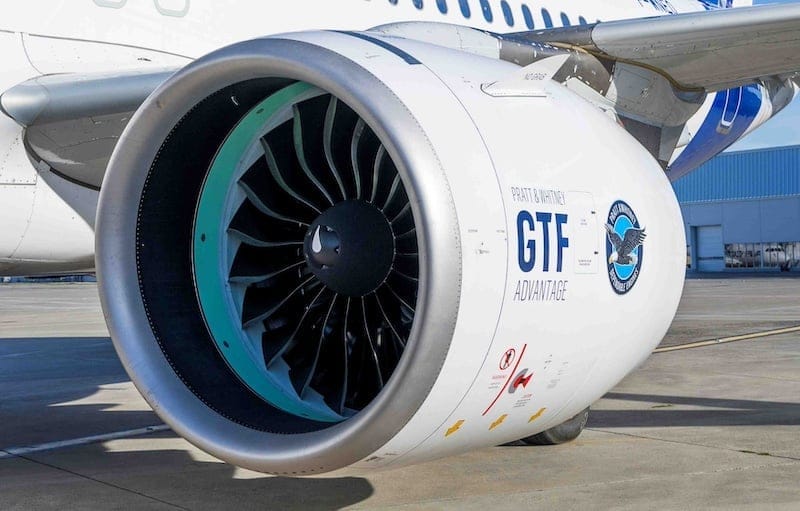
Pratt & Whitney developed the GTF Advantage engine incorporating substantial durability enhancements. The upgrade achieves 90-95% of full durability improvements through approximately 35 redesigned parts.

Key improvements include redesigned turbine airfoils, enhanced combustor panel design, improved bearing compartment architecture, and new manufacturing processes for critical hot section components.

Performance Specifications

Specification

GTF Advantage

Current GTF

Improvement

Takeoff Thrust (Sea Level)

+4%

Baseline

4% increase

Takeoff Thrust (High Altitude)

+8%

Baseline

8% increase

On-Wing Time

2x

Baseline

100% increase

Durability

95% better

Baseline

95% enhancement

The GTF Advantage will deliver 4-8% more takeoff thrust, enabling higher payload and longer range capabilities for airlines.

Market Entry Timeline

First GTF Advantage engines are scheduled for delivery in first half of 2026. The engine achieved type certification validation from European Union Aviation Safety Agency (EASA) in October 2025.

For existing operators, Pratt & Whitney offers a retrofit package called GTF Hot Section Plus (HS+), bringing durability improvements to today’s GTF engines. This option provides 90-95% of GTF Advantage benefits without full engine replacement.

Military Engines: F135 and Beyond

F135 for F-35 Lightning II

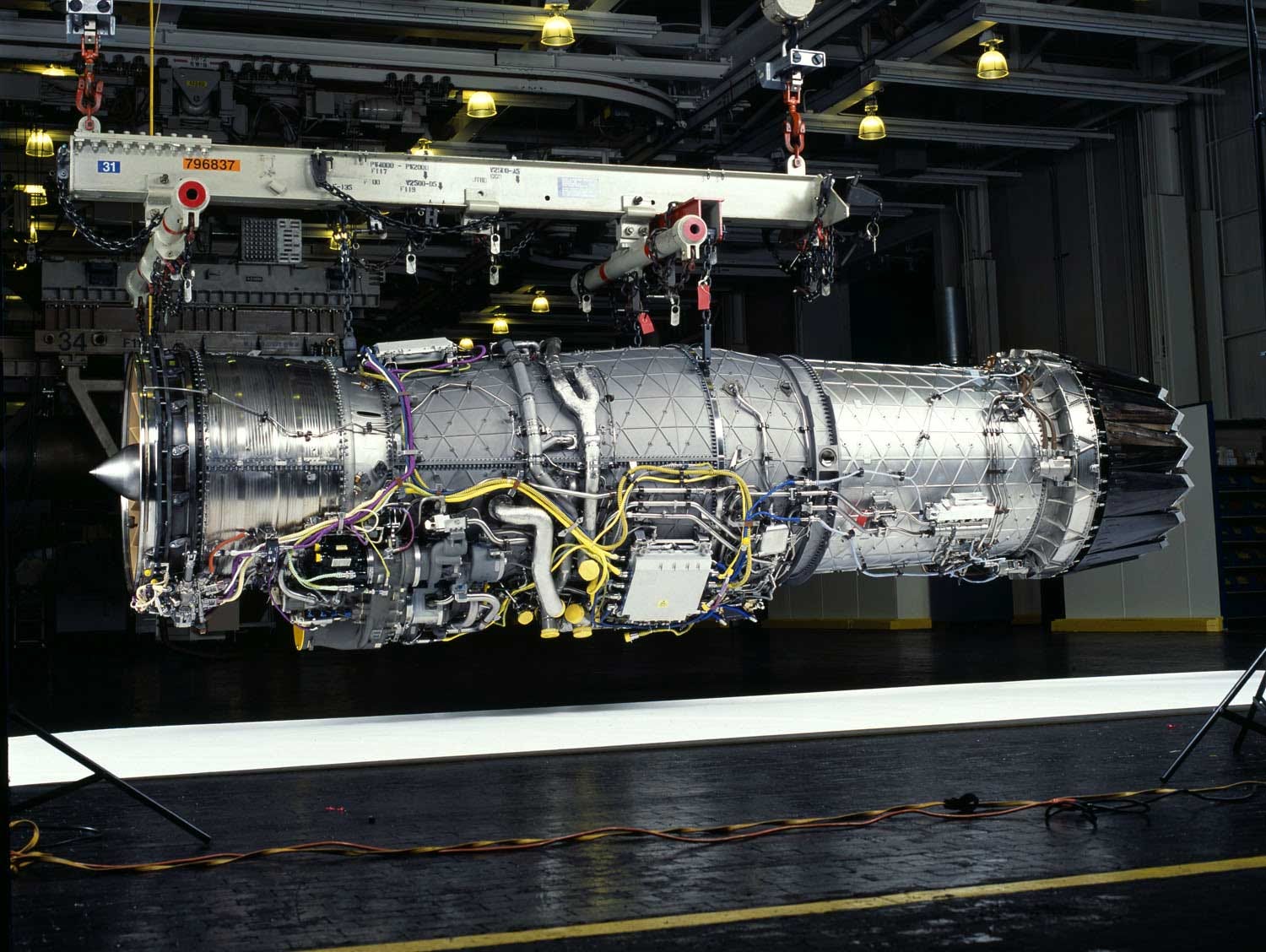
The F135 remains the most advanced operational fighter engine globally, powering all three F-35 variants. The engine delivers 43,000 pounds of thrust in conventional mode and enables short takeoff/vertical landing for the F-35B variant.

In late 2025, Pratt & Whitney secured a $1.6 billion contract for F135 engine sustainment work. Additionally, the company received a $2.8 billion contract for production and delivery of 141 F135 engines for Lot 18 aircraft.

Global F-35 operators include United States military services, United Kingdom, Italy, Netherlands, Norway, Denmark, Belgium, Poland, Finland, Germany, and multiple Asia-Pacific nations.

F135 Engine Core Upgrade (ECU)

The F135 ECU program represents the next evolutionary step for F-35 propulsion. The upgrade will provide increased thrust, improved thermal management capacity, and enhanced fuel efficiency to support Block 4 aircraft capabilities.

Pratt & Whitney received multiple contracts totaling over $1 billion to mature F135 ECU technology throughout 2025. The program aims to deliver 15-20% more thrust and significantly increased electrical power generation.

Next-Generation Adaptive Propulsion

For future sixth-generation combat aircraft, Pratt & Whitney is developing the XA103 adaptive-cycle engine under the U.S. Air Force’s Next Generation Adaptive Propulsion program.

Adaptive-cycle engines can reconfigure between high-thrust and high-efficiency modes during flight. This technology promises 25% better fuel efficiency and increased operational range for next-generation fighters.

Emerging Military Applications

Collaborative Combat Aircraft Engines

Pratt & Whitney completed critical engine testing for CCA platforms in September 2025. Testing confirmed the ability to increase thrust levels significantly on existing small turbofan engines.

The company is developing a new engine family scalable from 500 to 1,800 pounds of thrust. These engines will power unmanned combat aircraft designed to operate alongside manned fighters.

For unmanned applications, commercial off-the-shelf engines can offer up to 20% increase in qualified thrust capability, according to Pratt & Whitney statements.

Cruise Missile Propulsion

In June 2025, Pratt & Whitney secured a contract from Dynetics to supply TJ150 engines for the Black Arrow small cruise missile program.

The TJ150 turbojet engine provides affordable mass propulsion for tactical weapons systems. This contract represents expansion into the growing precision strike munitions market.

General Aviation: PT6 Turboprop Legacy

PT6A Engine Family

The PT6A turboprop family represents one of aviation’s most successful engine programs. With over 60 years of continuous production, PT6 engines have accumulated over 500 million flight hours.

The latest E-Series variant surpassed 500,000 flight hours within five years of service entry in 2020. This milestone demonstrates exceptional reliability and customer acceptance.

PW127XT Regional Turboprop

The PW127XT engine powers ATR 42-600 and ATR 72-600 regional turboprops. The engine offers 40% more time on wing and 20% reduction in maintenance costs compared to previous-generation PW127M engines.

Pratt & Whitney Canada achieved its 200th engine type certification with the PW127XT-L variant in December 2023.

Competitive Landscape Analysis

Commercial Engine Market Dynamics

The commercial aircraft engine market is dominated by three major players, with a fourth participant in the widebody segment. Market dynamics vary significantly between narrow-body and wide-body aircraft categories.

Market Share Distribution

CFM International holds the largest market share, closely followed by Pratt & Whitney. General Electric and Rolls-Royce maintain smaller market shares in narrow-body applications but dominate wide-body propulsion.

For single-aisle aircraft, CFM International (a joint venture between GE Aerospace and Safran) captured approximately 40% of new orders in recent years. Pratt & Whitney secured approximately 35% market share, primarily through GTF engine family penetration.

Boeing 737 MAX Exclusivity

CFM International maintains exclusive engine supply for the Boeing 737 MAX family through the LEAP-1B variant. This arrangement prevented Pratt & Whitney from competing on the world’s best-selling narrow-body aircraft program.

Boeing selected CFM as sole-source provider for 737 MAX engines based on existing 737NG engine relationships, certification timeline requirements, and performance specifications.

Airbus A320neo Competition

The Airbus A320neo family offers customers engine choice between PW1100G-JM and LEAP-1A. This competition drives innovation and provides airlines operational flexibility.

Recent order trends show CFM maintaining slight advantage in A320neo engine selections, partly due to Pratt & Whitney GTF reliability concerns affecting customer confidence.

Major Competitors Analysis

CFM International (GE Aerospace + Safran)

CFM International leverages decades of CFM56 operational experience and strong airline relationships. The LEAP engine family entered service in 2016 with excellent reliability records.

Competitive advantages include proven operational track record, exclusive 737 MAX position, extensive global MRO network, and strong financial backing from two aerospace giants.

LEAP engines power Boeing 737 MAX, Airbus A320neo family, and COMAC C919. The engine accumulated over 13 million flight hours with exceptional dispatch reliability.

GE Aerospace

GE Aerospace dominates the wide-body engine market with GE90, GEnx, and GE9X programs. The company supplies engines for Boeing 777, 787 Dreamliner, and 777X aircraft.

For military applications, GE Aerospace secured a $1.4 billion contract for CH-53K helicopter engines in January 2026, demonstrating continued defense market strength.

GE is developing the XA102 adaptive-cycle engine, competing against Pratt & Whitney’s XA103 for next-generation fighter applications.

Rolls-Royce Holdings

Rolls-Royce rules the wide-body crown with exclusive engine supply for Airbus A350 and primary provider status for Boeing 787-10. The company’s Trent XWB and Trent 1000 engines power significant wide-body fleets.

Rolls-Royce focuses on higher-value opportunities in wide-body and business aviation markets. The company maintains smaller unit volumes but generates outsized revenue through premium positioning.

For future applications, Rolls-Royce is advancing UltraFan technology and sustainable aviation fuel compatibility across product lines.

Competitive Differentiation Factors

Technology Leadership

Pratt & Whitney’s geared turbofan architecture represents fundamental technology differentiation. The gear system allows fan and low-pressure turbine to operate at optimal speeds independently, delivering superior efficiency.

This technology provides 16% better fuel efficiency and 75% noise reduction compared to previous-generation direct-drive turbofans.

Supply Chain and Manufacturing

All major engine manufacturers face supply chain constraints limiting production capacity. Pratt & Whitney reached a key milestone delivering sufficient GTF engines to support Airbus production rates up to 75 A320neo aircraft per month.

Manufacturing capacity determines market share growth potential. Companies investing in facilities, tooling, and workforce development gain competitive advantages.

Aftermarket Services

Engine aftermarket generates high-margin recurring revenue. Companies with extensive MRO networks and proprietary parts supply capture significant value over engine lifecycles.

Pratt & Whitney operates 20 GTF MRO network facilities across four continents, supporting growing installed base requirements.

Recent Developments

GTF Powder Metal Issue Resolution

Problem Identification and Scope

In 2023, Pratt & Whitney disclosed a rare powder-metal defect affecting high-pressure turbine discs manufactured between Q4 2015 and Q3 2021. Contaminated powder metal could cause component cracking, requiring accelerated inspections.

The issue affects 600-700 GTF engines requiring inspection through 2026. As of late Q4 2025, 835 aircraft remained grounded due to engine removals for inspection and refurbishment.

Financial Impact

RTX Corporation estimated the full-year 2025 cash impact at $1.1-1.3 billion for GTF-related activities. This includes accelerated shop visits, expedited parts production, and customer compensation.

The company redirected cash toward customer support and MRO capacity expansion rather than share buybacks. This strategic decision prioritizes long-term customer relationships over short-term shareholder returns.

Resolution Progress

ITA Airways expects resolution by late 2026, with technological upgrades and improvements implemented across affected engine populations.

Pratt & Whitney implemented enhanced quality control processes, qualified alternative powder metal suppliers, and developed improved inspection technologies to prevent future occurrences.

MRO Capacity Expansion Initiatives

Global Network Expansion

To address increased shop visit demand, Pratt & Whitney announced multiple MRO capacity expansions throughout 2025. The company boosted GTF MRO output by 30% in 2024 and expects similar improvements in 2025.

In April 2025, Delta TechOps agreed to increase GTF MRO capacity by 30%, bringing total capability to 450 shop visits annually at Delta’s Atlanta facility.

Strategic Partnerships

MTU Maintenance Zhuhai, a joint venture between MTU Aero Engines and China Southern Airlines, inducted its first PW1100G-JM engine in early 2025. This facility provides critical capacity in the Asia-Pacific region.

Pratt & Whitney announced GTF MRO facility expansion at West Palm Beach in April 2024, adding capability for growing fleet support requirements.

Capacity Constraints Analysis

Despite expansions, MRO demand could exceed supply by 17% by decade’s end according to Bain & Company analysis. Aircraft engine maintenance requirements will peak in 2026, creating capacity shortages for commercial aviation.

This shortage affects aircraft availability, airline operational planning, and residual engine values. Airlines with GTF-powered fleets must strategically manage shop visit schedules.

Sustainable Aviation Fuel and Alternative Propulsion

SAF Testing and Certification

Pratt & Whitney successfully tested GTF Advantage engine on 100% sustainable aviation fuel. The engine demonstrated full compatibility with HEFA-SPK (Hydroprocessed Esters and Fatty Acids Synthetic Paraffinic Kerosene) fuel.

All Pratt & Whitney engines and Embraer aircraft are currently certified for SAF blends up to 50% with conventional jet fuel. Industry efforts target 100% SAF approval by decade’s end.

Hydrogen Propulsion Research

Under Canada’s INSAT program, Pratt & Whitney is demonstrating hydrogen-fueled turboprop technology on PW127XT regional engines.

The company is developing Hydrogen Steam Injected, Inter-Cooled Turbine Engine (HySIITE) concept, designed to achieve 35% improved energy efficiency compared to current state-of-the-art engines.

Pratt & Whitney partnered with Next Hydrogen to develop electrolyzer technology for sustainable green hydrogen production at aviation scales.

Hybrid-Electric Architecture

For regional aviation, ATR and Pratt & Whitney Canada are investigating mild-hybrid architecture for PW127XT engines. This technology could deliver additional fuel efficiency improvements.

Advanced Propulsion Technology Development

Rotating Detonation Engine

Pratt & Whitney is developing rotating detonation engine (RDE) technology for hypersonic and high-speed applications. RDEs use pressure-gain combustion derived from continuous detonations in annular chambers.

This technology promises unsurpassed efficiency through higher thermal efficiency and power density. Applications include missiles, hypersonic vehicles, and future high-speed transport.

The company conducted multiple ground tests throughout 2025, validating fundamental RDE operating principles and performance predictions.

Adaptive-Cycle Engine Development

For sixth-generation fighter aircraft under the Next Generation Air Dominance (NGAD) program, Pratt & Whitney is accelerating XA103 adaptive-cycle engine development.

The XA103 competes against GE Aerospace’s XA102 for Air Force selection. Both engines incorporate variable-cycle technology enabling mode changes between maximum thrust and maximum efficiency during flight.

Pratt & Whitney is using digital design and twin modeling to accelerate development timelines and reduce physical testing requirements.

Financial and Commercial Implications

Impact on OEM Production Rates

Airbus Production Constraints

Engine availability has constrained Airbus output due to Pratt & Whitney GTF issues. The manufacturer targets 820 aircraft deliveries in 2025, up 7% from 2024, but engine shortages limit achievement.

Pratt & Whitney is in discussions with Airbus about engine supplies over the next three years as the planemaker seeks production increases to 75 A320neo aircraft monthly by 2026-2027.

The company successfully delivered engines supporting 65-70 monthly A320neo production rate in late 2025, demonstrating capability improvement.

Embraer and Airbus A220 Programs

For regional aircraft, Pratt & Whitney maintains exclusive engine positions. Embraer E2 and Airbus A220 programs depend entirely on PW1900G and PW1500G engine availability respectively.

Production disruptions from powder metal issues forced some airlines to delay aircraft acceptance. However, newer production engines incorporate durability improvements eliminating quality concerns.

Airline Operational Impact

Fleet Grounding Economics

Airlines with large GTF-powered fleets face significant operational disruptions. Spirit Airlines, Go First, and multiple European carriers experienced severe capacity constraints due to grounded aircraft.

Some operators resorted to cannibalizing nearly-new A321neo aircraft for engines and components to maintain operational fleets. This unprecedented practice demonstrates the severity of engine shortage impacts.

Compensation and Support

Pratt & Whitney provides compensation to affected operators including lease extension accommodations, spare engine availability, and expedited shop visit processing.

The company established dedicated customer support teams managing individual airline situations. Long-term customer relationships depend on successful navigation of this crisis period.

Competitive Market Repositioning

Customer Confidence Restoration

GTF reliability concerns shifted some airline preferences toward CFM LEAP engines for new aircraft orders. Restoring customer confidence requires demonstrable durability improvements and operational excellence.

The GTF Advantage engine launch represents critical opportunity to reset market perceptions. Early operational performance will significantly influence future order patterns.

Pricing and Contractual Terms

Engine manufacturers typically balance initial engine pricing against long-term aftermarket revenue. Pratt & Whitney may adjust commercial terms to regain market share lost during reliability crisis periods.

Some airlines negotiated improved maintenance agreements and extended warranty coverage as conditions for maintaining PW1000G engine orders.

Long-Term Value Proposition

Total Cost of Ownership

Despite near-term challenges, GTF engines deliver superior fuel efficiency compared to competing powerplants. Over 15-20 year operational lifecycles, fuel savings typically exceed maintenance cost differentials.

Airlines operating in high fuel-cost environments or emphasizing sustainability credentials continue selecting GTF engines based on total cost of ownership advantages.

Technology Leadership Position

Geared turbofan architecture represents fundamental advancement in gas turbine technology. Pratt & Whitney’s early commercialization established leadership position with implications for future product generations.

Competitors developing geared architectures validate Pratt & Whitney’s technical direction. This technology leadership supports premium positioning and pricing power.

Key Risks Analysis

Operational and Technical Risks

Risk Factor

Probability

Scenario Analysis

GTF Durability Below Expectations

Moderate

If GTF Advantage engines fail to achieve promised on-wing time improvements, customer confidence erodes further. Airlines may switch to CFM engines, reducing market share by 5-10% over five years.

Additional Quality Issues Discovery

Low

Discovery of new metallurgical or manufacturing defects could trigger additional groundings. Financial impact could reach $2-3 billion with severe customer relationship damage.

MRO Capacity Insufficient

High

If shop visit demand exceeds capacity expansion plans, aircraft groundings persist through 2027-2028. Airlines face severe operational constraints and Pratt & Whitney incurs additional compensation costs.

Certification Delays on New Programs

Moderate

Regulatory scrutiny following GTF issues could delay GTF Advantage, hybrid-electric, or hydrogen propulsion certifications by 12-24 months, impacting competitive positioning.

Commercial and Market Risks

Risk Factor

Probability

Scenario Analysis

Market Share Erosion

Moderate-High

Continued reliability concerns could shift A320neo engine selection toward LEAP-1A. Loss of 15-20% market share on new orders reduces long-term aftermarket revenue potential by $5-8 billion over next decade.

Airline Customer Financial Distress

Moderate

Major GTF operator bankruptcies (like Spirit Airlines potential restructuring) result in receivables losses and residual engine value impairments of $200-500 million.

OEM Production Rate Reductions

Low-Moderate

If Airbus or Embraer reduce production rates due to market softness, engine demand declines. 10% production rate reduction translates to $800 million-$1 billion annual revenue impact.

Competitive Technology Breakthrough

Low

If competitors develop superior propulsion technology (open-rotor, revolutionary thermodynamic cycle), GTF architecture becomes obsolete prematurely. This represents existential long-term risk.

Defense and Military Risks

Risk Factor

Probability

Scenario Analysis

F-35 Program Reductions

Low-Moderate

Political or budgetary decisions to curtail F-35 production affect F135 engine demand. 20% production reduction equals approximately $400-600 million annual revenue decline.

NGAD Program Cancellation/Delay

Moderate

If Air Force postpones or cancels sixth-generation fighter program, XA103 adaptive-cycle engine development becomes non-recoverable investment. Approximately $500 million-$1 billion R&D exposure.

CCA Platform Selection Risk

High

Multiple engine suppliers compete for Collaborative Combat Aircraft programs. Failure to secure major platform selections eliminates growth opportunity in emerging unmanned combat segment.

International Sales Restrictions

Low-Moderate

Geopolitical tensions or export control tightening could limit F135 international sales. Loss of 2-3 international customers represents $1-2 billion revenue reduction over program life.

Supply Chain and Manufacturing Risks

Risk Factor

Probability

Scenario Analysis

Critical Supplier Failures

Moderate

Single-source suppliers for forgings, castings, or specialty materials face financial distress or quality issues. Production delays of 6-12 months possible with $500 million-$1 billion revenue impact.

Labor Shortages and Retention

High

Aerospace manufacturing requires highly skilled workforce. Inability to attract and retain qualified technicians limits production scaling and increases costs by 5-10%.

Titanium and Strategic Material Availability

Moderate

Geopolitical disruptions to titanium supply (primarily from Russia and China) force costly alternative sourcing. Material costs could increase 20-30%.

Manufacturing Yield Issues

Low-Moderate

Complex components like turbine blades, combustors, and fan blades have tight tolerance requirements. Lower-than-expected manufacturing yields increase costs and limit production capacity.

Regulatory and Environmental Risks

Risk Factor

Probability

Scenario Analysis

Stricter Emissions Regulations

High

Accelerated decarbonization mandates could require costly engine modifications or premature product transitions. Compliance costs estimated at $300-500 million over five years.

Noise Regulation Tightening

Moderate

New noise standards could require additional acoustic treatments, impacting engine weight and performance. Certification costs and performance penalties affect competitiveness.

SAF Compatibility Requirements

Moderate-High

Mandates for 100% SAF compatibility by specific dates require accelerated certification programs. If competitor achieves certification earlier, temporary competitive disadvantage emerges.

Carbon Border Adjustment Mechanisms

Moderate

International carbon pricing on imported aerospace products increases costs and creates trade friction. Impact highly dependent on policy implementation details.

Strategic Analysis Frameworks

SWOT Analysis

Strengths

Weaknesses

• Geared turbofan technology leadership and patent portfolio
• 35% commercial engine market share position
• Exclusive F-35 F135 engine franchise
• Legendary PT6 turboprop brand with 60+ year heritage
• Integrated RTX Corporation resources and scale
• Strong commercial aftermarket service network
• Advanced manufacturing capabilities and digital twins

• Recent GTF reliability crisis damaging customer confidence
• Limited wide-body engine presence vs. competitors
• No Boeing 737 MAX engine position
• MRO capacity constraints limiting growth
• Higher maintenance costs vs. initial projections
• Dependency on Airbus narrow-body programs
• Supply chain concentration risks

Opportunities

Threats

• GTF Advantage engine reset market positioning
• Growing defense budgets and F-35 international sales
• Collaborative Combat Aircraft engine market emergence
• Sustainable aviation fuel and hydrogen propulsion leadership
• Regional aviation growth in emerging markets
• Digital services and predictive maintenance expansion
• Advanced propulsion technology (RDE, adaptive-cycle) commercialization

• Continued customer defection to CFM LEAP engines
• Potential new quality issues discovery
• GE/Safran competitive responses and market share defense
• Airbus production rate reductions
• NGAD program delays or competitive loss
• Geopolitical disruptions to supply chains
• Accelerated electric/hybrid propulsion timelines
• Recession reducing airline capital expenditures

Porter’s Five Forces Analysis

Force

Intensity

Analysis

Competitive Rivalry

High

Duopoly/oligopoly market structure with CFM, GE, and Rolls-Royce. Intense competition on narrow-body platforms. Price competition limited by high switching costs and long-term relationships. Innovation and reliability drive competitive outcomes.

Threat of New Entrants

Very Low

Extremely high barriers to entry including capital requirements ($5-10 billion), technology complexity, certification timelines (10-15 years), and established customer relationships. No credible new Western entrants. Chinese manufacturers (ACAE) remain decades behind.

Threat of Substitutes

Low-Moderate

Near-term: No viable substitutes for gas turbine engines in commercial aviation. Long-term: Electric and hybrid-electric propulsion for regional/short-range. Sustainable aviation fuels reduce, not eliminate, gas turbines. Timeline: 15-25 years for meaningful penetration.

Bargaining Power of Suppliers

Moderate

Specialized materials (titanium, nickel superalloys) have limited sources. Critical component suppliers have power. Pratt & Whitney’s scale provides leverage. Supply chain concentration creates mutual dependency. Vertical integration strategies reduce exposure.

Bargaining Power of Buyers

Moderate-High

Airlines and OEMs have significant leverage through competitive bidding. Multi-billion dollar programs create buyer concentration. Switching costs once platform selected are extremely high. Aftermarket lock-in provides some supplier power. Overall moderate to moderate-high buyer power.

PESTEL Analysis

Factor

Key Impacts

Political

• Defense spending priorities influence military engine demand
• Export controls affect international sales
• Trade policies and tariffs impact manufacturing location decisions
• Government R&D funding supports advanced technology development
• Diplomatic relationships affect F-35 partner nation sales

Economic

• Global air traffic growth drives commercial engine demand
• Airline profitability determines fleet expansion and replacement timing
• Currency fluctuations affect international competitiveness
• Inflation impacts manufacturing costs and pricing power
• Interest rates influence customer aircraft purchase financing

Social

• Public pressure for aviation sustainability accelerates SAF adoption
• Environmental consciousness affects airline brand positioning
• Workforce demographics create skilled labor shortages
• Remote work patterns could reduce business travel long-term
• Social acceptance of defense spending varies by region

Technological

• Additive manufacturing enables complex geometries and rapid prototyping
• Digital twins optimize engine performance and predict maintenance needs
• Advanced materials (ceramic matrix composites) improve efficiency
• Artificial intelligence enhances design optimization
• Alternative propulsion (hydrogen, hybrid-electric) emerging

Environmental

• Carbon emissions regulations drive efficiency improvements
• Noise regulations influence engine architecture decisions
• Sustainable aviation fuel compatibility requirements
• Circular economy principles affect end-of-life engine management
• Climate change impacts include supply chain disruptions

Legal

• Certification requirements determine product timelines
• International trade agreements affect market access
• Product liability considerations influence design decisions
• Intellectual property protection enables R&D investment recovery
• Antitrust scrutiny of industry consolidation

Stakeholder Implications

Airlines and Operators

Immediate Actions Required

  • Develop comprehensive fleet planning scenarios accounting for potential GTF-related groundings through 2027

  • Negotiate enhanced maintenance agreements and spare engine availability with Pratt & Whitney

  • Evaluate mixed-fleet strategies incorporating both PW1000G and LEAP-1A engines for operational flexibility

  • Build contingency capacity through wetlease agreements or strategic aircraft reserves

Strategic Considerations

  • Assess total cost of ownership over 20-year horizons including fuel, maintenance, and residual values

  • Monitor GTF Advantage engine early service performance before committing to large orders

  • Evaluate sustainable aviation fuel strategies and engine compatibility requirements

  • Consider timing of next-generation aircraft programs affecting engine replacement cycles

Aircraft Manufacturers (Airbus, Boeing, Embraer)

Supply Chain Management

  • Secure engine delivery commitments supporting production rate ramp plans

  • Develop contingency plans for engine shortage scenarios

  • Collaborate with Pratt & Whitney on durability improvement implementation schedules

  • Balance customer engine preference trends against supply reality

Product Strategy

  • Evaluate engine architecture diversity across product portfolios

  • Plan next-generation aircraft programs considering available propulsion technology maturity

  • Incorporate lessons learned from GTF crisis into supplier risk management frameworks

  • Consider implications of alternative propulsion timelines on product roadmaps

Lessors and Financial Institutions

Asset Valuation and Risk

  • Reassess residual value assumptions for GTF-powered aircraft considering reliability history

  • Build maintenance reserve provisions reflecting actual vs. projected shop visit patterns

  • Monitor Pratt & Whitney financial strength and parent RTX Corporation support commitment

  • Evaluate portfolio concentration risks in GTF-powered aircraft types

Transaction Structuring

  • Negotiate maintenance agreements and engine warranties into lease structures

  • Consider power-by-the-hour arrangements transferring engine risk to operators or OEMs

  • Build flexibility for lease extensions if groundings affect redelivery timing

  • Price risk premiums for GTF exposure into transaction terms

Defense and Military Customers

Program Planning

  • Plan F-35 fleet growth accounting for F135 production capacity and upgrade schedules

  • Evaluate F135 Engine Core Upgrade adoption timing and budget implications

  • Monitor Collaborative Combat Aircraft engine development for autonomous platform programs

  • Coordinate international F-35 orders considering allied acquisition timelines

Sustainment Strategy

  • Develop depot maintenance capacity plans for growing F135 installed base

  • Negotiate favorable life-cycle cost arrangements given single-source provider position

  • Build spare engine inventory adequate for high operational tempos

  • Plan technology insertion roadmaps maintaining competitive advantage

Suppliers and Supply Chain Partners

Capacity Investment

  • Align manufacturing capacity expansion with Pratt & Whitney production rate forecasts

  • Invest in quality systems meeting aerospace requirements and avoiding GTF-type issues

  • Develop workforce training programs ensuring adequate skilled labor availability

  • Evaluate geographic diversification reducing geopolitical supply chain risks

Technology Collaboration

  • Participate in sustainable aviation fuel compatibility programs

  • Support advanced manufacturing technology adoption (additive, automation)

  • Invest in materials research for next-generation temperature and strength requirements

  • Engage in digital supply chain integration enhancing visibility and responsiveness

Regulatory Bodies and Policymakers

Certification and Oversight

  • Enhance oversight of manufacturing quality control processes following powder metal issues

  • Develop certification standards for sustainable aviation fuel compatibility

  • Create regulatory frameworks for hydrogen propulsion testing and certification

  • Balance innovation encouragement with safety assurance in emerging technologies

Strategic Policy Development

  • Support aerospace industry research and development through government partnerships

  • Consider workforce development initiatives addressing skilled labor shortages

  • Evaluate export control frameworks balancing security and economic competitiveness

  • Develop policies incentivizing sustainable aviation technology adoption

Corporate and Financial Resources

Regulatory and Government Sources

Market Data and Statistics

My Final Thoughts

Pratt & Whitney stands at a defining moment in its century-long history. The company pioneered geared turbofan technology, achieving genuine thermodynamic advantages that competitors now seek to replicate. Yet this innovation came with execution challenges that damaged customer confidence and constrained near-term growth.

The path forward requires flawless execution on multiple fronts simultaneously.

  • GTF Advantage engines must deliver promised durability improvements from first production units.

  • MRO capacity expansion must meet aggressive timelines preventing further fleet groundings.

  • Supply chain reliability must improve dramatically.

  • Customer relationships require patient rebuilding through demonstrated performance rather than promises.

Beyond resolving immediate challenges, Pratt & Whitney is investing in technologies that could define aerospace propulsion for decades. Rotating detonation engines, adaptive-cycle military propulsion, and hydrogen combustion represent fundamental advances. Success in these programs would reinforce technology leadership and justify the strategic patience required during the current difficult period.

The competitive landscape shows no mercy for stumbles. CFM International aggressively defends and expands market share. GE Aerospace maintains wide-body dominance and develops competing next-generation military engines. Rolls-Royce owns premium wide-body positioning. Every delayed GTF delivery or extended aircraft grounding represents an opportunity for competitors.

The next 24-36 months will largely determine whether Pratt & Whitney emerges from this crisis with strengthened competitive position or permanently diminished market standing.

Early GTF Advantage operational performance, MRO capacity realization, and competitive win rates on new aircraft orders will provide clear signals.

One certainty persists: aerospace propulsion engineering operates on decades-long timelines where fundamental physics and thermodynamics ultimately determine outcomes.

Pratt & Whitney’s geared turbofan architecture remains sound.

The question is whether execution quality and customer confidence can be restored before market share losses become permanent.

Reply

or to participate

Keep Reading

No posts found