


Executive Summary
Rolls-Royce Holdings Group's underlying operating profit reached £3.46 billion on revenue of £20.06 billion for full-year 2025, with underlying operating margin lifting to 17.3% from 13.8% a year earlier.
Civil Aerospace is now the engine of the engine maker, posting a 20.5% underlying operating margin and £10.4 billion of segment revenue, with large-engine flying hours up 8% year-on-year and the installed fleet moving from catch-up to durability-led outperformance.
Defence order backlog stood at £17.4 billion at year-end 2025, equivalent to more than three years of segment revenue, anchored by EJ200, AE 2100, F130, GCAP and LiftSystem work with the UK MoD, U.S. Department of Defense and allied governments.
Management has upgraded its mid-term (2028) targets to £4.9 billion to £5.2 billion of underlying operating profit, an 18% to 20% margin, and announced a £7 billion to £9 billion multi-year share buyback across 2026 to 2028.
Recommended - Read Full Reports


Read All Reports
Table of Contents
Executive Summary
Introduction
Key Facts: Company Profile
Rolls-Royce Company Overview
From Near-Collapse to Margin Leadership
Corporate Structure and Operating Model
Civil Aerospace at a Glance
Defence at a Glance
Key Product Lines, Programmes and Services
Trent XWB: The Flagship Franchise
Trent 1000 and Trent 7000: The 787 and A330neo Franchises
UltraFan and UltraFan 30: The Narrowbody Bet
Pearl 10X, Pearl 700 and Pearl 15: Business Aviation Family
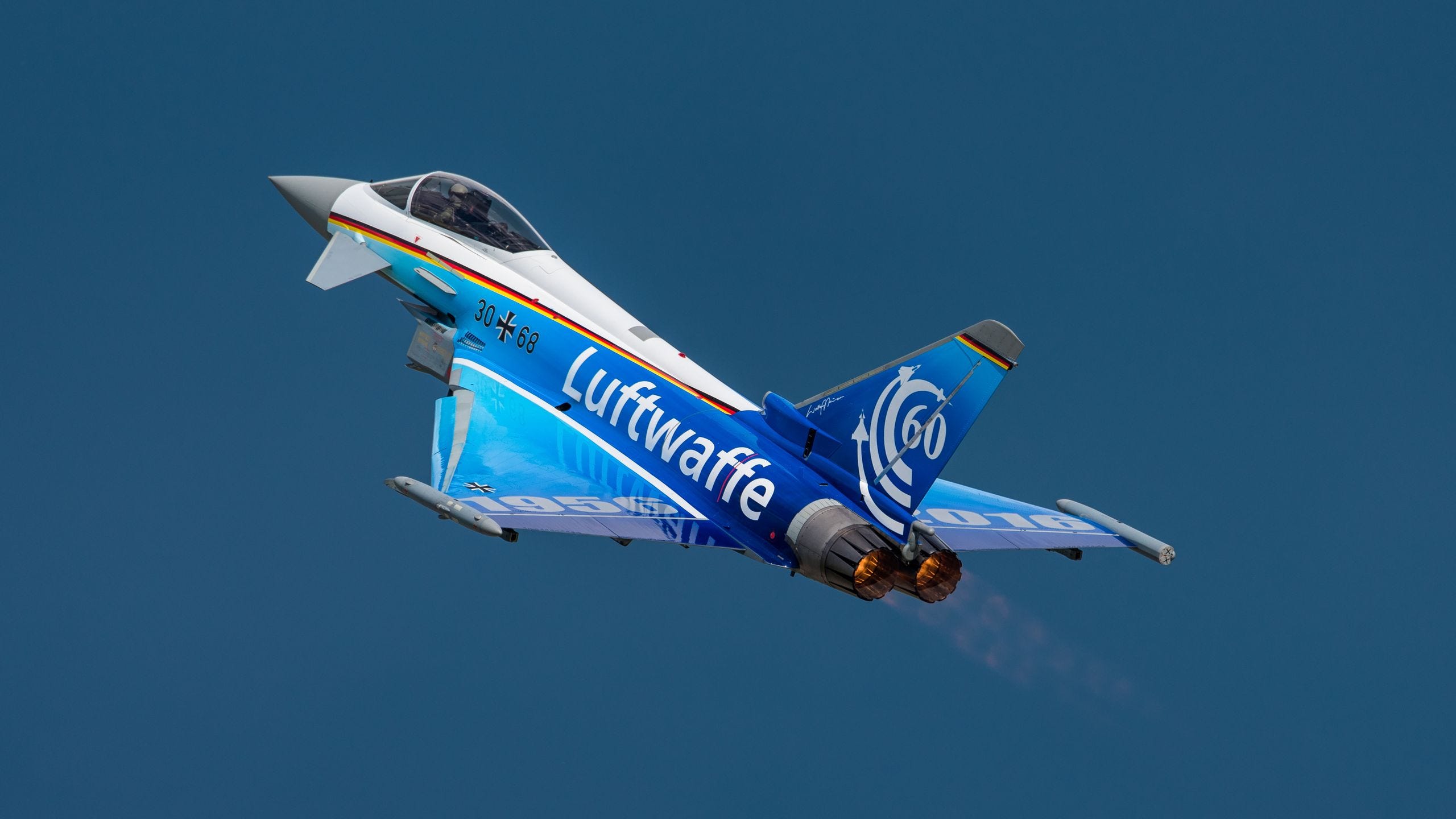
EJ200: Eurofighter Typhoon
LiftSystem: F-35B Vertical Lift
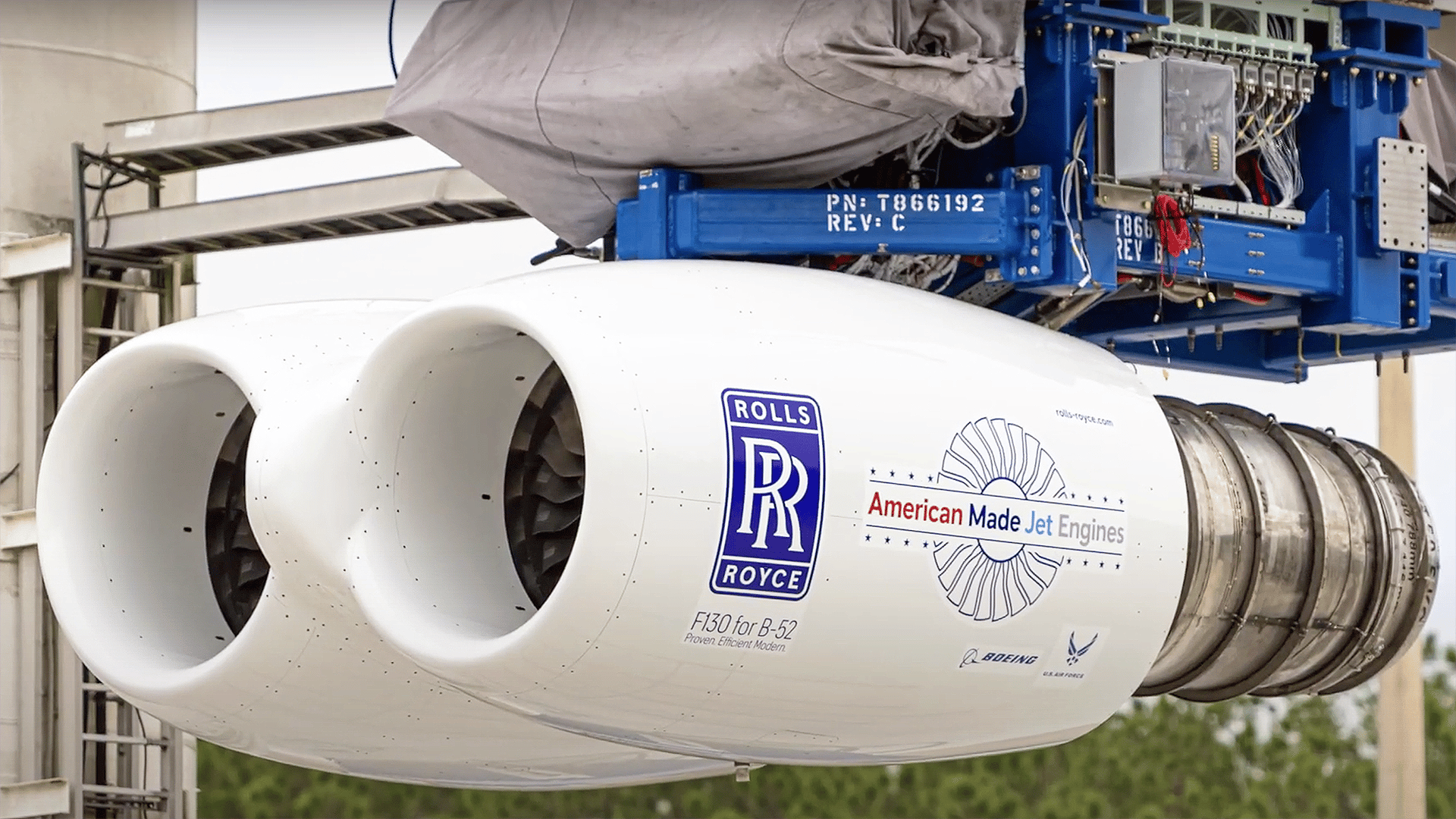
F130: Re-engining the B-52 Bomber
AE Family: The Workhorse Engines
GCAP: The Sixth-Generation Fighter Bet
Rolls-Royce SMR: The Adjacent Power Play
Rolls-Royce Financial Analysis
2025 Full-Year Group Results
Capital Returns and Balance Sheet
2026 Guidance and Upgraded Mid-Term Targets
Civil Aerospace Segment Economics
Defence Segment Economics
Cost Programme and Operational Leverage
Revenue and Growth Drivers
Widebody Aftermarket: The Compounding Machine
Trent Durability: Half-Way to a Doubled Time-on-Wing
Aftermarket Expansion and MRO Capacity
Business Aviation: Pearl Family in Full Production
Order Intake and Backlog Building
Major Competitors
Rolls-Royce vs. GE Aerospace
Rolls-Royce vs. Pratt & Whitney (RTX)
Rolls-Royce vs. Safran
Rolls-Royce vs. IHI and Avio Aero (GCAP Partners)
Competitive Analysis and Moat: Rolls-Royce
The Three-Shaft Architecture Moat
Sole-Source Status on Key Platforms
Installed-Base Aftermarket Flywheel
Defence Institutional Moat
R&D Intensity and the UltraFan Option
Where the Moat Is Weaker
Strategic Priorities: What Management Is Optimising For
Disciplined Capital Allocation
Repricing the Installed Base
Technology Durability Over Product Launches
Portfolio Simplification
Financial and Commercial Implications
What the Numbers Imply for 2026
The Buyback Math
Implications for Customers
Implications for Suppliers
Implications for the Defence Industrial Base
Key Risks (with Probabilities and Scenarios)
Supply Chain Disruption
Trent Durability Setback
787 Competitive Share Erosion
Geopolitical and Tariff Risk
GCAP Programme Slippage
UltraFan 30 Commercialisation Risk
Macro Air-Travel Demand Shock
Rolls-Royce SWOT Analysis
Strengths
Weaknesses
Opportunities
Threats
Aviation and Defence Industry Context for 2026
The Widebody Aftermarket Super-Cycle
The Defence Industrial Rearmament
The Sustainable Aviation Transition
Capital Markets Repositioning
Rolls-Royce Civil Aerospace Deep Dive: Programme-by-Programme
Trent XWB Programme Health
Trent 1000 and Trent 1000 XE
Trent 7000 on A330neo
Trent 700 and Trent 900 Legacy Fleets
Pearl Family Business Aviation
Rolls-Royce Defence Deep Dive: Programme-by-Programme
EJ200 and Typhoon Export Cycle
GCAP Propulsion Programme
F-35B LiftSystem
F130 on B-52J
AE 1107 and V-280 FLRAA
AE 2100 on C-130J
AE 3007 on Regional Jets and MQ-25
Defence MRO and Digital Services
ESG, Sustainability and Sustainable Aviation Fuel
Sustainable Aviation Fuel Compatibility
Emissions Trajectory
Quantum and AI Application
Official Sources and Data
Rolls-Royce Holdings Official Disclosures
Programme-Specific Pages
Programme and Customer Press Releases
Competitor and Industry Reference Materials
My Final Thoughts
Introduction
The company that spent half a decade in the financial wilderness is now the most improbable comeback story in European industrial engineering.
Three years into a full-throttle transformation, the Derby-based engine maker has rebuilt its cost base, repriced its service contracts, re-won lost customers and quietly moved into the centre of the Western defence-industrial response to a more dangerous world.
This in-depth report analyzes what the numbers actually say, what the product roadmap is really doing, and where the cracks could still open up.
Key Facts: Company Profile
COMPANY                 : Rolls-Royce Holdings plc
HEADQUARTERS            : Kings Place, London, United Kingdom
PRIMARY R&D / MFG HUB   : Derby, United Kingdom
LISTING                 : London Stock Exchange (RR.)
CEO                     : Tufan Erginbilgic (since Jan 2023)
CFO                     : Helen McCabe
2025 UNDERLYING REVENUE : £20.06 billion
2025 UNDERLYING OP PROF : £3.46 billion
2025 OPERATING MARGIN   : 17.3%
2025 FREE CASH FLOW     : £3.27 billion
2025 NET CASH           : £1.90 billion
2025 DIVIDEND (TOTAL)   : 9.5p per share
BUYBACK (2026-2028)     : £7bn to £9bn multi-year
EMPLOYEES               : ~42,000 globally (approx.)
SEGMENTS (CORE)         : Civil Aerospace, Defence, Power Systems
2025 ENGINE DELIVERIES  : 483 total (259 large, 224 business jet)
The two segments that form the focus of this report, Civil Aerospace and Defence, together contributed the bulk of 2025 profit, with Civil Aerospace alone responsible for a £2.1 billion underlying operating profit, a 41% year-on-year jump.
Rolls-Royce Company Overview
From Near-Collapse to Margin Leadership
Rolls-Royce entered the 2020s in the worst shape of any major Western engine maker.
The grounding of widebody fleets during the pandemic collapsed the high-margin long-term service-agreement (LTSA) revenue on which the Trent franchise depended, and the group booked an underlying operating loss of roughly £2.0 billion in 2020.
The turnaround began when Tufan Erginbilgic arrived as chief executive in January 2023 and framed the company publicly as a “burning platform”.
A 17-point strategic programme followed, targeting costs, contract economics, capital allocation, and portfolio focus in a way that had not been attempted in the modern history of the group.
Three years on, the trajectory is visible in the accounts.
Underlying operating profit has moved from a £2.0 billion loss in 2020 to £2.46 billion in 2024 and £3.46 billion in 2025, while return on capital has reached approximately 19% on the company’s own internal definition.
Corporate Structure and Operating Model
The group runs three core reporting segments: Civil Aerospace, Defence and Power Systems.
Alongside these, Rolls-Royce SMR (small modular reactors) sits as a separate growth business and in 2025 secured external strategic investment from ČEZ Group.
A new AI platform called AiRR was also launched during the year and a joint venture with Air China, known as Beijing Aero Engine Services Limited (BAESL), opened in December 2025.
SEGMENT SNAPSHOT - FY 2025 (underlying)
----------------------------------------------------
Civil Aerospace    Revenue: £10.4 bn   Op margin: 20.5%
Defence            Revenue: ~£4.9 bn   Op margin: 14.4%
Power Systems      Revenue: €5.72 bn   Op margin: 17.4%
----------------------------------------------------
Civil Aerospace at a Glance
Civil Aerospace is the widebody engine specialist, with an installed base led by the Trent XWB-84 on the Airbus A350-900, the Trent XWB-97 on the A350-1000, the Trent 1000 and new Trent 1000 XE on the Boeing 787, the Trent 7000 on the Airbus A330neo, and the legacy Trent 700 and Trent 900 fleets.
In business aviation, the Pearl family (Pearl 15, Pearl 700 and the new Pearl 10X) powers flagship Bombardier, Gulfstream and Dassault platforms.
Defence at a Glance
Defence covers combat, transport, helicopters and naval propulsion.
Combat jet engines include the EJ200 on the Eurofighter Typhoon and the Rolls-Royce LiftSystem that gives the F-35B its vertical lift.
Transport and helicopter engines include the AE 2100 on the C-130J, the AE 1107 on the V-22 Osprey and forthcoming Future Long Range Assault Aircraft, the AE 3007 on unmanned platforms including the MQ-25, and the F130 that will re-engine the U.S. Air Force B-52J fleet.
Key Product Lines, Programmes and Services
Trent XWB: The Flagship Franchise
The Trent XWB is the most important civil engine programme in the company’s modern history, sole-sourced on every Airbus A350 variant including the A350-900, A350-1000 and the new A350F freighter launched earlier in the decade.
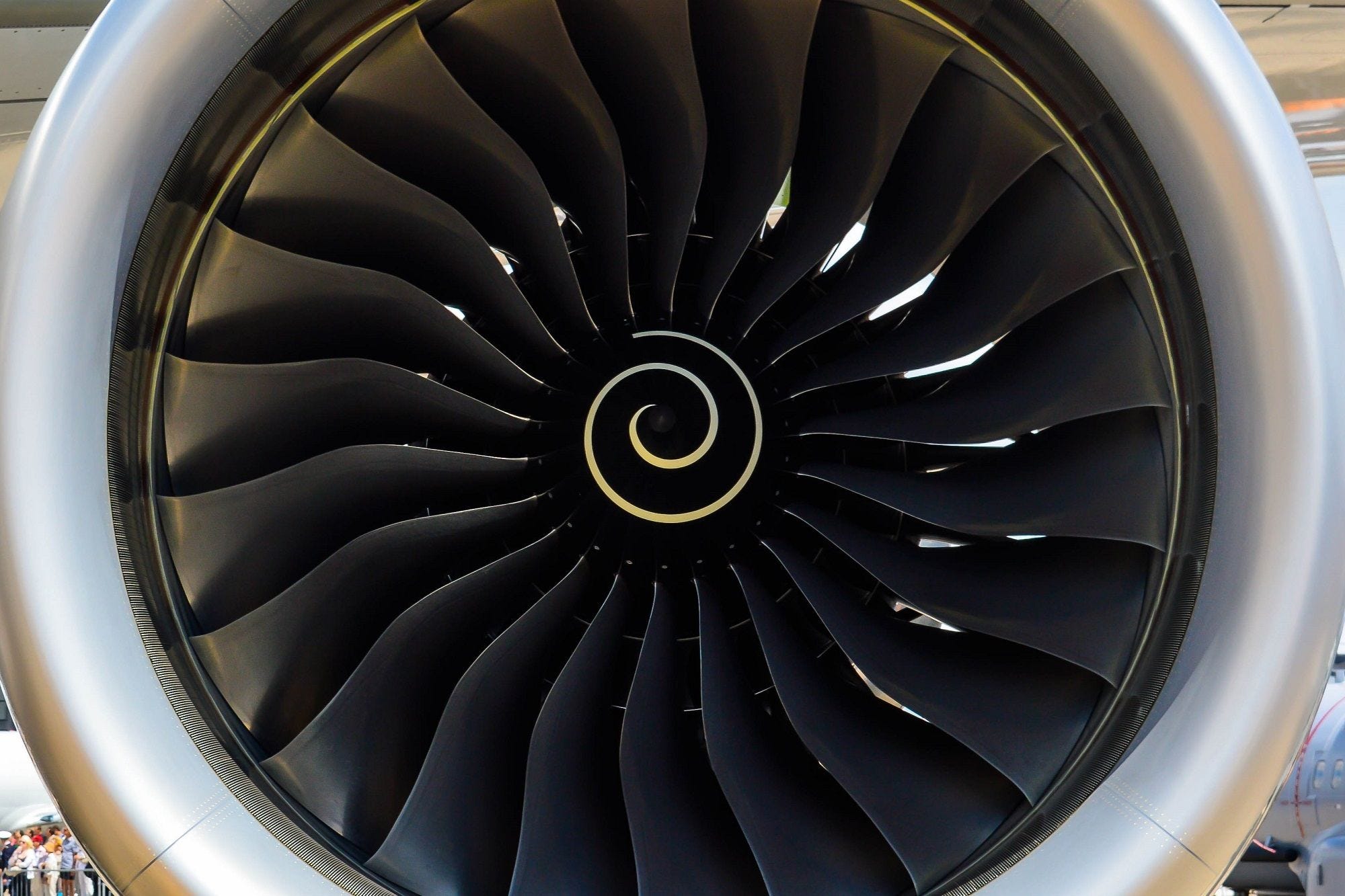
The engine family is a three-shaft, high-bypass turbofan that Rolls-Royce describes as the most efficient large aero engine in service, delivering roughly 25% better fuel burn compared with legacy first-generation widebody engines.
The fan diameter of approximately 3 metres (118 inches) and the twin-dome combustor architecture are distinctive engineering choices that enable the company’s time-on-wing story.
Sole-source status is a commercial moat that very few engine makers enjoy on a modern long-haul platform. Every A350 built carries two Rolls-Royce engines, every Trent XWB that enters service adds decades of aftermarket revenue, and there is no competitor share loss to be managed on this aircraft.
Trent 1000 and Trent 7000: The 787 and A330neo Franchises
The Trent 1000 powers the Boeing 787 Dreamliner in competition with GE Aerospace’s GEnx.
Rolls-Royce’s share of 787 fielded aircraft is around one-third, though recent industry data suggests its share of current 787 backlog has fallen to roughly 10%, a structural issue that management is actively trying to reverse with the Trent 1000 XE and its associated durability package.
The Trent 7000, a derivative of the Trent 1000 core, is sole-sourced on the Airbus A330neo. Compared with the Trent 700 on the earlier A330ceo, the Trent 7000 delivers 14% better fuel burn per seat, translating into roughly $2.5 million in annual fuel savings per aircraft on the company’s own performance data.
Vietjet Air’s 2025 top-up order for 40 additional Trent 7000 engines, covering 20 more A330neo aircraft, is a clear signal that Asian low-cost long-haul demand is alive and that A330neo is staying in production for longer than consensus previously assumed.
UltraFan and UltraFan 30: The Narrowbody Bet
The UltraFan is the largest aero-engine demonstrator ever built and the single most important piece of technology the group has ever developed for a future narrowbody re-entry.
In March 2026, Rolls-Royce secured €64 million of EU funding through the UNIFIED partnership to advance the UltraFan 30 demonstrator, which is sized specifically for a future narrowbody (single-aisle) application.
That matters because narrowbody aircraft production is forecast to roughly double over the next 25 years, and it is the single biggest engine market from which Rolls-Royce is currently absent. The CFM56 and its successor LEAP (a joint venture of GE Aerospace and Safran) and Pratt & Whitney’s geared turbofan have the single-aisle market to themselves.
ULTRAFAN 30: WHAT IS BEING DEMONSTRATED
---------------------------------------------
- Narrowbody-sized fan (scaled from larger UltraFan)
- Power gearbox at scale (lessons from PW GTF)
- Advanced composite fan blades and casings
- Short nacelle architecture for drag reduction
- 100% sustainable aviation fuel compatibility
- Hybrid-electric provisioning for future variants
---------------------------------------------
A successful UltraFan 30 ground-test programme would re-open the strategic option of a single-aisle engine bid when Airbus or Boeing launches a clean-sheet narrowbody replacement later this decade or early in the 2030s.
Management has deliberately kept the option alive without publicly committing to a programme launch.
Pearl 10X, Pearl 700 and Pearl 15: Business Aviation Family
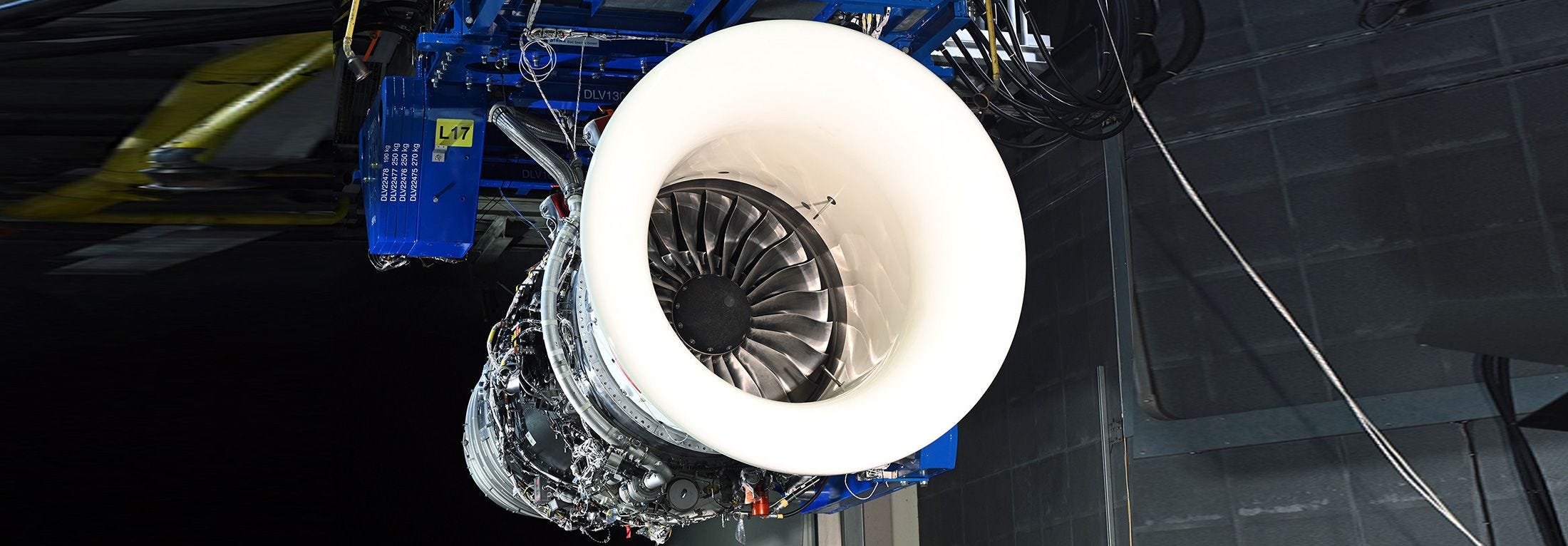
The Pearl family sits at the top of the business-aviation engine hierarchy.
The Pearl 700 is the most powerful engine in the Rolls-Royce business aviation line-up, purpose-designed for the Gulfstream G700 and G800, both of which are certified and in customer delivery.
The Pearl 10X, selected for the Dassault Falcon 10X, has completed all major engine certification tests and is moving toward EASA approval. The Pearl 15 remains on Bombardier’s Global 5500 and Global 6500 flagships.
The significance of this portfolio is that Rolls-Royce now has exclusive engine positions on the three most capable long-range business jets in the market (Gulfstream G700/G800, Dassault Falcon 10X, Bombardier Global 6500 series), giving it roughly a two-thirds share of the ultra-long-range ($70 million-plus) business aviation engine market.
EJ200: Eurofighter Typhoon
The EJ200 is the combat engine that powers the Eurofighter Typhoon, produced under the Eurojet consortium in which Rolls-Royce holds an approximately one-third economic interest, alongside MTU Aero Engines, Avio Aero and ITP Aero.
Rolls-Royce performs design authority and support work in the UK and is responsible for supporting the 130-engine Royal Air Force Typhoon fleet under a five-year agreement with the UK Ministry of Defence that runs until 2040, covering the full remaining service life of the UK fleet.
Export Typhoon volumes are the real upside. The UK-Turkey Typhoon export deal of October 2025, worth up to £8 billion and covering 20 aircraft with options for more, will include Rolls-Royce EJ200 engines.
Additional prospective exports covering Poland, Saudi Arabia, Austria and Qatar amount to as many as 134 aircraft, according to industry reporting out of DSEI UK 2025.
LiftSystem: F-35B Vertical Lift
The Rolls-Royce LiftSystem is the only vertical-lift technology for a fighter jet in production anywhere in the world.
It combines a 2.9-metre, counter-rotating LiftFan with a 3-bearing swivel duct at the rear of the F135 engine, redirecting thrust downward to enable the F-35B’s short take-off and vertical landing (STOVL) capability.
This is a profound strategic position. Every F-35B delivered to the U.S. Marine Corps, the UK Royal Navy, Italy, Japan and other F-35B operators carries a Rolls-Royce LiftSystem.
The U.S. Department of War’s continued procurement of F-35B variants, and the growing F-35B export pipeline, translate directly into LiftSystem production and life-cycle aftermarket work.
In 2024 the company established a new LiftSystem repair facility in Plainfield, Indianapolis, to service the growing US in-service fleet.
F130: Re-engining the B-52 Bomber
The F130 is the new engine that will replace the Pratt & Whitney TF33s on the U.S. Air Force’s B-52J bomber fleet.
The programme covers eight engines per aircraft across 76 aircraft, or 608 production engines, plus spares, and represents one of the largest single combat-engine programmes Rolls-Royce North America has ever won.
The F130 completed its Critical Design Review in late 2024 and, in February 2026, completed altitude and operability testing on the way to test-engine deliveries in 2027. The F130 is a derivative of the commercial BR725 used on the Gulfstream G650 fleet, which gives it an unusually mature technology base for a military programme.
The B-52J is scheduled to remain in USAF service until the 2050s, so this is effectively a 30-year aftermarket annuity once the fleet enters full rate production.
AE Family: The Workhorse Engines
The AE family, developed by Allison before its acquisition by Rolls-Royce, is an unusually versatile common core that has spawned multiple successful derivatives.
The AE 2100 turboprop powers the Lockheed Martin C-130J Super Hercules and the Saab-led family of special-mission aircraft, and is covered by a multi-year support agreement awarded by the U.S. Department of War during 2025.
The AE 3007 turbofan powers the Embraer regional jet family and the Northrop Grumman Global Hawk unmanned system, with the AE 3007N variant selected for the U.S. Navy’s MQ-25 Stingray carrier-based unmanned aerial tanker.
The AE 1107 turboshaft powers the Bell-Boeing V-22 Osprey tiltrotor and is the selected engine for the U.S. Army’s future Long Range Assault Aircraft (the Bell V-280 Valor). This is a multi-decade U.S. Army programme that could eventually replace much of the UH-60 Black Hawk fleet, giving Rolls-Royce a generational position in U.S. Army aviation.
GCAP: The Sixth-Generation Fighter Bet
The Global Combat Air Programme (GCAP) is the UK-Italy-Japan sixth-generation fighter programme, anchored by BAE Systems, Leonardo and Japan Aircraft Industrial Enhancement Co. on the airframe and avionics side.
On power and propulsion, Rolls-Royce is working with Avio Aero (Italy) and IHI Corporation (Japan) to deliver a next-generation power and propulsion system.
The engine will provide both propulsive thrust and a very large integrated electrical power take-off required to run future mission systems including directed-energy weapons, advanced sensors and electronic warfare suites.
Industry sources indicate that the combat-air flying demonstrator has commenced manufacture and is on track for first flight by 2027, with service entry targeted around 2035.
This is arguably the single most important long-term defence programme on which the group is working, because it defines Rolls-Royce’s participation in the Western combat-air industrial base for the back half of this century.
Rolls-Royce SMR: The Adjacent Power Play
Although outside the strict aviation and aerospace scope of this report, the Rolls-Royce SMR business is relevant because it uses engineering competencies, project management disciplines and regulatory experience developed in the aerospace and naval nuclear propulsion parts of the group.
In June 2025, the UK government selected Rolls-Royce SMR as the preferred bidder to partner with Great British Energy - Nuclear on the UK’s first fleet of SMR plants.
The follow-on agreement signed in April 2026 unlocks £2.6 billion of government funding covering three units.
Rolls-Royce Financial Analysis
2025 Full-Year Group Results
The headline 2025 numbers mark the third consecutive year of major upgrades.
Group underlying revenue of £20,059 million was up 12.4% on 2024’s £17,848 million, operating profit of £3,462 million was up 40.5% on 2024’s £2,464 million, and the underlying operating margin improved 350 basis points to 17.3% from 13.8% in the prior year, as disclosed in the group’s official FY 2025 press release.
Free cash flow of £3.27 billion was 34.8% higher year-on-year, driven by higher operating profit, stronger working capital performance and continued growth of the Civil Aerospace net LTSA balance.
Net cash at year end 2025 stood at £1.90 billion, a sharp improvement from £475 million at end-2024. This rebuilt balance sheet is the base on which the new capital-return framework is constructed.
GROUP UNDERLYING, FY 2025 vs FY 2024 (£m)
-----------------------------------------------
                           2025       2024
Revenue                  20,059     17,848
Operating profit          3,462      2,464
Operating margin %         17.3%      13.8%
Profit before tax         3,350      2,290
Free cash flow            3,270      2,425
Net cash                  1,895        475
-----------------------------------------------Capital Returns and Balance Sheet
A final dividend of 5.0p per share has taken the 2025 total to 9.5p, reflecting a payout ratio of roughly 32% of underlying profit.
Alongside the dividend, the board announced a multi-year share buyback programme of £7 billion to £9 billion across 2026 to 2028, with £2.5 billion scheduled for 2026.
That is a significant commitment. It signals management’s confidence that free cash flow will sustainably cover both shareholder returns and the capital intensity of next-generation programmes such as the narrowbody UltraFan 30 demonstrator.
The group also completed a £1 billion buyback during 2025 and retained an investment-grade credit profile, which matters in a world where tier-one engine suppliers need large, multi-year working capital to service long-cycle aftermarket contracts.
2026 Guidance and Upgraded Mid-Term Targets
For 2026, Rolls-Royce is guiding to underlying operating profit of £4.0 billion to £4.2 billion and free cash flow of £3.6 billion to £3.8 billion.
The mid-term framework, anchored on a 2028 timeframe, has been upgraded to £4.9 billion to £5.2 billion of operating profit, an 18% to 20% margin, £5.0 billion to £5.3 billion of free cash flow and 23% to 26% return on capital.
The previous mid-term framework was achieved two years ahead of its original 2027 timeline, which itself speaks to how far the transformation has run ahead of expectations.
2026 GUIDANCE AND 2028 MID-TERM TARGETS
--------------------------------------------------
                          2026 guide   2028 target
Underlying op profit      £4.0-4.2bn   £4.9-5.2bn
Operating margin          ~19%-20%     18%-20%
Free cash flow            £3.6-3.8bn   £5.0-5.3bn
Return on capital         mid-20s%     23%-26%
--------------------------------------------------Civil Aerospace Segment Economics
Civil Aerospace has been the star performer. Segment revenue grew 15% to £10.4 billion, operating profit rose 41% to £2.1 billion and the underlying operating margin expanded to 20.5% from 16.6% in 2024.
The margin expansion reflects stronger large-engine aftermarket performance, contractual margin improvements, higher spare-engine profitability and greater discipline in LTSA renewals.
Large-engine flying hours (LEFH) grew 8% year-on-year across 2025, with 109% of the 2019 level reached by the end of October 2025 on the company’s tracker. That matters because flying hours drive shop-visit schedules, which drive high-margin aftermarket revenue.
Engine deliveries tell a more nuanced story. Rolls-Royce delivered 259 large engines in 2025 versus 278 in 2024, with the dip concentrated on the Trent XWB-84 and Trent 1000 lines as Airbus and Boeing wrestled with supply-chain constraints. Business jet deliveries stood at 224 engines across the Pearl and BR725 families.
Defence Segment Economics
Defence reported an underlying operating margin of 14.4%, broadly flat on 14.2% in 2024, with growth in transport and combat programmes offsetting the absence of a one-off benefit in submarines the prior year. Segment revenue was approximately £4.9 billion on the company’s own disclosures.
Order intake was particularly strong. The segment booked £5.5 billion of new orders in 2025, with a book-to-bill ratio of 1.1 times, and closed the year with a £17.4 billion backlog that equates to more than three years of segment revenue at current run-rates, with roughly 90% order cover for 2026.
Key wins included more than £1.5 billion in aftermarket contracts with the UK Ministry of Defence and the U.S. Department of Defense (now Department of War) covering EJ200 and AE 2100 engine maintenance, and the export halo effect of the UK-Turkey Typhoon deal discussed later in this report.
Cost Programme and Operational Leverage
Underpinning the margin story is a three-year transformation programme that has delivered £0.6 billion of cost savings since 2022, exceeding the original £0.5 billion target, alongside £1.2 billion in third-party procurement savings against an original £1.0 billion goal.
The company has shifted finance, HR and engineering back-office operations into shared-service centres in India and Poland, rolled out zero-based budgeting, and migrated to a contract-by-contract profit and loss discipline. The ratio of total underlying cash costs to gross margin improved to 0.36 in 2025, from 0.47 in 2024.
These are not one-off, pandemic-rebound gains. They look structural, and that distinction is the basis for management’s confidence in the 2028 targets.
Revenue and Growth Drivers
Widebody Aftermarket: The Compounding Machine
The single most important driver of near-term profit growth is the widebody aftermarket, and specifically the combination of rising flying hours, improving LTSA contract margins and higher spare-engine profitability.
Rolls-Royce sells large engines at a low or negative margin and earns its return over decades through time-on-wing service contracts structured around TotalCare and related frameworks.
As the installed base matures and customers enter their second or third shop-visit cycle, the economics shift from investment to harvest. That is exactly the phase the Trent XWB is entering.
The Trent XWB has now accumulated close to 25 million flying hours across the A350 fleet, according to the company’s own service fleet update. Each additional year of fleet maturity and each durability upgrade that extends time on wing feeds directly into higher per-engine LTSA economics.
Trent Durability: Half-Way to a Doubled Time-on-Wing
A defining operational programme is the push to double time on wing across the in-production widebody fleet by the end of 2027. Management said during the 2025 results that the programme is now more than halfway to that goal.
The Trent 1000 received a certified high-pressure turbine blade upgrade in June 2025, with a Phase 2 blade upgrade for the Trent 1000 XE and Trent 7000 certified in December 2025 and slated to be fitted to new and in-service engines starting in 2026. The new Trent Trent 1000 XE is the production standard engine for all future Boeing 787 deliveries selecting Rolls-Royce.
On the A350 line, the Trent XWB-84 received a life-extension programme scheduled for completion in 2026, alongside the new Trent XWB-84EP variant which improves fuel efficiency by over 1% and extends time on wing for new engines. Durability upgrades for the Trent XWB-97 are on track to be complete by end-2027.
Aftermarket Expansion and MRO Capacity
The durability push is being matched by a physical build-out of maintenance, repair and overhaul (MRO) capacity.
Rolls-Royce expanded operations in Derby, in Dahlewitz in Germany and in Singapore during 2025, and opened the Beijing joint venture with Air China that is expected to handle up to 250 engine overhauls per year by the mid-2030s.
This is a deliberate de-risking of the aftermarket. A shop-visit pipeline that the company cannot service itself, or cannot service on schedule, is a pipeline that can slip and damage the economics it is supposed to generate.
Business Aviation: Pearl Family in Full Production
Business aviation has become an under-appreciated cash cow for the group. The Pearl 700 exclusively powers the Gulfstream G700 and G800, both of which are now in their customer-delivery ramp-up phase, and the Pearl 10X is in final certification for the Dassault Falcon 10X.
The Pearl 15 continues on the Bombardier Global 5500 and 6500, and the BR725 remains in service on the Gulfstream G650 fleet. Rolls-Royce delivered 224 business jet engines in 2025, a step-up in volume versus prior years as platform ramp-ups accelerated.
Business aviation is a structurally higher-margin part of the commercial engine universe because the aircraft are owner-operated, utilisation is lower and shop-visit economics are more predictable, which reduces LTSA volatility.
Order Intake and Backlog Building
On the Civil Aerospace side, 638 large engines were ordered across 2025 versus 494 in 2024, with the Trent XWB-97 and Trent 7000 the bestselling types, capturing 226 and significant additional units respectively.
High-profile customer wins included a 20-engine Trent XWB-97 order from STARLUX Airlines, a 20-engine Trent XWB-97 order from lessor AviLease for the A350F freighter, a 40-engine Trent 7000 top-up from Vietjet Air, and TotalCare coverage on 36 Trent XWB engines from China Airlines.
The backlog implication is significant: these orders lock in decades of aftermarket revenue under the LTSA model.
Major Competitors
The large aero-engine industry is the narrowest competitive landscape of any major aerospace segment.
Only three Western original-equipment manufacturers compete at the top tier, with Safran’s Aircraft Engines arm partnering GE on the CFM International joint venture that dominates the narrowbody market.
GE Aerospace: The largest Western commercial engine maker, dominant on widebody (GEnx, GE9X) and narrowbody (CFM LEAP, via CFM International joint venture with Safran)
Pratt & Whitney (RTX): The geared-turbofan specialist, dominant on narrowbody A320neo family and military F135 for F-35
Safran Aircraft Engines: Equal partner in CFM International, majority interest on many helicopter engines (Turbomeca-heritage), equal partner in EJ200 support work
Honeywell Aerospace: Auxiliary power units and business-jet engines
Eurojet Turbo GmbH: Rolls-Royce-led consortium for EJ200
IHI Corporation: Japanese combat engine maker, GCAP partner
Avio Aero (a GE Aerospace company): Italian combat engine maker, GCAP partner
Rolls-Royce vs. GE Aerospace
GE Aerospace is the largest competitor and, on commercial terms, is currently the more profitable business.
For full-year 2025, GE Aerospace reported operating profit of approximately $9.1 billion on roughly $40 billion of revenue, representing a 25% year-on-year profit increase, with backlog growth of nearly $20 billion.
The segmentation advantage is clear on the narrowbody: CFM LEAP (GE-Safran) effectively splits the single-aisle market with Pratt & Whitney’s geared turbofan, and Rolls-Royce is not present.
On widebody, GE dominates the 787 (GEnx) and has sole-source status on the 777X (GE9X), while Rolls-Royce has sole-source on the A350 (Trent XWB) and A330neo (Trent 7000).
The way to read this is that Rolls-Royce and GE operate largely in different widebody pools, with the A350 and A330neo platforms on one side, and the 777X, 787 and earlier GE95 on the other side. The 787 is the single battleground where they compete head to head on a major modern platform.
On defence, GE competes through Avio Aero on GCAP and dominates U.S. rotorcraft through its T700/T901 family, while Rolls-Royce dominates tiltrotor (AE 1107) and vertical lift (LiftSystem) niches.
ROLLS-ROYCE vs GE AEROSPACE (2025)
--------------------------------------------------
                     Rolls-Royce     GE Aerospace
Revenue (FY25)       £20.1bn         ~$40bn
Op profit (FY25)     £3.46bn         ~$9.1bn
Op margin            17.3%           ~22%+
Narrowbody (large)   Not present     CFM LEAP (dominant)
Widebody sole source A350, A330neo   777X, 787 share
F-35 position        LiftSystem      None (core engine is PW)
Sixth-gen fighter    GCAP (lead)     NGAD (F/A-XX) bids
--------------------------------------------------Rolls-Royce vs. Pratt & Whitney (RTX)
Pratt & Whitney, the engine arm of RTX, posted 2025 operating profit of $773 million on significantly higher revenue, reflecting the margin pressure created by the geared-turbofan (GTF) powder-metal fleet management action.

The GTF issue has been Pratt’s defining 2024-2026 story. A powder-metal contamination problem forced the grounding of thousands of engines for accelerated inspection, creating aircraft-on-ground (AOG) pressure across the A320neo family and generating billions of dollars in charges. Pratt advanced its GTF recovery through 2025 but the reputational damage persists.
For Rolls-Royce, the strategic read is mixed.
On one hand, Pratt’s distraction has given Rolls-Royce operational breathing room.
On the other hand, the GTF story is a warning about the commercial risk of a product-level durability issue at scale: the Trent 1000 Pack C / Package C crisis of the late 2010s cost Rolls-Royce more than £2 billion in aftermarket charges.
On defence, Pratt & Whitney dominates the F135 core engine on every F-35 variant, which means Rolls-Royce’s LiftSystem position on the F-35B is complementary rather than competitive. On the B-52 re-engining competition, Pratt & Whitney was a bidder and lost to the Rolls-Royce F130.
Rolls-Royce vs. Safran
Safran is both a partner and a competitor.
Through the CFM International joint venture with GE, Safran is a co-owner of the LEAP single-aisle engine and a major participant in the CFM56 aftermarket, which together produced full-year 2025 Safran group revenue of €31.3 billion with recurring operating income of €5.2 billion.
LEAP deliveries rose 28% in 2025 and Safran’s civil aftermarket business is entering its own aftermarket harvest phase, particularly on the LEAP-1A variant. Q1 2026 Safran revenue grew 18.8% year-on-year to €8.62 billion on the back of a 63% jump in LEAP engine deliveries.
Against Rolls-Royce, Safran competes in helicopter engines (Safran’s Arrano / Aneto competing against Rolls-Royce M250 / RR300 in light helicopter space, though Rolls-Royce has largely exited this segment) and co-competes in combat through its membership of the Eurojet consortium on EJ200.
Safran’s major near-term competitive pressure on Rolls-Royce is indirect: a strong Safran balance sheet supports a strong CFM LEAP roadmap, which makes it harder for any UltraFan-based narrowbody offering to displace LEAP on a future clean-sheet airframe.
Rolls-Royce vs. IHI and Avio Aero (GCAP Partners)
In GCAP, IHI Corporation and Avio Aero are partners rather than competitors, but they also represent latent capability in their home markets.
IHI has historically built the F7 for the Kawasaki C-2 transport and the XF9 fighter engine demonstrator for the Japanese F-X programme, and Avio Aero maintains combat-engine capability inherited from the Tornado and Typhoon programmes.
The GCAP structure means Rolls-Royce shares work and, eventually, life-cycle revenue across the three nations, which reduces the group’s percentage take on each aircraft compared with a unilateral programme.